
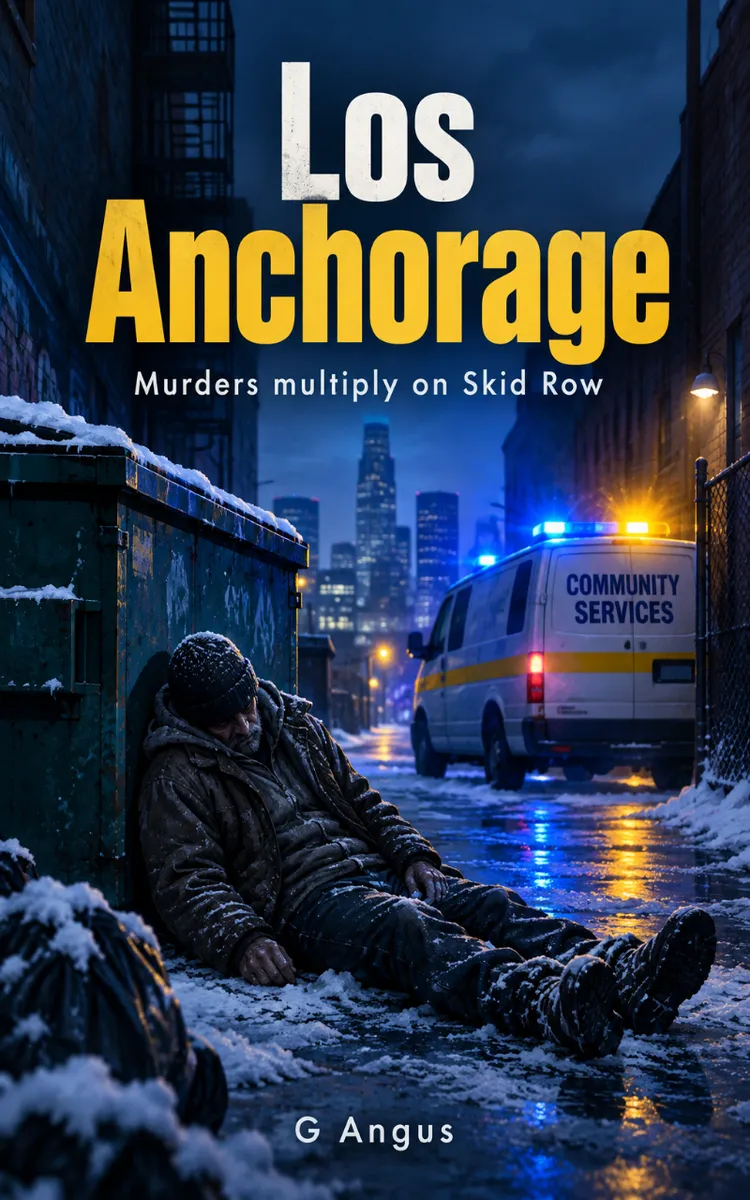

Read the first chapter
The whole of chapter one, free. About 9 min. Turn the pages with the arrows, your keyboard, or a swipe.
Chapter 1
A Fourth Body in the Alley
The alley off 3rd Avenue was barely wide enough for the patrol wagon, and its brick walls had turned the snow into a hard gray trench. Jerry Sommers ducked beneath the yellow tape and felt the cold bite through his gloves.
“Watch your step,” the uniformed officer called. “Blood’s frozen into the slush.”
Jerry looked down. A dark fan spread beneath the body, thin as spilled ink, locked solid against the pavement. The victim lay on his side beside a dented dumpster, one boot missing, his coat open to the weather. Snow had dusted his hair and eyebrows. From the mouth of the alley came the growl of traffic on 3rd Avenue, but back here the city sounded muffled, sealed in ice.
Jerry crouched without touching anything.
“Who found him?”
“Community Services Van,” the officer said. “Jon and Jorge. They’re by the loading door.”
Jerry glanced toward the two young men standing beneath a security light. Jon had his hands shoved into the pockets of his work jacket. Jorge kept looking at the body, then at the rooftops, as if the killer might still be watching from above.
Three times those two had found the dead before Jerry arrived. Three times they had made the call, stayed put, and given him what they knew. They were crude, loud, and too young to understand how quickly a scene could disappear. But they knew Skid Row. They knew which doors opened, which windows watched, which men lied for a bottle.
Jerry rose.
“Keep everyone out,” he told the officer. “Nobody crosses that tape. Not patrol, not shelter workers, nobody.”
The officer nodded. “We already had a crowd before we got here.”
“Where are they?”
“Across the street. Some went inside the bar.”
“Get them back. I want names.”
A gust shoved through the alley. The tape snapped against the brick. Jerry turned his collar up and studied the walls.
Nothing.
No dropped weapon. No torn fabric caught on a nail. No cigarette crushed into the snow. The dumpster lid stood open, its rim glazed white. A stack of cardboard leaned against one wall, undisturbed except for a shallow boot mark. The killer had come into the narrow passage, killed a man, and left without leaving the kind of mistake Jerry could put in a report.
The medical examiner’s assistant knelt near the body. “Looks like the others.”
Jerry’s jaw tightened. “Looks like isn’t a finding.”
“Single wound. Back of the head, maybe. We’ll know more under lights.”
“Any sign of a struggle?”
“Not much.”
“Not much isn’t a finding either.”
The assistant looked up at him. “You want me to call it a homicide or wait until spring?”
Jerry ignored that. He stepped closer to the body, careful to follow the officer’s footprints. The man’s hands were bare. His fingernails were black with grime, but there was no blood beneath them. His face had the slack, battered look of someone who had spent too many nights sleeping wherever the city let him fall.
A bottle neck protruded from the open coat. Jerry pointed.
“Bag it.”
The assistant drew it free with forceps. The glass was empty, its label half torn away. No prints would survive the cold, the dirt, and the dozen hands that might have handled it before the murder. Still, Jerry watched it go into the evidence bag.
He had seen the same kind of bottle beside the first body. Another beside the second. The third victim had carried a paper sack with two empty bottles inside.
“Detective.”
Jon’s voice came from the mouth of the alley.
Jerry turned. “What?”
Jon took a few steps forward, stopping short of the tape. His cheeks were red from the cold, and his eyelashes held tiny beads of frost.
“He was one of ours,” Jon said.
“Meaning?”
“Man-down regular. Slept around here. Took soup at the shelter when they had it. Drank when he could get it.”
Jorge came up beside him. “Name was Cal, we think. Folks called him Cal.”
“Think?”
“He never gave us a last name,” Jorge said. “Sometimes he said it was Miller. Sometimes he said it was nobody’s business.”
Jerry looked back at the body. “When did you last see him alive?”
“Yesterday afternoon,” Jon said. “He was outside the liquor store on 4th.”
“Alone?”
“Mostly.”
“Mostly isn’t an answer.”
Jon’s eyes hardened. “That’s what we saw. He was alone.”
Jorge rubbed his hands together. “He had a bottle tucked inside his shirt. Kept checking it like somebody was going to steal it.”
“Did somebody threaten him?”
“Everybody threatens everybody down here,” Jorge said. “Doesn’t mean they do anything.”
Jerry stepped toward them. “Did Cal say anything specific?”
The two young men exchanged a look.
Jon said, “He said people were waiting for him to pass out.”
“Who?”
“He didn’t say.”
“He said they wanted his bottle,” Jorge added. “Said they were taking turns.”
The wind drove a sheet of loose snow across the alley. It hissed along the pavement and struck the body’s coat.
Jerry stared at the victim’s open hand. The fingers were curled around nothing.
“Did he have enemies?”
Jorge gave a humorless laugh. “He lived on Skid Row.”
“That’s not an answer.”
“It’s the only one you get.”
Jerry took out his notebook. The paper stiffened almost immediately in the cold. “You two find him?”
Jon nodded.
“Tell me exactly what happened.”
“We got a man-down call from the pay phone near 3rd,” Jon said. “Caller hung up before dispatch could get a name. We were two blocks over. Came through here because the street was jammed.”
“Why come into this alley?”
“Shortcut.”
“Then?”
“We saw the boot first.”
“Did you touch him?”
“No.”
“Move anything?”
“No.”
“Call it in?”
“Jon called,” Jorge said.
Jon shot him a look. “You had the radio.”
“You called.”
Jerry held up a hand. “Enough. Did anyone else enter before patrol?”
“Two guys from the bar,” Jon said. “They looked, then ran.”
“Names?”
“Not sure.”
“Find them,” Jerry told the officer.
The officer moved away, shouting across the street.
Jerry walked the length of the alley. Sixteen paces from the avenue to the loading door. Brick on one side, corrugated metal on the other. No fire escape low enough to reach. No windows open. The snow along the walls was clean, except where boots had scuffed through near the body. The killer had used the center of the passage, where the wind and foot traffic erased everything.
He stopped beside a drain clogged with ice.
A small dark object lay half buried there.
Jerry crouched. It was a brass button, dull and scratched. He reached for it, then stopped. The assistant bagged it after photographing its position.
“Could be from the victim,” the assistant said.
“Could be.”
“Could be from a uniform.”
Jerry looked toward the officer. “Nobody touches the scene until I say.”
The assistant sealed the bag.
Jon shifted from foot to foot. “Detective, we need to get back to the van.”
“Not yet.”
“We’ve got shelter calls.”
“You’ve got a murder scene.”
“We’ve got people freezing on the sidewalks.”
Jerry faced him. “And this man froze after somebody put him here.”
Jon’s mouth tightened, but he said nothing.
The words landed harder than Jerry intended. He looked again at the body. Cal’s coat was cheap, his boots mismatched, his beard stiff with ice. There was no wallet. No identification. No photograph. Nothing that told Jerry where the man had come from before the streets took him.
Only the pattern.
Four dead men in less than a month. All homeless. All alcoholics. All found alone in places where the wind could erase a footprint before sunrise.
Jerry had resisted the pattern at first. Anchorage had plenty of drunks, plenty of alleys, plenty of ways for a man to die without help. But four bodies made coincidence a lazy word. The victims had not been chosen because they were important.
They had been chosen because nobody would come looking quickly.
“Jerry.”
The voice came from behind him. The medical examiner had removed one glove and was holding a folded plastic bag.
“Found this under the body.”
Jerry took a step closer. “What is it?”
“Paper. Wet through. I didn’t open it.”
“Bag it as found.”
The assistant lifted it for a photograph. Through the plastic, Jerry could see only a smear of blue ink. No clear writing. No useful edge. The paper had been pressed into the snow and frozen there.
“Anything else?” Jerry asked.
“Nothing.”
The answer settled into the alley like another layer of ice.
Jerry looked over the scene one more time. The crowd across the street had grown. Faces watched from the bar windows. A man in a wool cap shouted that the police were wasting time. Someone laughed. Someone else called Cal by a name Jerry could not hear.
The city was already swallowing the murder.
“Jorge,” Jerry said.
Jorge looked up.
“You said Cal thought people were waiting for him to pass out. Did he say who?”
“No.”
“Did he have a regular drinking place?”
“Under the viaduct. Behind the old warehouse. Sometimes near the shelters.”
“Anyone who followed him?”
Jorge hesitated.
Jerry saw it. “Say it.”
“There was a guy who kept asking about him.”
“Name.”
“Don’t know.”
“Description.”
“Thin. Gray coat. Talked to himself.”
Jon shook his head. “Half the block talks to itself.”
“This one talked like he was arguing with somebody,” Jorge said. “Kept saying the others were stealing what belonged to him.”
“What belonged to him?”
Jorge glanced at the bottle in the evidence bag. “Alcohol, I guess.”
Jerry wrote it down. “Why didn’t you tell patrol?”
“We didn’t know it mattered.”
“It matters now.”
The ambulance crew rolled the stretcher into the alley. Its wheels struck the frozen ruts with a hard metal clatter. Jon and Jorge stepped aside. Jerry watched as the crew lifted Cal from the pavement. A crust of snow broke away from the coat and scattered like salt.
When the body was gone, the alley looked smaller. The blood remained, black and flat beneath the yellow tape.
Jerry stood in the center of the passage and felt the case change shape around him. He had come looking for a weapon, a footprint, a witness who had seen too much. He got none of them. He got a dead homeless alcoholic, an empty bottle, a half-frozen scrap of paper, and a rumor about a man who believed the neighborhood was plotting to steal his liquor.
It was almost nothing.
Almost.
He turned to the uniformed officer. “Get the crime-scene team to sweep every inch again. Walls, roofs, dumpsters, drains. I want photographs before the snow shifts.”
“They’re already stretched thin.”
“Then stretch them.”
The officer looked toward the avenue. “Detective, we can’t hold this alley all night.”
“Yes, we can.”
“People need to get through.”
“People can use the street.”
“They’ll cut the tape.”
Jerry stepped close enough that the officer could see the anger in his face. “Put two men at each end. Nobody enters without my permission. I want the bar cleared and every person who knew this victim kept available for questioning.”
The officer swallowed. “You think the killer’s coming back?”
Jerry looked at the blood frozen into the pavement.
“No,” he said. “I think the killer already knows exactly how much time we waste finding out who these men were.”
Jon stared at him. Jorge’s face had gone pale beneath the cold.
Jerry opened his notebook again and wrote the victim’s name as Cal, then beneath it: homeless alcoholic. He underlined the words once.
The fourth murder was not an isolated killing. It was a selection. The same kind of man, the same kind of silence, the same clean disappearance into the city.
And the intervals were shrinking.
Jerry snapped the notebook shut.
“Tight perimeter,” he ordered. “Nobody walks out of this alley until we know what happened here.”
Behind him, the tape cracked in the wind. Beyond it, 3rd Avenue carried on - cars sliding over ice, doors opening, bottles clinking, men vanishing into the dark.
Somewhere out there, someone was already choosing the fifth place.
End of chapter one. 32 more chapters in the full book.
Swipe or use the arrows to turn the page


What's inside: 33 chapters
- 1. A Fourth Body in the Alley
- 2. Jon Finds a Victim’s Hidden Pocket
- 3. Jorge’s Map of Man-Down Calls
- 4. Jerry Gets Told to Chill
- 5. The Pocket Item Doesn’t Belong
- 6. A Sixth Man-Down Call Hits First
- 7. Jorge Spots the Same Boots
- 8. Jerry’s Interview Turns Into a Threat
- 9. Jon Follows a Liquor Trail
- 10. The Fifth Murder Makes Jerry Snap
- 11. A Shelter Clerk Names the Regular
- 12. Jon and Jorge Search the Alley Cache
- 13. Jerry Checks the Wristband Records
- 14. A Snowstorm Wipes the Footprints
- 15. Jorge Hears the Plotting Fear
- 16. Jon Finds a Missing Van Key
- 17. Midnight Surveillance Spots the Suspect
- 18. The Suspect’s Confession Is a Trap
- 19. Jon Watches Jorge Get Framed
- 20. Jerry Finds the Killer’s Tool
- 21. Jorge’s Shelter Witness Goes Silent
- 22. Jon Breaks Protocol to Protect Evidence
- 23. Jerry Learns Jon Lied
- 24. The Fourth Victim’s Last Call Resurfaces
- 25. Jerry Watches Another Body Hit
- 26. The Task Force Sets a Trap
- 27. Jon Lures the Suspect to the Van
- 28. Jerry’s Search Turns Up the Wrong Man
- 29. The Suspect’s Alcohol Belief Explodes
- 30. Jerry Forces the Truth Out
- 31. Jorge Sees the Van’s Role Clearly
- 32. Jon Pays for the Shortcut
- 33. Los Anchorage Stops at One Name
About this book
"Los Anchorage" is a fiction book by G Angus with 33 chapters and approximately 66,900 words. A gritty 1989 Anchorage skid-row murder thriller.
This book was created using Inkfluence AI, an AI-powered book generation platform that helps authors write, design, and publish complete books. It was made with the AI Novel Writer.
Frequently Asked Questions
What is "Los Anchorage" about?
A gritty 1989 Anchorage skid-row murder thriller
How many chapters are in "Los Anchorage"?
The book contains 33 chapters and approximately 66,900 words. Topics covered include A Fourth Body in the Alley, Jon Finds a Victim’s Hidden Pocket, Jorge’s Map of Man-Down Calls, Jerry Gets Told to Chill, and more.
Who wrote "Los Anchorage"?
This book was written by G Angus and created using Inkfluence AI, an AI book generation platform that helps authors write, design, and publish books.
How can I create a similar fiction book?
You can create your own fiction book using Inkfluence AI. Describe your idea, choose your style, and the AI writes the full book for you. It's free to start.
Write your own fiction book with AI
Describe your idea and Inkfluence writes the whole thing. Free to start.
Start writingCreated with Inkfluence AI


