
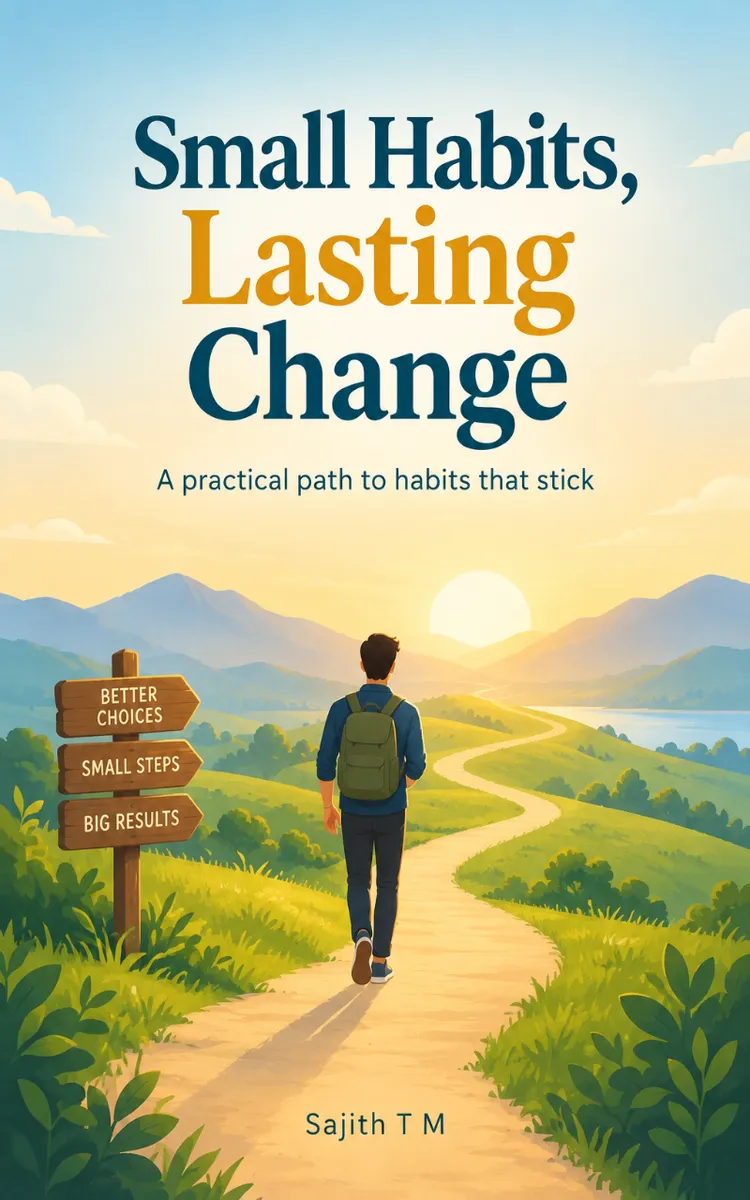
Read the first chapter
The whole of chapter one, free. About 6 min. Turn the pages with the arrows, your keyboard, or a swipe.
Chapter 1
Becoming Someone Who Follows Through
The Promise You Keep Missing
At 7:12 on Monday morning, you put your running shoes beside the door. They look hopeful. By 7:18, you’ve answered one message, checked the weather, and remembered that your coffee needs attention. By evening, the shoes are still there, quietly accusing nobody.
You’ve done this with books, budgets, stretching, language practice, and the half-finished online course open in another browser tab. The pattern is familiar: make a sincere promise when you feel motivated, miss it when life gets crowded, then treat the miss as evidence that you can’t be trusted with your own plans. Next time, you promise harder. You set a bigger goal, buy a better notebook, or create a stricter schedule. The cycle begins again.
The painful part isn’t skipping one workout. It’s the story that follows: “I never stick with anything.” Do you recognise that story in yourself?
The Question Beneath Your Goal
What if the real goal isn’t to finish the habit, but to become the kind of person who keeps a promise at the smallest possible size?
That question changes the job. You’re no longer trying to prove that you can run five miles, write a novel, or meditate for twenty minutes. You’re collecting evidence. Each small action becomes a vote for an identity: I’m someone who does what I said I’d do.
This is the Identity Evidence Loop. First, you choose a tiny action that matches the person you want to become. Then you complete it. You notice the completion instead of brushing it aside. That evidence makes the identity feel more believable, which makes the next action easier to begin. The loop grows through repetition, not drama.
Take the running shoes. The old plan says, “Run for thirty minutes every morning.” The new plan says, “At 7:15, put on my shoes and walk to the end of the street.” That might sound almost laughably small. Good. Its size makes it harder to negotiate away. After a week, you’ve kept seven promises. You may walk farther, but that’s extra. The main win is becoming someone who follows through.
This isn’t lowering your standards forever. It’s building trust before demanding performance. A person who has kept ten tiny promises has something solid to stand on when a larger challenge arrives. A person who keeps breaking oversized promises has to fight both the task and their own doubt.
How a Missed Promise Becomes an Identity
1. When you set a habit that’s too large for your busiest days, such as “read thirty pages every night,” you create a fragile promise. 2. You feel tired or rushed when evening arrives. 3. So you postpone the reading and tell yourself you’ll make up for it tomorrow. 4. Which leads to a broken promise, followed by the belief that you’re inconsistent.
The alternative chain looks different:
1. When dinner is cleared away, you place your book on your pillow and read one page. 2. You feel a small sense of completion because the promise was clear and manageable. 3. So you mark the action with a simple check on a calendar. 4. Which leads to visible evidence that you’re a reader who follows through, even on ordinary nights.
The trigger matters because habits begin before the action itself. A book on your pillow is a prompt. One page is the minimum. The checkmark is not a childish reward; it helps your attention register what happened. Without that pause, completed promises can disappear into the day while missed promises remain loud.
You can use the same structure for almost anything. After brushing your teeth, write one sentence. When you open your laptop, review one line of your budget. After putting your work bag down, fill a glass of water. The action should be so clear that your tired self doesn’t need to hold a meeting about it.
Tiny promises become believable identities when you keep them where life actually happens.
A More Honest Measure of Follow-Through
Before choosing a new habit, rate yourself honestly. Not harshly. Just accurately. The point isn’t to produce a flattering score; it’s to find the part of the loop that needs support.
1. From 1 to 10, how confident are you that you’ll keep a promise when your day goes badly? A low score suggests your habit is designed for ideal conditions. A high score may mean you already know how to shrink the action when life gets messy.
2. Yes or no: Is your minimum action small enough to complete in two minutes? “No” doesn’t mean the habit is wrong. It reveals that your starting line may still be carrying too much weight.
3. From 1 to 10, how clearly can you name the exact trigger for your habit? A low score points to a vague plan. “Sometime after work” is easy to lose; “after I hang my keys on the hook” gives the action a place to begin.
4. Yes or no: When you complete a small version, do you count it as a real success? A “no” reveals a common trap: moving the finish line so far away that your brain never gets evidence of progress.
Here’s a simple interpretation guide. If your lowest answers concern confidence, make the action smaller. If they concern timing, attach it to something already dependable. If they concern counting, create a visible mark - a calendar check, a note in your phone, or a row of paper squares on the fridge. If you answered “no” to recognising small wins, your next habit is not merely doing the action. It’s learning to notice that you did it.
The Seven-Day Promise Test
Choose one tiny promise and make it visible
1. Name the identity. Write, “I’m becoming someone who ___,” and fill in one honest phrase, such as “keeps a clear kitchen” or “takes care of their back.” Then choose an action that takes two minutes or less. Do this today. Difficulty: Easy. 2. Attach it to a reliable moment. Pick an existing event, not a hoped-for time. For example: after you put your mug in the sink, wipe one section of the counter. Put a note or object where the trigger occurs. Repeat for seven days, even if you could do more. Difficulty: Medium. 3. Record the evidence immediately. Each time you finish, place one checkmark on paper or in your phone. Say, “That counts,” even if the action felt almost too easy. At the end of day seven, review the marks without judging the missed spaces. Difficulty: Medium.
You’ll know it’s working when:
• You begin before bargaining with yourself. - A missed day feels like information, not a verdict. - You naturally want to continue or add a little more, without needing to force it.
If the action still feels difficult after two days, shrink it again. One push-up can become putting your hands on the floor. Writing can become opening the document and typing the date. The smallest version isn’t a loophole. It’s the doorway through which consistency enters.
Let the Evidence Change the Story
You don’t need more confidence before you begin; you need a few completed promises that confidence can grow from.
The Identity Evidence Loop works because your self-image is shaped by what you repeatedly observe yourself doing. The evidence doesn’t need to be impressive. It needs to be real, specific, and close enough together that you can see the pattern.
• A tiny action gives your identity somewhere practical to show up. - A reliable trigger removes the daily argument about when to begin. - A visible record helps completed promises compete with remembered failures. - A smaller promise protects follow-through when energy, time, or mood drops.
Tonight, choose one promise you can keep before the day ends. Make it almost embarrassingly manageable. Then keep it. Tomorrow, keep it again. You’re not trying to become a different person in one heroic burst. You’re giving yourself evidence, one ordinary moment at a time.
What other part of your daily life might become easier once you trust yourself to begin?
End of chapter one. 14 more chapters and about 21,964 words in the full book.
Swipe or use the arrows to turn the page


What's inside: 15 chapters
- 1. Becoming Someone Who Follows Through
- 2. Choosing a Habit Worth Keeping
- 3. Making Change Smaller Than You Think
- 4. Designing Cues That Start Habits
- 5. Clearing Friction from Your Environment
- 6. Using Rewards Without Losing Momentum
- 7. Tracking Progress Without Perfectionism
- 8. Protecting Habits on Busy Days
- 9. Recovering Quickly After a Miss
- 10. Building Focus in a Distracted Day
- 11. Making Movement a Daily Default
- 12. Eating Well One Choice at a Time
- 13. Creating Calmer Evenings for Better Sleep
- 14. Strengthening Relationships Through Small Gestures
- 15. Turning Small Wins Into Lasting Change
About this book
"Small Habits, Lasting Change" is a self-help book by Sajith T M with 15 chapters and approximately 21,964 words. Build habits that fit the day you actually have, not the ideal routine you keep postponing. Small Habits, Lasting Change shows you how to choose a meaningful action, shrink it to a repeatable size, and return to it after a missed day.
This book was created using Inkfluence AI, an AI-powered book generation platform that helps authors write, design, and publish complete books. It was made with the AI Self-Help Book Writer.
Frequently Asked Questions
What is "Small Habits, Lasting Change" about?
Build habits that fit the day you actually have, not the ideal routine you keep postponing. Small Habits, Lasting Change shows you how to choose a meaningful action, shrink it to a repeatable size, and return to it after a missed day. Use the Values-to-Action Compass to connect a habit to something you care about. Apply the Minimum Viable Habit when a forty-five-minute workout won’t fit, so ten minutes can still count. With the Identity Evidence Loop, treat each small action as proof that you can follow through, rather than waiting to feel motivated first. Across 15 chapters, you’ll find a way to make change manageable without turning every missed day into a verdict on your character. Begin with one small promise, keep it on an ordinary Tuesday, and build from there.
How many chapters are in "Small Habits, Lasting Change"?
The book contains 15 chapters and approximately 21,964 words. Topics covered include Becoming Someone Who Follows Through, Choosing a Habit Worth Keeping, Making Change Smaller Than You Think, Designing Cues That Start Habits, and more.
Who wrote "Small Habits, Lasting Change"?
This book was written by Sajith T M and created using Inkfluence AI, an AI book generation platform that helps authors write, design, and publish books.
How can I create a similar self-help book?
You can create your own self-help book using Inkfluence AI. Describe your idea, choose your style, and the AI writes the full book for you. It's free to start.
Write your own self-help book with AI
Describe your idea and Inkfluence writes the whole thing. Free to start.
Start writingCreated with Inkfluence AI


