
Read the first chapter
The whole of chapter one, free. About 8 min. Turn the pages with the arrows, your keyboard, or a swipe.
Chapter 1
60 BPM Hyper-Focus Entry
60 BPM Hyper-Focus Entry: The Fastest “Start Studying” Button You Can Build
Before you open your notes, you need one thing: a repeatable way to flip your brain into “ready mode.” Tempo-based background audio at 60 BPM is that switch. You’re basically teaching your nervous system a cue: when the beat hits this speed, focus shows up faster.
This is not “music as motivation.” It’s music as a trigger. You’ll set up a 60 BPM entry routine, test it in real time, and lock in the version that reliably gets you focused (without you bargaining with yourself).
---
Why 60 BPM Works as a Hyper-Focus Trigger (and Not Just Background Noise)
Your brain loves patterns. When the pattern is simple and steady, it becomes easier to ignore distractions and keep attention running. 60 BPM is a sweet spot because it’s slow enough that it doesn’t bulldoze your thinking, but steady enough that your attention can synchronize to it.
Here’s the practical angle: when you study, you’re constantly doing tiny time-synchronizations - when to start, when to check something, when to stop drifting. A consistent tempo gives you an external rhythm so you don’t have to “invent” focus from scratch every session.
If you’ve ever sat down and immediately started doom-scrolling, you already know your biggest enemy isn’t effort. It’s entry friction. 60 BPM reduces that friction by giving your brain a predictable “go” signal.
Your Turn Set a timer for 3 minutes. Don’t study yet. Just listen to your 60 BPM track at a comfortable volume. Then answer the checklist below.
• Fill in the line: At the end of 3 minutes, my attention felt like: ________ - Rate how “locked in” you felt from 1-10: ______ - Note one distraction you noticed (even if it was small): ________
You’re not judging the result - you’re measuring your baseline.
---
How to Choose Tempo-Based Background Audio for Reliable Entry
You’re aiming for consistency, not taste. “Reliable entry” means you can play the same thing tomorrow and your brain doesn’t have to relearn the cue.
Use audio that stays steady at 60 BPM. If your track drifts, your brain will notice (not consciously, but functionally). If you use something with big dynamic changes (sudden drops, drops into silence, random instrument swaps), your entry cue gets messy.
Pick a track that meets these rules:
• Tempo: 60 BPM (or extremely close, like 59-61) - Stability: no obvious tempo wobble - Complexity: minimal “surprises” (no abrupt melodies grabbing your attention) - Length: at least 20 minutes so your session can stay uninterrupted
If you’re using an app or playlist with multiple songs, set it so it loops or continues seamlessly. You want the cue to be one continuous signal, not a “song roulette.”
Apply It Create your “Hyper-Focus Entry Track” (yes, give it a name). Use one of these approaches:
• Choose a single track that’s already 60 BPM. - Or build a 60 BPM loop in your audio app so it won’t drift.
Then do this quick test:
Your Turn (10-minute test with clear outcome) Start the track and study something easy for 10 minutes (flashcards, reading with a highlighter, quick practice problems). Your only job is to begin within 2 minutes of starting the audio.
Expected outcome: by the 2-minute mark, you’re actively doing the task (not negotiating with yourself). Record:
• Did you start within 2 minutes? Yes / No - What happened at minute 1? ________ - What happened at minute 2? ________
If you didn’t start within 2 minutes, don’t “try harder.” Swap the track. The cue is the tool.
---
The 60 BPM Entry Routine: Step-by-Step Hyper-Focus Start
Now you’ve got your audio. Cool. Next is the routine. This is where people accidentally turn a cue into background noise - because they start the audio while doing everything except studying.
Your entry routine needs three moves: start cue → commit to the first action → ride the beat without negotiating.
Use this sequence every time you sit down to practice.
Your Turn (15-minute routine with measurable outcome) Set a timer for 15 minutes. Follow the steps exactly:
1) Put on your 60 BPM track at a consistent volume. 2) Open only the materials you need for the next task (one tab, one notebook, one page - no hunting). 3) Start the first action within 60 seconds of the audio starting (examples: “open the document,” “answer the next question,” “write the first equation,” “start the first flashcard stack”). 4) Work until minute 15 ends, even if you feel “not perfect yet.”
Expected outcomes (check them off):
• First action started within 60 seconds? Yes / No - You completed at least one full micro-task (example: a full set of 10 flashcards, 5 problems, or one page of notes)? Yes / No - You stayed on-task for the full 15 minutes (no switching contexts)? Yes / No
Write the micro-task you completed: __________
If you want the “secret sauce,” it’s this: you’re training your brain that the audio cue equals action, not contemplation. Action first. Thinking follows.
---
Volume, Distraction, and the “Don’t Ruin the Cue” Rules
Tempo-based entry works when the cue is clear. If the track is too quiet, you don’t get the signal. If it’s too loud, it becomes the thing you listen to instead of the thing you use.
Aim for “present but not competing.” You should be able to read or talk to yourself without the music pulling your attention.
Here are the practical rules that stop the cue from breaking:
• Keep your volume the same each session. Change it only when you’re clearly unable to focus. - Avoid lyrical tracks. Words create competition for attention. - If you catch yourself humming or following melodies, your track is too “sticky.” Switch to a more neutral 60 BPM background. - Don’t stack other audio right away (no podcasts, no random videos). One cue at a time.
Your Turn (2-minute calibration with measurable outcome) Play the track. Do a short reading or problem-solving burst for 2 minutes. Then answer:
• I could focus on the task more than the audio: Yes / No - I noticed the beat without it pulling me away: Yes / No - I felt annoyed by the volume or sound: Yes / No
If any answer is “No,” adjust volume or swap the track. This isn’t taste - this is cue reliability.
---
Your Hyper-Focus Entry Scorecard: Track What Works (Without Overthinking)
You don’t need a complicated tracking system yet. You need one scorecard that tells you whether the cue is doing its job. That way, you don’t keep using a track that’s “fine” but not effective.
Use this simple score after each session:
• Entry Speed: Did you start within 60 seconds? (0 or 1) - On-Task Time: Did you complete the full 15 minutes? (0 or 1) - Micro-Task Completion: Did you finish at least one micro-task? (0 or 1) - Cue Comfort: Did the audio feel like support, not distraction? (0 or 1)
Total score: 0-4.
Apply It Do this after your next 15-minute routine:
• Entry Speed (0/1): _ - On-Task Time (0/1): _ - Micro-Task Completion (0/1): _ - Cue Comfort (0/1): _ - Total (0-4): ___
If you consistently score 3 or 4, keep the same track. If you hover at 0-2, change one variable at a time: track stability first, then volume, then complexity (lyrical vs neutral).
A cue that works is boring. That’s good. Boring means reliable.
---
When to Use 60 BPM Entry (So It Doesn’t Turn Into a Ritual You Skip)
You want the cue at moments where entry friction shows up: starting a hard topic, beginning practice, or restarting after you’ve drifted. Don’t use it as a background wallpaper for the entire day. That’s how people stop noticing it.
Use it when you need a clean start: - before focused study blocks - before deliberate practice sessions - when you’re switching from one task type to another (reading → problems, problems → review)
If you catch yourself “waiting to feel ready,” that’s the moment. Put on the track and start the first action within 60 seconds. The feeling comes after the cue.
Your Turn Write one sentence for your “trigger moment”:
When I’m about to __________ and I feel stuck, I will start my 60 BPM track and complete my first action within 60 seconds.
Fill in the blank: __________
---
Closing Takeaway: Your Brain Learns the Cue, Not the Mood
The goal isn’t to find the “perfect” music. The goal is to build a dependable entry trigger so you don’t negotiate with your attention every time you sit down.
Once your 60 BPM routine reliably produces fast starts and on-task blocks, you’ve done the hardest part - getting into the state where learning actually sticks. Next, you’ll use audio intentionally for recall, not just for entry. But right now? Beat first, action first, focus follows.
---
Study Lab Tracking Sheet (60 BPM Hyper-Focus Entry)
Session Date: __________ Start Time: ________ Track Name (your cue): __________ BPM Confirmed (60?): Yes / No
Setup Check - Volume consistent with last session: Yes / No - Only needed materials open: Yes / No
15-Minute Routine - Started first action within 60 seconds: Yes / No - Completed full 15 minutes: Yes / No - Completed at least one micro-task: Yes / No - Micro-task completed: ____________
Hyper-Focus Score (0-4) - Entry Speed (0/1): _ - On-Task Time (0/1): _ - Micro-Task Completion (0/1): _ - Cue Comfort (0/1): _ - Total: ___ / 4
Cue Adjustments (if any) - Track swapped? Yes / No → If yes, why: __________ - Volume adjusted? Yes / No → If yes, new volume level: __________
---
Reflect (2 Prompts)
Reflect 1 (write a specific answer): What exact moment did your focus lock in (or fail to lock in)? Use a time marker like “around minute _” and name one thing you did during that moment. Your answer: __________
Reflect 2 (make a measurable change): If you ran this session again tomorrow, what single variable would you change to raise your score by at least +1 (track stability, volume, or complexity)? Your answer: ____________
End of chapter one. 6 more chapters in the full book.
Swipe or use the arrows to turn the page


What's inside: 7 chapters
- 1. 60 BPM Hyper-Focus Entry
- 2. Design Your Audio Note Prompts
- 3. Record Notes for Fast Recall
- 4. Build Your Silence-Spacing Schedule
- 5. Run Audio Reviews Like a System
- 6. Diagnose Recall Gaps by Listening
- 7. Accelerate Skill Transfer with Audio Drills
About this book
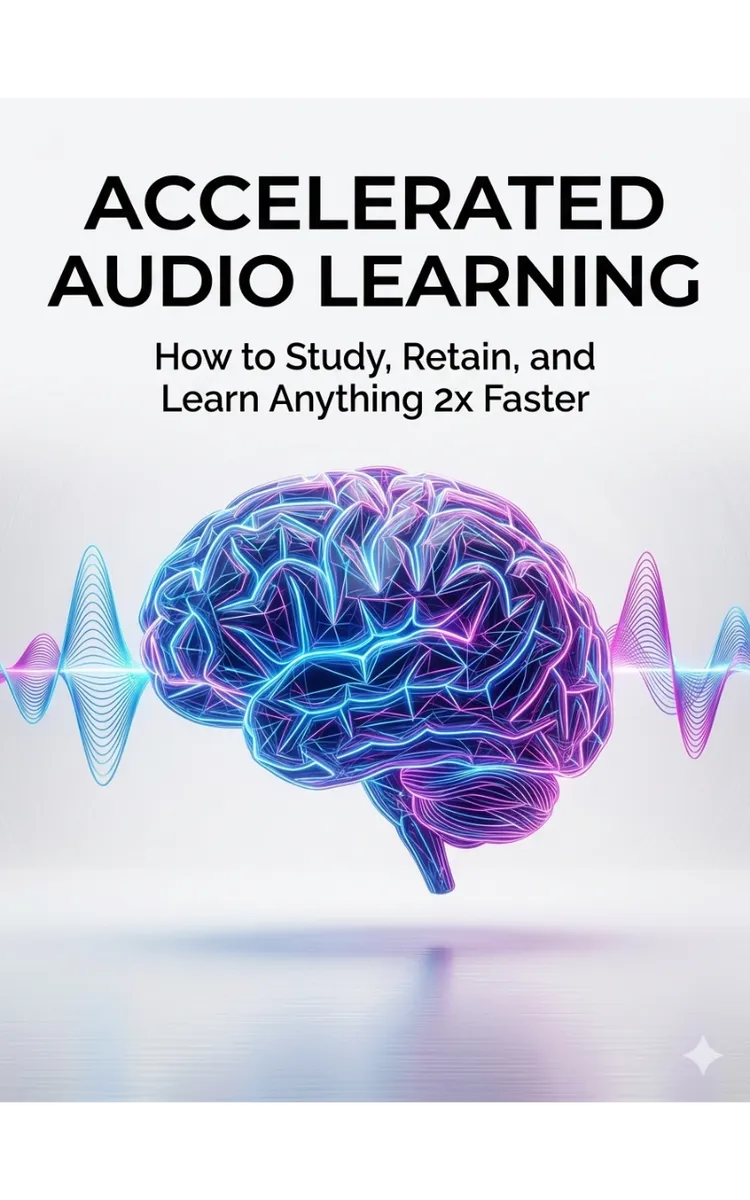
"Accelerated Audio Learning" is a workbook by JM. Albarado with 7 chapters and approximately 12,003 words. Using audio cues, active recall, and spaced repetition to learn faster.
This book was created using Inkfluence AI, an AI-powered book generation platform that helps authors write, design, and publish complete books. It was made with the Workbook Generator.
Frequently Asked Questions
What is "Accelerated Audio Learning" about?
Using audio cues, active recall, and spaced repetition to learn faster
How many chapters are in "Accelerated Audio Learning"?
The book contains 7 chapters and approximately 12,003 words. Topics covered include 60 BPM Hyper-Focus Entry, Design Your Audio Note Prompts, Record Notes for Fast Recall, Build Your Silence-Spacing Schedule, and more.
Who wrote "Accelerated Audio Learning"?
This book was written by JM. Albarado and created using Inkfluence AI, an AI book generation platform that helps authors write, design, and publish books.
How can I create a similar workbook?
You can create your own workbook using Inkfluence AI. Describe your idea, choose your style, and the AI writes the full book for you. It's free to start.
Write your own workbook with AI
Describe your idea and Inkfluence writes the whole thing. Free to start.
Start writingCreated with Inkfluence AI


