
Read the first chapter
The whole of chapter one, free. About 6 min. Turn the pages with the arrows, your keyboard, or a swipe.
Chapter 1
Mapping Your Driving Incidents
A driving timeline helps you see anxiety as a pattern, not a personal failure. Instead of treating every tense trip as one giant problem, you’ll place experiences in order and notice what changed over time.
You don’t need a perfect memory. Approximate dates are useful. A note such as “around age 19” or “during my first winter driving” is enough. The goal is to identify experiences that may have taught your nervous system, Driving is dangerous, I can’t handle surprises, or I must avoid certain roads.
A useful timeline includes more than crashes. Near misses, harsh criticism, sudden braking, getting lost, panic symptoms, long periods without driving, and stressful life changes can all add weight.
Key takeaway: Your driving anxiety may have accumulated through several smaller experiences, and mapping them makes the pattern easier to understand and work with.
You’ll build your timeline in four parts:
1. Event: What happened, and approximately when? 2. Impact: What did you feel, think, or do afterward? 3. Change: What driving behavior changed? 4. Meaning: What did your mind begin to believe about driving?
Build Your Personal Driving Timeline
Materials needed: Paper or a notebook, a pen or pencil, and a ruler if you want a straight timeline. Time required: 25-35 minutes. Expected outcome: A timeline with at least five driving-related events, each showing its emotional and behavioral impact.
You can pause if your anxiety rises sharply. Keep both feet on the floor, look around, and name five things you can see. Then continue only when you feel steady enough.
Your Turn
1. Draw a horizontal line across two pages. Mark the left side First driving memory and the right side Today. 2. Add five to ten points along the line. Include driving lessons, your first solo drive, difficult trips, accidents, near misses, panic episodes, criticism, avoidance, or periods when you stopped driving. 3. Write an approximate date or life stage beside each point. Use “around 2018,” “high school,” or “after moving” if you don’t know the exact date. 4. For every event, complete the four-part record below: - Event: What happened? - Impact: What did you feel in your body and emotions? - Change: What did you start doing differently? - Meaning: What conclusion did your mind draw? 5. Rate the event’s immediate distress from 0 to 10. Use 0 for no distress and 10 for the strongest distress you remember. 6. Circle any event that still affects your driving today. Put a star beside the event that seems to have started the pattern or made it noticeably worse. 7. Review the timeline and write one sentence beginning with: “My anxiety began to build when…” 8. Count your entries. You’re finished when you have at least five events, an impact rating for each, and one beginning sentence.
Here’s a completed example:
> Around age 17 - First solo drive on a busy road > Event: I missed a turn, heard several horns, and pulled into a parking lot. > Impact: My hands shook, my face felt hot, and I felt embarrassed. Distress: 7/10. > Change: I avoided busy roads and asked someone to ride with me. > Meaning: “If I make one mistake, other drivers will attack me.” > Still affects me? Yes. > My anxiety began to build when… I started believing that small mistakes made driving unsafe.
Notice that the example doesn’t label the driver as “bad.” It records what happened and what the mind learned. That difference matters. A timeline is information, not a courtroom.
Your Turn: Timeline Record
Copy this record for each event:
Approximate date or life stage: __________________________________________
What happened? ________________________________________________________________ ________________________________________________________________
What did I notice in my body or emotions? ________________________________________________________________ ________________________________________________________________
What changed in my driving afterward? ________________________________________________________________ ________________________________________________________________
What did I begin to believe? ________________________________________________________________ ________________________________________________________________
Distress rating, 0-10: ______
Does this still affect me? Yes / No
After completing your entries, compare the distress ratings. A later event may have a lower rating but still matter because it reinforced an older fear. For example, a missed exit might feel like a 4/10 on its own, yet strengthen a long-standing belief that you can’t recover from mistakes.
Use the Timeline in Everyday Driving
Your timeline becomes useful when you connect it to current situations. Before a planned trip, check whether the route resembles an earlier event. A crowded highway may bring back the pressure of a past near miss. Driving with a critical passenger may reactivate memories of harsh instruction. Night driving may connect to an earlier experience of poor visibility.
When you notice this connection, name it plainly: “This road is reminding me of the event from 2019.” Then separate the past from the present. Ask yourself what is the same and what is different. Perhaps the road is busy, but you now have more practice, better route information, and the option to pull over safely. The expected outcome isn’t instant calm. It’s a more accurate picture of the situation.
Use the timeline after a difficult trip, too. Suppose you felt panicky while merging but completed the merge safely. Add the event as a present-day entry. Record both the fear and the result. This prevents your memory from keeping only the scary part. Over time, you’ll collect evidence that anxiety can rise and fall without deciding what happens next.
Apply It
Choose one ordinary trip within the next seven days. Before leaving, write:
Route or driving situation: ______________________________________________
Timeline event this may remind me of: ___________________________________
What is different today? ________________________________________________________________ ________________________________________________________________
Prediction: “I’m afraid that…” __________________________________________________________________
After the trip, record:
What actually happened? ________________________________________________________________ ________________________________________________________________
Distress before, 0-10: ______
Highest distress, 0-10: ______
Distress after, 0-10: ______
What did I do that helped me continue safely? ________________________________________________________________ ________________________________________________________________
You’ve completed this application when you’ve recorded one trip before and after driving, including all three distress ratings. If your prediction was more frightening than the result, mark that entry with a small check. Those checks are evidence worth keeping.
For example, you might predict, “If traffic slows suddenly, I’ll panic and lose control.” During the trip, traffic may slow, your heart may race to 6/10, and you may safely reduce speed and continue. The result doesn’t prove that driving will always feel easy. It shows that a feared feeling can occur without the feared outcome.
Reflect on What Your Timeline Reveals
Look for clusters rather than one perfect explanation. Do several events involve being judged? Do they happen mostly on highways, in bad weather, at night, or when you’re alone? Did anxiety increase after a long break from driving? A repeated setting or belief can point to the part of the pattern that deserves attention first.
Also notice protective choices that became restrictive. Asking for a passenger may have helped after a frightening event. Avoiding all unfamiliar roads may have reduced anxiety in the short term. The timeline lets you see both sides: what helped you cope then and what may be keeping the fear active now.
Answer each question in two or three lines. Be specific. Use an event, date, rating, or driving situation in your response.
Which event has the highest distress rating, and what belief about driving did you connect to it? ________________________________________________ ______________________________________________ ________________________________________________
What driving behavior changed after your anxiety began building - such as avoiding highways, limiting distance, or needing a passenger? ________________________________________________ ______________________________________________ ________________________________________________
Which present-day situation most closely matches an earlier timeline event, and what small, safe step could help you gather new evidence? ________________________________________________ ______________________________________________ ________________________________________________
Keep your completed timeline where you can find it. It isn’t a record of everything that went wrong. It’s a map of how your fear learned its route - and where you can begin creating a different one.
End of chapter one. 4 more chapters and about 7,279 words in the full book.
Swipe or use the arrows to turn the page
What's inside: 5 chapters
- 1. Mapping Your Driving Incidents
- 2. Tracing Fear to Its Roots
- 3. Reframing Anxious Driving Thoughts
- 4. Grounding Yourself Behind the Wheel
- 5. Tracking Progress and Setting Goals
About this book
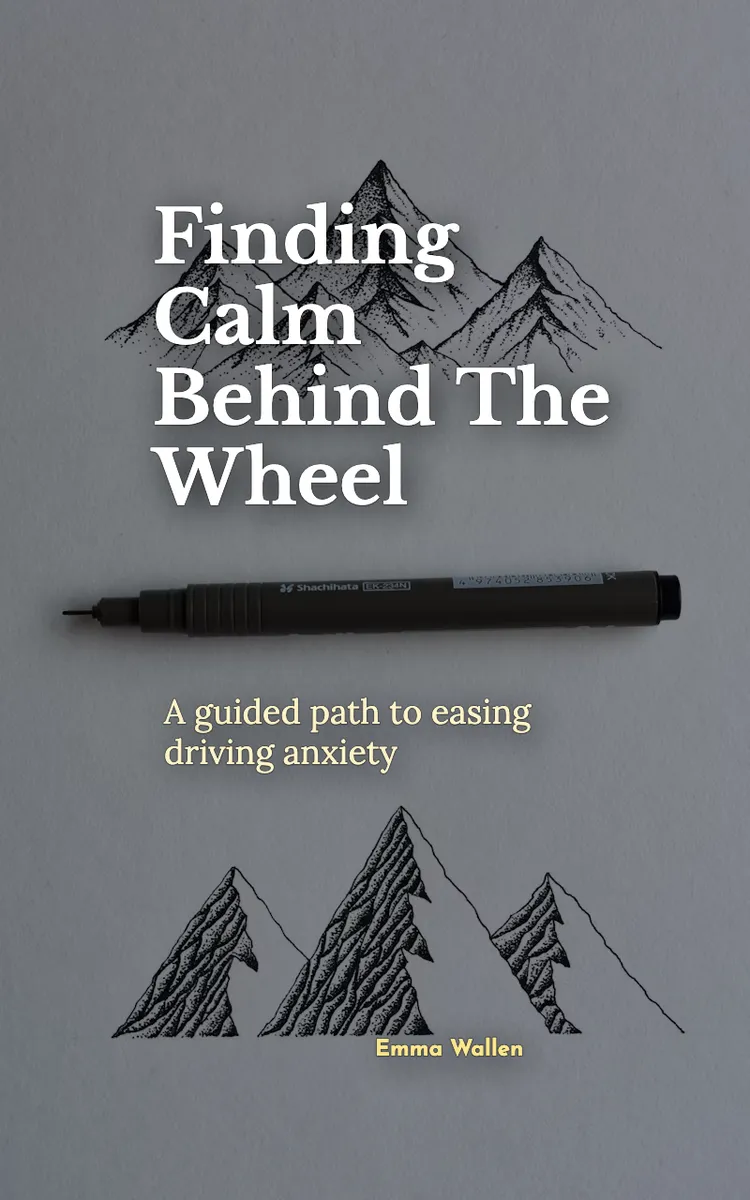
"Finding Calm Behind The Wheel" is a workbook by Emma Wallen with 5 chapters and approximately 7,279 words. Processing cumulative driving anxiety with CBT, mindfulness, and grounding exercises.
This book was created using Inkfluence AI, an AI-powered book generation platform that helps authors write, design, and publish complete books. It was made with the Workbook Generator.
Frequently Asked Questions
What is "Finding Calm Behind The Wheel" about?
Processing cumulative driving anxiety with CBT, mindfulness, and grounding exercises
How many chapters are in "Finding Calm Behind The Wheel"?
The book contains 5 chapters and approximately 7,279 words. Topics covered include Mapping Your Driving Incidents, Tracing Fear to Its Roots, Reframing Anxious Driving Thoughts, Grounding Yourself Behind the Wheel, and more.
Who wrote "Finding Calm Behind The Wheel"?
This book was written by Emma Wallen and created using Inkfluence AI, an AI book generation platform that helps authors write, design, and publish books.
How can I create a similar workbook?
You can create your own workbook using Inkfluence AI. Describe your idea, choose your style, and the AI writes the full book for you. It's free to start.
Write your own workbook with AI
Describe your idea and Inkfluence writes the whole thing. Free to start.
Start writingCreated with Inkfluence AI


