
Read the first chapter
The whole of chapter one, free. About 8 min. Turn the pages with the arrows, your keyboard, or a swipe.
Chapter 1
When Your Soul Feels Heavy
The Weight That Has a Location
In 1973, the anthropologist Paul Stoller described Songhay healers in Niger speaking of illness as something that could disturb a person’s inner life, not merely the body. Their language did not divide experience into neat modern compartments called “mental,” “emotional,” and “spiritual.” A troubled person might be understood as carrying a burden that had settled into the self.
That older way of speaking remains familiar, even where the vocabulary has changed. People describe grief as heaviness, conviction as a lightness, anxiety as pressure in the chest, and moral conflict as a divided interior. Spiritual traditions have often treated such sensations as clues - not always proof, but clues - about what is happening in the soul or spirit.
The distinction matters because soul and spirit have never meant exactly the same thing across cultures. In some traditions, the soul is the seat of memory, desire, character, and personal history, while the spirit suggests breath, life, divine connection, or a steadier dimension of awareness. The felt difference between them is the subject here: the soul as burdened by what a person has lived, and the spirit as associated with a steadiness that seems less dependent on circumstance.
When heaviness and peace feel so physical, where does a tradition say they truly belong?
The Many Meanings of Inner Weight
The English word soul carries traces of several older languages. The Hebrew nephesh can refer to a living being, a self, or a life; the Greek psyche may mean life, soul, or inner self; the Latin anima became linked with the animating principle of a person. None of these terms maps perfectly onto the modern idea of a private, invisible object inside the body. They point instead toward the whole person as alive, feeling, remembering, and vulnerable.
That helps explain why soul-level burdens are often described through ordinary human experiences. Grief, shame, loneliness, regret, and unresolved loyalty are not merely passing sensations. They gather around a person’s story. A bereaved person may feel that the world has become heavier because the relationship that organized daily life has vanished. Someone carrying shame may avoid mirrors, conversation, or familiar places, as though the self has become difficult to inhabit.
Religious traditions have given these experiences different names. In Christian writing, the soul may be troubled, restless, or weighed down by sin and sorrow. In Jewish thought, the nefesh is closely tied to life and personhood, while the ruach can suggest breath, wind, or spirit. In Islamic traditions, the nafs often describes the self with its appetites and conflicts, whereas ruh refers to spirit in relation to God. These distinctions are not identical, but they share a pattern: one aspect of a person is deeply entangled with biography, while another is associated with a more elevated or life-giving source.
The language of burden is not confined to religion. Modern speech still treats emotions as physical loads. We “carry” grief, “hold” resentment, “release” tension, and feel “lifted” after forgiveness. Contemporary research on emotion and the body gives this language a physiological basis. Stress can alter heart rate, breathing, muscle tension, digestion, sleep, and attention. The body does not simply report an emotion after it has happened; it participates in producing the experience.
A soul-level burden, in this sense, is not imaginary because it cannot be weighed on a scale. It is a pattern spanning memory, meaning, bodily sensation, and relationship. The old spiritual vocabulary and modern psychology approach it from different directions, but both recognize that suffering can become organized around the self.
The Spirit as Breath, Wind, and Steadiness
The word spirit has a physical history. It comes through the Latin spiritus, meaning breath, and is related to the act of breathing. The same association appears elsewhere: the Hebrew ruach can mean wind, breath, or spirit; the Greek pneuma carries a similar range. A spirit is therefore often imagined not as a heavy possession but as movement - air passing through, wind changing direction, life continuing.
This imagery gives spirit a different felt quality. Traditions frequently associate spiritual steadiness with spaciousness, clarity, quiet attention, or a sense of being less trapped inside immediate fear. The person is not necessarily cheerful. A spirit described as steady may coexist with grief, illness, or danger. Its defining feature is not pleasure but an ability to remain oriented when the surrounding conditions are unstable.
The contrast can be seen in the difference between emotional relief and spiritual composure. Relief follows the removal of a threat: the test is over, the diagnosis is benign, the argument ends. Composure may appear before any external problem has changed. A person awaiting a difficult medical procedure can still speak calmly, not because the danger is unreal, but because fear has not become the only authority in the room.
Neuroscience does not confirm a separate spiritual substance. It does, however, show that attention, breathing, expectation, and social connection influence the nervous system. Slow breathing can affect autonomic regulation; rituals can structure attention; familiar words, music, and communal rhythms can reduce uncertainty. These findings do not settle what spirit is. They show why spiritual steadiness can feel embodied rather than abstract.
A striking comparison appears in many contemplative traditions: the soul is like a surface disturbed by weather, while spirit is like depth beneath the waves. The metaphor does not claim that the surface is unimportant. Weather leaves real consequences. It says that a person may contain more than the most visible movement of the moment.
The Weight vs. Wind Compass
The Weight vs. Wind Compass is a way of reading the language people use for inner experience without treating that language as a medical diagnosis or a supernatural measurement. “Weight” points toward what has accumulated: memory, grief, guilt, attachment, and the pressure of an unfinished story. “Wind” points toward what moves through a person: breath, attention, conscience, prayer, and a sense of connection larger than immediate self-interest.
The compass is not a scale. It does not prove that one sensation belongs to the soul and another belongs to the spirit. Its value lies in showing why traditions describe similar experiences differently. A person may say, “My soul is tired,” when the central problem is exhaustion from years of loss. Another may say, “My spirit is strong,” while still feeling sorrow, because strength refers to an inner orientation rather than a pleasant mood.
Consider the difference between guilt and conscience. Guilt often circles backward. It returns to a particular act, relationship, or failure and repeatedly asks what should have happened instead. Conscience can also be painful, but it may face forward, calling attention toward truth, repair, or responsibility. Spiritual traditions sometimes describe the first as a burden of the soul and the second as a stirring of the spirit.
The distinction is not always clean. A burden can contain wisdom, and apparent steadiness can conceal numbness. Someone who feels nothing after repeated trauma may describe the experience as peace, though the absence of feeling is not necessarily spiritual freedom. Conversely, intense sorrow may be evidence of love rather than spiritual weakness. The compass becomes useful precisely because it resists simple labels.
One sentence captures the central tension: the soul remembers what happened, while the spirit asks what remains possible in meaning.
That is not a promise of recovery, and it is not a command to overcome pain. It is an account of why people can be wounded at one level and steady at another. The same person may carry a heavy history while retaining a quiet sense that life is not exhausted by that history.
The Counterintuitive Finding: Steadiness May Look Like Sadness
The surprising point is that spiritual steadiness may not feel light at all. In many traditions, the deepest forms of steadiness appear as grief, restraint, silence, or willingness to remain present with suffering rather than escape it.
This matters because modern culture often treats emotional brightness as evidence of health and heaviness as evidence of failure. Yet Buddhist accounts of equanimity, Christian accounts of lament, Jewish practices of mourning, and Islamic traditions of patient endurance all make room for sorrow that is not spiritual collapse. A person can be heartbroken without being inwardly scattered.
The body helps explain why this distinction is difficult to recognize. Crying, lowered energy, and a quiet voice may accompany both despair and reverence. The outward signals overlap. What differs is the relationship to the experience: despair can narrow the future until nothing seems meaningful, while spiritual steadiness may allow pain to remain real without becoming the whole definition of the self.
A Community That Gives Grief a Shape
The Jewish practice of shiva offers a clear example of how a community distinguishes soul-level burden from spirit-level steadiness. After a death, mourners traditionally remain at home for seven days, often seated low, receiving visitors, and speaking openly about the person who has died. The structure does not demand quick composure. It gives grief a social location.
The details matter. Visitors do not need to entertain the mourner or solve the loss. Silence, memory, and shared presence can be enough. The mourner’s heaviness is acknowledged as part of being bound to another human life. At the same time, the ritual prevents grief from becoming entirely private. The community surrounds the burden, giving it time, language, and witnesses.
What emerges is not simple cheerfulness. The steadiness comes through form: a known period, repeated prayers, familiar gestures, and people who understand that sorrow cannot be argued away. The soul carries the rupture. Spirit, in the religious sense, may be felt through continuity - the breath of prayer, the presence of others, and the recognition that death has changed a life without erasing its meaning.
Similar patterns appear elsewhere: mourning chants in many Indigenous communities, Qur’anic recitation at times of loss, Buddhist funerary rites, and Christian vigils. Their beliefs differ, but their human function often overlaps. They make inner weather visible and shared. A private heaviness becomes part of a larger rhythm.
The distinction between soul and spirit is therefore not only an idea about what exists inside an individual. It is also a way communities interpret visible signs: lowered eyes, tears, silence, singing, prayer, and the ability to remain present. What one culture calls a wounded soul, another may describe as a disturbed life-force or a mind caught in attachment. The vocabulary changes, but the question remains recognizable: is this person merely overwhelmed, or is some deeper steadiness still moving beneath the weight?
Human beings have always tried to answer that question through metaphors borrowed from the body - burden, breath, depth, heat, wind. Perhaps that is because inner life is never entirely separate from physical life. The soul feels heavy in a body, and the spirit is often recognized as a kind of breathing space within it. Between those two sensations lies an enduring mystery: how can a person remain marked by suffering and yet not be completely defined by it?
End of chapter one. 7 more chapters in the full book.
Swipe or use the arrows to turn the page


What's inside: 8 chapters
- 1. When Your Soul Feels Heavy
- 2. Why Your Spirit Feels Like Breath
- 3. The Inner Voice That Belongs to You
- 4. Dreams: Soul Theater or Spirit Message?
- 5. Grief’s Two Currents: Memory and Meaning
- 6. The Ego’s Mirror vs Spirit’s Witness
- 7. Prayer That Reaches Spirit, Not Performance
- 8. Your Soul Evolves; Your Spirit Anchors
About this book
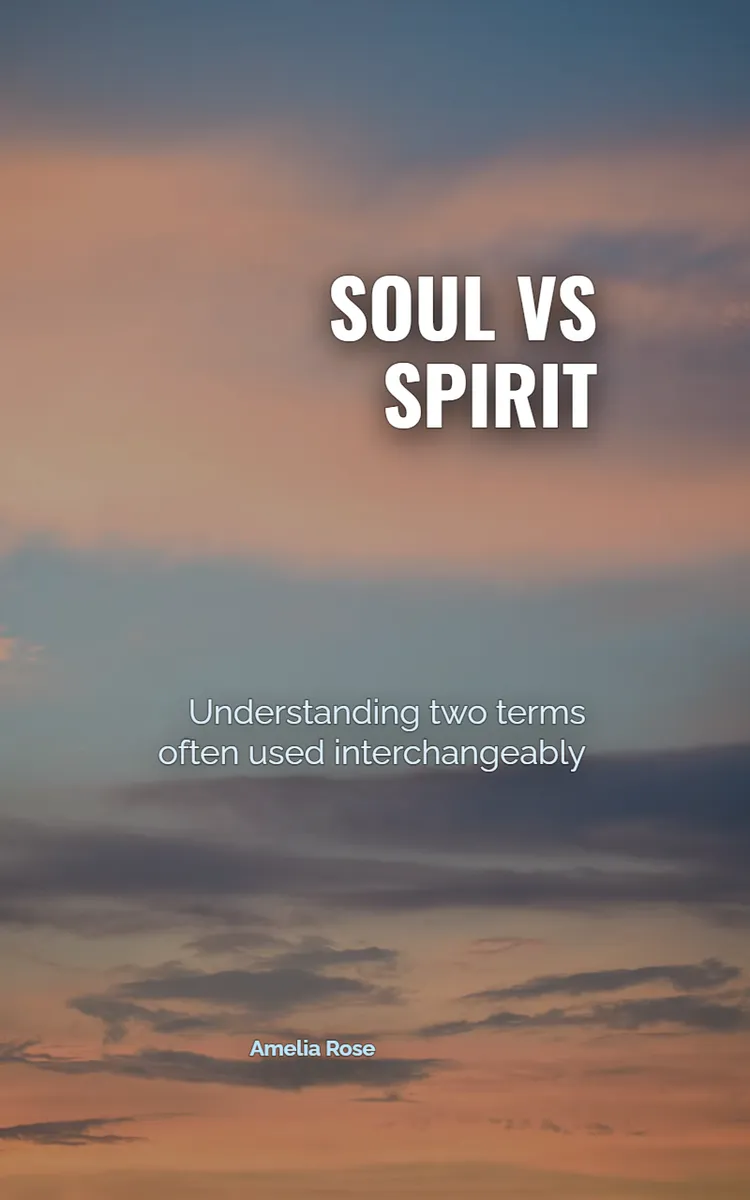
"Soul Vs Spirit" is a curiosity book by Amelia Rose with 8 chapters and approximately 14,932 words. Differences between soul and spirit in spiritual traditions.
This book was created using Inkfluence AI, an AI-powered book generation platform that helps authors write, design, and publish complete books.
Frequently Asked Questions
What is "Soul Vs Spirit" about?
Differences between soul and spirit in spiritual traditions
How many chapters are in "Soul Vs Spirit"?
The book contains 8 chapters and approximately 14,932 words. Topics covered include When Your Soul Feels Heavy, Why Your Spirit Feels Like Breath, The Inner Voice That Belongs to You, Dreams: Soul Theater or Spirit Message?, and more.
Who wrote "Soul Vs Spirit"?
This book was written by Amelia Rose and created using Inkfluence AI, an AI book generation platform that helps authors write, design, and publish books.
Write your own curiosity book with AI
Describe your idea and Inkfluence writes the whole thing. Free to start.
Start writingCreated with Inkfluence AI


