

Read the first chapter
The whole of chapter one, free. About 7 min. Turn the pages with the arrows, your keyboard, or a swipe.
Chapter 1
Recognizing the Monsters We Create
The Moment the Pattern Shows Its Face
The text says, “Can we talk?” You feel your stomach tighten before you even open the message. Maybe you’ve been here before: a small mistake, a missed call, a comment that landed badly. You already know how this tends to go. You explain. They push back. You get sharper. They go quiet. Then you both spend the evening treating the damage like it appeared out of nowhere.
But it didn’t appear out of nowhere. It was built in small pieces - one defensive reply, one avoided conversation, one promise made under pressure and broken later. Over time, those pieces become a role you both recognize. You become the person who snaps. They become the person who hides things. You resent their silence, while their silence grows out of what happens when they tell you the truth.
The monster isn’t born in one moment; it is built by what happens repeatedly between you.
From Personal Failure to Pattern Recognition
Old Belief: “This is just how I am, and they’re the reason I act this way.”
New Reality: “My repeated choices shape the reactions I bring out, and those reactions can become a pattern I must learn to manage.”
That shift matters because blame usually ends the investigation too early. If you decide you’re simply “an angry person,” you may feel stuck with your anger. If you decide the other person “makes you crazy,” you hand them the controls. Neither belief helps you notice the sequence that keeps producing the same result.
The Pattern Mirror offers a different look. It asks you to examine what happens before, during, and after a familiar conflict. Not to punish yourself. Not to pretend the other person has no responsibility. The point is to see your part clearly enough to change it.
Take a simple example. You ask your partner whether they paid a bill. They say they forgot. You hear irresponsibility, so you use a mocking tone: “Of course you did.” They feel attacked and stop explaining. You see their silence as proof that they don’t care, so you raise your voice. Later, they hide a missed payment because they’re afraid of your reaction. Now you’re furious about the secrecy, while the secrecy has been strengthened by the way the first mistake was handled.
The original problem was a forgotten bill. The repeated pattern became: mistake, criticism, withdrawal, suspicion, concealment. The pattern now causes more trouble than the bill ever did.
Reading the Pattern Mirror
A harmful pattern often feels like proof that your story is true. “They don’t respect me.” “I can’t trust anyone.” “If I don’t take control, everything falls apart.” The Pattern Mirror asks a less comfortable question: What do I repeatedly do after I believe this story?
Your reaction may be understandable and still be harmful. That’s an important distinction. Feeling afraid doesn’t make you bad. Checking someone’s phone every night can still damage trust. Feeling ignored doesn’t make you unreasonable. Sending twelve angry messages can still make honest conversation less likely.
Look for the loop, not just the latest incident. A loop has a trigger, a reaction, a response from the other person, and a consequence that seems to confirm your original fear.
Signs the Pattern Is Running Your Life
1. The same argument keeps changing costumes. One week it’s money, then chores, then a late arrival. The subject changes, but the emotional script stays the same: you pursue, they withdraw, you push harder, and both of you leave feeling justified.
2. You react to the history instead of the moment. A short reply feels like rejection because it carries the weight of ten earlier disappointments. You’re no longer answering one sentence. You’re answering every old wound at once.
3. People edit themselves around you. They delay bad news, soften facts, or avoid asking for help. You may call this proof that they’re dishonest, but it can also be evidence that your reactions have made honesty feel unsafe.
4. You keep getting the result you say you hate. You want closeness, but you interrogate. You want respect, but you insult. You want cooperation, but you issue commands. The method keeps defeating the goal.
The pattern becomes powerful when your reaction keeps creating the evidence you use to defend it.
Once you see that, you can stop asking only, “Who started this?” and begin asking, “What keeps this alive?” That question doesn’t erase anyone else’s choices. It gives you a place to act.
Questions That Make the Mirror Useful
1. What happens in the five minutes before I become someone I don’t like? Track the physical and emotional warning signs. Maybe your jaw tightens, your speech speeds up, or you start collecting old examples. Those details are often visible before the damaging behavior begins.
2. What reaction do I repeatedly bring out in the person closest to me? Do they shut down, argue, lie, over-explain, or become unusually agreeable? An honest answer might be, “When I question every detail, they stop telling me anything unless I ask three times.”
3. What am I trying to protect when I use this reaction? Anger may be guarding fear. Control may be guarding helplessness. Sarcasm may be guarding shame. Understanding the protection doesn’t excuse the behavior, but it helps you choose a better defense.
4. What do I do that makes the other person’s worst response more likely? If you want them to speak openly, notice whether you interrupt, cross-examine, or punish small admissions. The answer may sting. That sting is information, not a verdict.
5. What would change if I responded to the current event instead of the entire history? If a late arrival is the issue, address the late arrival. Don’t immediately bring in the forgotten birthday, the old argument, and the time they disappointed your family. Keeping one conversation to one problem can interrupt the loop.
Write your answers by hand if you can. A phone note works too, but handwriting slows the rush to defend yourself. You’re not building a case against yourself. You’re identifying the exact moment where a different choice becomes possible.
The Seven-Day Pattern Mirror Challenge
For the next 7 days, record one repeated reaction before trying to change it.
• Choose one pattern only: shutting down, snapping, checking, blaming, interrupting, or sending messages while angry. - Each time it happens, write four short notes: trigger, my action, their response, result. - Add one sentence beginning with, “What I was afraid would happen was…” - Before your next response, pause for ten seconds and name the goal you actually want: truth, repair, cooperation, space, or reassurance. - Choose one replacement action. You might say, “I’m getting defensive. Give me ten minutes,” instead of walking out without explanation. - At the end of each day, review the notes without calling yourself names. Look for repetition.
Difficulty: Medium
You’ll know it’s working when:
• You notice the trigger before the argument reaches full speed. - You can describe your behavior without immediately explaining theirs. - The other person gives you information sooner instead of hiding it. - One conversation ends with less damage than usual. - You catch yourself asking, “What am I creating here?” before asking, “Who’s to blame?”
The goal isn’t perfect behavior for seven days. That would only create another trap: failure, shame, and giving up. The goal is a clearer picture of the loop. You can’t manage a monster you keep calling a mystery.
What Repetition Builds
Your reactions do more than express who you are; repeated reactions teach people how to respond to you.
• You learned to look for the trigger beneath the argument, not just the argument itself. - You saw how understandable feelings can still produce harmful actions. - You used the Pattern Mirror to connect your choice with the response it invites. - You found a practical way to pause, record the loop, and test a different response.
The people around you are shaped by what happens repeatedly in your presence. So are you. A harsh reaction can train distance. A steady response can make honesty safer. Neither change happens because you made one perfect speech. It happens because the next ten ordinary moments begin to look different.
The monsters we create are fed by repetition, and repetition can be interrupted by one honest choice at a time.
The next step is learning what to do when the pattern has already erupted - when fear, anger, or control is no longer quietly building, but standing in the room with you.
End of chapter one. 9 more chapters in the full book.
Swipe or use the arrows to turn the page


What's inside: 10 chapters
- 1. Recognizing the Monsters We Create
- 2. Taking Ownership Without Shame
- 3. Tracing Triggers to Their Roots
- 4. Interrupting the Reaction Cycle
- 5. Speaking Before Resentment Grows
- 6. Setting Boundaries That Protect Connection
- 7. Repairing Harm After the Eruption
- 8. Changing Patterns Through Daily Practice
- 9. Rebuilding Trust Through Consistency
- 10. Choosing What You Create Next
About this book
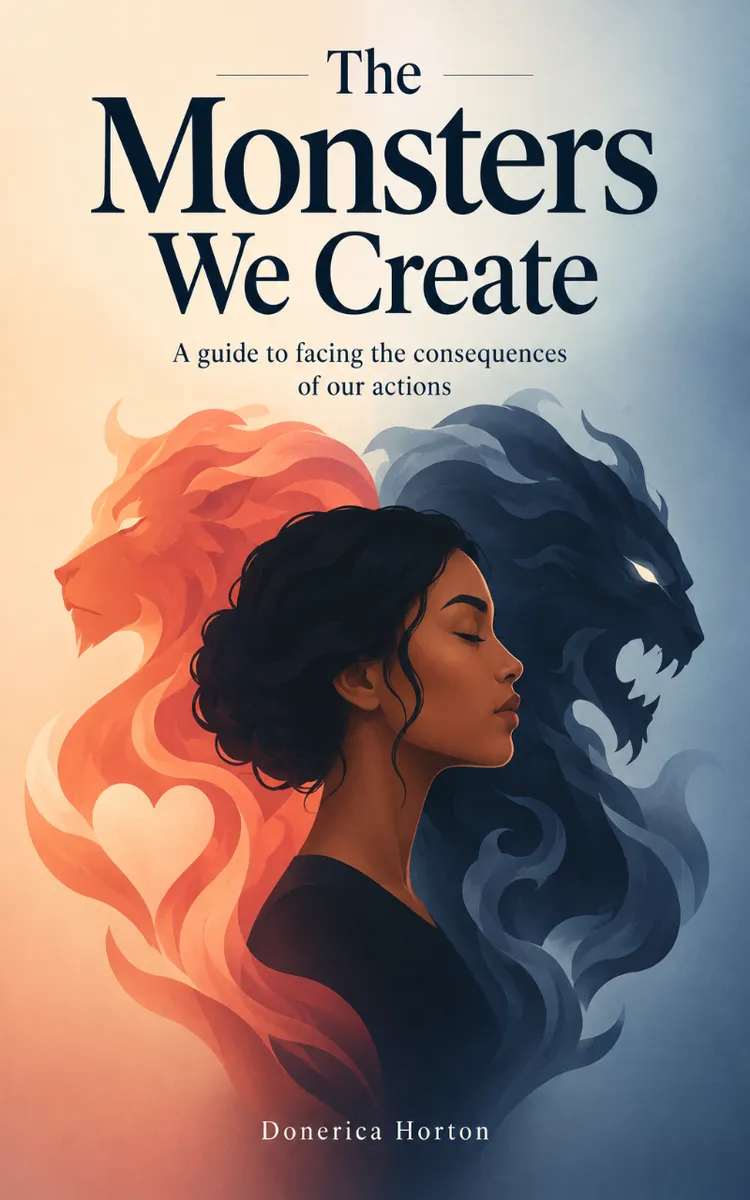
"The Monsters We Create" is a fiction book by Donerica Horton with 10 chapters and approximately 14,722 words. How relationships and life choices create harmful patterns we must learn to manage.
This book was created using Inkfluence AI, an AI-powered book generation platform that helps authors write, design, and publish complete books. It was made with the AI Novel Writer.
Frequently Asked Questions
What is "The Monsters We Create" about?
How relationships and life choices create harmful patterns we must learn to manage
How many chapters are in "The Monsters We Create"?
The book contains 10 chapters and approximately 14,722 words. Topics covered include Recognizing the Monsters We Create, Taking Ownership Without Shame, Tracing Triggers to Their Roots, Interrupting the Reaction Cycle, and more.
Who wrote "The Monsters We Create"?
This book was written by Donerica Horton and created using Inkfluence AI, an AI book generation platform that helps authors write, design, and publish books.
How can I create a similar fiction book?
You can create your own fiction book using Inkfluence AI. Describe your idea, choose your style, and the AI writes the full book for you. It's free to start.
Write your own fiction book with AI
Describe your idea and Inkfluence writes the whole thing. Free to start.
Start writingCreated with Inkfluence AI


