

Read the first chapter
The whole of chapter one, free. About 10 min. Turn the pages with the arrows, your keyboard, or a swipe.
Chapter 1
The Bog That Took His Boot
The causeway had become a river during the night, and Oswin had been promised it was only ankle-deep.
“Ankle-deep where?” he asked.
Corporal Hobb pointed with his spear. “There.”
The spear vanished into brown water.
Oswin looked from the spear to the flooded road and then to his horse, Brindle, who was already regarding the crossing with the flat suspicion of an animal that had survived seven years of military planning.
“I am going home,” Oswin said.
“Eventually.”
“Preferably with both boots.”
“Then lift your feet.”
Behind them, the army shuffled and groaned through the morning mist. Wagons creaked beneath sacks of grain, barrels of salt meat, bundles of arrows, and the accumulated misery of nearly seven years of war. The camp behind them had dissolved into mud overnight. Tents leaned like drunkards. Fires hissed in puddles. Somewhere, a cook was cursing a goose that had escaped its pot.
Oswin had no objection to the war ending wherever it happened to be. He had no objection to the king winning, provided the king did it quickly and at a considerable distance. What he wanted was a dry road, a warm meal, and a bed that did not contain somebody else’s elbow.
The causeway offered none of these.
It was an old stone road crossing the marsh, raised barely above the flooded fields. Water rushed over it in a broad, restless sheet, carrying reeds, branches, and one dead chicken. The army needed to reach the far bank before the enemy scouts found the camp. This made the crossing important, which meant officers had been shouting at it since dawn.
“Take the horse by the bridle,” Hobb said. “Walk steady.”
“I was planning to gallop.”
“Of course you were.”
Oswin dismounted. His left boot sank to the ankle before he had reached the water. He pulled it free with a wet sucking sound and placed his foot on a patch of stone that looked firmer.
It was not.
The stone shifted. Oswin lurched sideways, caught Brindle’s reins, and dragged the horse after him. Brindle gave a startled snort and stepped into the current.
The water struck the horse’s legs and shoved them downstream.
“Steady,” Oswin said.
Brindle continued sideways.
“Steady, you great coward.”
The horse’s ears flattened.
“I know how you feel.”
The current climbed to Oswin’s knees. Cold water poured over the tops of his boots. His cloak ballooned behind him, dragging like a sail. Ahead, a baggage cart laboured onto the causeway, its driver cracking a whip at two mules that had already made clear their opinions on the matter.
“Move!” shouted someone behind Oswin.
“I am moving!”
“You’re moving the wrong way!”
Oswin glanced down. His right boot had caught between two stones. The leather pulled hard against his ankle.
He tugged once. Nothing.
He tugged again. His leg remained where it was, while Brindle slid another foot sideways.
“Oswin,” Hobb called, “leave the boot.”
Oswin stared at him.
“It is my boot.”
“It is a bad boot.”
“It is my only good boot.”
“It has a hole in it.”
“That is where the foot goes.”
Brindle stumbled. Oswin seized the saddle strap with one hand and bent to free his boot with the other. The water slapped his face. Mud filled his mouth. His fingers found the leather, slipped, and closed around something cold and slimy.
He pulled.
The thing came loose with a pale, boneless twist. It was a drowned eel.
Oswin flung it away. The eel struck a passing shield and slid down the arm of a pikeman, who looked at it, looked at Oswin, and decided not to ask.
The current shoved Brindle against the baggage cart.
The cart driver shouted. One mule brayed. The second mule, offended by both the water and the first mule’s braying, kicked backward.
Its hoof struck Brindle’s chest.
Brindle reared.
Oswin lost the saddle strap.
For one magnificent instant he stood alone in the flood, his trapped boot anchoring him to the causeway while the rest of him attempted to continue downstream. His cloak rose over his head. His sword scabbard filled with water. A reed entered his sleeve.
Then his boot came free.
Oswin shot backward beneath the baggage cart.
The underside of the cart was a dark forest of wheels, axles, dripping sacks, and mule legs. He struck the water on his back, swallowed half the marsh, and found himself wedged between the cart’s rear wheel and a crate marked FLOUR.
The crate settled on his shoulder.
He tried to push it away. It did not move.
“Help!” he shouted.
The cart rolled forward six inches.
Oswin’s helmet struck the axle.
“Not like that!”
The cart stopped. One mule turned its head and looked beneath itself. Oswin looked back. The mule had a long, wet face and the expression of a clerk discovering an error in a ledger.
“Please,” Oswin told it. “Do not make this worse.”
The mule stepped on his cloak.
The cloth tightened around Oswin’s throat.
He clawed at the fastening, kicked at the wheel, and discovered that his left boot was now gone as well. The cold water rushed around his bare foot. Somewhere above him, soldiers shouted warnings about the current, the cart, and the general condition of Oswin’s judgment.
Hobb waded closer. “Can you get out?”
“I have chosen not to.”
“Oswin!”
“The cart is on my cloak!”
“Cut the cloak.”
“It is the only thing keeping me warm.”
“You are underwater.”
“That is why I need it.”
Hobb reached beneath the cart. His fingers caught Oswin’s wrist, but the current pulled them both sideways. Hobb swore and braced himself against the wheel.
A wagon behind them crashed into the first.
The impact sent a barrel rolling loose. It passed over Oswin’s stomach, paused against his ribs, and then continued downstream with the solemn determination of a small wooden ship.
Oswin watched it go.
“That was pickled cabbage,” someone said.
“It still is,” Oswin replied.
The second wagon pressed against the first. The mules screamed. A sack of flour toppled from the cart and burst in the water, turning the current white around Oswin’s face.
For several breaths he could see nothing but flour paste.
He wiped his eyes and found himself staring at a boot.
It belonged to a young soldier standing on the cart above him.
“Sir,” the soldier said.
Oswin spat flour. “What?”
“Are you trapped?”
“No. I am inspecting the underside.”
The soldier bent down and offered a hand. Oswin seized it. Three more hands joined. They pulled while Hobb pushed from the other side.
The cart moved.
Unfortunately, it moved toward Oswin.
The wheel rolled over his scabbard, snapped the leather belt, and sent his sword spinning into the flood. Oswin made a noise that began as a curse and ended as a prayer to any god willing to return a sword without requiring paperwork.
“Leave it!” Hobb shouted.
“It is a sword!”
“It is a very wet sword!”
The current caught Oswin’s cloak again. The mule stepped off it. Oswin slid free so suddenly that the soldiers above lost their grip. He shot beneath the cart, between the two wagons, and out into open water.
For a moment he floated face-up, arms spread, one boot on his foot and the other somewhere in the kingdom.
The sky was grey. Rain tapped his helmet. A crow flew overhead carrying a strip of bacon.
Oswin considered following it.
Then Brindle’s reins wrapped around his neck.
The horse had made it to the far side of the causeway, where he stood trembling beside a pile of wet baggage. The reins stretched back through the flood. Oswin grabbed them and was immediately dragged toward the horse.
“Brindle!” he shouted.
Brindle pulled harder.
Oswin’s remaining boot struck a stone. His knee folded. He went under, came up with a mouthful of water, and found himself being hauled across the causeway on his belly. His helmet filled. His cloak snagged on a submerged branch. His sword was gone. His dignity had been lost before the flour.
“Pull!” shouted the young soldier.
“I am pulling!”
“Not you!”
The soldiers hauled on the reins. Brindle, convinced that something behind him was trying to eat his tail, backed away. This brought Oswin forward faster.
He slid past the baggage cart, beneath the flailing legs of a mule, and into the shadow of the far bank. His hands found the muddy edge. He gripped it.
At that exact moment, the army’s spare mule came down the bank.
It was a broad, patient beast carrying two sacks of onions and a driver who had not noticed Oswin. One hoof landed beside Oswin’s fingers. The mule shifted its weight, considered the problem, and then nudged him with its shoulder.
Oswin rolled uphill.
The mule nudged him again.
He rolled farther, gathered speed, and struck the bank on his back. Mud splashed over his face. The sacks of onions tipped. One onion bounced off his helmet and settled neatly in his lap.
The mule continued past him.
Oswin lay still.
On the causeway, Hobb raised both hands. “He did that deliberately!”
The young soldier stared at Oswin, who was covered in flour, mud, and river weed, with one boot, no sword, and an onion resting against his belt.
“He saved the baggage,” the soldier said.
“I did not,” Oswin said.
The soldier pointed toward the crossing. The cart had stopped. The rear wheel was lodged against the broken stone where Oswin’s boot had been trapped. Behind it, three wagons had jammed together, blocking the current and forming a rough bridge. Soldiers were already scrambling over the piled baggage to reach the far bank.
“You stopped the carts,” the soldier said. “You held the causeway.”
“I was stuck.”
“Under the enemy’s baggage train.”
“There was no enemy.”
“Exactly,” said the soldier, with the solemn certainty of a man who had just witnessed something important. “They could not even see you.”
Hobb climbed the bank, dripping from helmet to knee. “He lost his boot.”
The young soldier looked at Oswin’s bare foot.
“His famous boot,” he said.
Oswin sat up. His head rang. Around him, men dragged sacks from the water and righted a barrel. Brindle stood nearby, chewing a strap that had once belonged to Oswin’s saddle. The rain had stopped, though the sky still threatened to resume the matter.
A pikeman approached, carrying Oswin’s sword. It was bent slightly at the tip and full of river water.
“Found this,” the man said.
Oswin took it. “Thank you.”
The pikeman glanced at the flooded causeway. “They’ll be talking about this.”
“They will not.”
“You went beneath the baggage train to save the crossing.”
“I fell.”
“You faced the current alone.”
“I was attached to a horse.”
“You sacrificed your boot.”
“It was stolen by the road.”
The soldier who had helped pull him free was already speaking to two others. “He saw the wagons were going to overturn, so he threw himself beneath them. Wouldn’t let go until the whole train was secure.”
Oswin rose, slipped on the mud, and caught himself against Brindle.
The onion fell from his lap.
“Did you see that?” the young soldier cried. “Even wounded, he refuses to kneel.”
“I slipped.”
“He says it was nothing,” Hobb muttered.
Oswin looked at the causeway. The army was crossing now, one wagon at a time, over the obstruction his boot and bad decisions had created. Men glanced toward him as they passed. A few nodded. One lifted his spear in salute.
He wanted to explain.
He wanted to say that the current had dragged him sideways, that the cart had trapped him, that the mule had done the only useful thing anyone had managed all morning. He wanted to say he was not fearless, not clever, and certainly not the sort of man who sacrificed footwear for military advantage.
Instead, he noticed the young soldier watching him with shining admiration.
Oswin closed his mouth.
By the time the last wagon reached the far bank, the story had acquired a name. The Bootless Stand, someone called it. Another man insisted Oswin had held the causeway against a dozen unseen riders. By noon, a camp follower claimed he had drowned three enemies with his bare hands.
Oswin limped after the army with one wet foot and a sword that dripped steadily into his boot.
Ahead, a quartermaster was arguing with a cook beside a stack of oil jars.
A spark rose from the cook’s fire and landed on the supply banner.
Oswin saw it catch.
He also saw the quartermaster turn toward him.
“Sir Oswin!” the man called. “We need your help!”
End of chapter one. 13 more chapters and about 36,544 words in the full book.
Swipe or use the arrows to turn the page


What's inside: 14 chapters
- 1. The Bog That Took His Boot
- 2. The Cookfire Banner
- 3. Who Started the Song?
- 4. The Siege Ladder Tangle
- 5. The Horse He Wouldn’t Ride
- 6. The Retreating Drum
- 7. The Letter from Home
- 8. The Bridge Toll Disaster
- 9. The Challenge at the Alehouse
- 10. The Stolen Siege Map
- 11. The Saint’s Empty Reliquary
- 12. The Banner in the Millrace
- 13. The Welcome He Didn’t Want
- 14. The Ballad’s Missing Verse
About this book
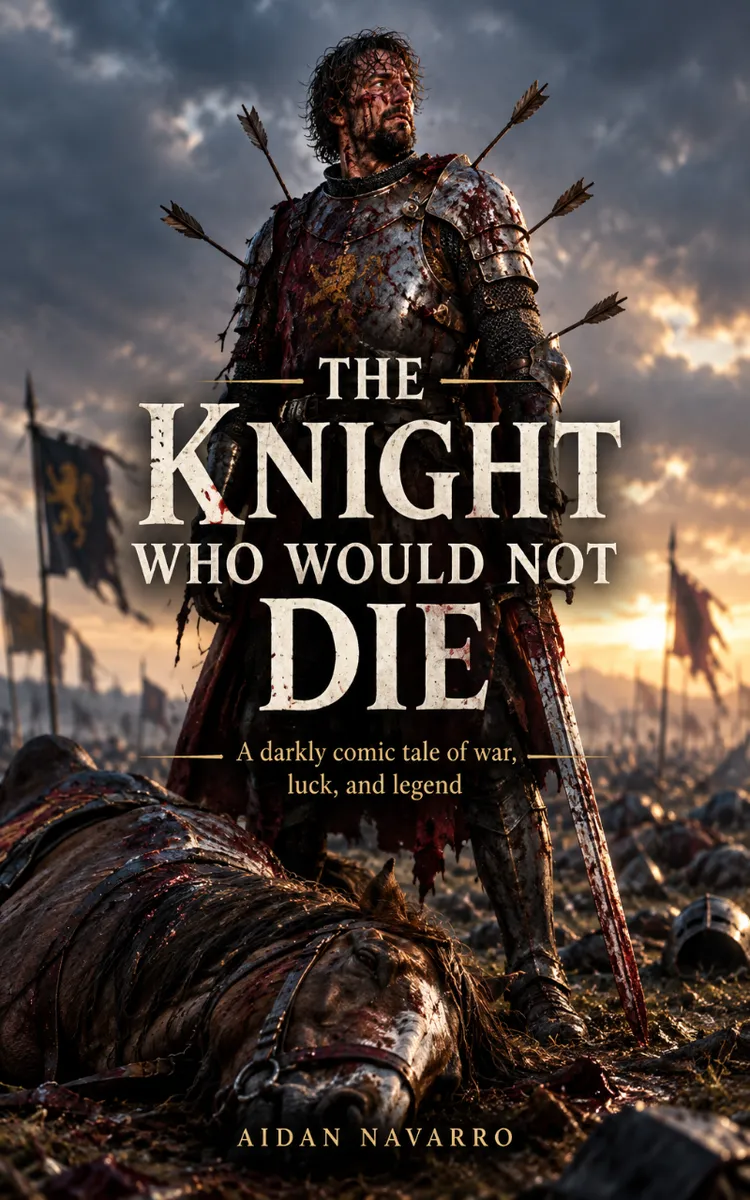
"The Knight Who Would Not Die" is a comedy book by Aidan Navarro with 14 chapters and approximately 36,544 words. Oswin wants a dry road, a warm meal, and no part in the war. The flooded causeway has other plans.
This book was created using Inkfluence AI, an AI-powered book generation platform that helps authors write, design, and publish complete books. It was made with the AI Novel Writer.
Frequently Asked Questions
What is "The Knight Who Would Not Die" about?
Oswin wants a dry road, a warm meal, and no part in the war. The flooded causeway has other plans. When his boot, a burning supply banner, and a streak of battlefield luck turn into the tale of the Bootless Stand, the army starts singing about a hero Oswin barely recognizes. A minstrel has already made him “the knight who mocked the grave.” Oswin would rather correct the song. Unfortunately, every attempt to keep his head down gives the story another verse. Now a reluctant hedge knight must survive the war, the army’s growing legends, and the consequences of being famous for deeds he never meant to do. In a kingdom that has spent nearly seven years fighting, staying alive may be the hardest part of becoming a hero.
How many chapters are in "The Knight Who Would Not Die"?
The book contains 14 chapters and approximately 36,544 words. Topics covered include The Bog That Took His Boot, The Cookfire Banner, Who Started the Song?, The Siege Ladder Tangle, and more.
Who wrote "The Knight Who Would Not Die"?
This book was written by Aidan Navarro and created using Inkfluence AI, an AI book generation platform that helps authors write, design, and publish books.
How can I create a similar general book?
You can create your own general book using Inkfluence AI. Describe your idea, choose your style, and the AI writes the full book for you. It's free to start.
Write your own comedy book with AI
Describe your idea and Inkfluence writes the whole thing. Free to start.
Start writingCreated with Inkfluence AI


