

Read the first chapter
The whole of chapter one, free. About 8 min. Turn the pages with the arrows, your keyboard, or a swipe.
Chapter 1
The Stool That Stayed Warm
The bar’s front door stuck in its frame whenever the tide was coming in. Leon had to shoulder it twice before the latch gave, and the bell above him rang like a cracked spoon.
Cal looked up from the register.
“Thought you were done.”
Leon kept his hand on the door. Outside, the harbor lamps shook in the black water. “I am.”
“You’re inside.”
Leon let the door swing shut. The room was low enough that the ceiling fan stirred the hair at the crown of his head. It clicked once every rotation. The place smelled of wet wool, old beer, and the fried grease sunk into the floorboards.
He walked to the stool nearest the end of the bar and sat.
Cal set down a glass without asking. Whiskey. Two fingers, heavy.
Leon watched the amber settle. He wanted the first swallow to take the edge off the day, the second to blur the motel room waiting across the street, and the third to make the walk there seem like something a man could do without remembering where he had been.
“Closing in twenty,” Cal said.
“I know.”
Cal moved away.
Leon drank. The liquor burned a clean path down his throat and left the rest of him alone. That was the arrangement. He had kept it in towns with paper mills, ferry docks, dead shopping strips. Saltmere was only the latest place with a harbor and a room he had not paid for yet.
At the far end of the bar, a man named Vick sat by himself beneath the television. He had been there most nights that week, drinking bottled beer and reading the same folded newspaper. He never spoke unless someone asked him something.
Tonight he was not reading. He was looking at the empty stool beside him.
Leon noticed because Vick noticed.
“What?” Cal called.
Vick turned. “Nothing.”
Cal wiped a glass. “Then stop staring at it.”
Vick’s mouth tightened. He looked back at the stool.
The fan clicked overhead. The television showed a weather map without sound. Red bands moved along the coast.
Leon finished his drink and raised two fingers.
Cal poured again.
By ten-thirty the room had thinned. A pair of deckhands left arguing over a fishing permit. A woman in a yellow raincoat stood at the door for nearly a minute, searching her pockets, then found her keys in her hand. Vick folded his newspaper and put it away.
Before he left, he leaned toward Leon.
“You staying late?”
Leon looked at the whiskey. “Maybe.”
“Don’t.”
The word was quiet enough that Cal could have missed it. He did not look up.
Vick pulled on his coat.
Leon watched him push through the door into the wet dark.
“What’s his problem?” Leon asked.
Cal stacked glasses. “He has one.”
“Which one?”
“People ask too many questions.”
Leon laughed once. It came out dry. “That a rule here?”
“It’s a bar.”
Cal went back to the register.
Near midnight, Leon stopped counting his drinks. The room had narrowed to the wood beneath his palms and the line of bottles behind Cal. The whiskey had softened the corners but not erased the thought of Harborview. It came sometimes when he drank, not as a memory but as a sound: his father’s breath catching before the rest of him went still.
Leon set his glass down.
Cal glanced at him. “You all right?”
“Fine.”
“You look pale.”
“I’m always pale.”
Cal gave him the smallest smile. It did not reach his eyes.
At twelve-fifteen, Cal turned the sign in the window. CLOSED. He shut off the television, then the lights over the booths. The bar became a strip of yellow behind the bottles and the dull blue glow from the harbor.
Leon slid off his stool.
The stool did not move.
He looked down. One leg had caught on the warped floorboard. He pulled harder. The wood released with a soft knock.
The seat was warm beneath his hand.
Not warm from his body. He had been sitting at the other end of the bar for the last three hours.
Leon touched it again.
Cal was behind him, locking the front door.
“You feel that?” Leon asked.
Cal kept the key in the lock. “Feel what?”
“The seat.”
“It’s a stool.”
“It’s warm.”
Cal turned. His face had gone flat.
Leon rubbed his palm against his jeans. The heat remained in his hand, faint and unpleasant, like a fever.
Cal walked past him and lifted the stool by its back. He carried it to the wall beneath the coat hooks.
“Don’t sit there,” he said.
Leon looked at the row of empty seats. “Why?”
Cal set the stool down.
“Because I said so.”
The harbor wind pressed against the windows. Somewhere outside, a chain struck a mast in a slow, hollow rhythm.
Leon reached for his jacket. He wanted to leave without making a scene. He wanted the motel door, the thin mattress, the bottle in his bag. He wanted not to think about the heat on his palm.
At the front door, Cal spoke again.
“Vick didn’t make it home.”
Leon stopped.
Cal stood behind the bar, one hand resting on the register. “Found him this morning. In bed.”
“Drunk?”
“Alone.”
“That’s not what I asked.”
Cal looked toward the warm stool. “No sign of anything.”
“Heart?”
“Maybe.”
“People don’t just die because they drink alone.”
“People die for less.”
Leon turned back. “Who found him?”
“Landlord.”
“And you know this how?”
Cal’s expression hardened. “Small town.”
Saltmere was small enough for news to cross the street before the ambulance did. Leon had seen the crowd outside the blue house that morning, though he had not known whose house it was. A woman in slippers had been crying beside the curb. Two men had carried something under a white sheet.
He had kept walking.
Vick’s face came back to him now. The folded newspaper. The way he had watched the empty stool.
“What was he asking about?” Leon said.
Cal’s hand tightened on the register.
“Nothing.”
“People ask questions.”
“Not you.”
Leon smiled without meaning to. “You don’t know me.”
“I know you close the place down and walk back to the motel.”
“That all?”
“That’s enough.”
The warning sat between them.
Leon opened the door. Cold rain struck his face. He stepped outside, then looked back.
Cal had already turned away.
The door shut behind Leon, and the bell gave one last thin ring.
He stood beneath the awning. Across the street, the motel sign buzzed in red, missing the letter O. The harbor was black beyond the buildings. Rain ran along the gutter carrying cigarette ends and a small white pill wrapper.
Leon reached into his jacket for the bottle he kept there.
His fingers closed around the neck.
He did not take it out.
For a few seconds he stood with his hand inside the pocket, holding the bottle through the cloth. Then he crossed the street.
In the motel room, the radiator knocked without producing heat. Leon sat on the edge of the bed and emptied his pockets onto the nightstand: keys, loose change, a bent lighter, the bottle.
He stared at it.
His hand still felt warm.
The phone on the nightstand rang.
Leon flinched hard enough to knock the lighter to the floor. He let it ring twice before picking up.
“Yeah?”
A pause. Static. Then Jim Holloway’s voice, older and rougher than Leon remembered.
“You sound drunk.”
“Good ear.”
“You in Saltmere?”
Leon looked at the bottle. “For now.”
“What bar?”
Leon said nothing.
Jim breathed into the phone. In the background, something mechanical hummed, steady as a refrigerator.
“I heard a name,” Jim said. “Vick.”
Leon sat forward. “How?”
“People talk.”
“People where?”
“Florida. It travels.”
Leon rubbed his palm against his knee. “He died in his sleep.”
“Was he alone?”
“Yes.”
“Did he drink at the harbor bar?”
Leon looked toward the window. The red motel sign pulsed across the glass.
“Yes.”
Jim was quiet for a moment.
“Leon,” he said, “don’t be the last one in that place.”
“Why?”
“Because the last ones are the ones people remember.”
“That’s not an answer.”
“It’s the one I’ve got.”
Leon heard a chair scrape on Jim’s end. Jim’s leg had been bad for years, and every movement made itself known through the phone.
“Vick was asking about a drowning,” Jim said. “Old one. Somebody connected to the senator’s office. It got buried.”
Leon looked at the bottle again.
“Who told you that?”
“Doesn’t matter.”
“It matters to me.”
“No. What matters is that Vick talked too much near closing, drank alone, and ended up dead in bed.”
The room seemed to contract around Leon. He could still feel the stool beneath his hand. Heat without a body.
“Cal said there was no sign of anything.”
“Cal say a lot?”
“Not much.”
“That’s the kind you watch.”
Leon stood and went to the sink. Rust-colored water came from the tap before clearing. He washed his hand. The warmth faded under the cold stream, but not entirely.
Jim said, “You drinking now?”
Leon shut off the water.
“No.”
The lie came easily. It had been practiced longer than anything else.
Jim did not challenge it. “Stay out of the bar tomorrow.”
Leon looked through the window at the dark street. “I need the work.”
“You need to stay alive.”
“That’s different?”
“For you, it is.”
The line clicked softly. Jim had not hung up. Neither had Leon.
Ten years since Harborview, and Jim was still the only person who called without asking what Leon had done with the years between. The others had disappeared into lives Leon could not picture. Jim stayed in Florida with his damaged leg, his bad phone, and a way of hearing what Leon left out.
“Get some sleep,” Jim said.
Leon glanced at the bottle. “You too.”
The call ended.
He stood in the room until the radiator knocked again.
Then he picked up the bottle and carried it to the bathroom. He did not pour it out. He put it in the medicine cabinet behind a chipped plastic cup, shut the door, and returned to the bed.
In the morning, he would go back to the bar.
He knew that before he slept.
Not for the drink. Not exactly.
Outside, the harbor chain struck the mast again, and somewhere across the street a door opened and closed. The sound traveled through the rain like someone leaving quietly.
End of chapter one. 12 more chapters and about 24,137 words in the full book.
Swipe or use the arrows to turn the page


What's inside: 13 chapters
- 1. The Stool That Stayed Warm
- 2. The Call from Florida
- 3. Names After Last Call
- 4. The Boardwalk Witness
- 5. A Glass Left Untouched
- 6. The Night the Bar Closed
- 7. The Dose in the Bottle
- 8. The Motel Room Ransacked
- 9. Cal’s Empty Apartment
- 10. The Father’s Unanswered Silence
- 11. The Last Empty Stool
- 12. A Morning Without a Drink
- 13. The Official Bad Batch
About this book
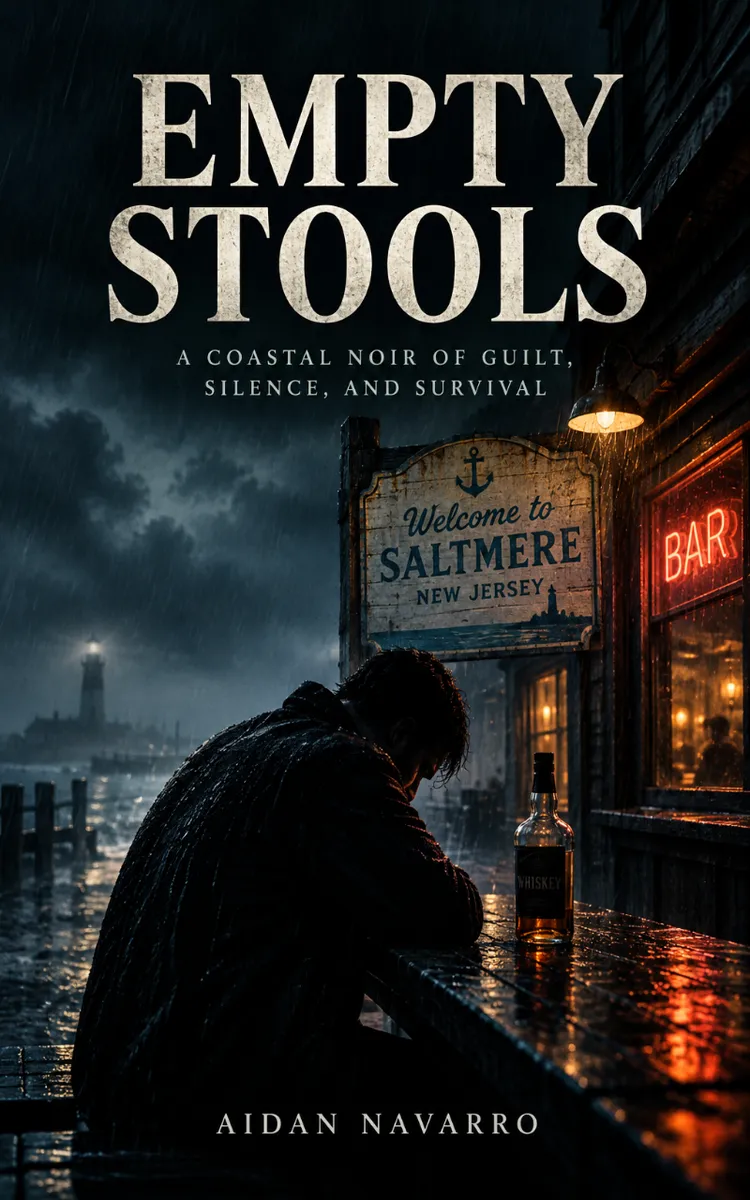
"Empty Stools" is a fiction book by Aidan Navarro with 13 chapters and approximately 24,137 words. Leon says he is done with Saltmere. Then he shoulders through the harbor bar’s sticking door and takes his old stool.
This book was created using Inkfluence AI, an AI-powered book generation platform that helps authors write, design, and publish complete books. It was made with the AI Novel Writer.
Frequently Asked Questions
What is "Empty Stools" about?
Leon says he is done with Saltmere. Then he shoulders through the harbor bar’s sticking door and takes his old stool. Vick has been asking who kept a senator’s office quiet. Now Vick is dead, and Leon is asking the people who heard him. They answer in fragments, with eyes lowered and names that change. Cal pours whiskey without asking. Leon keeps looking at the bottles, though he knows what they do to him. The trail runs from a rain-dark bar to pieces of a story Jim has in Florida, and toward the guilt Leon brought with him to the coast. In Saltmere, every empty stool marks someone who might have spoken. Leon has to decide what the truth is worth before the room falls silent again.
How many chapters are in "Empty Stools"?
The book contains 13 chapters and approximately 24,137 words. Topics covered include The Stool That Stayed Warm, The Call from Florida, Names After Last Call, The Boardwalk Witness, and more.
Who wrote "Empty Stools"?
This book was written by Aidan Navarro and created using Inkfluence AI, an AI book generation platform that helps authors write, design, and publish books.
How can I create a similar fiction book?
You can create your own fiction book using Inkfluence AI. Describe your idea, choose your style, and the AI writes the full book for you. It's free to start.
Write your own fiction book with AI
Describe your idea and Inkfluence writes the whole thing. Free to start.
Start writingCreated with Inkfluence AI


