
Read the first chapter
The whole of chapter one, free. About 8 min. Turn the pages with the arrows, your keyboard, or a swipe.
Chapter 1
The Money Snapshot and Baseline
Why Your Starting Point Matters
What would you find if you opened every bank, credit card, loan, investment, and payment app today and wrote down the exact balance? If the answer is “I would need to check several places,” you do not yet have a reliable starting point. You may know your income and a few monthly bills, but scattered information can hide the real cost of your financial life.
The Money Snapshot and Baseline solves that problem. It gathers every account, bill, balance, due date, and regular payment in one place. You need this complete picture because a budget built from guesses can leave out an annual insurance bill, a store card, a loan payment, or a subscription that quietly drains your checking account. A complete snapshot replaces uncertainty with facts.
After you finish, you will know what you own, what you owe, what you must pay each month, and which amounts still need confirmation. You will not need a perfect spreadsheet or a new financial app. You need a secure place to record the facts and enough time to check each source carefully. The result becomes your baseline: a clear record of where your money stands before you make changes.
Build the Money Snapshot Scorecard
The Money Snapshot Scorecard gives you one organized view of your money. Think of it as an inspection sheet. You record each item, verify the amount, and mark anything that needs follow-up. Do not rely on memory. Open the account, bill, statement, or payment history and copy the current information.
Use these five parts:
1. Cash accounts: Record checking accounts, savings accounts, cash management accounts, and money held in payment apps. Write the current balance and the account’s last four digits so you can identify it without recording sensitive login details.
2. Debts: List credit cards, personal loans, student loans, vehicle loans, medical payment plans, buy-now-pay-later plans, and any money owed to another person. Record the current balance, minimum payment, interest rate if shown, and due date.
3. Regular bills: Capture housing, utilities, insurance, phone service, internet, childcare, memberships, subscriptions, and other repeating charges. Record the normal amount and note bills that change from month to month.
4. Assets and investments: Record retirement accounts, brokerage accounts, certificates of deposit, vehicles, and other major items that affect your financial position. Use the current account value when the provider gives one. Do not spend time estimating the resale value of ordinary household items.
5. Irregular expenses: Find payments that occur quarterly, twice a year, or once a year. Examples include property taxes, professional licenses, vehicle registration, insurance premiums, school fees, and holiday spending. Record the total amount and the month it usually arrives.
A simple table keeps the information readable:
| Item | Type | Current amount | Regular payment | Due date | Source checked | Follow-up | |---|---|---:|---:|---|---|---| | Main checking | Cash | $2,140 | - | - | Bank app | - | | Visa card | Debt | $3,860 | $125 minimum | 18th | Statement | Confirm rate | | Car insurance | Bill | - | $168 | 5th | Email statement | - | | Vehicle registration | Irregular expense | - | $420 yearly | October | State website | Set reminder |
Separate balances from payments. A credit card balance of $3,860 tells you what you owe today. The $125 minimum payment tells you what the lender currently requires each month. Both numbers matter, but they answer different questions. Also separate fixed bills from changing bills. Rent may stay at $1,450, while electricity may range from $90 to $210. Record the latest amount and check several recent bills when you need a usable monthly estimate.
Gather information from the places that hold the facts: bank apps, lender websites, recent statements, payroll records, insurance emails, payment-app histories, and your calendar. Search your email for words such as “receipt,” “renewal,” “payment due,” and “subscription.” Review your bank transactions for the last two or three months and flag any repeating charge you did not already list. This step matters because some bills never arrive as paper statements, and some subscriptions renew only once a year.
Finish the Scorecard by adding three totals: total cash, total debt, and total regular monthly payments. You can also calculate a simple net position by subtracting total debt from the value of your listed assets. Treat that number as a baseline, not a judgment. Its purpose is to show what needs attention and give you a number to compare against later.
Put the Scorecard Into Practice
Tanya is 34 and works as a nurse. Her money reaches several places: a checking account for everyday spending, a savings account, a retirement account through work, two credit cards, a car loan, and a payment app she uses for occasional purchases. Her schedule changes often, so she has never gathered everything at one time.
She completes the snapshot on a Sunday afternoon. She uses a password-protected spreadsheet and keeps account passwords out of the file. She opens each account rather than copying figures from memory.
1. List the accounts. Tanya records $2,140 in checking, $4,600 in savings, $18,750 in her workplace retirement account, $3,860 on her first credit card, $940 on her second credit card, and $11,200 remaining on her car loan. She finds $75 in her payment app and adds it to cash.
2. Record required payments. Her rent is $1,450, the car payment is $365, the first card requires $125, and the second card requires $40. Her phone costs $82, internet costs $65, and health insurance costs $210. She records each due date from the account or statement instead of guessing.
3. Find repeating charges. Her bank history reveals a $14.99 streaming subscription, a $9.99 meditation app, and a $32 professional membership. She also finds a $168 car insurance payment that renews monthly. She adds each item to the Scorecard.
4. Find irregular bills. Her vehicle registration costs $420 every October. Her professional license renewal costs $185 every two years. She records the next due month and the full amount. These charges do not disappear just because they skip most months.
5. Check the totals. Tanya has $6,815 in listed cash, $16,000 in listed debt, and $2,461.98 in regular monthly payments from the items she recorded. She marks the monthly total as a working figure because electricity, groceries, fuel, and other changing costs still need review.
6. Mark gaps instead of hiding them. Tanya cannot find the interest rate on her second credit card, so she writes “confirm rate” in the follow-up column. She also checks whether her retirement balance reflects the latest payroll contribution. The Scorecard is complete enough to use only when every unknown has a clear next action.
Her expected outcome is not a perfect financial plan. It is a verified list with no unexplained accounts or recurring charges. Tanya can now see that her cash is split across three locations, her debt has four required payments, and her annual registration bill needs a place in her plan. That clarity gives her a dependable baseline for the decisions that follow.
Quick checklist
• Open every bank, credit, loan, investment, and payment-app account. - Record balances as of the same date. - List each regular payment, amount, and due date. - Review recent transactions for subscriptions and repeating charges. - Search for annual, quarterly, and renewal bills. - Record debt balances separately from minimum payments. - Add total cash, total debt, and regular monthly payments. - Mark every unknown with a specific follow-up task. - Save the Scorecard in a secure location.
What to Watch For
A forgotten account or payment app
People often remember their main checking account and credit card but overlook an old savings account, store card, digital wallet, or workplace account. Small balances still matter because an attached payment or automatic transfer can affect your cash flow.
Do this: Review your bank transaction list, email receipts, tax documents, and credit reports for accounts you may have missed. Add each account, even if the balance equals zero.
Not this: Assume an account does not matter because you rarely use it.
Mixing a balance with a monthly cost
A loan balance shows the amount still owed. A payment shows the amount required or scheduled each month. Recording one without the other makes the Scorecard incomplete. A $11,200 car loan with a $365 payment creates a different planning problem from a $11,200 credit card balance with a $125 minimum payment.
Do this: Use separate columns for current balance, required payment, and interest rate when available.
Not this: Treat every debt as if its balance and payment mean the same thing.
Leaving irregular bills out
Annual expenses create surprises when you record only monthly charges. A $420 vehicle registration bill may feel manageable when you know it is coming, but painful when it arrives without preparation.
Do this: Search your calendar and email for renewals, registrations, taxes, licenses, premiums, and school or work expenses. Record the full amount and due month.
Not this: Call a bill “unexpected” when it arrives on a known schedule.
Using old numbers without checking the source
A statement from several months ago may show a different balance, payment, or premium. Automatic payments can change, and lenders can adjust minimums after a payment or rate change.
Do this: Date every balance and check the newest statement or account screen available. If you cannot verify a figure, label it “needs confirmation.”
Not this: Build the baseline from memory or from a spreadsheet you have not updated.
Your Money Snapshot Scorecard works when it answers four questions without guesswork: What cash do I have? What do I owe? What must I pay regularly? Which bills arrive outside the normal month? Once you can answer those questions, you have more than a list of accounts. You have a trustworthy starting point. That starting point makes every later money decision clearer, because you can measure progress against facts instead of assumptions.
End of chapter one. 7 more chapters in the full book.
Swipe or use the arrows to turn the page


What's inside: 8 chapters
- 1. The Money Snapshot and Baseline
- 2. Build Your Budget Buckets
- 3. Set a Cash-Flow Calendar
- 4. Create Your Emergency Fund Plan
- 5. Pay Off Debt with Snowball
- 6. Automate Savings and Bill Pay
- 7. Invest Simply with a Starter Plan
- 8. Maintain Freedom with Monthly Reviews
About this book
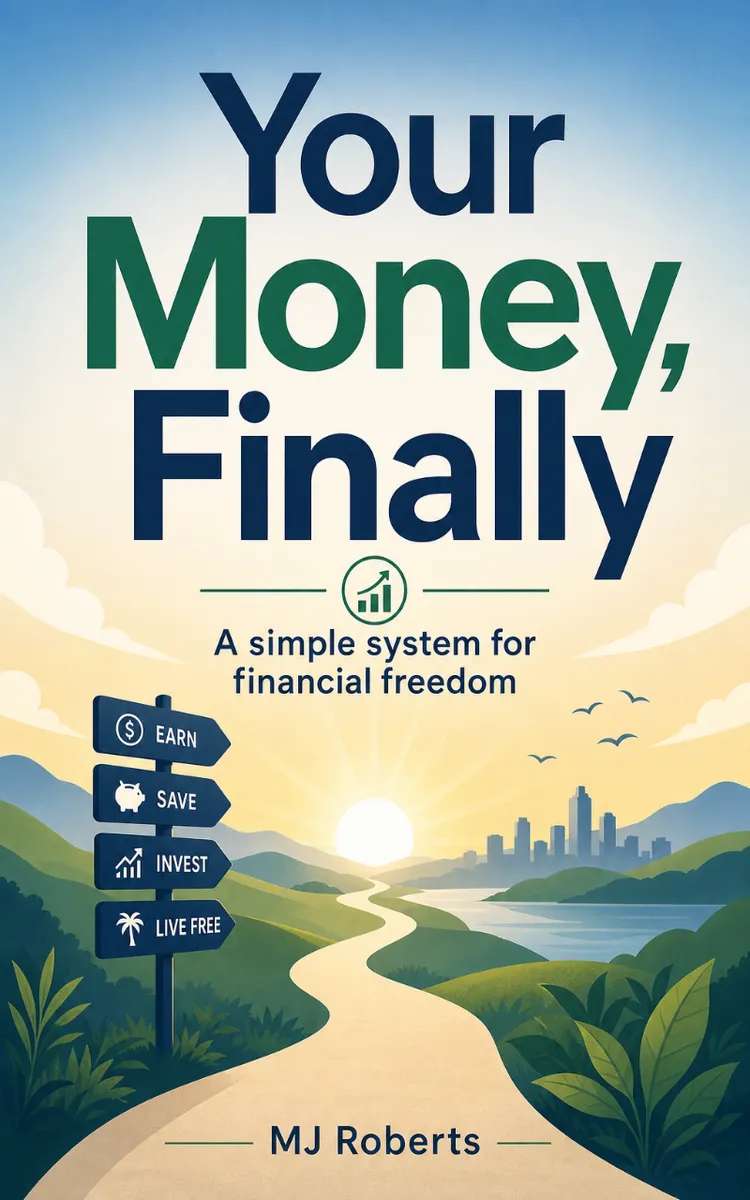
"Your Money, Finally" is a finance book by MJ Roberts with 8 chapters and approximately 13,690 words. Personal finance system for achieving financial freedom.
This book was created using Inkfluence AI, an AI-powered book generation platform that helps authors write, design, and publish complete books. It was made with the AI Ebook Generator.
Frequently Asked Questions
What is "Your Money, Finally" about?
Personal finance system for achieving financial freedom
How many chapters are in "Your Money, Finally"?
The book contains 8 chapters and approximately 13,690 words. Topics covered include The Money Snapshot and Baseline, Build Your Budget Buckets, Set a Cash-Flow Calendar, Create Your Emergency Fund Plan, and more.
Who wrote "Your Money, Finally"?
This book was written by MJ Roberts and created using Inkfluence AI, an AI book generation platform that helps authors write, design, and publish books.
How can I create a similar finance book?
You can create your own finance book using Inkfluence AI. Describe your idea, choose your style, and the AI writes the full book for you. It's free to start.
Write your own finance book with AI
Describe your idea and Inkfluence writes the whole thing. Free to start.
Start writingCreated with Inkfluence AI


