
Read the first chapter
The whole of chapter one, free. About 6 min. Turn the pages with the arrows, your keyboard, or a swipe.
Chapter 1
Recognize Narcissistic Patterns Early
The Moment You Realize the Conversation Has Changed
You’re halfway through a normal conversation when the air shifts. You ask a simple question about a missed deadline, a shared expense, or a promise that wasn’t kept. Instead of answering, the other person says you’re attacking them. Suddenly, you’re defending your tone, explaining your intentions, and apologizing for bringing it up.
Later, you replay the exchange while washing dishes or driving home. You know something went wrong, but you can’t quite name it. The original issue has vanished. What remains is the tight chest, the mental fog, and the familiar urge to make peace quickly - even if you did nothing wrong.
The earlier you recognize the pattern, the less power it has to hijack you.
From Explaining Yourself to Reading the Pattern
Old Belief: If I stay calm, explain myself clearly, and show enough patience, the conversation will become reasonable.
New Reality: A repeated pattern matters more than a single conversation, and recognizing it early gives you choices before your emotions take over.
This shift matters because narcissistic behavior often pulls you into the wrong question. You start asking, “How can I prove I’m not the problem?” The better question is, “What just happened, and have I seen this sequence before?”
A person can have a bad day. They can misunderstand you, react sharply, or forget something. That alone doesn’t tell you much. The warning sign is repetition: they avoid responsibility, turn the focus onto your character, demand special treatment, or punish you when you hold a reasonable boundary.
Take a workplace example. You ask a business partner why a customer order wasn’t completed. They respond, “You always make me look incompetent.” You explain that you’re only discussing the order. They accuse you of being controlling. You soften your words, apologize, and finish the task yourself. The next week, the same thing happens.
The problem isn’t that you failed to explain yourself well enough. The pattern is doing its job: moving attention away from their behavior and placing you on trial. Once you can spot that move, you don’t have to chase the conversation into endless explanations.
The Pattern Radar Checklist helps you notice three things: what happened, how the person redirected the moment, and what happened inside you. That last part matters. Your emotional response is often an early alarm, not proof that you’re wrong.
How the Pattern Radar Works Before You’re Hijacked
Early signals are usually small. A sudden accusation. A compliment followed by a demand. A story that changes when responsibility appears. A warm conversation that turns cold the moment you say no.
Narcissistic patterns gain strength when you respond automatically. You rush to defend yourself, calm the other person, fix the problem, or earn back their approval. That reaction is understandable. Your nervous system is trying to end the tension. But ending tension isn’t the same as solving the problem.
Use the Pattern Radar Checklist after a difficult interaction. Don’t diagnose the person. Track the behavior.
Signs this pattern is running your life
1. You leave ordinary conversations feeling guilty or confused. You raised one practical issue, but you’re now apologizing for your personality, your tone, or your entire history together.
2. You prepare every sentence to avoid a reaction. You rehearse how to ask for payment, time, help, or accountability because you expect the request to become a personal attack.
3. You keep fixing consequences you didn’t create. At work, you finish their incomplete task. At home, you smooth things over with the children, customers, relatives, or friends.
4. You trust their mood more than your own memory. If they’re pleased, you feel safe. If they’re angry, you assume you must have done something wrong - even when the facts haven’t changed.
The Pattern Radar Checklist turns emotional fog into observable information.
Start with three quick notes:
• Event: What happened in plain, factual language? - Redirect: How did the conversation move away from the original issue? - Impact: What did you feel compelled to do next?
For example: “The invoice was three weeks late. When I asked about it, he called me disloyal. I felt pressured to apologize and drop the subject.” That record is more useful than writing, “I had another awful conversation.” It shows the sequence.
You’re not collecting evidence to win an argument. You’re building enough clarity to choose your next response. A pattern becomes easier to manage when you can see it before it reaches full volume.
Questions That Help You Catch the First Signal
1. What was the original issue before the conversation became about me? Write one sentence without describing anyone’s personality. “The schedule changed without notice” is clearer than “They were being impossible.”
2. What did I feel pressured to do within the first few minutes? Did you want to apologize, explain, agree, withdraw, or fix something immediately? That impulse can reveal the hook being used.
3. Does this person respond to facts, or do they turn facts into an attack on my character? A healthy disagreement may be uncomfortable, but it can still return to the subject. A repeated character attack keeps you defending yourself instead.
4. What happens when I say no to a small, reasonable request? Try looking at the last three examples. Did they accept the limit, negotiate respectfully, punish you, mock you, or act as though you had betrayed them?
5. What would I notice if I trusted the pattern instead of the promise? Promises can be moving, especially after conflict. Compare them with repeated behavior over the last month. The gap often tells you what words hide.
Answer these privately, and be specific. You don’t need a dramatic conclusion. “I notice I become responsible for their feelings whenever I raise a concern” is already a powerful piece of clarity.
If you work with customers, staff, or relatives, keep your notes somewhere private. A dated phone note with three short lines can protect your memory when a later conversation makes you question what happened.
Your Seven-Day Pattern Radar Challenge
Challenge: Track the First Five Minutes
For the next seven days, use the Pattern Radar Checklist after any interaction that leaves you tense, confused, guilty, or unusually eager to repair the relationship.
• Record the date and setting. - Write the original issue in one factual sentence. - Note the first redirect, accusation, demand, or sudden mood change. - Name your immediate impulse: defend, apologize, fix, explain, agree, or escape. - Write one response you could use next time, such as: “I’m willing to discuss the invoice, but not insults,” or “I’ll answer the question when we return to the schedule.” - Wait at least ten minutes before sending a long explanation or apology.
Difficulty: Medium
The challenge may feel harder than it sounds because you’re interrupting an old reflex. You may want to make the discomfort disappear immediately. Let the record hold the discomfort for a little while instead.
You’ll know it’s working when...
• You can name the original issue without adding a long defense. - You notice the redirect while it’s happening. - You pause before apologizing automatically. - You see repeated behavior across different conversations. - You choose shorter, calmer responses. - You feel less responsible for managing another adult’s reaction.
The goal isn’t to become suspicious of every difficult person. It’s to stop treating every emotional reaction as an emergency. A clear pattern gives you room to respond instead of react.
See the Signal, Keep Your Center
The earlier you name the pattern, the less you have to recover from it.
You learned to:
• Separate a single bad moment from a repeated behavior pattern. - Notice when a practical issue is redirected into an attack on your character. - Use the Pattern Radar Checklist: Event, Redirect, and Impact. - Track your first impulse before it turns into automatic apologizing or fixing. - Create a short pause between the other person’s reaction and your response.
You don’t need perfect certainty before taking your own experience seriously. Start with what you can observe. The next step is learning how to respond when the pattern appears - without feeding the argument, surrendering your boundary, or abandoning yourself to keep the peace.
End of chapter one. 19 more chapters in the full book.
Swipe or use the arrows to turn the page


What's inside: 20 chapters
- 1. Recognize Narcissistic Patterns Early
- 2. Separate Your Worth From Their Image
- 3. Audit Your Beliefs About Conflict
- 4. Choose Your Values Before You React
- 5. Stop the Approval-Seeking Loop
- 6. Set Boundaries Without Needing Permission
- 7. Use the Calm-Anchor Communication Method
- 8. Handle Gaslighting With the Reality Log
- 9. De-escalate Triangles and Blame Games
- 10. Build a Work-First Strategy for Meetings
- 11. Create Evidence Trails for Accountability
- 12. Respond to Criticism Without Self-Abandonment
- 13. Stop Rewarding Performative Apologies
- 14. Manage Hoovering With the No-Engagement Rule
- 15. Protect Your Energy With Micro-Recovery Rituals
- 16. Practice Assertive Requests That Hold Firm
- 17. Rebuild Trust in Yourself After Manipulation
- 18. Create a Safe Exit Plan When Needed
- 19. Turn Boundaries Into Long-Term Peace
- 20. Choose Purpose Over Proving Yourself
About this book
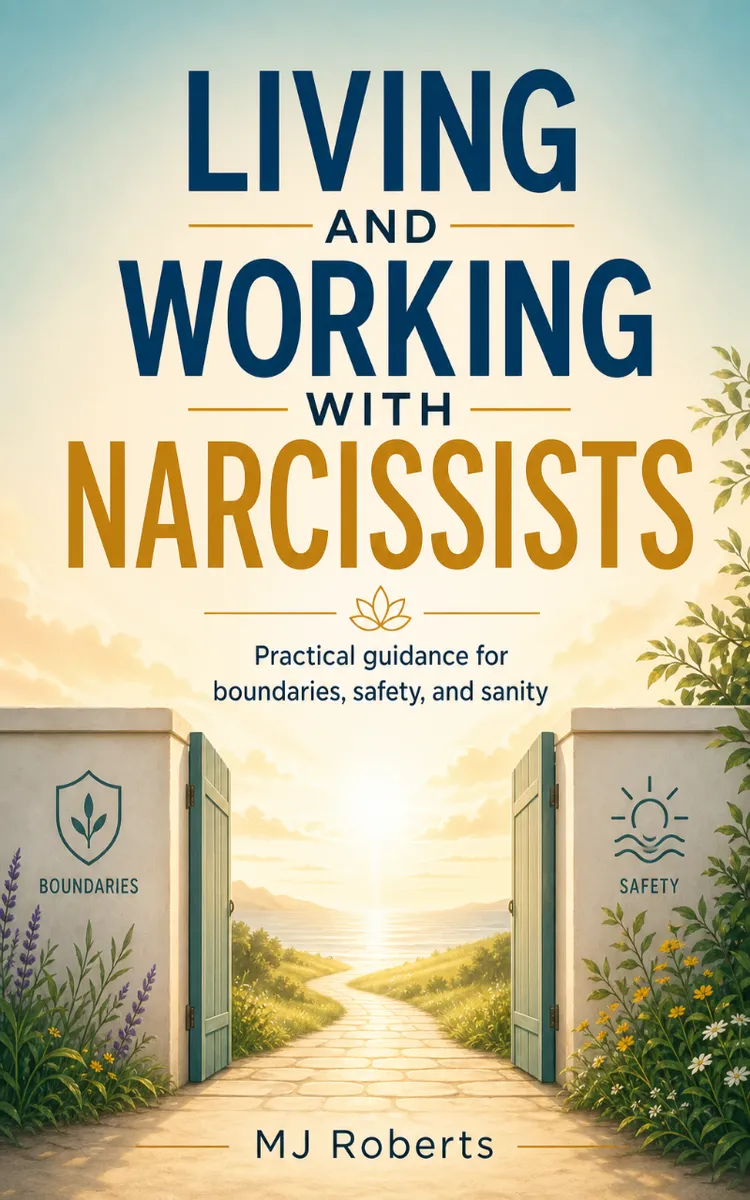
"Living And Working With Narcissists" is a self-help book by MJ Roberts with 20 chapters and approximately 29,038 words. Strategies for managing relationships and work with narcissistic people.
This book was created using Inkfluence AI, an AI-powered book generation platform that helps authors write, design, and publish complete books. It was made with the AI Self-Help Book Writer.
Frequently Asked Questions
What is "Living And Working With Narcissists" about?
Strategies for managing relationships and work with narcissistic people
How many chapters are in "Living And Working With Narcissists"?
The book contains 20 chapters and approximately 29,038 words. Topics covered include Recognize Narcissistic Patterns Early, Separate Your Worth From Their Image, Audit Your Beliefs About Conflict, Choose Your Values Before You React, and more.
Who wrote "Living And Working With Narcissists"?
This book was written by MJ Roberts and created using Inkfluence AI, an AI book generation platform that helps authors write, design, and publish books.
How can I create a similar self-help book?
You can create your own self-help book using Inkfluence AI. Describe your idea, choose your style, and the AI writes the full book for you. It's free to start.
Write your own self-help book with AI
Describe your idea and Inkfluence writes the whole thing. Free to start.
Start writingCreated with Inkfluence AI


