
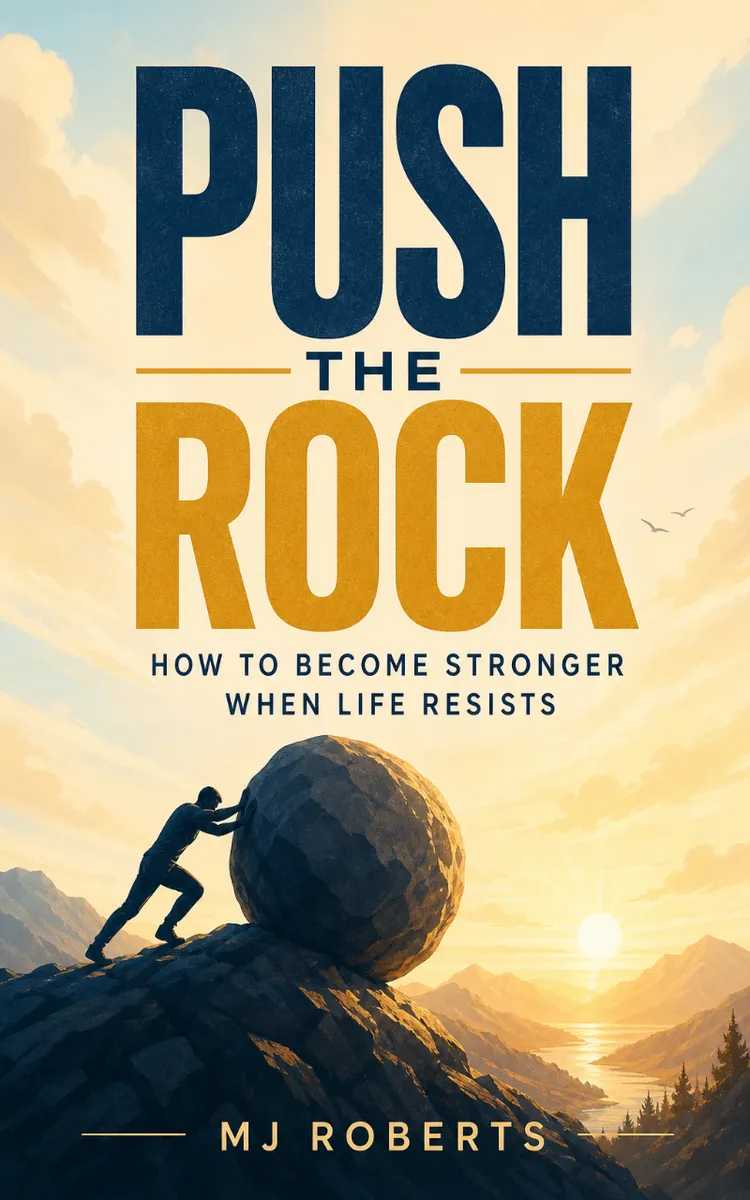
Read the first chapter
The whole of chapter one, free. About 7 min. Turn the pages with the arrows, your keyboard, or a swipe.
Chapter 1
Adopting a Stronger Identity
When the Rock Doesn’t Move
At 6:12 on a wet Tuesday morning, a shop owner stood outside his locked business with a ring of keys in one hand and a past-due notice in the other. The sign in the window still promised, “Back in ten minutes.” He’d been saying that for three years. The broken freezer, the slow season, the employee who quit without warning - none of it had waited for him to feel ready.
He stared through the glass at the dark counter and heard the sentence that had become almost automatic: I can’t keep doing this. Maybe you know that sentence. It shows up when the bills stack up, when your body won’t cooperate, when the same family problem returns for the hundredth time, or when you’ve pushed hard and the rock still hasn’t moved an inch.
The danger isn’t admitting that life is hard. The danger is letting a hard season tell you who you are.
When life refuses to move, will you let it rename you - or will you practice becoming stronger?
From “I Can’t” to “This Is Who I Am Becoming”
Old Belief: If I can’t change the situation, I can’t change anything.
New Reality: I may not control the situation today, but I can practice the identity that carries me through it.
That shift sounds small. It isn’t. “I can’t” often begins as an honest report about a problem. Then, through repetition, it turns into a verdict about you. The unpaid invoice becomes I’m failing. The diagnosis becomes I’m helpless. The stalled business becomes I’m not cut out for this. A temporary limit quietly puts on a permanent name tag.
The stronger identity doesn’t pretend the limit isn’t real. It doesn’t slap a smile over exhaustion and call that courage. It says, “This is hard. I’m disappointed. I don’t know how this ends. But I’m still the kind of person who takes the next responsible step.”
That’s the Identity Rehearsal Loop: notice the old sentence, replace it with a chosen identity, then prove that identity with one small action. The action doesn’t need to fix the whole mountain. It needs to give your mind evidence.
Take the shop owner outside the locked business. He couldn’t create customers that morning. He couldn’t erase the notice. But he could unlock the door, call the supplier, review the day’s numbers, and decide not to hide. “I can’t save everything today” may have been true. “I’m a person who faces the next fact instead of running from it” was also true - and he could practice it before breakfast.
Your identity grows in the direction of your repeated behavior. Not your intentions. Not the speech you give yourself in the shower. The behavior.
The Identity Rehearsal Loop in the Hard Season
When “I can’t” takes over, your mind is usually trying to protect you from another disappointment. If success feels impossible, lowering your effort can feel safer. If you decide you’re powerless, you no longer have to risk trying and failing. The sentence offers relief for a moment.
Then it charges interest.
A resilient identity gives you a different place to stand. You stop asking, “How do I force life to cooperate?” and start asking, “Who do I choose to be while it doesn’t?” That question returns power to the part of the situation that still belongs to you: your words, your attention, your next action, and your willingness to repeat them tomorrow.
You’ll know the old pattern is running your life when:
1. You use one difficult event to describe your entire future. A rough month becomes “Nothing ever works for me.” The brain loves a sweeping conclusion because it saves energy, but it also locks the door on options.
2. You wait to feel confident before acting. You tell yourself you’ll make the call, start the repair, or return to the gym once you feel ready. Confidence usually arrives after a few kept promises, not before them.
3. You treat a setback as proof of character. Missing a payment plan or losing your temper may require repair. It doesn’t prove you’re broken. It proves there’s something to face and practice.
4. You keep repeating the same label without testing it. “I’m bad with money.” “I’m unreliable.” “I can’t handle pressure.” A label becomes powerful when it goes unchallenged.
Your Identity Gets Stronger When You Give It Evidence
The Identity Rehearsal Loop is simple: catch the old identity, choose the stronger one, and act it out before your feelings agree.
You might catch, “I can’t have this conversation.” Choose, “I’m a person who tells the truth with respect.” Then send the message, make the call, or sit at the table for ten minutes. That action may feel clumsy. Good. Rehearsal is supposed to feel less natural before it becomes natural.
Don’t choose an identity that sounds impressive but gives you no handle. “I’m unstoppable” can collapse the first time something stops you. Try “I’m someone who returns to the work” or “I’m someone who asks for help before the crisis gets bigger.” These identities are sturdy because they can be practiced on ordinary days, not just dramatic ones.
Questions That Put Your Identity Back in Your Hands
1. What exact sentence follows “I can’t” most often in this season? Write the sentence word for word. “I can’t keep up,” “I can’t trust myself,” or “I can’t make enough money” gives you something real to work with instead of a vague cloud of discouragement.
2. What identity is hidden inside that sentence? “I can’t keep up” may be carrying the belief, “I’m always behind.” Naming the hidden label helps you separate a current struggle from a permanent definition.
3. What stronger identity would be honest enough to believe and specific enough to practice? Try “I’m a person who handles one priority before chasing five” rather than “I’m perfectly organized.” The first one can guide your next hour.
4. What action would give that identity evidence before noon today? If you’re practicing “I face facts,” open the account statement. If you’re practicing “I keep promises to my body,” take a ten-minute walk. Make the action small enough that excuses have nowhere to hide.
5. Where are you demanding proof that the whole situation will improve before you take the next step? You may not need certainty to act. You may only need enough courage to make one call, wash one load, write one paragraph, or tell one honest truth.
Answer without polishing. The goal isn’t to sound strong on paper. The goal is to find the sentence you can carry when the day gets heavy. A resilient identity should fit in your mouth during a bad morning.
The Seven-Day Identity Rehearsal
Challenge: Replace the Sentence, Prove the Identity
For the next seven days, don’t try to solve your entire life. Train one identity instead.
• Choose one identity statement that matches the person you need to become. Use this format: “I’m a person who ______.” Examples: “I’m a person who returns to the task,” “I’m a person who faces the next fact,” or “I’m a person who asks for help early.” - Keep a note on your phone titled Identity Rehearsal. - Each morning, write the old “I can’t” sentence you expect to hear that day. - Write your replacement identity directly beneath it. - Before the day ends, take one visible action that supports the replacement identity. - Record what you did in one plain sentence. No essays. No courtroom defense. - At night, answer: “What did today prove about who I’m becoming?”
Difficulty: Medium
You’ll know it’s working when:
• You catch “I can’t” earlier, before it becomes a full-day mood. - Your replacement identity sounds more believable because you’ve acted on it. - You recover faster after missing a step. - You begin asking, “What would my chosen identity do next?” - One small action happens even when the larger problem remains unsolved.
Some days, the action will be unimpressive. You’ll wash the dishes, make the call, walk around the block, or write the first three lines. Don’t dismiss those moments. A bridge is built from pieces too small to admire individually.
The point isn’t to perform strength for seven days. It’s to teach your mind that “I can’t” is a sentence you can question - not a command you must obey.
You Are More Than the Rock in Front of You
You don’t become resilient by waiting for life to get lighter; you become resilient by repeatedly practicing who you are while carrying the weight.
• “I can’t” may describe a real limit, but it doesn’t have to define your identity. - The Identity Rehearsal Loop turns a chosen identity into evidence through repeated action. - Strong identities are honest, specific, and practical enough to use on difficult days. - One small action can challenge a permanent label and reopen the next step.
The rock may still be there tomorrow. That doesn’t mean today was wasted. Every time you catch the old sentence, choose a stronger one, and act before you feel ready, you add strength to the person doing the pushing. Soon, the question won’t be whether you can move everything at once. It will be whether you’re willing to keep becoming the kind of person who can meet what comes next.
End of chapter one. 7 more chapters in the full book.
Swipe or use the arrows to turn the page


What's inside: 8 chapters
- 1. Adopting a Stronger Identity
- 2. Challenging the Stories That Freeze You
- 3. Building Boundaries Without Guilt
- 4. Designing Micro-Habits for Stuck Days
- 5. Practicing Self-Compassion That Moves You
- 6. Communicating Needs Under Pressure
- 7. Rebuilding Resilience After Setbacks
- 8. Finding Purpose in the Unmoving Season
About this book
"Push The Rock" is a self-help book by MJ Roberts with 8 chapters and approximately 12,249 words. Resilience and personal growth through adversity.
This book was created using Inkfluence AI, an AI-powered book generation platform that helps authors write, design, and publish complete books. It was made with the AI Self-Help Book Writer.
Frequently Asked Questions
What is "Push The Rock" about?
Resilience and personal growth through adversity
How many chapters are in "Push The Rock"?
The book contains 8 chapters and approximately 12,249 words. Topics covered include Adopting a Stronger Identity, Challenging the Stories That Freeze You, Building Boundaries Without Guilt, Designing Micro-Habits for Stuck Days, and more.
Who wrote "Push The Rock"?
This book was written by MJ Roberts and created using Inkfluence AI, an AI book generation platform that helps authors write, design, and publish books.
How can I create a similar self-help book?
You can create your own self-help book using Inkfluence AI. Describe your idea, choose your style, and the AI writes the full book for you. It's free to start.
Write your own self-help book with AI
Describe your idea and Inkfluence writes the whole thing. Free to start.
Start writingCreated with Inkfluence AI


