

Read the first chapter
The whole of chapter one, free. About 6 min. Turn the pages with the arrows, your keyboard, or a swipe.
Chapter 1
Warm-Up Reset (Weeks 1-2)
Phase Overview
Your first work task starts before your first workout: you stand up from a chair, breathe shallowly, and discover that your hips, shoulders, and ankles feel stiff. The Warm-Up Reset (Weeks 1-2) gives you a repeatable way to shift from screen time into movement without wasting energy. The goal is not to get tired during the warm-up; it is to raise body temperature, prepare the joints, and leave you ready for the main session.
Use the 5-5-5 Reset Protocol before every workout: five minutes, five breathing cycles, and five controlled joint-prep movements. Nadia, a 34-year-old remote customer-support lead, uses it after long blocks of calls because it gives her a clear stop between work mode and training mode. During these first two weeks, keep every movement smooth and finish feeling more mobile than when you started.
Workouts
Complete three reset sessions each week, ideally on Monday, Wednesday, and Friday. The sessions are short and consistent rather than demanding. Keep a timer, a stable chair or desk, and a small towel nearby. Wear shoes if your floor is slippery, and keep enough space to extend both arms without touching furniture.
The first five minutes are the general reset. Move continuously but easily. Use the table below before each workout.
| Exercise | Sets × Reps | Load | Rest | | --- | --- | --- | --- | | Easy march in place | 1 × 60 seconds | Body weight | None | | Step-touch with arm swing | 1 × 60 seconds | Body weight | None | | Heel raise with reach | 1 × 10 | Body weight | None | | Alternating knee lift | 1 × 10 per side | Body weight | None | | Easy march with nasal breathing | 1 × 60 seconds | Body weight | None |
Keep the first minute deliberately easy. Let your arms swing naturally and allow your breathing to settle. During the step-touch, stay light on your feet rather than reaching for speed. The heel raises warm the calves and ankles, while the knee lifts begin moving the hips through a comfortable range. The final minute is your check-in: you should feel warmer, but you should still be able to speak a full sentence.
After the five-minute general reset, perform five slow breathing cycles. Stand tall with your feet about hip-width apart, or sit upright if standing is uncomfortable. Breathe in through your nose for a count of four, then breathe out gently for a count of six. That is one cycle. Do not force a huge inhale or hold your breath. The longer exhale helps reduce rushed breathing before you begin the strength work.
Next, complete the joint-prep circuit. Perform it once in Week 1 and twice in Week 2. Rest only as needed between movements. The load for every exercise is body weight unless the table says otherwise.
| Exercise | Sets × Reps | Load | Rest | | --- | --- | --- | --- | | Neck turn, slow | 1 × 5 per side | Body weight | 10 seconds | | Shoulder circle | 1 × 8 forward and 8 backward | Body weight | 10 seconds | | Wall slide | 1 × 8 | Body weight | 15 seconds | | Standing trunk rotation | 1 × 6 per side | Body weight | 15 seconds | | Hip hinge reach | 1 × 8 | Body weight | 15 seconds | | Supported reverse lunge | 1 × 5 per side | Body weight | 20 seconds | | Ankle knee-to-wall rock | 1 × 8 per side | Body weight | 20 seconds | | Deep squat hold with support | 1 × 20 seconds | Body weight | 30 seconds |
For the neck turns, keep your chin level and turn only as far as feels easy. The wall slide prepares the upper back and shoulders for pressing, rowing, and overhead work; keep your ribs from flaring as your hands travel upward. During the standing trunk rotation, rotate from the upper back while keeping your hips mostly facing forward.
The hip hinge reach teaches your body to fold at the hips instead of rounding your lower back. Place one hand on a desk if balance is limited. For the supported reverse lunge, hold the desk lightly, step back, bend both knees, and return by pushing through the front foot. The ankle rock should be slow enough that your heel stays down. Use the chair or desk for the deep squat hold, and stop before your heels lift or your back collapses.
Week 1 is about learning the sequence. Complete the five-minute reset, five breathing cycles, and one joint-prep circuit before each of your three workouts. Use a range of motion you can control, and stop one or two repetitions before discomfort changes your form. If a movement produces sharp pain, skip it and use the nearest pain-free option, such as a smaller lunge or a shorter squat hold.
Week 2 keeps the same order but adds a second joint-prep circuit. Do not add speed or heavy loading at the same time. If the first round made you feel loose and alert, repeat it with the same smooth tempo. If your breathing is still hurried or your joints feel irritated, remain with one round for that day. Progression means being more prepared, not doing more for its own sake.
Use the following progression guide across the two weeks:
| Week | General reset | Breathing | Joint prep | Readiness target | | --- | --- | --- | --- | --- | | 1 | 5 minutes | 5 cycles, 4-second inhale and 6-second exhale | 1 circuit | Warm, mobile, calm breathing | | 2 | 5 minutes | 5 cycles, same breathing counts | 2 circuits if form stays steady | Ready to train without stiffness |
Before moving to the main workout, ask yourself three questions: Can I breathe through my nose for several repetitions? Can I move the joints without pinching or sharp pain? Do I feel more awake than when I began? If the answer is yes, the reset has done its job. If not, take another minute of easy marching rather than forcing the next exercise.
Training Notes
Treat the reset as a routine, not a test. Starting at the same place in your home makes it easier to begin: clear a small area near your desk, place your towel there, and set a five-minute timer. Nadia keeps her timer beside her keyboard so the transition from her final support call to training does not depend on remembering every step.
Use the breathing cue throughout the warm-up: inhale quietly through the nose, then make the exhale longer and relaxed. When a movement becomes difficult, reduce the range before holding your breath. A useful check is to say a short sentence after the joint-prep circuit. If you cannot speak comfortably, slow the marching or take a longer rest.
The most common mistake is turning preparation into conditioning. Fast knee lifts, deep forced stretches, and large shoulder circles can make you tired before the main workout. Keep the effort around a four out of ten: active enough to feel warm, easy enough to stay precise. Another common mistake is rushing through the joints that feel stiff. Spend an extra breath at the end of the available range, but never bounce or push into pain.
Desk posture can also change how the reset feels. If your shoulders have been raised during calls, make the shoulder circles smaller and focus on lowering them away from your ears. If sitting has made your hips feel tight, use the desk for support during the hinge and lunge rather than trying to match a deep range immediately. The correct range is the one you can repeat without compensation.
For Weeks 1-2, record only three details after each session: the warm-up duration, whether breathing felt controlled, and the stiffest joint before and after. This takes less than a minute and gives you useful feedback. A successful reset may look simple on paper, but its result is clear: you begin the workout warmer, steadier, and more prepared than when you left your desk. Carry that readiness into the main training, one consistent start at a time.
End of chapter one. 9 more chapters in the full book.
Swipe or use the arrows to turn the page

Courage Under Pressure: A Daily Devotional for First Responders

Faith While They're Away: A Daily Devotional for Military Families

Lessons from the Garden: A Daily Devotional
What's inside: 10 chapters
- 1. Warm-Up Reset (Weeks 1-2)
- 2. Foundation Strength (Weeks 3-4)
- 3. Posture Power (Weeks 5-6)
- 4. Cardio Without Equipment (Weeks 7-8)
- 5. Hypertrophy Tempo (Weeks 9-10)
- 6. Core That Holds Up (Weeks 11-12)
- 7. Strength Peak Sets (Weeks 13-14)
- 8. MetCon Energy Builder (Weeks 15-16)
- 9. Deload and Reset (Weeks 17-18)
- 10. Final Push and Fit Check (Weeks 19-20)
About this book
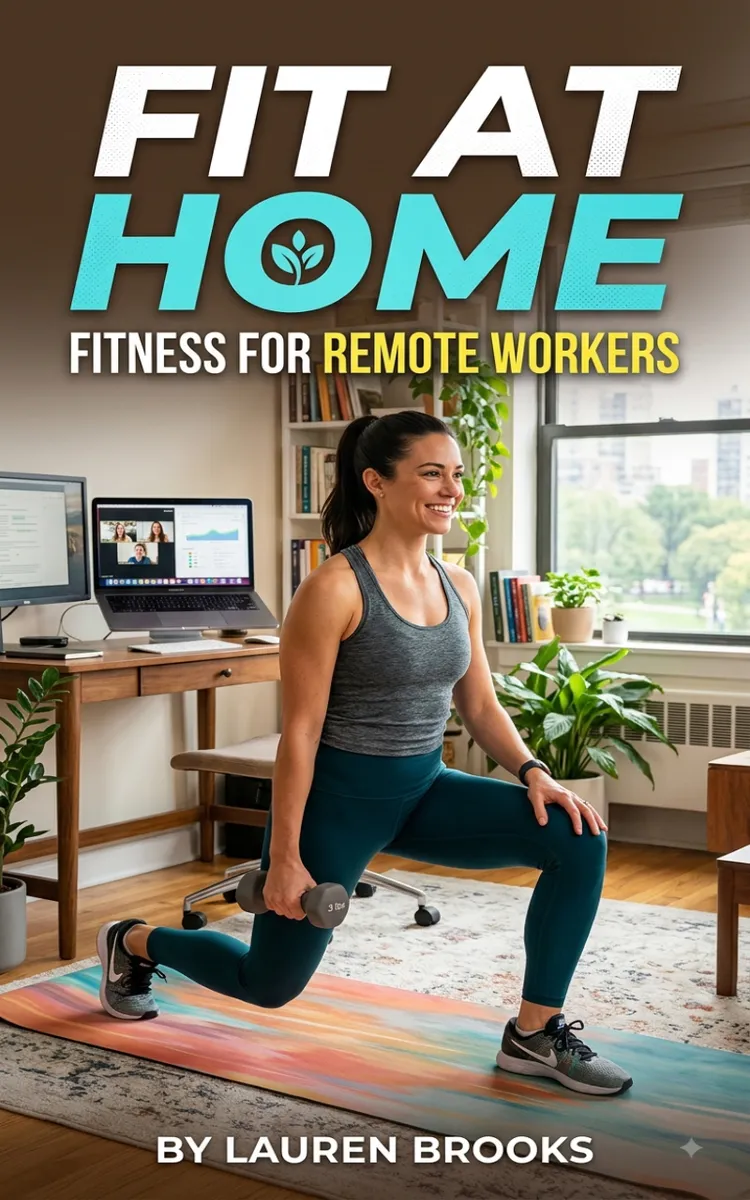
"Fit at Home: Fitness for Remote Workers" is a fitness book by Grace Whitmore with 10 chapters and approximately 17,920 words. Home fitness routines tailored for remote workers.
This book was created using Inkfluence AI, an AI-powered book generation platform that helps authors write, design, and publish complete books. It was made with the AI Workout Plan Generator.
Frequently Asked Questions
What is "Fit at Home: Fitness for Remote Workers" about?
Home fitness routines tailored for remote workers
How many chapters are in "Fit at Home: Fitness for Remote Workers"?
The book contains 10 chapters and approximately 17,920 words. Topics covered include Warm-Up Reset (Weeks 1-2), Foundation Strength (Weeks 3-4), Posture Power (Weeks 5-6), Cardio Without Equipment (Weeks 7-8), and more.
Who wrote "Fit at Home: Fitness for Remote Workers"?
This book was written by Grace Whitmore and created using Inkfluence AI, an AI book generation platform that helps authors write, design, and publish books.
How can I create a similar fitness book?
You can create your own fitness book using Inkfluence AI. Describe your idea, choose your style, and the AI writes the full book for you. It's free to start.
Write your own fitness book with AI
Describe your idea and Inkfluence writes the whole thing. Free to start.
Start writingCreated with Inkfluence AI


