

Read the first chapter
The whole of chapter one, free. About 4 min. Turn the pages with the arrows, your keyboard, or a swipe.
Chapter 1
Day 1: The Call to Courage
Scripture Focus
Joshua 1:9
> Have I not commanded you? Be strong and courageous. Do not be afraid; do not be discouraged, for the Lord your God will be with you wherever you go.
God’s call to courage begins before the alarm sounds, because His presence - not your adrenaline - is the foundation of your response.
A first responder often meets fear before meeting the scene: the tone of the dispatch, the address on the screen, the silence in the rig, or the split second when a familiar situation suddenly changes. Courage doesn’t mean you feel nothing. It means you remember who you are and who is with you while you act.
Reflection
Joshua received this command at a turning point. Moses was gone, and Joshua had to lead people into an uncertain future. God didn’t pretend the assignment would be easy. He didn’t tell Joshua that strong feelings would disappear. Instead, He gave Joshua something steadier than confidence in his own ability: the promise of God’s presence.
That matters when your work places you close to pain, danger, and decisions that can’t be postponed. You may be a firefighter entering a smoke-filled structure, a paramedic kneeling beside a patient, a police officer approaching a tense call, or a dispatcher carrying someone’s fear through a headset. Your training matters. Your equipment matters. Your partner matters. But your deepest identity isn’t determined by the worst call of the shift or by whether you handled every detail perfectly. You are called to serve, but you are held by God.
Fear can narrow your vision. It may pull your attention toward everything that could go wrong: a missed symptom, an unstable building, a hidden weapon, a family member’s panic, or the possibility that the outcome won’t be what you hoped. Scripture doesn’t ask you to deny those realities. It invites you to place them in a larger reality: God is with you wherever you go.
That promise also protects you from confusing courage with recklessness. Courage isn’t ignoring procedure or proving that you’re tougher than the situation. It may look like slowing down long enough to check your air supply, asking for another unit, speaking calmly to someone who is frightened, or admitting after a call that you need support. A calling greater than fear doesn’t make you invincible. It makes you available to do the next faithful thing.
Your identity, then, begins before the uniform, badge, radio, or medical bag. Those are meaningful tools, but they aren’t the source of your worth. God’s purpose is larger than a job title. He has placed you in a position to protect life, bring order into confusion, offer mercy, and serve people who may be having the worst day of their lives. Some calls will end with relief. Others will leave questions that follow you home. In both, God’s presence remains.
When pressure rises, try returning to one simple phrase: “I am here to serve, and God is here with me.” It isn’t a slogan meant to erase fear. It’s a truth meant to steady you inside it. You can breathe, assess, communicate, and act without letting fear become your commander.
Practice for Today
1. Name your calling before your role. Take two quiet minutes before your shift, or before your next responsibility, and write this sentence: “God, You have placed me here to serve by…” Complete it with specific words. You might write, “protecting vulnerable people,” “bringing calm to emergencies,” “treating each person with dignity,” or “helping my team make wise decisions.” Keep the sentence practical. Your calling becomes easier to remember when you can say it plainly.
2. Use a three-breath courage prayer. Before entering a difficult scene, receiving a challenging call, or making a high-pressure decision, take three deliberate breaths. With the first breath, pray, “God, You are with me.” With the second, pray, “Keep me clear and steady.” With the third, pray, “Show me the next faithful step.” Then follow your training and your safety procedures. This prayer isn’t a substitute for preparation; it helps bring your heart into the same moment as your body.
3. Journal about fear without giving it the final word. At the end of the day, write about one moment when fear showed up. What did it make you notice? How did it affect your words, pace, or decisions? Then answer this question: “Where did I see God’s purpose or presence in that moment?” Be specific. Maybe a partner caught a detail you missed. Maybe you found the patience to listen. Maybe you recognized that asking for help was the wisest action. The goal isn’t to grade yourself. It’s to notice how God met you while you served.
Courage grows through repeated choices. It may be the choice to pray before the radio crackles, to keep compassion in your voice, or to trust that your value isn’t measured by controlling the outcome. You don’t need to manufacture a heroic feeling. You need to remember your calling and take the next faithful step.
Closing Prayer
God, You know the pressure I carry and the fears I don’t always name. Anchor my identity in Your purpose today. Help me serve with courage, wisdom, and compassion. When I feel overwhelmed, remind me that I’m not alone. Keep me safe, guide my decisions, and make me a steady presence for the people I’m called to help. Amen.
End of chapter one. 29 more chapters in the full book.
Swipe or use the arrows to turn the page

Fit at Home: Fitness for Remote Workers

Faith While They're Away: A Daily Devotional for Military Families

Lessons from the Garden: A Daily Devotional
What's inside: 30 chapters
- 1. Day 1: The Call to Courage
- 2. Day 2: When Pressure Speaks Louder Than Peace
- 3. Day 3: Trusting the God Who Sees
- 4. Day 4: Prayer Before Problem-Solving
- 5. Day 5: God’s Strength in Your Weakness
- 6. Day 6: The Peace That Guards Your Mind
- 7. Day 7: Rest for the Responders
- 8. Day 8: Hope That Doesn’t Deny Reality
- 9. Day 9: Surrendering the Outcome
- 10. Day 10: Courage for the Waiting
- 11. Day 11: Obedience in Small Steps
- 12. Day 12: The Presence of God on the Scene
- 13. Day 13: When Fear Tries to Lead
- 14. Day 14: Prayer That Breathes Through You
- 15. Day 15: Courage to Speak Truth with Love
- 16. Day 16: Faithful When You’re Not in Charge
- 17. Day 17: The Strength to Keep Showing Up
- 18. Day 18: Healing for the Aftermath
- 19. Day 19: Surrendering Your Reputation
- 20. Day 20: Hope for the Hard Conversations
- 21. Day 21: God’s Wisdom for Decisions Under Stress
- 22. Day 22: Courage to Forgive and Release
- 23. Day 23: The Team That Prays Together
- 24. Day 24: When You Feel Unqualified
- 25. Day 25: Surrendering Control of Your Schedule
- 26. Day 26: The Discipline of Gratitude
- 27. Day 27: Courage to Hope Again
- 28. Day 28: Living with Eternal Perspective
- 29. Day 29: Steadfast to the End of the Shift
- 30. Day 30: Courage Under Pressure-A Lifelong Practice
About this book
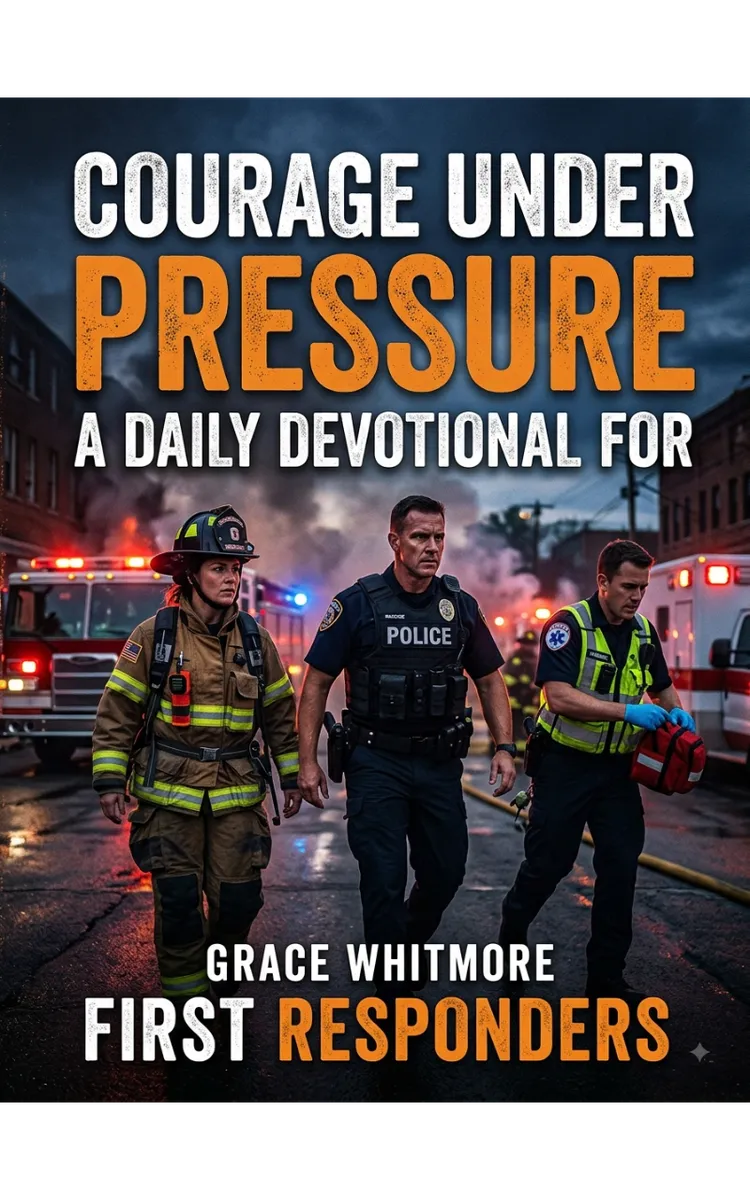
"Courage Under Pressure: A Daily Devotional for First Responders" is a religious devotional book by Grace Whitmore with 30 chapters and approximately 27,625 words. Daily devotional for first responders facing high-pressure situations.
This book was created using Inkfluence AI, an AI-powered book generation platform that helps authors write, design, and publish complete books.
Frequently Asked Questions
What is "Courage Under Pressure: A Daily Devotional for First Responders" about?
Daily devotional for first responders facing high-pressure situations
How many chapters are in "Courage Under Pressure: A Daily Devotional for First Responders"?
The book contains 30 chapters and approximately 27,625 words. Topics covered include Day 1: The Call to Courage, Day 2: When Pressure Speaks Louder Than Peace, Day 3: Trusting the God Who Sees, Day 4: Prayer Before Problem-Solving, and more.
Who wrote "Courage Under Pressure: A Daily Devotional for First Responders"?
This book was written by Grace Whitmore and created using Inkfluence AI, an AI book generation platform that helps authors write, design, and publish books.
Write your own religious devotional book with AI
Describe your idea and Inkfluence writes the whole thing. Free to start.
Start writingCreated with Inkfluence AI


