
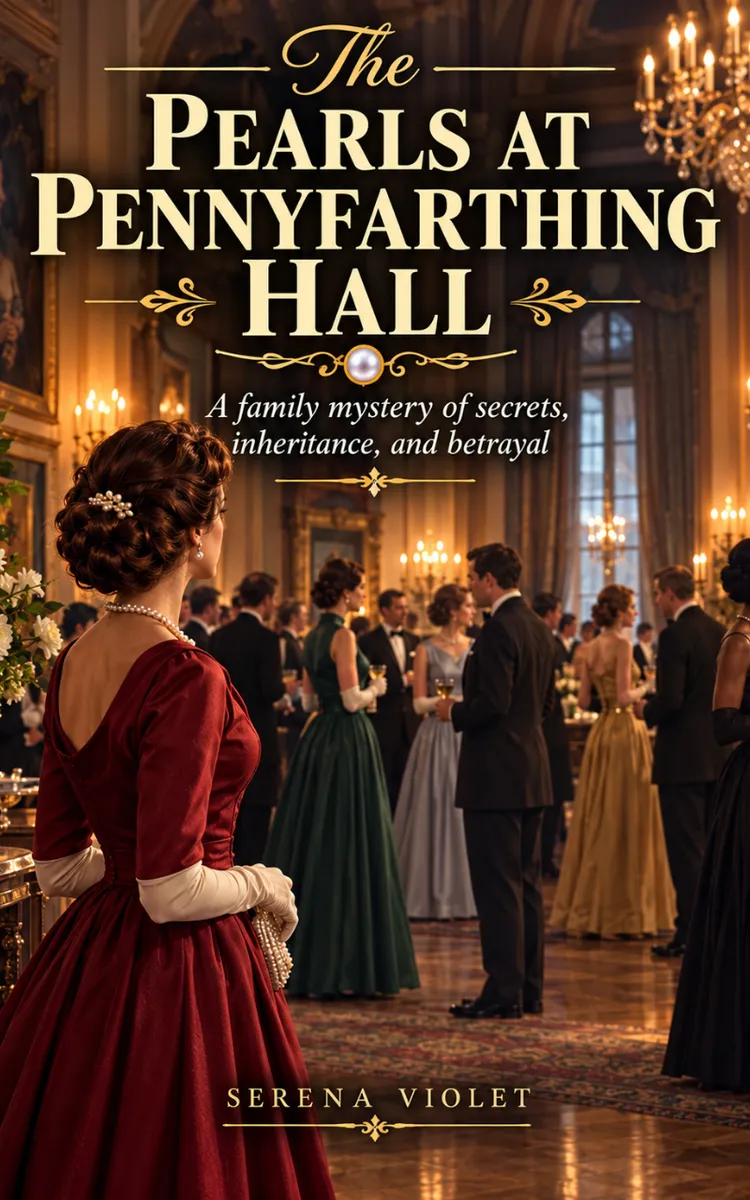

Read the first chapter
The whole of chapter one, free. About 8 min. Turn the pages with the arrows, your keyboard, or a swipe.
Chapter 1
The Locked Pearl Cabinet
The brass horse on the hall clock had stopped halfway around its track, its tiny wheels frozen above the twelve. Eleanor Ashcombe noticed it before she noticed the portraits, the polished staircase, or the dark green door at the far end of the entrance hall.
“Still broken,” she said.
Richard Ashcombe looked up from the umbrella stand. “It isn’t broken. It’s decorative.”
“At seventy-two, I’m wary of anything that calls itself decorative while refusing to tell the time.”
He gave a short laugh, though his eyes remained on her. “You haven’t changed.”
“That is not what my doctor says.”
Pennyfarthing Hall received her with the same cool silence it had offered when she left it eleven years earlier. The Vermont evening pressed blue against the tall windows. Somewhere beyond the stone walls, gravel shifted beneath arriving tyres, followed by the muffled slam of a car door. Inside, the hall smelled of beeswax, old wood, and the faint smoke of a fire that had burned down in the library.
Eleanor set her overnight case beside the umbrella stand. She had come with one clear intention: stay for the reunion honoring Margaret’s late sister, eat a respectable dinner, and leave in the morning before anyone could ask her to take sides.
Richard reached for her case.
“I can manage,” she said.
“I know you can.” He released the handle. “That has always been the trouble.”
The words were light, but the old quarrel beneath them was not. Eleanor glanced toward the staircase. Its carved banister curved upward into shadow, passing three closed doors on the landing. Pennyfarthing Hall had belonged to the Ashcombes for more than a century, and every generation had added another room, another lock, another reason not to ask what lay behind it.
“You look tired,” Richard said.
“I have driven four hours through rain to attend a family gathering. Tired is the expected condition.”
“You could still turn around.”
“I could,” she said. “But then Margaret would say I had become unreliable.”
“She says that about anyone who disagrees with her.”
A woman’s voice floated from the drawing room. “Richard, if you have finished frightening Eleanor, bring her in.”
Margaret Ashcombe sat beside the fire in a high-backed chair, dressed in dark blue silk and a string of modest pearls. At eighty-four, she was small and straight, with silver hair arranged so neatly that it seemed pinned into place by willpower alone. She held a walking stick across her knees but did not use it.
Eleanor kissed her cheek. Margaret’s skin was cool.
“You came,” Margaret said.
“I was invited.”
“That has not always been enough.”
The drawing room was full. Peter Ashcombe stood near the mantel, one hand resting on the marble as though he were examining a patient. Beatrice Shaw occupied the sofa, her red spectacles low on her nose. Jonathan Reed, the family solicitor, had claimed the chair nearest the drinks table. Catherine Vale stood by the window with a leather portfolio tucked beneath one arm.
Eleanor knew them all, though some had altered more than others. Peter’s hair had gone completely white. Beatrice had acquired a silver cane but held it like a conductor’s baton. Jonathan looked exactly as he had when he handled Eleanor’s father’s estate, which meant he appeared both polished and vaguely apologetic.
Catherine was the exception. Eleanor remembered her as a young woman with a quick smile and a habit of leaving early. Now she was sixty-six, composed and watchful, with a narrow face that seemed familiar in a way Eleanor could not place.
“Eleanor,” Catherine said. “I’m glad you came.”
“That makes one of us.”
Catherine smiled. “I meant me.”
Margaret tapped her stick once against the floor. “We are not beginning with old complaints.”
“No,” said Beatrice. “We are beginning with drinks. Old complaints come after soup.”
Peter chuckled. Richard poured Eleanor a glass of wine.
She accepted it, though her immediate goal was not comfort. She wanted to find her room, put away her coat, and establish a quiet corner before the family’s history began circling her ankles.
Margaret had other plans.
“You will sit beside me at dinner,” she said.
“Why?”
“Because you are family.”
“That is not an explanation. It is an accusation.”
Beatrice laughed, and even Peter smiled. Margaret did not.
“The pearls will be displayed tonight,” she said. “It is important that everyone sees them.”
Eleanor looked toward the glass doors at the end of the room. Beyond them lay the dining room, where a tall cabinet stood against the far wall. Even from here she could see its brass fittings and the small silver key in the lock.
Richard’s expression tightened. “Must we make a ceremony of it?”
“It is the first reunion since your aunt’s death.”
“It is a necklace.”
“It is the Pennyfarthing Pearls,” Margaret replied.
Catherine opened her portfolio. “There are at least three accounts of where they came from.”
Margaret’s gaze sharpened. “Not at this table.”
“Then perhaps at the next one,” Catherine said.
Jonathan cleared his throat. “The family records describe them as a wedding gift presented to Beatrice Ashcombe in 1911.”
Peter turned from the mantel. “That is one version.”
“What is yours?” Eleanor asked.
Peter’s fingers moved over the marble. “My father said they were purchased with money no one could account for.”
Richard lifted his glass. “And I was told they belonged to a woman named Rose something.”
“Rose Vale,” Catherine said.
The room changed. Not dramatically. No one gasped. Yet the fire seemed to settle, and the rain at the windows became suddenly distinct.
Margaret’s hand closed around her walking stick. “That name has no place in this family.”
Catherine’s voice stayed calm. “It appears in a photograph.”
“You brought photographs to a memorial dinner?”
“I brought questions.”
“Then you should have left them at home.”
Eleanor felt the old instinct rise in her, the one that had served her through thirty years of wills, contracts, and family disputes. Separate what was known from what was claimed. Note who answered too quickly. Watch who reached for an object when a name was spoken.
She wanted no part of it. She had promised herself that before turning into the drive.
“Perhaps,” she said, “we might wait until after dinner to conduct the trial.”
Richard glanced at her. “You always did like a good cross-examination.”
“I liked evidence. It was quieter.”
Margaret stood. The room fell silent again.
“The pearls will be shown after the toast,” she said. “No one will handle them. No one will invent stories around them. And no one will question the accepted history in front of guests.”
“Which accepted history?” Catherine asked.
Margaret’s face hardened. “The true one.”
Dinner began with careful politeness. Plates arrived, conversations rose and fell, and Eleanor sat between Margaret and Peter, exactly as ordered. The dining room was long and narrow, paneled in walnut darkened by age. At one end, beneath a portrait of a stern woman in a lace collar, stood the locked display cabinet.
The cabinet’s glass was clean enough to reflect the chandelier. Inside, on pale blue velvet, lay the necklace.
The pearls were larger than Eleanor remembered, each one softly luminous, with a faint blush near the centre. They were not flashy. That was what made them compelling. They seemed to hold their light rather than throw it.
“Your aunt wore them only twice,” Peter said quietly.
“Three times,” Margaret corrected.
“You were not present at the second.”
“I was.”
“You were fourteen.”
“I remember what I saw.”
Beatrice leaned across the table. “You remember what you were told.”
Margaret’s knife touched her plate with a small, exact click.
Jonathan drank his wine. Richard stared at the cabinet.
Catherine had brought one photograph from her portfolio and placed it beside her plate. Eleanor saw only its edge, a strip of faded brown paper.
“Where did you get that?” Richard asked.
“Among my mother’s things.”
“Your mother never came here.”
“She did once.”
Margaret’s gaze moved to Catherine. “Your mother was not invited.”
The words struck harder than their volume suggested. Catherine folded the photograph and returned it to the portfolio.
Eleanor put down her fork. “Margaret.”
“I will not have family lies repeated as family facts.”
For the first time, Margaret looked directly at her. “Then do not encourage them.”
The rest of the meal passed beneath that warning. After the pudding, Jonathan rose and unlocked the cabinet. The key turned with a stiff metallic scrape. Margaret crossed to him, moving slowly but without assistance.
She lifted the necklace from its velvet bed. The pearls slid over her gloved fingers with a soft, dry whisper.
“For the family,” she said, and held them beneath the chandelier.
Richard leaned forward. Peter looked away. Catherine did not blink.
Eleanor watched Margaret’s hands. The gloves were white cotton, buttoned at the wrist. The clasp of the necklace was old-fashioned, made of gold and shaped like two leaves. A tiny dark mark showed beneath one hinge.
“Beautiful,” Beatrice said.
“Valuable,” Richard replied.
Margaret returned the pearls to the cabinet. Jonathan locked it, then tested the key twice before placing it in his pocket.
Eleanor was reaching for her wine when Margaret came to stand beside her.
“You have always been clever,” Margaret said quietly.
“An unfortunate reputation.”
“Do not let Catherine’s bitterness draw you in.”
“I have not been drawn anywhere.”
“Some doors are locked for good reason.”
Eleanor looked toward the cabinet. Its glass reflected Margaret’s face, pale and watchful, beside the pale glow of the pearls.
“What happened in 1938?” Eleanor asked.
Margaret’s expression did not change. Only her fingers tightened around the walking stick.
“Nothing that concerns you.”
“That is rarely true of family history.”
Margaret leaned closer. Her voice dropped to a whisper.
“The Ashcombes have survived because we know which truths to preserve.”
Then she turned away, leaving Eleanor with the wine untouched in her hand and the locked cabinet shining at the end of the room.
End of chapter one. 14 more chapters and about 28,096 words in the full book.
Swipe or use the arrows to turn the page


What's inside: 15 chapters
- 1. The Locked Pearl Cabinet
- 2. The Empty Display
- 3. The Photograph with a Cutout
- 4. The Room Behind the Panel
- 5. Margaret’s Version
- 6. The Solicitor’s Warning
- 7. The Doctor’s Memory
- 8. The Name in the Ledger
- 9. Beatrice’s Unkept Promise
- 10. The Will That Wasn’t There
- 11. The Family’s Closed Door
- 12. Catherine’s Birth Record
- 13. The Pearls in the Sewing Box
- 14. A Will in Lillian’s Hand
- 15. The Hall Without Its Legend
About this book
"The Pearls At Pennyfarthing Hall" is a fiction book by Serena Violet with 15 chapters and approximately 28,096 words. A retired legal professional investigates a missing heirloom and concealed family history.
This book was created using Inkfluence AI, an AI-powered book generation platform that helps authors write, design, and publish complete books. It was made with the AI Novel Writer.
Frequently Asked Questions
What is "The Pearls At Pennyfarthing Hall" about?
A retired legal professional investigates a missing heirloom and concealed family history
How many chapters are in "The Pearls At Pennyfarthing Hall"?
The book contains 15 chapters and approximately 28,096 words. Topics covered include The Locked Pearl Cabinet, The Empty Display, The Photograph with a Cutout, The Room Behind the Panel, and more.
Who wrote "The Pearls At Pennyfarthing Hall"?
This book was written by Serena Violet and created using Inkfluence AI, an AI book generation platform that helps authors write, design, and publish books.
How can I create a similar fiction book?
You can create your own fiction book using Inkfluence AI. Describe your idea, choose your style, and the AI writes the full book for you. It's free to start.
Write your own fiction book with AI
Describe your idea and Inkfluence writes the whole thing. Free to start.
Start writingCreated with Inkfluence AI


