

Read the first chapter
The whole of chapter one, free. About 8 min. Turn the pages with the arrows, your keyboard, or a swipe.
Chapter 1
The Teapot Behind Glass
The teapot stood beneath a glass dome with one handle turned precisely towards the ballroom, as though it had been placed there to receive applause.
Clara Whitmore noticed the handle because a child had just tried to turn it the other way. She caught the girl’s wrist before the glass rattled.
“Not that one, darling,” Clara said. “It has survived a century without assistance. We mustn’t ruin its record now.”
The girl’s mother murmured an apology and drew her away, leaving Clara to straighten the small card beneath the dome. It read:
VICTORIAN SILVER-PLATED TEAPOT RECENTLY REDISCOVERED IN THE ASHCOMBE FAMILY COLLECTION DATE AND PROVENANCE UNCERTAIN
Uncertain provenance was the polite phrase. In Bellweather, it generally meant that three people had lied, two had forgotten, and Margaret Bell knew the truth but was waiting to decide whether it would improve the afternoon.
Beyond the exhibition room’s tall windows, bunting snapped in the September wind. Inside, the manor was full of warm bodies, damp coats, polished wood and the faint, persistent clink of china. The heritage fair had been open for less than an hour, and already Clara’s list of small disasters included a missing tray of scones, a leaking umbrella stand and Oliver Finch arguing with a taxidermied fox.
Her immediate aim was simple: keep the exhibition intact until the private gathering began at four. If she could also examine the teapot without Beatrice Ashcombe appearing at her shoulder, so much the better.
“Miss Whitmore.”
Beatrice’s voice arrived before she did. Clara looked up to find the manor’s owner standing beside the doorway in a dark green dress, her expression composed enough to have been varnished.
“Beatrice,” Clara said. “The teapot has attracted a good deal of interest.”
“It always does.”
“That may be because it is the only object in the room with a rumour attached to it.”
A flicker crossed Beatrice’s face and vanished. “Bellweather has attached rumours to less attractive objects.”
“Such as the fox?”
“Especially the fox.”
The fox, which had been shot in 1894 and preserved in a pose of permanent disappointment, seemed unlikely to object.
Clara bent over the card again. The teapot was smaller than she had expected, with a bulbous body, a narrow spout and a lid decorated with a little wheel of engraved ivy. Its silvering had darkened around the base. Along the handle, beneath a strip of fresh-looking resin, ran a fine hairline crack.
“Who repaired it?” Clara asked.
“An expert.”
“That is a broad parish.”
“Edmund arranged it.”
At the mention of Edmund Pritchard, Beatrice’s gaze shifted towards the far end of the room. Edmund stood near a cabinet of Georgian clocks, speaking to Theo Marsh. He was a handsome man in his late fifties, silver-haired and broad-shouldered, with the confident manner of someone accustomed to deciding what an object was worth before anyone else had finished looking at it.
Oliver Finch had abandoned the fox and was watching Edmund over the rim of his glass.
“Edmund has been very helpful,” Beatrice continued. “He identified the piece as belonging to my great-grandmother’s collection.”
“Yet the card says its provenance is uncertain.”
“Edmund likes certainty when it benefits him.”
The remark was so quietly delivered that Clara wondered if she had heard it correctly. Before she could ask, a bell sounded in the hall. Guests began moving towards the ballroom, drawn by the promise of champagne and the announcement of the private viewing.
Beatrice straightened. “Please see that no one touches the display.”
“I shall guard it with my life.”
“I was hoping for something less dramatic.”
“Then with my clipboard.”
Beatrice gave her a thin smile and went to receive the guests. Clara watched her cross the room, accepting greetings with gracious nods while keeping one hand closed around the strap of her handbag.
The exhibition became crowded almost at once. Clara stationed herself beside the dome, redirecting elbows, umbrellas and a determined spaniel. Margaret Bell appeared with a folder tucked beneath her arm and stopped beside the teapot.
“Still here,” Margaret said.
“The teapot?”
“The story.”
Clara glanced at her. Margaret’s white hair was pinned severely, and her spectacles hung from a chain decorated with tiny brass keys.
“What story?”
Margaret looked towards the ballroom. “The Ashcombe inheritance. The missing papers. The piece that was said to have vanished before the family ever owned it.”
“That is several stories.”
“They are all the same story, if you go back far enough.”
“And if one does not?”
“Then one has a pleasant afternoon and avoids upsetting the dead.”
Margaret’s fingers tightened around her folder. Before Clara could draw her further, Theo appeared, notebook open.
“Margaret, is it true the teapot was connected to the Bellweather scandal?”
“Nothing is true merely because you print it,” Margaret said.
“That has never stopped a newspaper.”
Theo grinned, but his eyes remained fixed on the display. “Edmund says the teapot proves the old account was wrong.”
“Edmund says many things,” Margaret replied.
A sharp crack sounded from the ballroom. Conversation faltered. Clara turned in time to see a champagne glass broken beneath the heel of Oliver Finch’s shoe.
“Entirely my fault,” Oliver announced. “The carpet moved.”
“The carpet has been here since 1887,” Beatrice said.
“Then it has had ample opportunity to develop bad habits.”
A few guests laughed. Edmund did not. He was looking at Oliver with open dislike.
“Perhaps you should keep away from the valuable things,” Edmund said.
Oliver glanced at the teapot. “I thought that was your department.”
The room cooled by a degree, though no window had opened. Beatrice stepped between them with the ease of a woman accustomed to placing furniture between quarrelling men.
“Oliver, help Theo with the press photographs. Edmund, the document is ready in your study whenever you are.”
Clara noticed the change in Edmund’s expression. His irritation sharpened into alarm.
“What document?” Theo asked.
“Nothing for the exhibition,” Beatrice said. “A family paper.”
“Then why is Edmund involved?” Oliver asked.
“Because I asked him to be.”
Edmund’s gaze moved to Clara, then to the teapot. For a moment, she had the odd impression that he wanted to speak to her. Instead he said, “Miss Whitmore, make sure the display remains attended.”
“I have been doing precisely that.”
“Do it more carefully.”
He walked away towards the corridor. Beatrice followed, her composure now stretched thin enough to show the strain beneath it.
Clara remained by the dome, but her attention had shifted. The teapot’s repaired handle caught the light. The resin was not merely along the crack; it had been pressed into a tiny notch beneath the silver. Something dark showed there, no larger than a grain of rice.
She leaned closer.
“Clara.”
Felix Mercer stood at her elbow, carrying a small velvet case. His waistcoat was the colour of old brass, and there was oil beneath one fingernail.
“Felix. Have you come to admire the fox?”
“I have come to rescue the hall clock from Theo’s enthusiasm. He wound it twice.”
“That sounds like a journalistic offence.”
“It is certainly a mechanical one.”
He looked at the teapot without touching the glass. “That repair is recent.”
“So I thought.”
“Whoever did it understood metal, but not silver. The join is too clean.”
“Could it have been repaired to hide something?”
Felix’s eyes met hers. “Anything can be hidden in a teapot. Usually tea.”
Before Clara could reply, a young footman hurried into the room. He was pale and breathless.
“Miss Ashcombe?”
Beatrice turned from the corridor. “What is it?”
“Mr Pritchard’s door is locked. He told me to bring the ledger from his study, but he isn’t answering.”
“Have you knocked?”
“Yes, ma’am. I heard something fall.”
The guests had begun to listen. Clara saw Oliver stop beside the ballroom doors. Theo closed his notebook, though not before marking the page with his thumb.
Beatrice crossed the room quickly. Clara followed, as did Felix and Margaret. The corridor seemed narrower than it had a moment before, its portraits watching from gilt frames as the group passed beneath them.
Edmund’s study lay at the end, beyond a carved screen. The door was oak, fitted with a brass handle and an old-fashioned keyhole. Beatrice knocked once.
“Edmund?”
No answer.
She tried the handle. It did not move.
“Perhaps he is on the telephone,” Theo said.
“Inside a locked room?” Oliver asked.
Beatrice’s face had lost its colour. “Edmund always locks the door when examining private papers.”
“Then he may be examining them very privately,” Clara said, though the attempt at humour fell flat.
The footman fetched a ring of keys. None fitted. Beatrice tried a smaller key, then another. The corridor filled with the dry scrape of metal and the distant, cheerful sound of a string quartet beginning in the ballroom.
Clara knelt beside the threshold. A narrow line of light showed beneath the door. There was also a dark smear on the carpet, as though something wet had been dragged across it.
“What is that?” Margaret whispered.
Clara touched it with the corner of her handkerchief. The mark was cold and slightly sticky.
“Oil,” Felix said behind her. “Clock oil, perhaps.”
Beatrice stared at the door. “Break it.”
The footman hesitated.
“Now.”
He fetched a heavy brass fire iron from the stand. Oliver took it from him and struck the lock. The first blow shook the portraits. The second split the wood around the latch. On the third, the door flew inward.
Edmund Pritchard lay beside his desk.
For one suspended second Clara saw only details: his hand curled against the carpet, a dark stain at his temple, one shoe twisted under the chair. A clock on the mantel ticked steadily, absurdly polite. Papers lay scattered across the desk, but the room itself was otherwise undisturbed.
Then Beatrice made a sound that was not quite a cry.
Felix caught her arm before she stepped inside. “Don’t touch anything.”
Clara stood in the doorway, unable to look away from Edmund’s desk. An empty leather folder lay open beside the blotter. Its brass clasp was still fastened.
Beatrice’s hand flew to her mouth.
“The Ashcombe deed,” she said.
Theo raised his notebook. “What about it?”
“It was in that folder.”
Oliver’s voice was low. “What deed?”
Beatrice turned towards him, and the guarded owner of Bellweather Manor disappeared. In her place stood a woman who had just watched the past become evidence.
“The original inheritance document,” she said. “The one proving who owned the teapot.”
Behind Clara, the ballroom erupted in applause for the musicians. Inside the study, Edmund lay dead, the door had been locked from within, and the paper that might explain the teapot had vanished.
End of chapter one. 14 more chapters and about 30,594 words in the full book.
Swipe or use the arrows to turn the page


What's inside: 15 chapters
- 1. The Teapot Behind Glass
- 2. The Clockmaker’s Alibi
- 3. A Repair Beneath the Glaze
- 4. The Manor’s Service Passage
- 5. Margaret’s Missing Page
- 6. The Fairground Accusation
- 7. The Shop That Kept No Time
- 8. The Inheritance in the Ledger
- 9. The Cost of Staying Quiet
- 10. The Exhibition Goes Dark
- 11. A Name in the Margin
- 12. The Witness Who Rehearsed
- 13. The Teapot’s Hidden Spring
- 14. What the Document Restores
- 15. Tea After the Fair
About this book
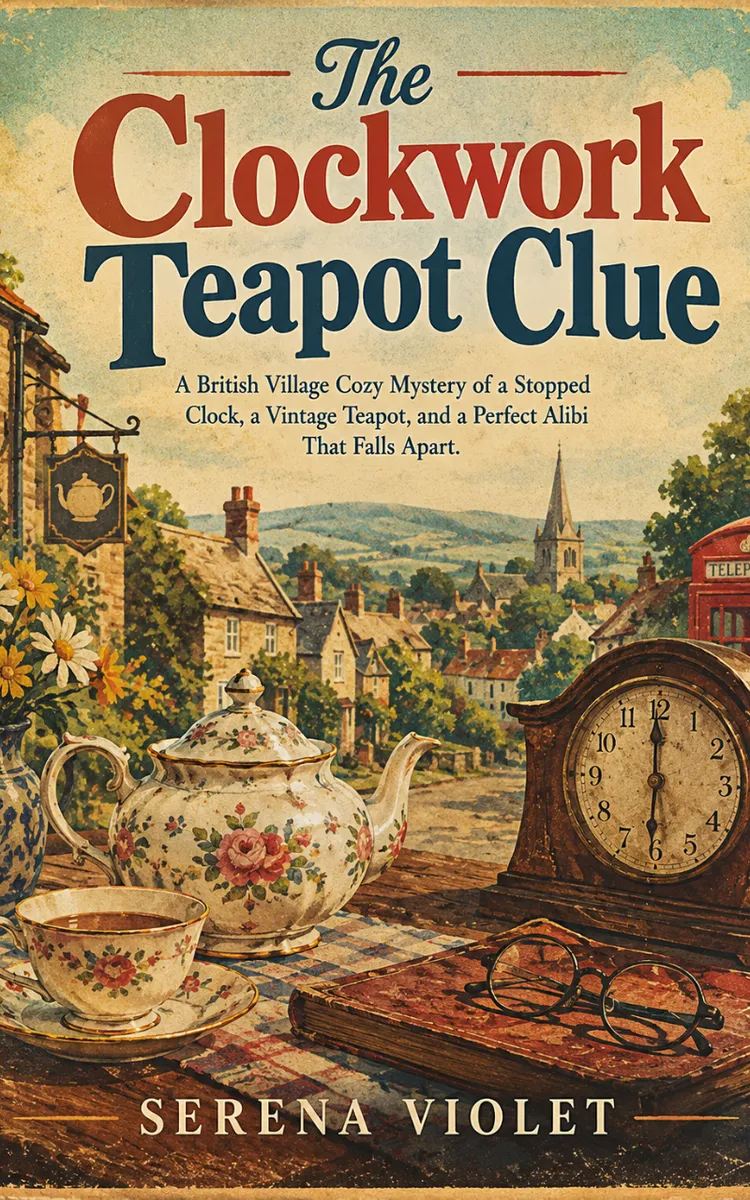
"The Clockwork Teapot Clue" is a fiction book by Serena Violet with 15 chapters and approximately 30,594 words. An amateur sleuth investigates a manor-house murder, missing document, and manipulated clockwork alibi.
This book was created using Inkfluence AI, an AI-powered book generation platform that helps authors write, design, and publish complete books. It was made with the AI Novel Writer.
Frequently Asked Questions
What is "The Clockwork Teapot Clue" about?
An amateur sleuth investigates a manor-house murder, missing document, and manipulated clockwork alibi
How many chapters are in "The Clockwork Teapot Clue"?
The book contains 15 chapters and approximately 30,594 words. Topics covered include The Teapot Behind Glass, The Clockmaker’s Alibi, A Repair Beneath the Glaze, The Manor’s Service Passage, and more.
Who wrote "The Clockwork Teapot Clue"?
This book was written by Serena Violet and created using Inkfluence AI, an AI book generation platform that helps authors write, design, and publish books.
How can I create a similar fiction book?
You can create your own fiction book using Inkfluence AI. Describe your idea, choose your style, and the AI writes the full book for you. It's free to start.
Write your own fiction book with AI
Describe your idea and Inkfluence writes the whole thing. Free to start.
Start writingCreated with Inkfluence AI


