
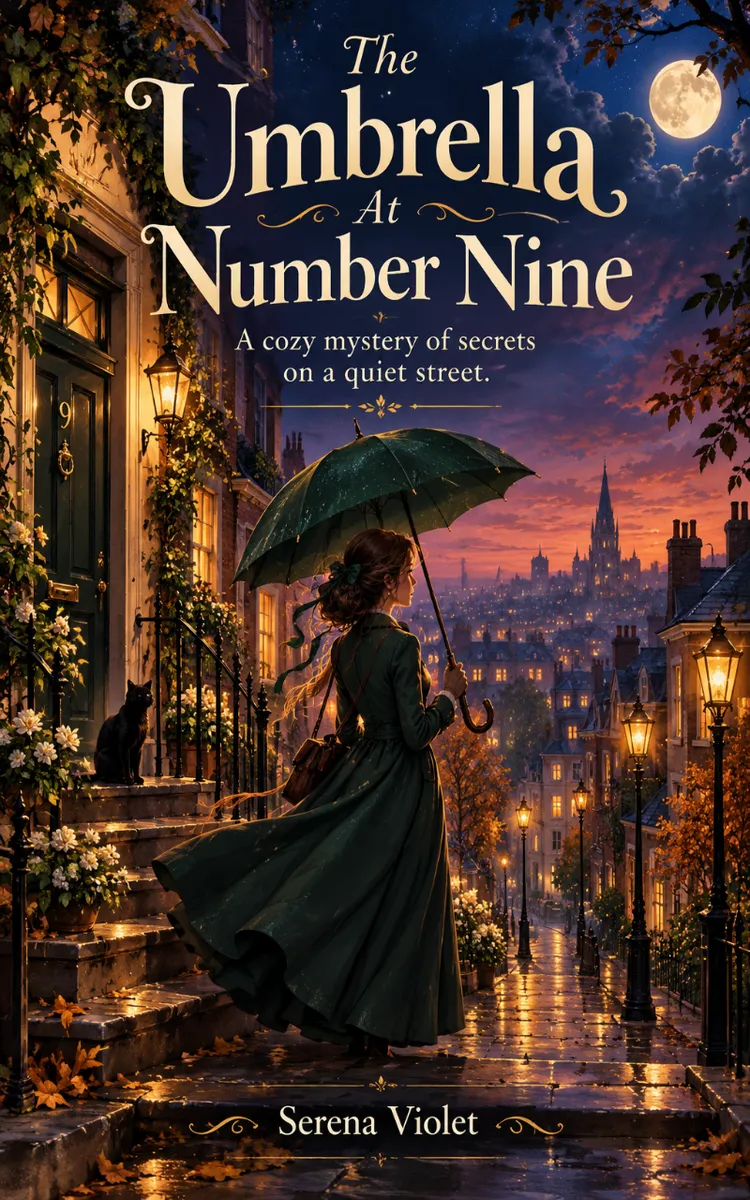

Read the first chapter
The whole of chapter one, free. About 7 min. Turn the pages with the arrows, your keyboard, or a swipe.
Chapter 1
The Umbrella at Number Nine
The rain had turned the brass number nine on Mara Bell’s gate into a small, shining moon.
She noticed it while wrestling the latch with one hand and balancing a paper bag of groceries in the other. Alderwick Lane was usually at its quietest on wet mornings. Curtains stayed drawn, bicycles remained chained to railings, and even Mrs. Pritchard’s terrier had surrendered its post beneath the hydrangea.
Mara had three errands to finish before ten. The bakery, the post office, and a quick stop at the chemist for her father’s cough mixture. After that, she meant to spend the afternoon sorting the boxes in her front room, a task she had postponed for six months and mentioned often enough to make it sound like a family tradition.
She pushed the gate open.
Something dark lay across her doorstep.
Mara stopped so suddenly that the grocery bag swung against her knee. A red apple rolled free, bumped the threshold, and spun in a slow circle before settling against the object.
It was an umbrella.
Not one of the cheap folding kind that turned inside out at the first serious gust, but a long, old-fashioned umbrella with a curved wooden handle and a dark green canopy. Rainwater dripped from its ribs onto the stone. One brass tip had caught beneath the edge of the lowest paving slab, pinning it awkwardly across the entrance.
Mara looked up and down the lane.
No one stood nearby. The rain tapped on the parked cars and whispered through the bare branches of the plum trees. Number Seven’s curtains twitched, then went still.
“Oh, for goodness’ sake,” Mara murmured.
She set the grocery bag beneath the porch awning and rescued the apple. The umbrella was in the way, and whoever had left it there had either been careless or in a remarkable hurry. She tried lifting it by the handle. The brass tip scraped beneath the stone with a sharp metallic squeal.
It did not move.
Mara glanced at the clock above her hall mirror. Eight twenty-three. If she missed the bakery before the school crowd arrived, she would be trapped behind three prams and a man who ordered individual pastries for his entire office.
She tried again, this time pulling the umbrella toward her. The paving stone shifted half an inch. Mud squeezed up through the crack and spotted the toe of her shoe.
“Morning, Mara.”
The voice came from the neighboring garden.
Mara turned to see Mr. Lionel Finch peering over the brick wall that separated Number Nine from Number Eleven. He wore a yellow rain hat, though he was standing beneath the shelter of his own porch, and held a pair of pruning shears as if he had been interrupted in the middle of a dangerous operation.
“Is that yours?” Mara asked.
“If it were mine, I should hope it would be somewhere less damp.”
“It’s on my doorstep.”
“That does suggest a certain lack of ownership.”
Mara gave him a look. Lionel smiled, untroubled.
He had lived on Alderwick Lane for thirty years and regarded every event, from a fallen branch to a police car, as an opportunity to be entertained. His garden was crowded with clipped bushes, ceramic frogs, and labels identifying plants he had personally named.
“Did you see who left it?” Mara asked.
“I saw the rain.”
“Lionel.”
“I’m afraid the rain was more memorable.”
Mara crouched and examined the umbrella. The canopy was soaked but intact. A thin smear of blue marked one of the wooden ribs near the handle. Blue paint, perhaps. She touched it with one finger. It came away tacky.
“Careful,” Lionel said. “That may be evidence.”
“It may be paint.”
“Evidence of paint.”
Mara stood. “I’m going to move it inside and ask around later.”
“Ask Mrs. Pritchard first. She knows everyone’s business, including the business they haven’t started yet.”
“I need to get to the bakery.”
“Then you’ll have to defeat the umbrella.”
The brass tip had wedged itself deeper beneath the paving stone. Mara went inside for a butter knife, a tea towel, and the small garden trowel she kept beside the umbrella stand. When she returned, Mrs. Pritchard was at the gate in a purple waterproof coat, her terrier tucked under one arm.
The dog stared at the umbrella with deep suspicion.
“I heard a scrape,” Mrs. Pritchard said. “Then Lionel called out. Is there a problem?”
“No problem,” Mara replied. “Just a stuck umbrella.”
“Whose is it?”
“That’s what I’m trying to find out.”
Mrs. Pritchard lowered the dog to the pavement. It immediately sniffed the umbrella, sneezed, and retreated behind its owner’s ankles.
“Not local,” she said.
“Umbrellas don’t have addresses.”
“This one does.”
Mara looked at her.
Mrs. Pritchard pointed at the handle. “There’s something underneath.”
The handle was a smooth curve of dark wood, polished by years of use. Mara wiped it with the tea towel, revealing a shallow groove near the base. At first she thought it was a scratch made by a key. Then she saw the shape of a letter.
“Can you read it?” Mrs. Pritchard asked.
“Not yet.”
The narrow passage between Number Nine and Number Eleven was barely wide enough for two people to pass. The wall on one side was damp brick, the other a tangle of ivy and overgrown rosemary from Lionel’s garden. Mara knelt, pushed the trowel beneath the loosened stone, and levered it upward.
The stone lifted with a wet sucking sound.
“Don’t put your fingers there,” Mrs. Pritchard said sharply.
Mara froze. Beneath the stone, the passage was black with mud. A fat earthworm wriggled across the opening, and something pale gleamed near the umbrella’s brass tip.
“What is it?” Lionel asked.
“Probably a bit of glass,” Mara said, though she could not see clearly.
Mrs. Pritchard leaned closer. “Probably?”
Mara shifted the umbrella, trying to free the tip without disturbing whatever lay below. The canopy snagged against the ivy. A shower of cold water fell down the back of her neck.
“Oh, splendid.”
“Perhaps leave it,” Lionel suggested.
“That would mean leaving it across my front door.”
“Then perhaps cut the ivy.”
“It’s my ivy,” Lionel said. “And it has seniority.”
A curtain moved in the window of Number Five. Then another at Number Thirteen. The lane was waking, drawn by the spectacle of Mara Bell kneeling in the rain beside an umbrella that refused to be ordinary.
Mara set her jaw. She could feel the morning slipping away. The bakery would be crowded. The post office queue would reach the door. Her father’s cough mixture would have to wait until afternoon, and he would say he had never liked the taste of it anyway.
She put on the tea towel as a glove, reached beneath the lifted stone, and worked the brass tip loose.
The umbrella came free all at once.
Mara fell backward onto the wet paving. Mrs. Pritchard caught her elbow, while Lionel made a noise that sounded suspiciously like laughter. The paving stone dropped back into place with a heavy clack.
“Are you hurt?” Mrs. Pritchard asked.
“Only my dignity.”
“That washes off,” Lionel said.
Mara ignored him and examined the umbrella. The brass tip was muddy, but there was no glass beneath the stone. The pale gleam had been the edge of a small metal washer, old and rusted.
She opened the umbrella halfway. Water cascaded onto the rosemary. A faint blue streak showed along the underside of the handle, where the wood met the brass collar.
“Someone’s painted this recently,” she said.
“Why would anyone paint an umbrella?” Mrs. Pritchard asked.
“Perhaps they didn’t.”
Mara turned the handle over. The scratch beneath it was clearer now. Two letters had been cut into the wood with a sharp point.
E.V.
The marks were uneven but fresh. Pale wood showed through the dark polish, and tiny curls of shaving clung to the groove.
Lionel stopped smiling.
Mrs. Pritchard’s terrier gave a low, uncertain growl.
“E.V.,” Mara said quietly.
“Do you know anyone with those initials?” Mrs. Pritchard asked.
Mara thought of the names on the lane: Finch, Pritchard, Bell, Wren, Dalloway, and the Harrisons at Number Three. None matched.
“Not here,” she said.
“Could be from somewhere else,” Lionel offered.
“Then why leave it here?”
No one answered.
Mara looked down at the paving stone. Along its upper edge, where the umbrella’s brass tip had been trapped, ran a fresh smear of blue paint. It was brighter than the mark on the handle and still glossy beneath the rain.
The umbrella had not simply been dropped on her doorstep. It had been dragged through the passage, forced beneath the stone, and left where she would find it.
A cold thread moved through Mara that had nothing to do with the rain.
She wrapped the umbrella in the tea towel and carried it beneath the porch. The grocery bag waited beside the door, one apple short and leaking a little milk from the carton.
“I’ll take it inside,” she said.
Mrs. Pritchard’s expression tightened. “You’re not keeping it.”
“Only until I find its owner.”
“Mara, perhaps you should call someone.”
“Who?”
That silenced them again.
Beyond the gate, a bus groaned at the end of the lane. Mara glanced at the clock. Eight forty-one. The bakery, the post office, the chemist - her ordinary morning had become a list of things she might no longer manage.
She picked up the umbrella.
Under the handle, the initials caught the gray light.
E.V.
Mara had wanted only to clear her doorstep and return a stranger’s property. Instead, she was carrying a wet umbrella marked with a name that did not belong to anyone she knew, while beneath her feet the fresh blue smear gleamed like a small, deliberate warning.
End of chapter one. 9 more chapters and about 20,237 words in the full book.
Swipe or use the arrows to turn the page


What's inside: 10 chapters
- 1. The Umbrella at Number Nine
- 2. The Stories Neighbors Tell
- 3. The Note Under the Grip
- 4. The Locked Archive Room
- 5. The Photograph in the Frame
- 6. The Cost of Keeping Quiet
- 7. Blackout on Alderwick Lane
- 8. The Wall Behind Number Nine
- 9. The Key That Never Fit
- 10. Elspeth’s Last Letter
About this book
"The Umbrella At Number Nine" is a fiction book by Serena Violet with 10 chapters and approximately 20,237 words. A neighborhood investigation sparked by a mysterious umbrella and years of hidden lies.
This book was created using Inkfluence AI, an AI-powered book generation platform that helps authors write, design, and publish complete books. It was made with the AI Novel Writer.
Frequently Asked Questions
What is "The Umbrella At Number Nine" about?
A neighborhood investigation sparked by a mysterious umbrella and years of hidden lies
How many chapters are in "The Umbrella At Number Nine"?
The book contains 10 chapters and approximately 20,237 words. Topics covered include The Umbrella at Number Nine, The Stories Neighbors Tell, The Note Under the Grip, The Locked Archive Room, and more.
Who wrote "The Umbrella At Number Nine"?
This book was written by Serena Violet and created using Inkfluence AI, an AI book generation platform that helps authors write, design, and publish books.
How can I create a similar fiction book?
You can create your own fiction book using Inkfluence AI. Describe your idea, choose your style, and the AI writes the full book for you. It's free to start.
Write your own fiction book with AI
Describe your idea and Inkfluence writes the whole thing. Free to start.
Start writingCreated with Inkfluence AI


