

Read the first chapter
The whole of chapter one, free. About 9 min. Turn the pages with the arrows, your keyboard, or a swipe.
Chapter 1
The Paris Sevenfold Body Map
The seventh body was behind a door that refused to admit the dead.
Amélie Laurent stood beneath the forensic annex’s blue emergency lamps while the sealed morgue wing flashed the same warning across every surface: NONLOCAL EVIDENCE - ACCESS DENIED. The corridor smelled of disinfectant, hot circuitry, and rain dragged in from the hospital courtyard. Beyond the glass, seven covered forms rested in separate examination bays, each tagged, scanned, and rejected by the annex system as if Paris itself had no jurisdiction over them.
“Lock the north passage,” Amélie said. “No transfers. No remote access.”
A technician looked up from a trembling console. “The system already sealed it.”
“Then make certain no one opens it.”
The Pitié-Salpêtrière forensic annex had been built for biological disasters, terrorist attacks, and the legal nightmares of a networked age. Its morgue could compare tissue, implants, environmental residue, and genetic records faster than any human team. It could also refuse evidence that did not conform to its registered geography. Tonight, every scan returned the same impossible classification: nonlocal.
The seven deaths had been discovered in Paris within the same response window. Their identities had not yet been released, and Amélie would not invent certainty where the evidence offered none. What she knew was narrower and worse: seven bodies, one staging signature, no clear local suspect, and a pattern that appeared to have been designed for recognition by someone far beyond the room.
She pressed her palm to the access plate. The door remained dark.
“Detective,” said the technician, “the annex is asking for an international jurisdiction key.”
“From whom?”
“Unknown.”
That answer moved through her like cold water. She turned toward the observation glass. The body bays were empty of motion, yet the monitors beside them continued to update. One screen displayed a seven-point arrangement. Another showed a string of coordinates that shifted between Paris, Tokyo, and the United States before dissolving into static.
The case summary entered her report at 02:17: A coordinated seven-death murder discovered in Paris, France, in 2044, bearing a signature that may be repeated across Tokyo, Japan, and the United States.
She saved it locally before the network could alter the wording.
The initial facts were equally stark:
• Date: 2044, exact date withheld in the active investigation record - Location: Pitié-Salpêtrière forensic annex, Paris, France - Victims: Seven deceased persons discovered in a coordinated murder scene - Status: Unsolved
The first officer on scene had secured the outer corridor, but the inner wing had become its own hostile territory. Doors changed status without warning. Evidence labels rewrote themselves. A swab collected from the floor was first classified as human biological material, then as synthetic residue, then as “origin unavailable.” Amélie watched the file history scroll backward, erasing the technician who had handled it.
“Stop the sync,” she said.
“We did.”
“Stop it physically.”
The technician pulled the data spine from the console. Every monitor went black. For three seconds, the corridor held only the hum of ventilation and the faint ticking of rain against the high windows.
Then one monitor came alive.
A single line appeared.
SEVEN IS NOT A COUNT. SEVEN IS A MAP.
Amélie did not touch the screen.
The principal actors in the first hours of the case were already becoming clear, though their motives were not.
Amélie Laurent - The Paris detective assigned to secure the scene and establish whether the deaths belonged to one offender or several coordinated actors. Her immediate obstacle was not a missing suspect but a crime scene that rejected ordinary jurisdiction. Every useful answer risked implicating systems beyond local police authority.
The forensic annex system - A high-security morgue intelligence network designed to authenticate evidence across borders. It became an active barrier when it reclassified biological and digital material as nonlocal, sealing the wing and denying Amélie direct access to the bodies.
The seven deceased persons - The victims at the center of the Paris cluster. Their identities and personal histories remained under controlled review. What connected them, according to the early evidence, was not a known relationship but the same arrangement of postmortem markers.
The Paris forensic technician - The staff member operating the annex interface when the classifications began changing. His observations established that the system’s alterations were not ordinary software errors and that the evidence had been manipulated at the level of jurisdictional metadata.
The unknown killer - No local suspect had been identified. The working theory was limited to a single responsible person associated with a repeatable staging method. Later records would connect that person to a clone of an original created by a scientist described in the case mythology as a 68th-dimensional god of death.
At 02:24, Amélie obtained a manual override from the hospital’s emergency authority. It opened the outer vestibule and nothing more. The inner door remained sealed, its surface cold beneath her fingers.
“Can you cut power?” she asked.
“That would disable the containment locks.”
“Then we do not cut power.”
“You cannot enter without the jurisdiction key.”
“I can enter if the door recognizes a body.”
The technician stared at her.
Amélie removed her identification badge and placed it against the reader. The scanner pulsed once. Her name appeared, then vanished. The screen replaced it with a list of cities.
PARIS.
TOKYO.
UNITED STATES.
The three entries blinked in sequence. Beneath them, a fourth field opened: SAME EVENT.
She photographed the display before it closed.
At 02:31, the first sequence of events was entered into the investigation log.
2044, 01:42 - Hospital security detected unauthorized movement near the forensic annex and initiated an internal lockdown.
2044, 01:49 - Seven deceased persons were confirmed inside the sealed examination wing.
2044, 01:57 - Paris police established an outer perimeter and restricted hospital access.
2044, 02:03 - Initial scans identified a common staging signature across the seven examination bays.
2044, 02:11 - The annex classified biological and digital evidence as nonlocal.
2044, 02:17 - Amélie Laurent assumed investigative control and ordered the scene preserved.
2044, 02:24 - Manual override opened the outer vestibule but failed to release the inner morgue door.
2044, 02:31 [TURNING POINT] - The access interface displayed Paris, Tokyo, and United States under the designation SAME EVENT.
2044, 02:38 - A forensic scan produced a partial digital trace linked to an external death ledger.
2044, 02:46 - The Paris body cluster matched a seven-entry structure appearing in records outside France.
2044, 02:51 - The morgue wing relocked during Amélie’s audit, isolating the newly identified evidence.
The turning point came from a machine Amélie no longer trusted. She returned to the console and restored power to only one diagnostic channel. The annex generated a sequence of timestamps stripped of names, addresses, and national identifiers. Seven entries. Seven intervals. Seven corresponding marks beside the Paris bodies.
The technician leaned close. “That is not a medical record.”
“No,” Amélie said. “It is a ledger.”
“Whose?”
The screen answered before she could.
TOKYO NODE: MATCH 1.00 UNITED STATES NODE: MATCH 1.00
Amélie felt the room contract around the words. The deaths were not merely similar. The system had found an identical arrangement elsewhere.
She opened the evidence register.
Physical Evidence:
• Seven examination bays containing bodies arranged according to the same spatial pattern. - A repeated biological and postmortem signature recorded by the annex across all seven victims. - Digital access records altered to identify the evidence as nonlocal. - A diagnostic sequence containing seven timestamps and a matching structure linked to Tokyo and the United States. - A partially recovered death ledger with entries corresponding to the Paris cluster.
Witness Accounts:
• The forensic technician reported that the system changed classifications without an active network connection. - Hospital security reported movement near the annex before the bodies were formally logged. - Responding officers reported no confirmed local suspect leaving or entering the secured area. - Amélie observed the access display identify Paris, Tokyo, and the United States as one event.
The leads narrowed, though none offered safety.
1. The sealed-wing access record - Manual and digital overrides failed to identify a local operator. The record instead redirected jurisdiction across three locations. 2. The common staging signature - The seven bodies shared a repeatable arrangement, establishing a single method rather than seven unrelated deaths. 3. The nonlocal classification - The label was not a routine error. It appeared to be an imposed barrier that prevented ordinary forensic handling. 4. The death ledger - A partial digital record matched the Paris sequence to seven entries outside France. Its source remained inaccessible. 5. The institutional connection - The ledger’s metadata referenced archives associated with the Epstein files, presidency canon, and suspicious United States and United Nations activity. At this stage, the material established a line of inquiry, not a proven legal conclusion.
Amélie copied the ledger to an air-gapped evidence wafer. The file resisted transfer. Each time the copy reached ninety-nine percent, the final entry changed location. Paris became Tokyo. Tokyo became the United States. The United States became blank.
“Run it again,” she said.
“It may corrupt the original.”
“There is no original. There is only what the system permits us to see.”
The technician looked toward the locked wing. “What if the ledger is bait?”
“Then it is bait that knows the bodies.”
She initiated the transfer. This time the seven entries held.
What changed was not a confession or a face caught on camera. It was the discovery that the Paris deaths could be indexed against a matching seven-entry ledger beyond France. The evidence no longer described a local crime scene. It described a repeatable event distributed across continents, with the same person - or the same designed identity - at its center.
Why it mattered was immediate. A single Paris murderer could be pursued through local surveillance, transport records, and known associates. A killer whose staging appeared simultaneously in Tokyo and the United States belonged to a different category of threat. The case now touched clone-forensics, cross-border intelligence, and the possibility that the institutions controlling the records were part of the concealment.
What followed was swift:
• Amélie placed the copied ledger under restricted evidence control. - The Tokyo match was forwarded through a secured channel to investigator Renji Sato, whose separate inquiry concerned Hive brain communication residue. - The United States reference was withheld from the public incident report pending authentication. - The morgue wing began a second containment cycle.
The final audit started at 03:04. Amélie compared the seven Paris entries against the ledger, one by one. The timestamps aligned. The staging markers aligned. The system’s confidence rating climbed from ninety-eight percent to absolute match.
Then the inner door slammed shut.
The sound traveled through the annex like a metal verdict. Every examination-bay monitor went dark except one. On it, the seven points rearranged themselves into a shape Amélie recognized from the ledger’s final field: not a circle, not a grid, but a hand extended toward another hand.
The screen displayed a new message.
ORIGINAL SOURCE PRESENT.
Amélie reached for the console. The morgue locks engaged again, cutting her off from the bodies and the only evidence that could confirm what the ledger implied. Behind the sealed glass, the seven covered forms remained motionless. Across the network, Tokyo and the United States waited inside the same pattern.
She had arrived with chaos, a locked door, and no suspect.
She left the first audit holding something more dangerous than a name: a repeatable signature.
End of chapter one. 7 more chapters in the full book.
Swipe or use the arrows to turn the page


What's inside: 8 chapters
- 1. The Paris Sevenfold Body Map
- 2. Amélie’s Clone-Chain Dilemma
- 3. Tokyo’s Hive-Brain Signal Trail
- 4. The Epstein-Canon Ledger Crosswalk
- 5. UN Blackout Protocol Triggers
- 6. Renji’s Choice to Burn Evidence
- 7. The 68th God’s Handshake Trap
- 8. Paris-Tokyo-US Justice in One Breath
About this book
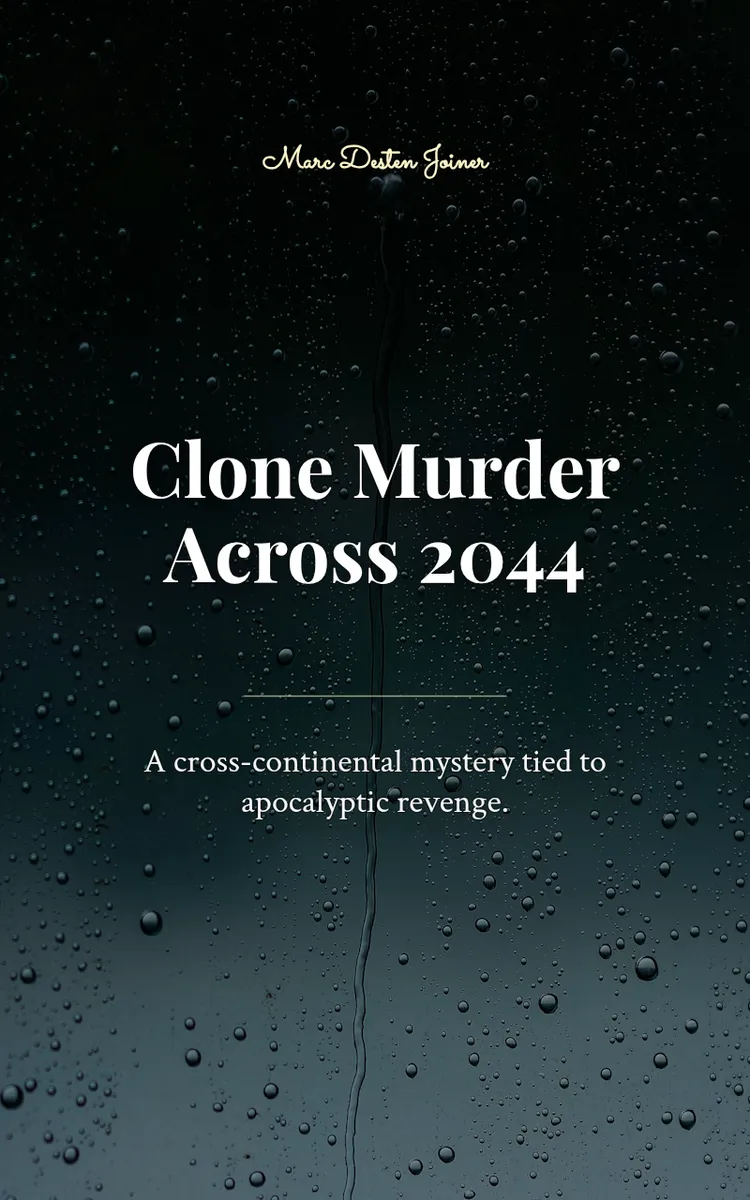
"Clone Murder Across 2044" is a true crime book by Marc Desten Joiner with 8 chapters and approximately 15,085 words. A 2044 murder mystery spanning Paris, Tokyo, and the U.S.
This book was created using Inkfluence AI, an AI-powered book generation platform that helps authors write, design, and publish complete books. It was made with the AI True Crime Book Writer.
Frequently Asked Questions
What is "Clone Murder Across 2044" about?
A 2044 murder mystery spanning Paris, Tokyo, and the U.S.
How many chapters are in "Clone Murder Across 2044"?
The book contains 8 chapters and approximately 15,085 words. Topics covered include The Paris Sevenfold Body Map, Amélie’s Clone-Chain Dilemma, Tokyo’s Hive-Brain Signal Trail, The Epstein-Canon Ledger Crosswalk, and more.
Who wrote "Clone Murder Across 2044"?
This book was written by Marc Desten Joiner and created using Inkfluence AI, an AI book generation platform that helps authors write, design, and publish books.
How can I create a similar true crime book?
You can create your own true crime book using Inkfluence AI. Describe your idea, choose your style, and the AI writes the full book for you. It's free to start.
Write your own true crime book with AI
Describe your idea and Inkfluence writes the whole thing. Free to start.
Start writingCreated with Inkfluence AI


