
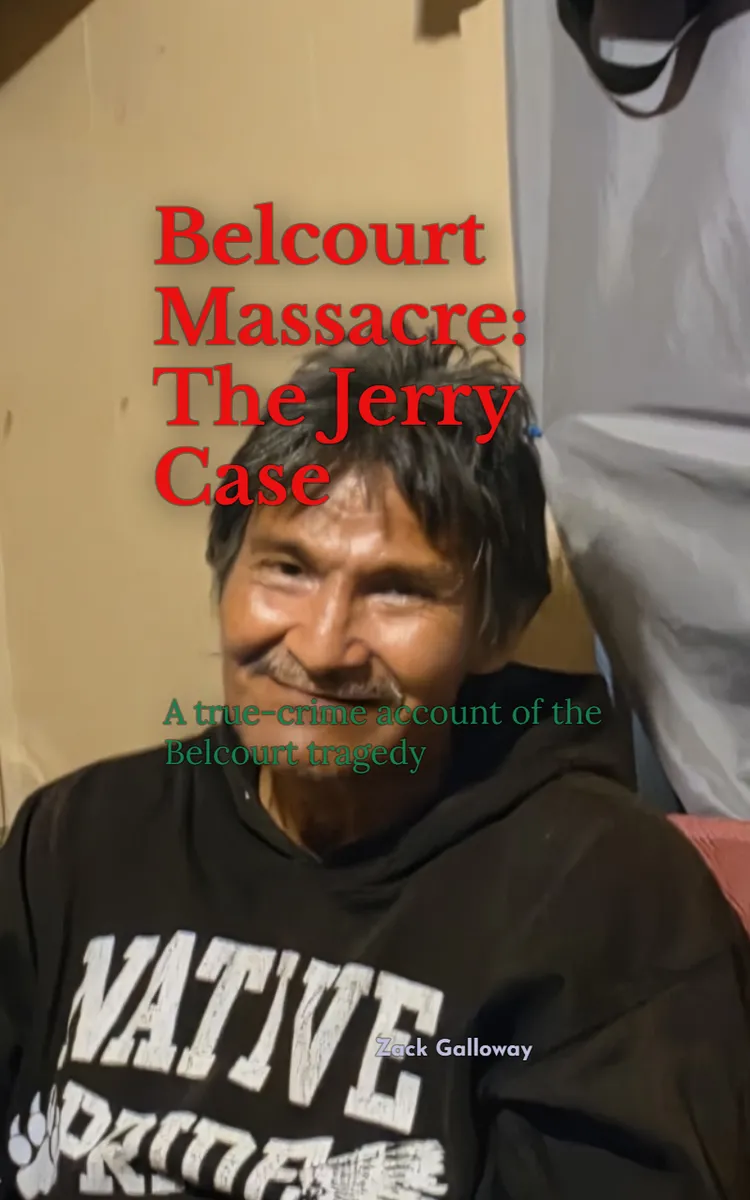

Read the first chapter
The whole of chapter one, free. About 9 min. Turn the pages with the arrows, your keyboard, or a swipe.
Chapter 1
The Belcourt Night Jerry Changed
The first siren cut through Belcourt before anyone could say what had happened. Ellen Peterson stood at the edge of the street in the blue-black cold, one hand gripping her coat closed, while red light moved across the snowbanks and the sides of parked vehicles. Doors opened. People stepped into yards, then stopped there, listening.
A second siren followed from somewhere beyond the houses. Then a third.
No official account had reached the neighborhood. Rumor had.
“Stay back,” someone called.
Ellen could not tell whether the warning came from a responder or a neighbor. The wind carried voices in pieces. There had been shooting. Someone was hurt. More than one person. Jerry had been there. Jerry had left. Jerry was still nearby.
Each version arrived with the confidence of a fact.
The street itself offered no explanation. Snow had been pressed flat by tires and boots. A porch light burned over an empty walkway. Farther down, responders moved between vehicles, their figures briefly visible in the wash of headlights before disappearing again. The air smelled of exhaust, cold metal, and something sharper that Ellen could not identify.
She watched them work and tried to separate what she had heard from what she had seen. That distinction became difficult almost immediately. People spoke over one another. A vehicle reversed with a warning beep. Someone cried out from behind a house, and the sound was swallowed by the wind.
The first shock of the night was not a single discovery. It was the failure of the scene to explain itself.
Belcourt, North Dakota, was not a place where a disturbance could remain contained for long. Streets connected yards, yards opened onto side roads, and in winter the snow recorded movement while darkness concealed it. The first responders had to move through the same confusion as everyone else: uncertain locations, conflicting accounts, and witnesses who had heard something without seeing its source.
Ellen stayed near the street because she wanted to understand what had happened, but every step toward the activity seemed to produce another uncertainty. A responder asked people to clear the area. Someone else asked whether anyone had seen a vehicle. A voice answered that Jerry had gone one way. Another insisted he had gone another.
The name traveled faster than the facts.
At that early stage, the known details were limited:
• Date: The exact date is not established in the available account. - Location: Belcourt, North Dakota, in street and yard areas near the first reported scene. - Victims: The available account confirms multiple victims in what was described as a massacre; individual identities and the confirmed victim count are not provided here. - Status: The case status is not established in the available account.
Ellen looked toward the responders again. Their movements had become more deliberate. One marked an area near the edge of a yard. Another spoke into a radio, turned away from the crowd, and repeated the message. No one announced what had been found. No one confirmed Jerry’s role.
That silence did not slow the rumors. It strengthened them.
Ellen Peterson - Ellen was a local observer caught in the first hours of the aftermath. She had no official authority and no complete account of the violence. Her significance came from her position close enough to hear the commotion and watch the response begin, but far enough away that what she knew remained partial and vulnerable to distortion.
Jerry - Jerry became the central name attached to the incident before the early information had been reconciled. His presence near the reported scene was discussed by witnesses and neighbors, but the initial accounts did not agree about where he had been, when he had left, or what he had done. That uncertainty made him the focus of attention without yet establishing a complete case against him.
Responders - The first responders entered a disordered scene in darkness and cold. Their immediate task was to secure the area, locate victims, identify witnesses, and prevent further danger. Their early reports would have to be built from separate observations made under pressure.
Witnesses and neighbors - People in the surrounding streets supplied the first accounts, but they did not share the same vantage point. Some heard noise from inside their homes. Others saw vehicles or movement between yards. Their statements helped establish the sequence while also exposing contradictions that investigators would need to test.
The night unfolded in fragments.
First reported disturbance - A commotion drew attention in the streets and yards near the initial scene. The available account does not establish the precise time or the first confirmed description of the violence.
Minutes later - Sirens approached Belcourt as residents moved outside and responders began closing in on the area. The presence of multiple vehicles indicated that the event was more serious than an ordinary disturbance.
Early aftermath - Residents heard conflicting reports about the number of victims and the location of the violence. Some information came from direct observation; other details moved through the neighborhood as rumor.
Initial response - Responders worked through the street and adjoining yards, attempting to determine where the incident had begun and whether danger remained. Snow, darkness, vehicles, and the movement of bystanders complicated that effort.
Jerry’s name emerges - Witnesses and neighbors began linking Jerry to the scene. The first references did not agree on whether he had been present at the beginning, had arrived later, or had already left.
Contradictory movement accounts - Separate accounts placed Jerry on different routes through the area. No single early statement established a reliable path.
Scene control - The area was restricted while responders continued to identify victims, preserve potential evidence, and locate people who might have seen or heard the events. The restriction reduced some confusion but also pushed observers farther from the details they were trying to understand.
[TURNING POINT] The name reaches Ellen - Ellen learned directly that Jerry was being tied to the incident. The information came with no consistent explanation of his exact role, turning her concern into a question investigators would have to answer.
The search for a sequence begins - Attention shifted from the general fact of violence to the order of events: where Jerry had been, which route he might have taken, and what witnesses had actually observed.
The first accounts harden - As statements began to circulate, some details were repeated while others conflicted. The case moved from immediate alarm toward an investigation, but the central uncertainty remained.
The physical scene offered only pieces. Snow retained tire tracks and footprints, but the tracks crossed and overlapped as residents, responders, and vehicles moved through the area. Lights swept across yards. Doors opened and closed. A route that might have been clear before the response became difficult to read afterward.
Physical Evidence:
• Tire tracks and disturbed snow in the street and yard areas, potentially relevant to movement through the scene but difficult to interpret after emergency traffic. - Footprints near the reported scene, subject to the same contamination from responders and bystanders. - The locations of vehicles and emergency equipment, useful for reconstructing the response but not, by themselves, proof of who had been involved. - The secured areas examined by responders, where investigators could distinguish original conditions from changes caused by the aftermath.
Witness Accounts:
• Residents reported hearing a disturbance and then seeing emergency vehicles arrive. - Some witnesses connected Jerry to the area, but their accounts differed about his location and movements. - Neighbors described activity along more than one route, creating an early problem for any attempt to place Jerry in a precise sequence. - Ellen observed the response and heard Jerry’s name circulate, but she did not possess a complete firsthand account of the violence.
Investigative Leads:
1. The first reported scene - Responders worked to identify the exact location and boundaries of the incident. The surrounding movement made the original conditions harder to isolate. 2. Jerry’s presence - Investigators pursued accounts placing Jerry near the scene. Early information established his relevance but did not resolve the timing or nature of his involvement. 3. Movement through the snowbound streets - Tire tracks, footprints, vehicles, and witness observations offered possible routes. None of the early details, standing alone, provided a complete path. 4. Conflicting witness statements - Investigators compared what residents heard and saw. The contradictions became leads rather than conclusions. 5. The victims and immediate response - The number and condition of the victims shaped the investigation, but the available account does not provide their identities or a confirmed count.
For Ellen, the most important change came quietly. No officer stood before the neighborhood and named Jerry. There was no verified statement she could repeat with certainty. Instead, his name passed from one person to another until it reached her with the weight of an accusation.
“What did Jerry do?” someone asked near the vehicles.
“I heard he was there,” another person answered.
“That’s not what I heard.”
The exchange ended when a responder ordered everyone farther back. Ellen watched the people retreat toward the yards. Their boots broke the crusted snow, leaving fresh marks over older ones.
What Changed: Jerry’s name became attached to the massacre in the immediate aftermath, even though the early accounts could not agree about his position, route, or exact conduct. The discovery was not a confession or a conclusive piece of evidence. It was the emergence of a central investigative fact: Jerry’s presence had to be established and tested.
Why It Mattered: Until then, the neighborhood was reacting to an unnamed act of violence. Once Jerry’s name began circulating, the response acquired a direction. Investigators could compare statements, examine movement through the streets, and determine whether the accounts placing him near the scene were reliable. But the same development carried a danger: repetition could make an unverified claim sound settled.
What Followed:
• Responders continued securing the scene and separating witnesses from the area. - Investigators began focusing on Jerry’s movements and the conflicting routes described by witnesses. - Ellen faced the possibility that what she had heard might become part of the official record.
By the time Ellen returned inside, the cold had worked through her gloves. She set them on a chair and listened to the house settle around her. Outside, engines idled and radios crackled. The neighborhood had not returned to its ordinary nighttime sounds.
She understood that investigators would need people who had seen something, heard something, or noticed a vehicle moving through the snow. She also understood how little certainty she could offer. She had witnessed the shockwave, not the whole event. Cooperating might help establish the truth, but Jerry’s name was already moving through Belcourt without verification, and fear traveled with it.
Legal Outcome: No trial, verdict, or sentence is established in the available account. The early phase described here remains focused on scene control, witness identification, and the effort to determine Jerry’s connection to the massacre.
Impact:
• The incident disrupted the ordinary sense of safety in the surrounding Belcourt streets and yards. - Conflicting early reports shaped public understanding before an official account was available. - The response created a need to reconstruct movement through snowbound routes and distinguish firsthand observation from rumor.
Unresolved Questions:
1. What was the precise date and time of the massacre? 2. How many victims were confirmed, and who were they? 3. Where was Jerry when the violence began? 4. Which route did Jerry take through the area, if any? 5. What did each witness directly observe, and what details were learned secondhand? 6. What evidence ultimately confirmed or disproved the early accounts of Jerry’s involvement?
Near midnight, another vehicle moved slowly past Ellen’s house, its headlights sliding across the walls. She saw the beam pause, then continue down the street toward the secured area.
Jerry’s name had reached her.
What it meant was still unsettled.
End of chapter one. 7 more chapters and about 16,710 words in the full book.
Swipe or use the arrows to turn the page


What's inside: 8 chapters
- 1. The Belcourt Night Jerry Changed
- 2. Ellen’s Choice to Talk
- 3. Searching the North Dakota Winter Roads
- 4. The Forensic Call That Reframes Jerry
- 5. The Missing Phone Records Break
- 6. Tanya’s Doubt After Contradictory Witnesses
- 7. The Warden’s Tip Leads to the Turning Point
- 8. Aftermath: The Jerry Case’s Final Account
About this book
"Belcourt Massacre: The Jerry Case" is a true crime book by Zack Galloway with 8 chapters and approximately 16,710 words. A true-crime investigation of a Belcourt North Dakota massacre.
This book was created using Inkfluence AI, an AI-powered book generation platform that helps authors write, design, and publish complete books. It was made with the AI True Crime Book Writer.
Frequently Asked Questions
What is "Belcourt Massacre: The Jerry Case" about?
A true-crime investigation of a Belcourt North Dakota massacre
How many chapters are in "Belcourt Massacre: The Jerry Case"?
The book contains 8 chapters and approximately 16,710 words. Topics covered include The Belcourt Night Jerry Changed, Ellen’s Choice to Talk, Searching the North Dakota Winter Roads, The Forensic Call That Reframes Jerry, and more.
Who wrote "Belcourt Massacre: The Jerry Case"?
This book was written by Zack Galloway and created using Inkfluence AI, an AI book generation platform that helps authors write, design, and publish books.
How can I create a similar true crime book?
You can create your own true crime book using Inkfluence AI. Describe your idea, choose your style, and the AI writes the full book for you. It's free to start.
Write your own true crime book with AI
Describe your idea and Inkfluence writes the whole thing. Free to start.
Start writingCreated with Inkfluence AI


