
Read the first chapter
The whole of chapter one, free. About 8 min. Turn the pages with the arrows, your keyboard, or a swipe.
Chapter 1
Love Starts With a New Lens
A New Lens for Seeing Love
What if the word love has been guiding your relationship decisions while carrying the wrong meaning?
Many people call love patience, but practice pressure. They call love honesty, but avoid difficult truth. They call love faithfulness, but remain only when it feels convenient. The word sounds right, yet the choices underneath it tell another story.
The nature of true love gives us a clearer lens. Love is patient. Love is not selfish. Love rejoices in truth. Love keeps faith, love, and hope alive. It isn’t childish in the sense of being playful or tender; it is childish when it is ruled by impulse, pride, entitlement, or the need to win. Mature love puts away those habits and chooses what is steady, truthful, and good.
The Love Lens Reset helps you pause before making a relationship decision and ask, “What would patience, truth, faithfulness, and unselfish care look like here?” That question can change how you speak, stay, leave, forgive, set boundaries, and receive love.
This Chapter Is For You If...
• You often confuse strong feelings with true love and want a steadier way to tell the difference. - You’re making a decision about trust, conflict, commitment, or boundaries and need more than emotion to guide you. - You tend to rush toward closeness, withdraw during tension, or say yes when love requires a healthy no. - You want your relationships to reflect faith, hope, truth, and maturity rather than fear or self-protection.
The Core Truth: Love Needs a Truer Definition
True love is patient, truthful, faithful, and unselfish; it chooses mature care over childish impulse.
Patience doesn’t mean tolerating harm or waiting forever for someone to become responsible. It means refusing to let urgency make your decisions for you. Truth doesn’t mean saying every thought sharply. It means being honest without using honesty as a weapon. Faithfulness doesn’t mean losing yourself to prove loyalty. It means keeping your word, honoring what is right, and remaining dependable when feelings shift.
Love that isn’t selfish still has needs and boundaries. It simply doesn’t make one person’s comfort the ruler of every decision. It can say, “I care about you, and this behavior cannot continue.” It can also say, “I was wrong,” without turning the apology into a performance. This is where love becomes more than affection. It becomes a way of living.
Consider Nora, a 34-year-old school counselor. After a disagreement with her partner, she felt the familiar urge to send a long message late at night. She wanted immediate reassurance, a clear admission of fault, and a promise that the conflict would never happen again. Her first impulse said, “Make this hurt stop now.” The Love Lens Reset gave her a different question: “What would patience and truth require before I respond?”
Nora waited until morning, wrote down what actually happened, and separated facts from assumptions. She admitted where she had spoken harshly. She also named the pattern that needed attention. Her decision wasn’t passive. It was patient, truthful, and faithful to the kind of relationship she wanted to build.
In Practice, This Means...
• You pause before sending a message, ending a relationship, or making a promise while emotionally flooded. - You tell the truth about both your part and the other person’s responsibility. - You choose consistency over grand gestures, especially when no one is applauding. - You measure love by its fruit: safety, honesty, patience, responsibility, and hope.
The Love Lens Reset in Daily Life
The Love Lens Reset is a simple pause for moments when emotion is loud. It doesn’t ask you to become detached or perfectly calm. It gives your heart a little room to speak alongside your feelings.
Use these actions as a daily rhythm:
1. Morning: name the kind of love you intend to practice. Before checking messages, choose one quality: patience, truth, faithfulness, or unselfish care. Write one sentence such as, “Today I’ll practice patience by listening before correcting,” or, “Today I’ll practice truth by saying what I actually need.”
2. Midday: check the motive beneath your response. When a relationship decision appears, ask, “Am I trying to build trust, or am I trying to control the outcome?” This takes less than two minutes. The answer may reveal that a quick reply is really a demand for reassurance, revenge, or approval.
3. During conflict: use the four-question reset. Ask: - What is true, not merely assumed? - What would patience change about my timing or tone? - What would faithfulness require me to honor? - What choice is caring without being selfish?
You don’t need a perfect answer. You need an honest one.
4. Evening: review one decision without condemning yourself. Note where you acted from love’s mature traits and where you slipped into childish patterns such as defensiveness, scorekeeping, silent treatment, or impulsive promises. Then choose one repair for the next day: a clear apology, a calm conversation, a boundary, or a follow-through.
A useful rule is the twenty-minute rule: if you feel ready to send a message that could change the relationship, wait twenty minutes unless safety requires immediate action. During that time, breathe, walk, pray, or write the message without sending it. Patience often begins with a pause small enough to practice.
Truth also needs a container. Choose a time when both people can speak without rushing. Say what happened, how it affected you, and what you need next. Avoid exaggerations such as “you always” and “you never.” Accurate words give love a better chance to be heard.
Faithfulness shows up in the ordinary places. Keep the small promise. Return the call when you said you would. Don’t use private information as leverage. If you need to change your commitment, explain it directly rather than disappearing. These choices may not feel dramatic, but trust is usually built in small deposits.
A Decision Changed by the Love Lens Reset
Before
Nora received a short reply from her partner after sharing a difficult day. The message felt dismissive: “That sounds rough. Hope tomorrow is better.” She immediately decided he didn’t care. Her plan was to ignore him for the evening so he would feel the distance she felt.
The first interpretation made the decision for her. It treated an assumption as truth and punishment as communication. It also made her need for care the only need that mattered in the moment.
Action
Nora used the Love Lens Reset. She asked what she knew and what she was guessing. She knew the reply was brief. She didn’t know whether he was distracted, tired, or unaware that she needed more support.
She waited until after dinner rather than responding from hurt. Then she said, “When I shared about my day, I was hoping you’d ask a little more. I felt alone when the reply stayed brief. Could we talk for ten minutes?”
She also acknowledged her own part: “I almost ignored you instead of telling you what I needed. That wouldn’t have been honest or helpful.”
Result
The conversation didn’t erase every difference. It did create clarity. Her partner explained that he was handling an urgent work issue and had misunderstood the kind of support she wanted. He apologized and asked what would help next time. Nora received care without demanding mind-reading, and he received truth without being attacked.
The result mattered because the lens changed before the behavior did. Patience slowed the reaction. Truth corrected the assumption. Unselfish love made room for both people. Faithfulness kept Nora committed to honest communication rather than emotional punishment.
This approach also protects you from calling every difficult relationship “love.” If a person repeatedly lies, manipulates, threatens, or ignores your boundaries, patience does not require unlimited access. Truth may require naming the pattern. Faithfulness to what is good may require distance. Love can remain compassionate while becoming clear.
Questions for an Honest Reset
1. When I say “I love them,” what behaviors am I actually describing? You may discover that you mean strong attraction, history, fear of loss, or genuine patience and care. Naming the difference helps you stop asking love to carry a meaning it doesn’t have.
2. Where do I use urgency to avoid a truthful conversation? Perhaps you send repeated messages, make sudden promises, or end discussions before your real need is spoken. Honest reflection might show that slowing down would be more loving than pushing for immediate relief.
3. What truth about this relationship have I been editing? This could be a repeated broken promise, your own resentment, or a need you’ve never clearly expressed. Truth isn’t meant to shame you; it gives you solid ground for the next decision.
4. What does faithfulness require here, and what does it not require? Faithfulness may require keeping a commitment, apologizing, or seeking help. It does not require covering up harm, abandoning wisdom, or remaining in a relationship that consistently destroys your well-being.
5. What childish pattern do I need to put away this week? Choose one specific pattern, such as scorekeeping, testing someone’s love, withdrawing to gain power, or insisting on winning. Replace it with one mature action: direct speech, a boundary, a repair, or patient listening.
Make One Love Lens Decision Today
Set aside 15 minutes today to write about one relationship decision currently sitting on your mind. Divide a page into four lines: What is true? What requires patience? What would faithfulness honor? What choice is unselfish and healthy? Then take one action based on your answers - a calm conversation, a sincere apology, a clear boundary, or a necessary pause.
You will know it worked when your next step feels less like a reaction and more like a faithful response. You may still feel nervous. You may still wish the situation were easier. But your choice will be guided by a truer definition of love: patient, honest, dependable, hopeful, and mature enough to seek what is good.
That is how the lens begins to change - not by pretending every relationship is simple, but by learning to see clearly before you choose.
End of chapter one. 20 more chapters in the full book.
Swipe or use the arrows to turn the page


What's inside: 21 chapters
- 1. Love Starts With a New Lens
- 2. Choosing Patience Over Urgency
- 3. Let Love Be Unselfish
- 4. Rejoicing in Truth, Not Drama
- 5. Putting Away Childish Thinking
- 6. Maintaining Faith When Feelings Fade
- 7. Hope That Keeps Showing Up
- 8. Communicating With Patient Clarity
- 9. Boundaries That Protect Love
- 10. Serving Without Controlling
- 11. Turning Off the Selfish Scoreboard
- 12. Handling Conflict With Truth and Mercy
- 13. Rejoicing in Growth, Not Winning
- 14. Love That Refuses to Retaliate
- 15. Healing From Past Hurts Without Carrying Them
- 16. Faithful Love in Small Daily Choices
- 17. Hopeful Boundaries for Hard Seasons
- 18. Truth-Telling That Builds Trust
- 19. Eternal Love: Growing Beyond Temporary Feelings
- 20. Putting Love Into Practice Today
- 21. The Direction That Lasts
About this book
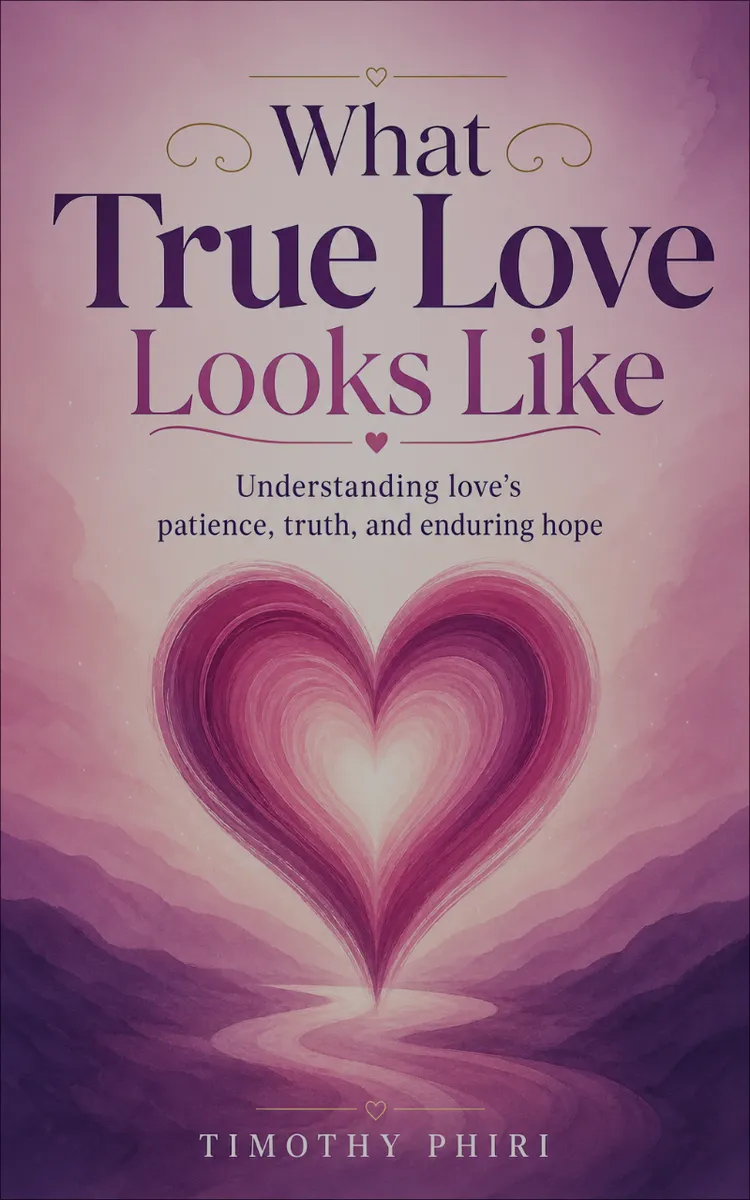
"What True Love Looks Like" is a inspirational book by Timothy Phiri with 21 chapters and approximately 32,568 words. Guidance on the nature and traits of true love.
This book was created using Inkfluence AI, an AI-powered book generation platform that helps authors write, design, and publish complete books. It was made with the AI Inspirational Book Writer.
Frequently Asked Questions
What is "What True Love Looks Like" about?
Guidance on the nature and traits of true love
How many chapters are in "What True Love Looks Like"?
The book contains 21 chapters and approximately 32,568 words. Topics covered include Love Starts With a New Lens, Choosing Patience Over Urgency, Let Love Be Unselfish, Rejoicing in Truth, Not Drama, and more.
Who wrote "What True Love Looks Like"?
This book was written by Timothy Phiri and created using Inkfluence AI, an AI book generation platform that helps authors write, design, and publish books.
How can I create a similar inspirational book?
You can create your own inspirational book using Inkfluence AI. Describe your idea, choose your style, and the AI writes the full book for you. It's free to start.
Write your own inspirational book with AI
Describe your idea and Inkfluence writes the whole thing. Free to start.
Start writingCreated with Inkfluence AI


