
Read chapter 3
The whole of chapter three, free. About 7 min. Turn the pages with the arrows, your keyboard, or a swipe.
Chapter 3
Finding Enough in Simplicity
The Wide Space Between Enough and More
“The Karoo does not apologise for having less; it shows us how much can still be held in that less.”
A dry riverbed, a few thorn trees, a fence running toward the horizon: the Karoo can look almost empty at first glance. Stay with it, though, and the details begin to gather. A lark lifts from the dust. Stone catches the late light. After rain, green appears where you thought nothing was waiting.
That spare beauty asks a useful question: what in your life is actually sustaining you, and what is only occupying space? The difference isn’t always obvious. A full calendar can look like purpose. A crowded room can feel like security. Yet some things leave you steadier, while others simply leave you tired.
The Enoughness Compass helps us notice the difference. It isn’t a rule for owning less or doing less for its own sake. It’s a way of checking whether your time, attention, work, and surroundings are helping you live according to what matters.
Read This Chapter If...
• Your days are full, but you can’t name what they’re full of. - You keep adding tasks, purchases, or commitments without feeling more settled. - You’re deciding what to keep in your home, business, or weekly routine. - You want a simpler life without turning simplicity into another performance.
From Filling the Day to Following What Sustains
The Karoo’s lesson isn’t that emptiness is automatically good. An empty water tank is a problem. An open stretch of land can be harsh without shade, shelter, or a reliable source of water. The lesson is more exact: what looks spare may be carefully arranged around what is essential.
That gives us the From filling every gap → To protecting what sustains shift. The Enoughness Compass points toward three daily changes.
1. From counting activity to noticing nourishment. Instead of asking, “How much did I get done?” ask, “What gave me strength, clarity, or a sense of belonging?” A quiet meal eaten without your phone may sustain you more than three hurried errands. An hour repairing a gate with care may feel more worthwhile than an entire afternoon of restless scrolling.
2. From keeping everything available to choosing what earns its place. The Karoo doesn’t carry a forest where a few hardy shrubs will do. You can apply the same care to your commitments. If a weekly meeting has no clear purpose, question its place. If a tool, subscription, or habit hasn’t served you in three months, don’t let its mere presence make the decision for you.
3. From mistaking desire for need to separating the two kindly. Wanting something isn’t wrong. The useful question is what you expect it to provide. A new jacket may meet a real need for warmth. A second one may be about novelty, recognition, or relief after a difficult week. Naming the deeper need gives you more choices. Sometimes the answer is the purchase. Sometimes it’s rest, company, or a walk beyond the last house.
This isn’t about making your life severe. It’s about making room for the things that keep you rooted. The Karoo’s beauty comes partly from proportion: a broad sky, a low ridge, one acacia holding its ground. Nothing needs to shout to be important.
A Ten-Minute Enoughness Compass Check
Use this ritual at the end of a workday, before supper, or whenever your mind feels cluttered. A scrap of paper works. So does the notes app on your phone. The point is not to produce a perfect record. It’s to make a small clearing.
1. Name what filled the day. - 2 minutes Write down the main activities, not every detail. Include work, messages, errands, purchases, and the time you spent online. Be plain: “answered emails,” “drove to town,” “watched videos,” “fixed the leaking tap.”
2. Mark what sustained you. - 3 minutes Put a star beside anything that left you calmer, stronger, more connected, or more capable. Perhaps it was tea with your partner, finishing a repair, hearing birds before sunrise, or doing one job without interruption.
3. Circle what merely occupied you. - 2 minutes Look for activities that took time but gave little back. Don’t call them failures. Simply circle them. A habit becomes easier to change once it can be seen without drama.
4. Choose one small protection for tomorrow. - 3 minutes Decide what you’ll protect. It might be twenty minutes without your phone, one proper lunch, or the first hour for your most important task. Write when and where it will happen. “Rest more” is vague. “Sit outside with tea at 6:30 before opening messages” can actually happen.
On a low-energy day, use the shorter version:
• Write one thing that sustained you. 1 minute - Write one thing that only filled time. 1 minute - Choose one small thing to leave out tomorrow. 1 minute
That’s enough. The compass still works when the day has been dusty and long. You don’t need a grand reset. You need one honest direction.
When a Full Calendar Hid an Empty Reserve
Situation: A self-employed builder has a week packed with small jobs, supplier calls, quotes, and messages. None of the work is pointless, but the days keep breaking into fragments. He accepts another Saturday job because the calendar has an open space. By Friday afternoon, he’s behind on invoicing, short-tempered at home, and too tired to maintain the equipment that earns his living.
Choice: He uses the Enoughness Compass for one week. Each evening, he marks the tasks that sustained the business: completing a careful repair, speaking clearly with a good client, keeping tools maintained, and sending invoices on time. He circles the tasks that only filled space, including chasing vague enquiries and checking messages every few minutes. On the following Monday, he blocks ninety minutes for invoicing and maintenance before accepting new work. He also gives uncertain enquiries a set reply: “Please send the measurements and required date before I can quote.”
Outcome: The calendar still has work in it, but it no longer controls every hour. The ninety-minute block doesn’t produce an immediate dramatic result. It prevents small problems from becoming expensive ones. By the end of the month, there are fewer unpaid invoices, better-kept tools, and one evening each week that isn’t swallowed by catch-up.
The change wasn’t a retreat from responsibility. It was a clearer distinction between what sustained the work and what merely made the day look busy. That distinction matters whether your workplace is a workshop, a kitchen, a home office, or a patch of land that needs tending.
Questions for a Life with More Room
1. What would happen if you treated your attention like water in a dry season? You might stop pouring it into every request simply because it arrives. Notice which people, tasks, and places return something steady to you, and which ones leave the tank low.
2. When did you last finish a day feeling nourished rather than merely occupied? Look for the conditions around that day. Perhaps there was fewer rushing, one meaningful conversation, or a clear end to work. Those details can show you what to repeat.
3. What would happen if one possession had to explain the space it takes? Choose one drawer, shelf, or cupboard. Ask whether the item is useful, loved, or genuinely needed for a season ahead. Keep the answer honest, not impressive.
4. When did you last say yes because an empty space made you uncomfortable? An unbooked hour can feel like waste when you’re used to measuring life by output. It may instead be the space where recovery, thought, or an unplanned act of care becomes possible.
5. What would happen if “enough” had a number for one part of your life? Set a practical limit: three evenings of work after supper, two social commitments this week, or one online purchase. A number turns a feeling into something you can notice and adjust.
These questions aren’t meant to produce a smaller life by force. They help you see the shape of the life already asking to be lived. The Karoo doesn’t offer abundance everywhere. It offers enough in particular places: shade beneath a tree, water after rain, a road that leads home.
Protect One Essential Thing Tomorrow
Within the next 24 hours, choose one activity that genuinely sustains you and protect it for 20 minutes. Put it on your calendar or write it on paper with a start time. Leave your phone in another room. Then remove one activity that only fills time during that same period.
You might sit outside before work, prepare a proper meal, mend something that has been waiting, walk a familiar road, or finish one important task without switching screens. Keep it ordinary. That’s the point.
Time needed: 20 minutes to protect the sustaining activity, plus 5 minutes to identify and remove the time-filler.
You’ll feel the difference when... the day contains one clear moment you can remember, rather than a blur of things you managed to get through.
Enoughness won’t arrive as a grand announcement. It may feel more like the first green after rain: small, unmistakable, and already part of the land.
End of chapter three. 2 more chapters and about 7,769 words in the full book.
Swipe or use the arrows to turn the page
What's inside: 5 chapters
- 1. Learning to Be Still
- 2. Belonging to a Place
- 3. Finding Enough in Simplicity
- 4. Making Peace with Change
- 5. Carrying the Karoo Within
About this book
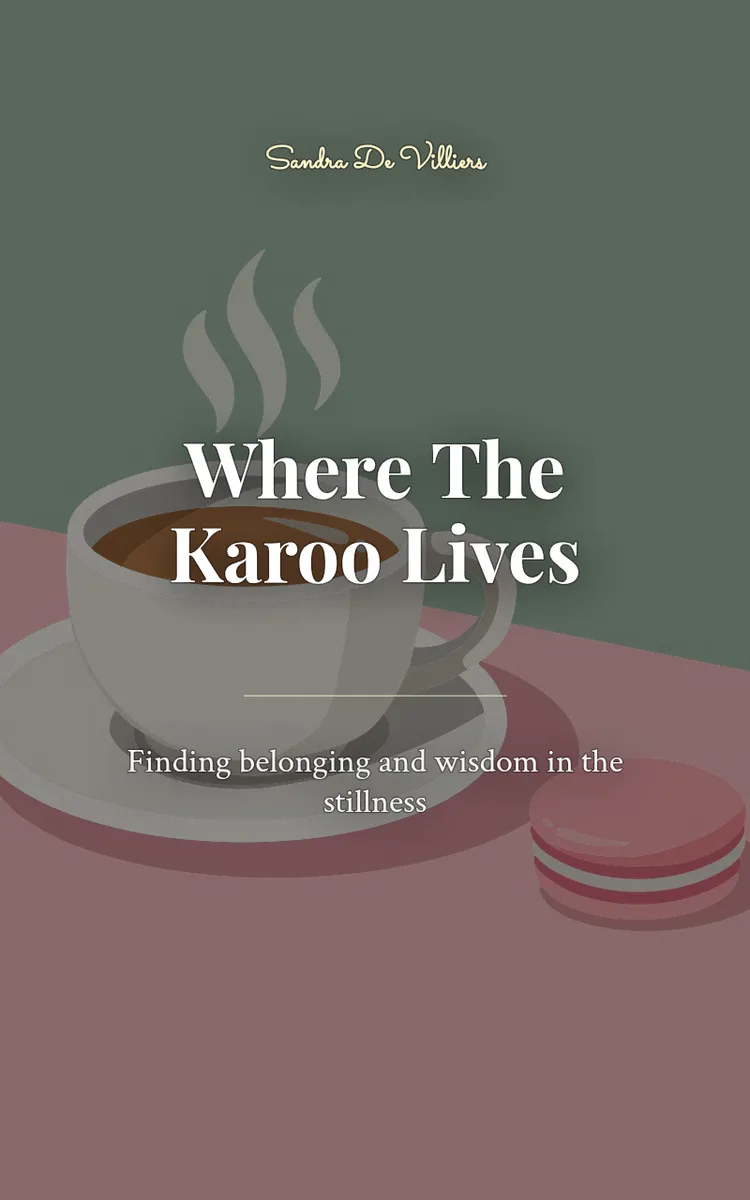
"Where The Karoo Lives" is a inspirational book by Sandra De Villiers with 5 chapters and approximately 7,769 words. Personal connection to the Karoo and lessons found in its stillness.
This book was created using Inkfluence AI, an AI-powered book generation platform that helps authors write, design, and publish complete books. It was made with the AI Inspirational Book Writer.
Frequently Asked Questions
What is "Where The Karoo Lives" about?
Personal connection to the Karoo and lessons found in its stillness
How many chapters are in "Where The Karoo Lives"?
The book contains 5 chapters and approximately 7,769 words. Topics covered include Learning to Be Still, Belonging to a Place, Finding Enough in Simplicity, Making Peace with Change, and more.
Who wrote "Where The Karoo Lives"?
This book was written by Sandra De Villiers and created using Inkfluence AI, an AI book generation platform that helps authors write, design, and publish books.
How can I create a similar inspirational book?
You can create your own inspirational book using Inkfluence AI. Describe your idea, choose your style, and the AI writes the full book for you. It's free to start.
Write your own inspirational book with AI
Describe your idea and Inkfluence writes the whole thing. Free to start.
Start writingCreated with Inkfluence AI


