
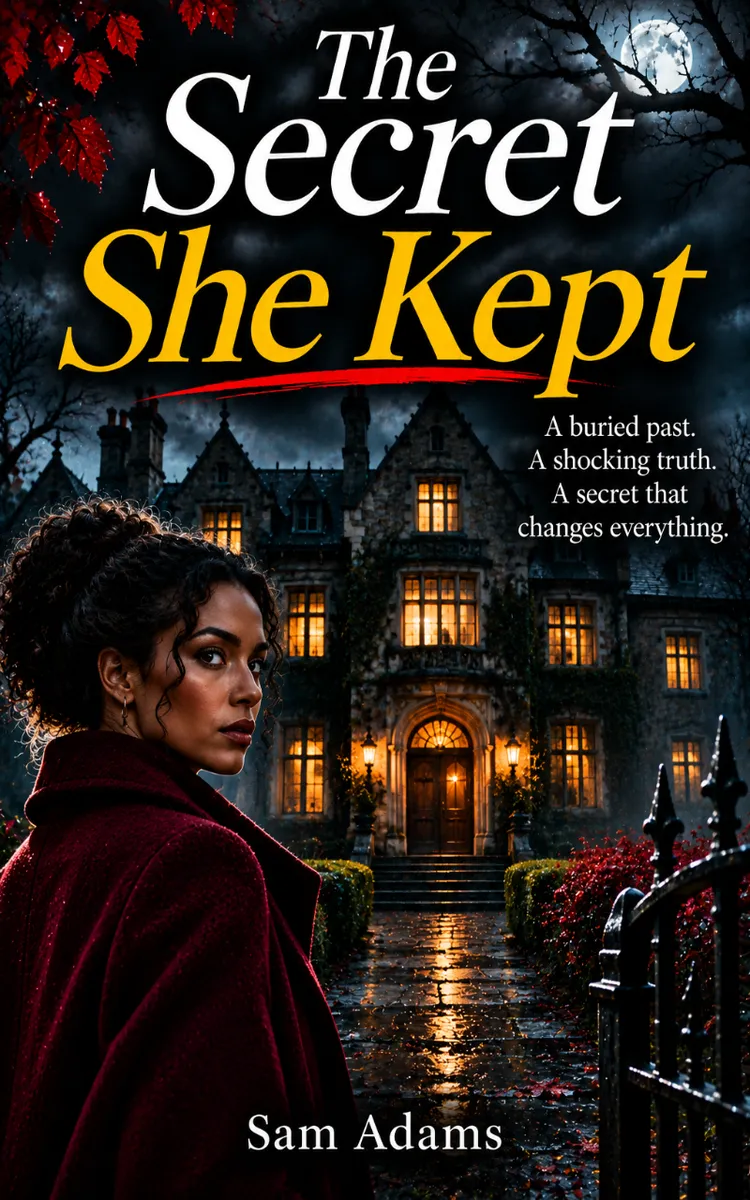

Read the first chapter
The whole of chapter one, free. About 8 min. Turn the pages with the arrows, your keyboard, or a swipe.
Chapter 1
The House Above the Beck
The key snapped in the lock and turned back with a dry, stubborn click.
Catherine Ellis stood beneath the dripping stone porch, one hand around the handle of her suitcase, the other pressed against the swollen door. Beyond the garden wall, the beck ran brown and fast beneath the alders, carrying twigs and last autumn’s leaves towards the valley. The house watched her from its dark windows.
‘Come on,’ she whispered.
She tried the key again. It caught halfway. The metal was cold enough to hurt her fingers.
Her mother had always locked the back door twice. Even when Catherine was a child, even in daylight, she had checked the latch with a sharp tug before drawing the curtains. Catherine could still hear that sound: pull, pause, pull again.
She set down the suitcase and leaned her shoulder into the wood. The door gave a fraction, then stopped. Something scraped on the other side.
Catherine stepped back.
For a moment she listened to the rain ticking against the porch roof and the thin rush of water below the garden. The house had been empty for eleven days. The solicitor had said the police were satisfied with the death being sudden but natural. Her mother had gone to bed on a Tuesday and never woken. Catherine had received the call in a hotel room in Manchester, where she had been staying between work assignments.
She had not cried then. She had cried in the station toilet, with one hand over her mouth.
Now she needed to get inside, open the curtains, find the meter, and begin the practical work. There would be forms. Clothes to sort. Food in the freezer. Her mother’s affairs waiting in their usual untidy piles.
Catherine put her shoulder against the door again.
This time it opened with a groan.
The hallway was colder than outside. A draught moved over her ankles, carrying the stale scent of damp wool and furniture polish. Her torch found the familiar umbrella stand, the framed print of a hare, the narrow table where her mother had kept a bowl for keys. Dust dulled every surface.
‘Mum?’
The word left her before she could stop it.
Nothing answered. Somewhere deeper in the house, a pipe knocked once.
Catherine stepped over the threshold and pulled the door behind her. It would not close properly. The wood had warped, leaving a black line of daylight beside the frame. She tried the handle, then wedged her suitcase against it.
The house seemed to settle around her.
She removed her coat and hung it on the peg nearest the stairs. The peg was loose. It tilted under the weight, just as it had when she was eight, when her mother had laughed and said the whole house was coming apart but would never admit it.
Catherine looked at the staircase.
The wallpaper was patterned with small blue flowers. One strip had lifted near the skirting board, revealing grey plaster beneath. At the top, the landing lay in darkness. She had slept in the room on the left until she was seventeen. The room on the right had been kept locked.
She turned away.
The kitchen was worse than she remembered. Plates stood in the sink beneath a skin of cold water. A mug sat beside the kettle, its tea gone black. On the table, a calendar remained open to the month of her mother’s death. The date was circled in red.
Catherine touched the paper. The ink had bled slightly where a drop of water had fallen.
She switched on the light. It flickered twice, then held.
‘Right,’ she said, though there was nobody to reassure.
She found the fuse box beneath the stairs and checked each switch. Then she opened the curtains in the sitting room. Grey daylight entered reluctantly, showing the dust on the carpet and the dent in the armchair where her mother had spent her evenings.
The dent was still there.
Catherine stood beside it, holding her breath. A cardigan lay folded over one arm. It was dark green, with a loose thread at the cuff. She remembered pulling that thread as a child while her mother read the newspaper. Her mother had slapped her hand away without looking up.
Don’t pick.
The memory came with such force that Catherine nearly sat down.
She crossed to the fireplace instead. The clock above it had stopped at 2.17. Her mother had never allowed it to run fast or slow. Catherine reached up and touched the glass. It was cold.
A sound came from the hall.
Not the house settling. A soft, deliberate knock.
Catherine turned.
The front door stood where she had left it, wedged by the suitcase. Rain silvered the narrow gap. No one was visible through it.
She waited.
Another knock came, this time from the other side of the wall.
Catherine moved into the hall. The sound had come from the back of the house, near the kitchen. She picked up the umbrella from the stand and held it like a weapon, its hooked handle slick beneath her palm.
The kitchen was empty.
A loose branch tapped against the window. Catherine let out the breath she had been holding and almost laughed. The laugh did not come.
She went to the back door. Its bolt was drawn. The window beside it showed the garden, the shed, and the low stone wall that separated the property from the beck. Rain had darkened the paving stones.
There were marks in the mud.
At first she thought they were made by an animal. Then she saw the shape of a sole: a deep heel, a narrow tread, the impression of a small stone caught in the pattern.
One footprint lay below the window.
Another led towards the shed.
Catherine crouched, keeping her hands away from the glass. The marks were blurred at the edges but not washed out. They could have been made that morning. They could have been made an hour ago.
She looked towards the front of the house.
Her mother had not worn outdoor shoes in the kitchen. Even if she had, she would not have walked through the wet garden after her death. Catherine had seen the police photographs. The paramedics had found her in bed.
The umbrella slipped lower in Catherine’s grip.
She unlocked the back door and opened it a few inches. Cold rain touched her face. The garden was empty. The shed door stood closed. Beyond the wall, the beck flashed through the trees.
‘Is someone there?’
Her voice travelled across the garden and vanished.
She shut the door and pushed the bolt home.
For several minutes she stood with her back against it. The refrigerator hummed. Water dripped from the tap. In the distance, a sheep called once and was answered from the next field.
Catherine took out her phone. There was no signal.
She walked through the house, checking each room. The dining room was undisturbed except for a pile of unopened post. In the downstairs cloakroom, the mirror had a grey bloom at its edges. The study door resisted when she tried it, then opened with a sudden jerk.
Her mother’s desk stood beneath the window.
Catherine had intended to deal with it first. The desk contained the solicitor’s papers, bank statements, and the household accounts her mother had kept in a red folder. If she could find those, she could call the solicitor and make a start.
The room smelt of damp paper. A thin line of mud crossed the carpet near the desk.
Catherine stopped.
It was not a footprint, only a smear, as though a wet shoe had been dragged across the pile. She knelt beside it. The fibres were still dark.
The desk drawers were locked.
She searched the usual places: the bowl by the telephone, the kitchen drawer with the batteries and string, the pocket of her mother’s old dressing gown hanging behind the study door. Nothing.
Her mother had kept spare keys in a blue tin marked flour, though there had never been flour in it. Catherine found the tin in the pantry. Inside were two safety pins, a dead moth, and three keys.
The smallest opened the desk.
The first drawer contained bills. The second held old birthday cards, a packet of photographs, and a brown envelope addressed in a hand Catherine did not recognise.
She lifted it.
The name on the front was Eleanor Vale.
Catherine read it twice.
She had never heard of Eleanor Vale.
The envelope had already been opened. Its flap was bent back, and the paper inside had been removed and replaced carelessly. Catherine glanced towards the study door.
There was nobody in the hall.
She pulled out the letter.
The first line was dated twenty-six years earlier.
I should have told you what happened to the child.
Catherine’s fingers tightened around the page.
A floorboard creaked upstairs.
She looked up.
The sound came again, slow and heavy, followed by another: a footstep crossing the landing.
Catherine shoved the letter into her coat pocket and backed into the desk. The umbrella was still in her hand. She raised it, though she knew it would be useless against anyone who had entered the house.
The footsteps stopped.
She could see the bottom of the staircase from the study. Nothing moved above it. The house seemed to draw itself closed, room by room.
Catherine reached for her phone again. No signal. She thought of leaving, but the front door was still blocked by her suitcase, and the letter was in her pocket. She could not walk away from it.
She crossed the hall and seized the suitcase handle. The wheels snagged on the mat. As she pulled, something shifted upstairs.
A door opened.
Catherine let go.
Mud marked the first stair.
Then the second.
The footprints continued up into the darkness, fresh enough that water still shone in the grooves. They were larger than her mother’s shoes, and they led from the front hall to the landing, as if someone had entered while Catherine was outside at the door.
She stared at them until her eyes adjusted.
At the top of the stairs, one final print pointed towards the locked room.
End of chapter one. 19 more chapters and about 37,752 words in the full book.
Swipe or use the arrows to turn the page


What's inside: 20 chapters
- 1. The House Above the Beck
- 2. The Name in the Drawer
- 3. A Child Not Named
- 4. The Locked Boathouse
- 5. The Memory in the Orchard
- 6. The Funeral Photograph
- 7. The Vicar’s Register
- 8. The Flooded Cellar
- 9. The Daughter in the Mirror
- 10. The Sister in the Diary
- 11. The Cousin’s Confession
- 12. The Name Beneath the Ink
- 13. The Quarry Road
- 14. The Death Called Accident
- 15. The Mother’s Last Lie
- 16. The Witness at the Station
- 17. The Tunnel Under the Moor
- 18. The Child in the Tin
- 19. The Sister’s True Name
- 20. The Family She Inherited
About this book
"The Secret She Kept" is a fiction book by Sam with 20 chapters and approximately 37,752 words. A woman uncovers family secrets while investigating a missing child and unexplained death.
This book was created using Inkfluence AI, an AI-powered book generation platform that helps authors write, design, and publish complete books. It was made with the AI Novel Writer.
Frequently Asked Questions
What is "The Secret She Kept" about?
A woman uncovers family secrets while investigating a missing child and unexplained death
How many chapters are in "The Secret She Kept"?
The book contains 20 chapters and approximately 37,752 words. Topics covered include The House Above the Beck, The Name in the Drawer, A Child Not Named, The Locked Boathouse, and more.
Who wrote "The Secret She Kept"?
This book was written by Sam and created using Inkfluence AI, an AI book generation platform that helps authors write, design, and publish books.
How can I create a similar fiction book?
You can create your own fiction book using Inkfluence AI. Describe your idea, choose your style, and the AI writes the full book for you. It's free to start.
Write your own fiction book with AI
Describe your idea and Inkfluence writes the whole thing. Free to start.
Start writingCreated with Inkfluence AI


