
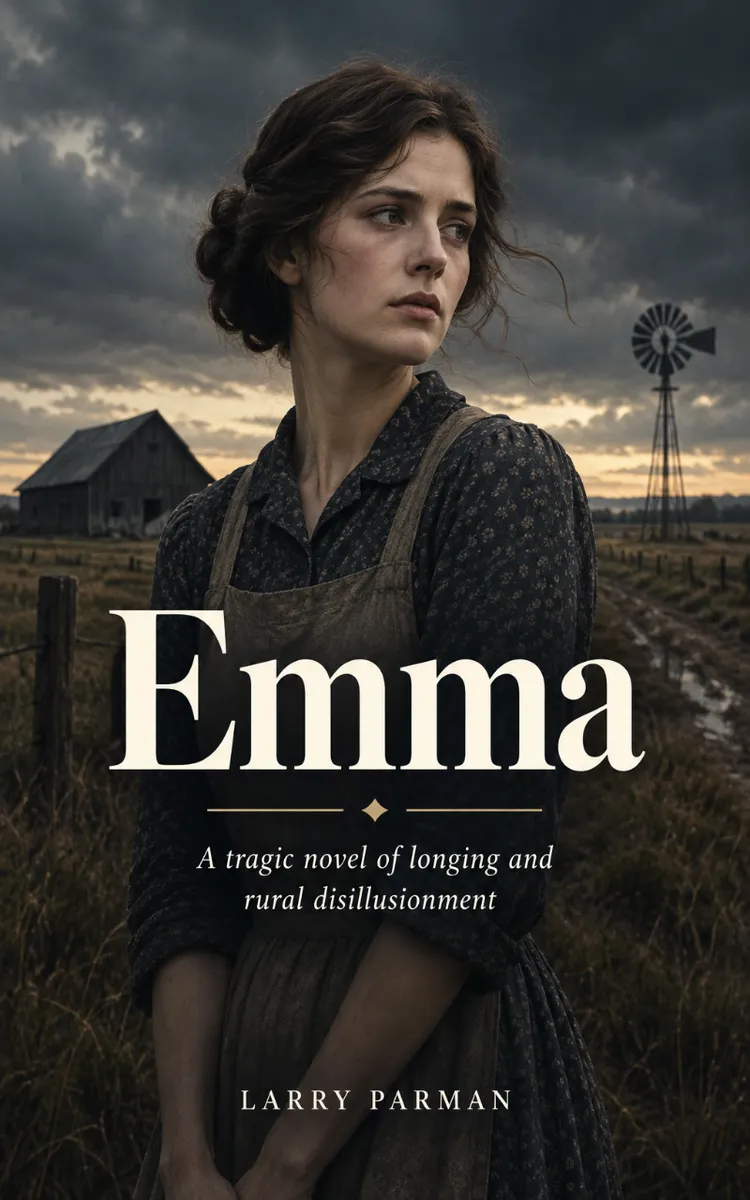
Read the first chapter
The whole of chapter one, free. About 9 min. Turn the pages with the arrows, your keyboard, or a swipe.
Chapter 1
The County Road Home
The train left Emma beside a green watering tank and a platform no wider than a kitchen table. Its last car shuddered past, carrying the sound of iron wheels toward the county seat, while the prairie resumed its enormous silence.
She stood with one gloved hand on her valise and watched the smoke flatten over the fields. Beyond the station, the Hartwell farm lay three miles down a road bleached pale by July dust. She had pictured her return differently: a motorcar waiting, perhaps, or her father’s buggy shining in the sun. Instead there was only a hired wagon, its horse switching flies, and a boy she did not know asleep beneath the seat.
“Miss Hartwell?” the boy called without rising.
Emma gathered her skirt and climbed in. The valise struck the wooden floor. Inside it, between two folded blouses, lay a silver-backed mirror from the finishing school and a stack of magazines whose covers showed women in satin beside city fountains. She kept one hand over them as the wagon started.
The road ran straight through corn taller than a man. Dust climbed through the slats and settled on her stockings. At school, the streets outside her window had been paved and wet with rain; automobiles moved beneath electric signs, and every evening seemed to promise an entrance. Here the fields stood shoulder to shoulder, their leaves rasping in the heat. The only movement was the slow turning of a windmill and the occasional crow lifting from a fence post.
When the farmhouse appeared, it seemed smaller than memory. Its white paint had gone gray along the porch. A washcloth hung from the pump. Near the kitchen door, three hens scratched in the dirt, scattering straw over the path.
Her father came out wiping his hands on a flour sack.
“There she is,” he said.
Emma stepped down. He kissed her cheek, leaving the faint roughness of his beard against her skin.
“You’ve grown thin.”
“I have not.”
“You have.” He reached for the valise. “School must have fed you air.”
She let him take it, though the gesture irritated her. “Is my room ready?”
“It’s as you left it.”
That was precisely what she feared.
Inside, the farmhouse held the smells of boiled coffee, lamp oil, and sun-warmed wood. Her father carried the valise upstairs while Emma paused in the narrow hall. The clock above the parlor door ticked with the same stubborn sound she remembered from childhood. Nothing had been altered to receive her. No fresh curtains, no flowers, no evidence that her absence had made a vacancy anyone felt.
Her room contained the iron bed, the washstand, and the small paper roses she had pasted along the mirror when she was fifteen. Their edges had curled. On the dresser lay a parcel tied with twine.
“What’s that?” she asked.
“Your mother’s things,” her father said from the doorway. “Found them in the attic.”
Emma untied the parcel. Inside was a pair of pearl earrings, a lace collar yellowed at the fold, and a photograph of her mother seated beside a window. The woman in the photograph had a composed, distant expression, as if waiting for someone more interesting to arrive.
“Take the earrings,” her father said. “They’re no use to me.”
Emma held one to the light. Its pearl was small and imperfect.
“I thought you might have had the room papered.”
Her father looked at the walls. “Paper’s expensive.”
“At school, every girl’s room was different.”
“This isn’t school.”
The words fell between them with the finality of a shut door. He picked up the empty twine.
“Dinner in half an hour.”
After he left, Emma opened the window. The screen rattled in its frame. Across the yard, the barn roof flashed red beneath the sun, and beyond it the fields reached without interruption to a low line of trees. She searched for something that might answer her: a road leading toward a town, a distant roof with a cupola, any sign that life here extended beyond the boundaries of the farm.
A truck appeared on the county road and passed in a cloud of dust. For one instant she imagined herself seated in it beside a man with a city hat, traveling toward a hotel where music rose from a ballroom. Then the truck vanished, and the dust settled over the road.
At dinner, her father spoke of rain.
“Three weeks since a proper one,” he said. “If it doesn’t come by Friday, the south field will curl.”
Emma cut into the roast. “Did anyone from the county call?”
“Call about what?”
“About me.”
He looked up. “You’ve been home ten minutes.”
“I mean, did anyone ask when I was returning?”
“Mrs. Bell sent word. She wants you to come Sunday.”
“To sit in her parlor?”
“She has a daughter your age.”
“I know.”
Her father’s fork scraped the plate. “People are glad to see you.”
Emma turned toward the window. In the fading light, the yard seemed to draw nearer. The pump, the chicken shed, the fence with its broken rail - each familiar object took its place as though arranging a boundary around the house.
A car horn sounded from the road.
Her father rose. “That’ll be Charles.”
Emma watched him go to the porch. Dr. Charles Hartwell parked beside the barn in a dark touring car powdered with dust. He was a broad, middle-aged man with a doctor’s black case in one hand and a newspaper tucked beneath his arm. He spoke to her father for a moment, then glanced toward the dining-room window.
Emma lowered her eyes, though she could still see him in the glass.
Charles entered without ceremony.
“Evening,” he said. “I heard the train came in.”
“Emma arrived this afternoon,” her father replied.
“I’m pleased.” Charles set the medical case by the door. “How was school?”
“Finishing school,” Emma said. “It was very pleasant.”
“That’s good.”
He said it as though she had reported a successful harvest. His shirt collar was wilted, and a pale line marked his forehead where his hat had rested. He smelled faintly of carbolic soap and hot leather.
Her father offered him coffee. Charles accepted and sat at the table, speaking of a child with croup near Miller’s farm and a woman whose fever had broken. Emma listened as he described the county in terms of roads, symptoms, and distances. Even illness became ordinary in his mouth.
“You must be tired,” Charles said to her.
“I’m not.”
“You’ll find the farm quiet after school.”
“Quiet is not always a virtue.”
He smiled, uncertain whether she had made a joke. “No. But it’s healthy.”
She wanted him to contradict the place, to confess that the roads were too long and the evenings too empty, that he too had once dreamed of something beyond the county. Instead he finished his coffee and asked her father about the south field.
Later, Emma carried her valise upstairs and unpacked beneath the yellow light of the lamp. She placed the silver-backed mirror on the dresser, then arranged the magazines beside it. Their pages showed Paris gowns, apartment interiors, women leaning from balconies above streets crowded with taxis. She set the pearl earrings in front of the mirror. The room changed hardly at all.
A knock came at the door.
Charles stood in the hall, his hat in his hands.
“Your father says you’re thinking of staying.”
“For a while.”
“I wondered if you had plans.”
She looked at him through the mirror. “What sort of plans?”
“Work, perhaps. There isn’t much here for a woman unless she wants to teach.”
“I didn’t go to finishing school to teach.”
“No.” He considered this. “I know.”
His voice held neither mockery nor admiration. It was simply a fact placed on the table between them.
“Why did you come?” he asked.
Emma turned. “Home is where one comes.”
“Not always.”
The answer startled her. In the doorway, Charles seemed less dull than he had downstairs. The lamplight deepened the hollows beneath his eyes. He looked tired, but not unhappy. His life, she thought, had been built without asking whether he desired it.
“What do you do when you’re not seeing patients?” she asked.
“I read the county paper. Mend things. Sleep.”
“That sounds unbearable.”
“It isn’t.”
She laughed once. “You are very certain.”
“I’m certain about some things.”
The farmhouse creaked around them. From downstairs came her father’s cough, then the scrape of a chair. Charles glanced toward the stairs.
“I could offer you a different house,” he said.
Emma did not move.
“The practice is small,” he continued. “But it’s steady. I have rooms above the office in town, and I’m looking to rent a place nearer the county seat. Nothing grand. A good roof. A proper kitchen.”
She waited for the rest - the declaration, the sudden recognition, the sentence that would lift the room out of its plainness. Charles only held his hat.
“You’re asking me to marry you.”
“Yes.”
“Because you need someone to keep house?”
“Because I think we might suit.”
The honesty offended her more than flattery would have. “You don’t know me.”
“I know you’ve returned from school with no wish to remain here. I know your father cannot give you the life you want. I can give you a respectable home. I can give you security.”
Security. The word had no music in it, yet it opened a door.
She looked again at the mirror, the pearl earrings, the magazines arranged like windows. Charles’s proposal was not the life they promised. It did not contain chandeliers or foreign cities or a man who would look at her as though she had altered the course of his existence. But it offered movement away from the farmhouse. It offered a key, a separate room, a name that might carry her beyond the fields.
“Would I be expected to live here?” she asked.
“For now. Until I find the right place.”
“And your patients?”
“They would still need me.”
“Of course.”
He nodded, relieved by the practical question.
Emma touched one of the pearl earrings. Its surface was cool against her fingertip.
“When would you want an answer?”
“I’m not in a hurry.”
That, too, disappointed her. She had imagined that a proposal would make time stop. Instead the clock downstairs continued ticking, patient and exact.
“Then you have one,” she said.
Charles looked at her. “Yes?”
“Yes. I’ll marry you.”
He stepped into the room and took her hand. His palm was dry, his grip careful.
“I’ll do my best,” he said.
Emma smiled because she believed a smile was required. Through the open window, the windmill groaned once, and the fields answered with their long, whispering rustle. Charles bent and kissed her forehead. The gesture was kind, almost brotherly.
When he had gone, Emma removed the pearl earrings from the dresser and put them on. In the mirror, she saw a young woman dressed for a future that had not yet begun. Behind her, the farmhouse walls remained exactly where they had always been.
Down the road, Charles’s car started and moved toward the county seat. Emma watched its red tail light diminish until it became no more than a coal in the dark. Then she closed the window, not against the night, but against the sound of the fields.
End of chapter one. 39 more chapters and about 94,062 words in the full book.
Swipe or use the arrows to turn the page
What's inside: 40 chapters
- 1. The County Road Home
- 2. A Practical Wedding
- 3. The Rooms Above the Practice
- 4. Winter at the Farmhouse
- 5. The Fever of Discontent
- 6. The County Social
- 7. The Serial’s Last Installment
- 8. The Catalogue Parlor
- 9. A City in the Picture House
- 10. The Bill Charles Cannot Explain
- 11. The City’s Shop Windows
- 12. The Road Back to Stillwater
- 13. The Mirror’s New Face
- 14. The Fairground’s Bright Noise
- 15. Who Ordered the Silk
- 16. The County Line
- 17. The Woman in the Magazine
- 18. A Doctor’s Unanswered Question
- 19. The Drummer at the Depot
- 20. The Question Behind His Stories
- 21. The Promise in the Orchard
- 22. The First Stolen Afternoon
- 23. The Alibi at the Pharmacy
- 24. The County’s Watching Windows
- 25. The Cost of Being Chosen
- 26. The Note Julian Never Answered
- 27. The Ledger’s Missing Pages
- 28. The Empty Hotel Room
- 29. The Banker’s Son Arrives
- 30. The Price of Another Dream
- 31. Where the Money Went
- 32. The Locked County Road
- 33. A Confession Without Relief
- 34. The Clerk’s Last Account
- 35. The County Hears the Truth
- 36. The First Honest Morning
- 37. The Auction of the Parlor
- 38. The Road Charles Takes
- 39. The County’s Quiet Judgment
- 40. The Account That Remains
About this book
"Emma" is a fiction book by Anonymous with 40 chapters and approximately 94,062 words. A restless rural wife pursues romantic fantasies amid 1920s Midwestern life.
This book was created using Inkfluence AI, an AI-powered book generation platform that helps authors write, design, and publish complete books. It was made with the AI Novel Writer.
Frequently Asked Questions
What is "Emma" about?
A restless rural wife pursues romantic fantasies amid 1920s Midwestern life
How many chapters are in "Emma"?
The book contains 40 chapters and approximately 94,062 words. Topics covered include The County Road Home, A Practical Wedding, The Rooms Above the Practice, Winter at the Farmhouse, and more.
Who wrote "Emma"?
This book was written by Anonymous and created using Inkfluence AI, an AI book generation platform that helps authors write, design, and publish books.
How can I create a similar fiction book?
You can create your own fiction book using Inkfluence AI. Describe your idea, choose your style, and the AI writes the full book for you. It's free to start.
Write your own fiction book with AI
Describe your idea and Inkfluence writes the whole thing. Free to start.
Start writingCreated with Inkfluence AI


