

Read the first chapter
The whole of chapter one, free. About 8 min. Turn the pages with the arrows, your keyboard, or a swipe.
Chapter 1
The Woman at the Gallery
The final spotlight was aimed at the blue canvas when the woman stepped into its circle of light.
For a moment, I thought she was part of the exhibition. The gallery was full of deliberate stillness: white walls, polished concrete, sculptures balanced on plinths as if gravity had been persuaded to behave. Even the guests seemed arranged, champagne glasses held at elegant angles, their voices kept low enough not to disturb the art.
Then she looked directly at me.
I had been standing beneath the gallery’s brass clock, watching a collector from Hampstead study one of my installations. The clock’s second hand clicked loudly in the quiet, each movement irritatingly precise. I should have been listening to the collector’s questions. Instead, I found myself staring at the woman across the room.
She wore a dark green coat despite the mild evening, its collar turned up beneath her chin. Her hair was pale and cut bluntly at her jaw. Not fashionable pale. Not the careful silver of women who paid to look older or younger than they were. Hers had the flat, colourless quality of old photographs.
She did not look away.
“Charlotte?”
The collector’s voice brought me back. “I’m sorry?”
“I was asking whether the piece is intended to feel unfinished.”
He smiled as if he had offered me an opportunity rather than caught me drifting.
“Unfinished is exactly the intention,” I said. “The missing sections are there to make the viewer aware of what they’re supplying themselves.”
A safe answer. A polished answer. I had spent years learning how to make uncertainty sound purposeful.
The collector nodded, satisfied. Behind him, the woman remained motionless.
I turned towards the bar and lifted a glass I did not want. The champagne was warm against my fingers. Across the gallery, my exhibition continued to gleam under its carefully calibrated lighting. The folded-metal sculpture near the entrance had already attracted a buyer. My name appeared in discreet black lettering beside each work. Charlotte Hayes, curator and creative director. A woman who knew how to make things appear complete.
My phone vibrated in my handbag.
I glanced down, expecting Daniel.
He had promised to text once he and the children had eaten. He was taking them to his sister’s in Richmond for the night, giving me the freedom to host the private viewing without worrying about bedtime, spilled juice or Sophie’s sudden conviction that she was too old to be kissed in public.
The message was from Daniel.
Hope it’s going well. Proud of you. Don’t stay too late x
I felt the familiar warmth that came whenever he wrote something simple and kind. I typed, It’s perfect. Love you. Then I looked up.
The woman had moved.
She stood beside the partition wall, close enough to one of my photographs that her shoulder almost touched the frame. The image showed an empty hallway with a door at the far end. The woman’s gaze had shifted to the photograph, but I knew she was watching me through the glass.
“Charlotte, there you are.”
Mara, the gallery owner, appeared at my elbow with a tray of fresh glasses. Her perfume was sharp and citrusy, cutting through the scent of wine and warm electrical equipment.
“The London Review photographer is here,” she said. “He wants a word before he leaves.”
“Of course.”
“And the couple by the window are asking whether the red piece is available.”
“I’ll speak to them.”
Mara followed my glance. “Do you know her?”
“No.”
The answer came too quickly. Mara noticed. She noticed everything.
“She’s been here since before the doors opened,” she said. “I assumed she was with you.”
“She isn’t.”
Mara looked over her shoulder. The woman had turned away from us and was examining the photograph as though she had all the time in the world.
“Do you want me to ask security to remove her?”
The question should have relieved me. Instead, I imagined the woman being approached, her face tightening, her attention becoming public. I imagined every guest turning to watch. The exhibition would acquire a story, and the story would not be about my work.
“No,” I said. “She may be a journalist.”
“She doesn’t look like one.”
“Neither do I, apparently. People keep asking whether I’m the assistant.”
Mara gave a brief laugh, but I could feel her still watching me.
“I’ll handle it,” I said.
The photographer from the London Review caught me near the red sculpture. He was young, damp-haired and eager, with a recorder clipped to his jacket.
“What drew you to domestic spaces?” he asked.
I smiled for him. “The tension between what a home promises and what it conceals.”
The words left me before I could stop them.
He leaned closer. “Conceals?”
“Emotionally,” I said. “Not literally.”
He laughed, and I laughed with him. The exchange was harmless. I knew how to make harmlessness convincing.
Over his shoulder, I saw the woman lift her phone.
A small black rectangle. The screen faced me.
I stopped smiling.
“Charlotte?” the photographer prompted.
“Sorry. The lights are rather bright.”
He glanced up at the spotlights. “They are.”
I forced myself to answer the rest of his questions. I spoke about negative space, domestic architecture and the unreliable nature of memory. I heard my own voice moving smoothly through the room while part of me counted the distance between the woman and the nearest exit.
When the interview ended, she was gone.
I searched the gallery without appearing to search it. The entrance stood open to the pavement, where taxis moved through the rain-slicked street. A waiter carried an empty tray towards the service corridor. Guests clustered around the bar, talking over one another.
No green coat.
“Looking for someone?” Mara asked.
“No.”
She gave me a sympathetic smile. “You’re doing that thing.”
“What thing?”
“Pretending you’re not frightened.”
The word landed harder than it should have.
“I’m not frightened.”
“Then stop checking the door.”
I looked towards it again.
Before Mara could say anything else, a man in a charcoal suit approached and introduced himself as the buyer interested in the red piece. He spoke at length about his wife’s taste and his own preference for work that made guests uncomfortable. I answered him, nodded at the right moments, and kept my hand wrapped around my phone.
At half past nine, the gallery began to empty. The room looked different without the crowd. My work became less impressive and more exposed. The white walls seemed colder. Somewhere in the back, a tap dripped at measured intervals.
I helped Mara gather abandoned glasses. When I bent to lift one from the floor, I noticed a cream envelope beneath the nearest plinth.
There was no stamp. No name.
For one second I thought it belonged to Mara. Then I saw the handwriting.
My name was written across the front in narrow black capitals.
CHARLOTTE HAYES.
I straightened slowly.
Mara was at the bar with her back to me. “Are you all right?”
“Yes.”
The lie came easily. That was the worst part.
I slid the envelope beneath my exhibition catalogue and carried both to the office. The room was barely larger than a cupboard, with a desk, a printer and a security monitor showing the gallery entrance in grainy black and white. I closed the door.
The envelope was unsealed.
Inside was a photograph.
It showed the front of my house.
Not a photograph from the estate agent’s website. Not the flattering image Daniel had once taken for our Christmas card. This had been taken from the pavement opposite, through the railings and the wet branches of the magnolia tree.
Our upstairs windows were lit.
In one, I could make out the pale shape of Sophie’s curtains. In another, the warm yellow square of our bedroom.
The date was printed in the bottom corner.
Three days earlier.
I pressed my thumb against the glossy paper. The edges were damp, as if someone had held it in the rain.
On the back, a single sentence had been written.
YOU BUILT IT ON WHAT YOU BURIED.
The gallery door opened.
I shoved the photograph into the inside pocket of my jacket and turned so quickly that my hip struck the desk.
Mara stood in the doorway. “I’ve been calling you.”
“I didn’t hear.”
“The last guests have gone. Security is locking up.”
“I’ll be out in a minute.”
Her eyes moved to my jacket, then to the closed envelope on the desk.
“Is there a problem?”
“No.”
“Charlotte.”
I wanted to tell her. The words rose as far as my throat and stopped there. If I said them aloud, the photograph would become real in a different way. It would belong not only to me but to someone else, someone who might ask sensible questions I could not answer.
Mara stepped inside. “You look ill.”
“I’m tired.”
“That woman left before the photographer.”
I stared at her.
“What woman?”
“The one in the green coat.”
“Did you see her go?”
“No. She was simply gone.”
The security monitor flickered. The entrance was empty now, the pavement shining under the street lamps. A black umbrella passed across the screen, then disappeared.
Mara touched my arm. “Do you want me to call someone?”
“No.”
“Daniel?”
His name tightened something inside me.
“No,” I said again, more sharply. “He’s with the children.”
Mara withdrew her hand. “All right. But I’m walking you to your car.”
“I came by taxi.”
“Then I’ll wait until it arrives.”
I almost refused. Then I pictured the woman standing outside, watching through the rain, and accepted.
We left the office together. I kept one hand over the inside pocket of my jacket. The photograph pressed against my ribs with every step.
At the gallery entrance, Mara checked the street. “Nothing.”
I looked past her.
The woman was not there. The pavement was empty. The only movement came from rainwater running along the kerb.
A taxi pulled up. I stepped towards it, then stopped.
Across the road, fixed to a black iron railing, was a small white card. It fluttered once in the wind.
I crossed before Mara could stop me.
The card was blank on one side. On the other, beneath a blurred photograph of my house, someone had written:
ASK DANIEL WHAT HE REMEMBERS.
My fingers went numb.
“Charlotte,” Mara called. “Come back.”
I tore the card from the railing and folded it into my palm. When I turned towards the gallery, the woman in the green coat stood at the far end of the street.
She was watching me.
A bus passed between us.
When it had gone, she had vanished.
I got into the taxi with the photograph hidden beneath my coat, leaving Mara beneath the gallery lights. As the car pulled away, I looked back through the rain-streaked window at the empty pavement.
For the first time that evening, I did not care whether anyone had admired my work.
I was thinking about the light in our upstairs windows, and who had been standing outside our house when the photograph was taken.
End of chapter one. 39 more chapters and about 78,990 words in the full book.
Swipe or use the arrows to turn the page


What's inside: 40 chapters
- 1. The Woman at the Gallery
- 2. The Hayes Family Breakfast
- 3. A Date I Buried
- 4. The Locked Archive
- 5. The Lie I Chose
- 6. The Photograph in Felix’s Bag
- 7. The School Gate Witness
- 8. The Empty Car Park
- 9. The Name I Won’t Say
- 10. The Police Interview
- 11. The Gallery’s Visitor Log
- 12. The House Without Power
- 13. A Mother’s Alibi
- 14. The Missing Key
- 15. The Client Who Knew
- 16. The Hotel Corridor
- 17. The Confession Rehearsal
- 18. The School Evacuation
- 19. The Woman on the Platform
- 20. The Locker’s Contents
- 21. Mara’s Photograph
- 22. Daniel’s Old Photograph
- 23. Elise’s Last Letter
- 24. The Flooded Underpass
- 25. The Story I Rewrote
- 26. The Anonymous Caller
- 27. The Board’s Questions
- 28. The House Under Watch
- 29. Daniel’s Hidden Meeting
- 30. The Truth I Cannot Keep
- 31. The Original Statement
- 32. The Archive Basement
- 33. My Name in Elise’s Hand
- 34. The Adviser’s Address
- 35. The Recording at the Gallery
- 36. The Confession to Daniel
- 37. The Children’s Questions
- 38. The Empty Gallery
- 39. The Statement I Sign
- 40. A Smile Without Practice
About this book
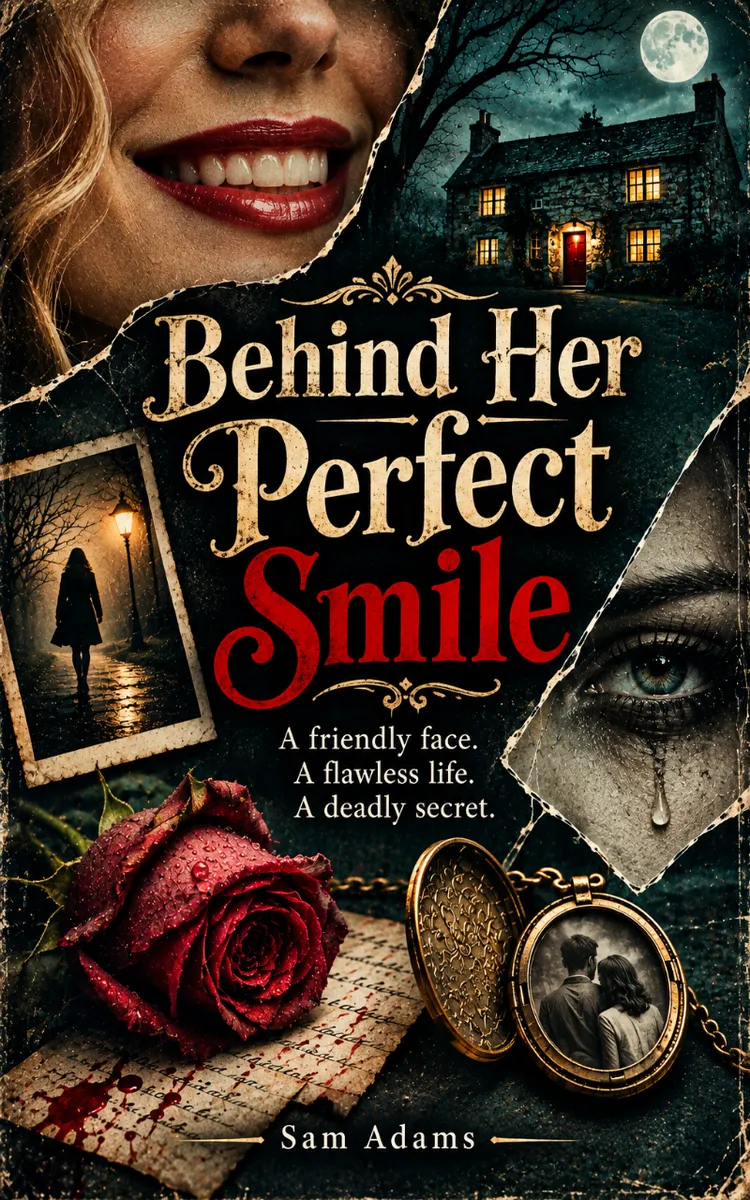
"Behind Her Perfect Smile" is a fiction book by Sam with 40 chapters and approximately 78,990 words. A woman’s carefully built family life unravels under threats from her past.
This book was created using Inkfluence AI, an AI-powered book generation platform that helps authors write, design, and publish complete books. It was made with the AI Novel Writer.
Frequently Asked Questions
What is "Behind Her Perfect Smile" about?
A woman’s carefully built family life unravels under threats from her past
How many chapters are in "Behind Her Perfect Smile"?
The book contains 40 chapters and approximately 78,990 words. Topics covered include The Woman at the Gallery, The Hayes Family Breakfast, A Date I Buried, The Locked Archive, and more.
Who wrote "Behind Her Perfect Smile"?
This book was written by Sam and created using Inkfluence AI, an AI book generation platform that helps authors write, design, and publish books.
How can I create a similar fiction book?
You can create your own fiction book using Inkfluence AI. Describe your idea, choose your style, and the AI writes the full book for you. It's free to start.
Write your own fiction book with AI
Describe your idea and Inkfluence writes the whole thing. Free to start.
Start writingCreated with Inkfluence AI


