
Read the first chapter
The whole of chapter one, free. About 9 min. Turn the pages with the arrows, your keyboard, or a swipe.
Chapter 1
Why EVs Feel Instant
The Torque-First Feel Model: Why Electric Acceleration Starts Like a Switch
A rideshare driver once told me something that sounds backwards if you’ve mostly driven gas cars: the “push” from an EV often feels like it arrives before your foot fully finishes the motion. Not in a mystical way - more like the car is already prepared, already spinning up the right response, and your pedal is simply turning a ready signal into motion. The paradox is that electric cars can feel simpler on the inside while delivering a start that seems almost too immediate.
That immediacy isn’t just marketing language about “instant torque.” It’s the combined effect of torque, traction, and the motor control logic that decides what the wheels should do second by second. In this chapter, we’ll trace how those pieces line up so smoothly that acceleration can feel both forceful and calm, even when traffic is stop-and-go and the road surface is doing its own unpredictable thing.
Electric vehicles don’t accelerate because they have a different engine sound. They accelerate because they have a different way of making force - and because the computer controlling that force reacts in a way your muscles can’t measure but your body can feel. So why does an electric car’s push often land like a well-timed shove, while a gas car tends to feel like it’s negotiating its response?
Torque, Traction, and the “Instant” Part of Acceleration
To understand the “instant” feeling, it helps to start with a basic mechanical fact: torque is twisting force, and what matters at the wheels is how that twist turns into acceleration through the tire-road grip. In a typical electric motor, the magnetic field and electrical current are coordinated so the motor can generate torque right away at low speed. Gas engines don’t work that way. They create torque through combustion, and combustion has to build - air intake, fuel delivery, ignition timing, and the steady spinning that comes with rpm.
When people say “EVs have instant torque,” they’re compressing a deeper story. The motor can produce torque at near-zero vehicle speed, but the car still has to decide how much torque to apply so the tires don’t just spin. That decision is where traction becomes the real character in the drama. A slippery street turns “instant torque” into instant wheelspin if the control system didn’t act quickly.
Historically, this control problem is not new. Early electric vehicles were often described as smooth at low speeds, but they were also limited by less sophisticated power electronics. Modern EVs use fast switching and high-resolution sensing - things that weren’t practical in early electric cars. The result is that the torque request from your pedal is translated almost immediately into motor commands, and those commands are continuously adjusted based on wheel speed, vehicle speed, and stability needs.
The key point is that the car doesn’t simply “give you torque.” It curates torque to match the traction available under the tires. That’s why EV acceleration can feel both strong and smooth: the car avoids the jerky tug that would happen if it treated the road like it was always perfectly grippy.
Even the language we use hints at how different the experience is. In a gas car, the sensation of acceleration often comes with a ramp-up: engine rpm rises, the drivetrain catches up, and the car builds momentum. In an EV, the drivetrain is already in the business of producing torque, and the ramp-up is more about the control system steering how quickly that torque reaches the wheels.
Nina’s Rideshare: When Control Meets Busy Streets
Consider Nina, 34, who drives for a rideshare service in a dense city where stops are frequent and road conditions can change block to block. Her workday isn’t a track day. It’s curbside starts, merges, and short gaps in traffic where you want the car to move promptly - but not in a way that jerks passengers forward or triggers tire squeal. Her “feel” for the car comes from repetition: the same street corner in morning rain, the same on a dry afternoon, the same again when construction changes the pavement.
On a rainy stretch, Nina notices that the car’s initial push doesn’t turn into drama. The acceleration is still there, but it behaves like it’s respecting the grip. That’s traction control working in the background, but the sensation is broader than “traction control exists.” It’s that the electric drivetrain can deliver torque immediately, and the vehicle’s control system can shape that torque so the wheels don’t lose contact with the road.
On a dry day, the car can feel even more responsive - not because it’s making a different kind of force, but because the control system has more traction to work with. The same torque request from the pedal translates into a different wheel behavior depending on how much grip is available. Nina doesn’t need to know the math to feel it. She feels a push that’s quick, then settles into a steady pull rather than a series of surges.
This is also why EVs can feel calm in traffic. A gas car’s response can depend on the engine’s operating point and the drivetrain’s readiness. An EV’s response can be tuned around a desired acceleration curve, so the transition from stationary to moving can be made to feel consistent. For a rideshare driver, consistency matters: passengers notice sudden lurches even if they don’t know why they happen.
Nina’s experience is a reminder that “instant” doesn’t mean “uncontrolled.” It means the system is ready to generate torque right away, and then the control software makes sure that readiness doesn’t produce wheelspin or harshness. Smoothness isn’t an accident; it’s the audible and tactile result of control decisions happening faster than your conscious mind can track.
How Motor Control Turns Torque into a Smooth Push
A motor can only create torque when electricity and magnetic fields are coordinated in the right way. That coordination is handled by motor control - electronics that measure what’s happening and adjust what they command. The most important thing to grasp is that torque isn’t a fixed output. It’s an adjustable target, and the car continuously updates that target to match real-world conditions.
One way to picture the control problem is to think of the car as juggling competing goals: strong acceleration, stable traction, and rider comfort. If the system aims for too much torque at low speed on a wet surface, the tires will slip. Slip sounds like a small problem until you consider what it does to acceleration: wheelspin wastes energy and can make the car feel unpredictable. It also affects stability, because sideways motion can begin at the tire contact patch before you feel it as a “spin.”
So the control system uses feedback. It watches wheel speeds and vehicle behavior, then adjusts torque accordingly. The “instant” feeling comes from the fact that the system can respond rapidly enough that the torque curve you feel is shaped rather than merely delivered. The car can decide, for example, to reduce torque momentarily when it sees the wheels starting to spin, then reapply smoothly as grip returns.
There’s also a human reason EVs feel smoother: the torque request from your pedal can be interpreted into a controlled acceleration response rather than an immediate raw force. In other words, the car can translate your input into a target that feels progressive. That translation is part mechanical, part electronic, and part calibration - tuned so the first movement forward doesn’t feel like a sudden jerk.
This is where traction and motor control become inseparable. Torque is the “engine of acceleration” in an EV, but traction is the limiter that decides how that torque can safely become forward motion. Motor control is the referee, timing the torque so the tires stay within the grip zone.
It’s also why two EVs can feel different even if they both advertise strong acceleration. Different motor control strategies, tire choices, vehicle weight, and drivetrain tuning all affect the shape of the torque-to-wheel response. The same underlying physics can feel “instant” but not identical, because the control layers decide what instant means in practice.
And if you’ve driven a car that feels jumpy at low speed, you’ve already encountered what happens when the control doesn’t keep up with traction. The EV’s advantage isn’t only that it can make torque quickly. It’s that it can manage that quick torque so it doesn’t turn into roughness.
The Counterintuitive Link: “Instant” Depends on Slower-Than-You Think Decisions
Here’s the surprise: the acceleration you feel as “instant” is often the result of control decisions that are happening extremely fast, but the final feel is shaped by something that looks almost opposite - limits and smoothing. In other words, the car’s immediate torque capability doesn’t automatically translate into immediate wheel torque. The control system may intentionally restrain or reshape the torque at the very beginning to keep the tires planted and the motion comfortable.
That matters because it challenges a common mental picture: that EVs accelerate instantly because they simply push harder from the start. The reality is more nuanced. The initial response is immediate in potential - the motor can generate torque right away - but the realized acceleration is filtered through traction limits and comfort targets.
This reframing changes how you interpret everything you feel. When an EV launches smoothly, you’re not just noticing an absence of lag; you’re experiencing a carefully managed negotiation between electric power and tire grip. When it launches more assertively on dry pavement than on wet pavement, you’re watching the control system adapt in real time. “Instant” isn’t a single switch. It’s a controlled pathway that stays stable even when conditions change.
The counterintuitive part is that smoothness can be evidence of restraint, not raw power. A car that jumps too quickly would feel “instant” in the wrong way - like a lurch. The EV’s advantage is that it can be immediate without being chaotic, and that requires the control system to be both fast and selective.
What Nina’s Car Teaches About How Bodies Learn Motion
There’s a broader human angle hiding inside Nina’s daily driving. People don’t experience acceleration as physics; they experience it as a sequence of sensations - how the seat pushes back, how the body settles, how the tires sound and feel at low speed. The brain is quick to flag mismatch: if the car surges, the body reads it as instability. If the car eases too slowly, the brain reads it as delay.
EVs succeed at “instant feel” partly because they’re engineered around that sensory reality. The torque is available instantly, but the motion is presented to your senses in a way that matches what stability feels like. That’s why passengers often describe EV acceleration as smooth even when it’s strong: the car is using motor control to keep the transition coherent.
In a city, the real world supplies constant variability - wet leaves, patchy asphalt, uneven traction where one wheel grips more than the other. Nina’s rides are a rolling experiment in traction conditions. The fact that the car still feels predictable points to a larger truth about technology: the most impressive performance isn’t just the ability to do something quickly. It’s the ability to do it consistently while the environment refuses to cooperate.
And it leaves you with a question worth carrying into the next parts of EV technology. If a motor can create torque instantly, what else do we take for granted about “instant” in the way computers respond - especially when the final outcome is not speed, but feel?
End of chapter one. 7 more chapters in the full book.
Swipe or use the arrows to turn the page


What's inside: 8 chapters
- 1. Why EVs Feel Instant
- 2. Inside the Battery: Cells to Pack
- 3. BMS: The Battery’s Silent Babysitter
- 4. AC vs DC: How Charging Really Works
- 5. The Charger Handshake That Protects You
- 6. Regenerative Braking: Charging While Slowing
- 7. Inverter Magic: Turning Battery Power into Motion
- 8. Range Math: Where Energy Actually Goes
About this book
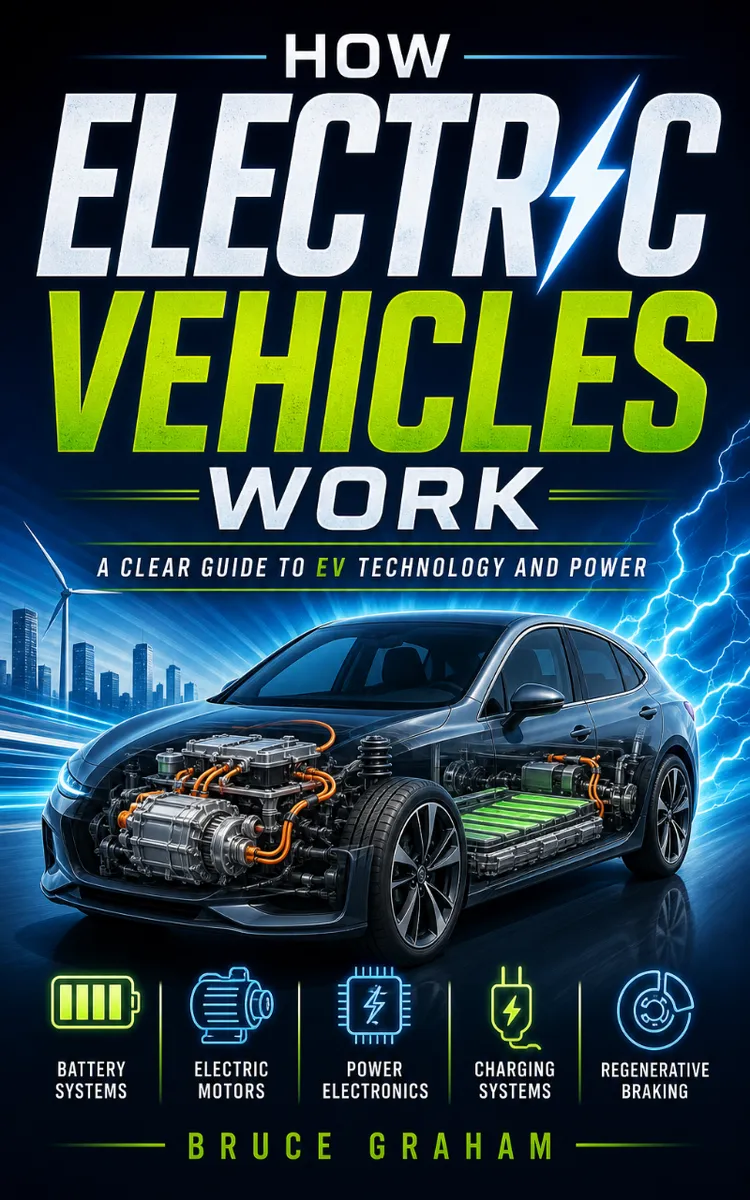
"How Electric Vehicles Work" is a curiosity book by Bruce Graham with 8 chapters and approximately 14,951 words. Electric vehicle technology explained: batteries, motors, charging, and control.
This book was created using Inkfluence AI, an AI-powered book generation platform that helps authors write, design, and publish complete books.
Frequently Asked Questions
What is "How Electric Vehicles Work" about?
Electric vehicle technology explained: batteries, motors, charging, and control
How many chapters are in "How Electric Vehicles Work"?
The book contains 8 chapters and approximately 14,951 words. Topics covered include Why EVs Feel Instant, Inside the Battery: Cells to Pack, BMS: The Battery’s Silent Babysitter, AC vs DC: How Charging Really Works, and more.
Who wrote "How Electric Vehicles Work"?
This book was written by Bruce Graham and created using Inkfluence AI, an AI book generation platform that helps authors write, design, and publish books.
Write your own curiosity book with AI
Describe your idea and Inkfluence writes the whole thing. Free to start.
Start writingCreated with Inkfluence AI


