
Read the first chapter
The whole of chapter one, free. About 9 min. Turn the pages with the arrows, your keyboard, or a swipe.
Chapter 1
The New Prometheus of Governance
The Infrastructure Hidden in Plain Sight
In 2023, officials in Brussels were negotiating rules for artificial intelligence while millions of people were already using systems that crossed borders without asking permission. A model trained in one country could be hosted in another, queried from a third, and used to make decisions affecting people in dozens more. The machinery was digital, but the problem looked strangely old: who sets the rules for a system everyone depends on?
That question is larger than whether a chatbot gives a wrong answer. AI is becoming part of hiring, banking, public administration, scientific research, logistics, and security. Its influence travels through supply chains that are difficult to see: chips designed in one place, manufactured in another, assembled into data centers elsewhere, and connected to software used around the world.
This is why AI governance is not merely a matter of writing rules for a new industry. It is an attempt to build shared infrastructure for a technology whose effects move faster than national borders. Roads, ports, electrical grids, and telecommunications networks all required standards that allowed strangers to rely on the same systems. AI presents a similar challenge, except that the infrastructure is also making judgments.
What happens when the world’s newest infrastructure is not only carrying decisions, but helping to make them?
From Local Machines to Global Systems
The phrase “artificial intelligence” once suggested a machine in a laboratory or a computer program performing a narrow task. Today, the important systems are less like isolated machines and more like weather systems. They draw energy, data, talent, chips, and capital from many places, then release consequences far beyond the site where they were built.
The basic ingredients are familiar. A model learns patterns from large collections of text, images, sound, or other data. Its internal settings - often called weights - are adjusted during training, much as a vast network of tiny dials is tuned until the system becomes capable of producing useful outputs. Once trained, the model can be copied, adapted, connected to other software, and placed inside services used by people who may never know which model is operating behind the screen.
That portability is its power and its governance problem. A bridge has a location. A chemical plant has a permit. A model can be updated overnight and deployed across thousands of services. A decision made by a system in one jurisdiction may depend on data gathered in another and affect a person who has no practical way to identify the institution responsible.
Earlier technologies also created international rule-making problems. Commercial aviation required shared definitions of safety. Shipping needed common standards for ports, navigation, and liability. The internet grew through technical agreements that allowed separate networks to communicate. None of these systems became global simply because engineers made them work. They became global because institutions made cooperation possible.
AI is arriving with fewer settled boundaries. Its creators may be private companies, universities, governments, or partnerships among all three. Its uses may shift from harmless assistance to high-stakes decision-making without a visible change in the underlying software. The same general-purpose model can draft an email, summarize a medical record, generate code, or help organize a campaign of digital intrusion. Governance must therefore address not one product, but a moving layer of capability.
The Governance Gravity Model
The Governance Gravity Model begins with a simple observation: the more widely a technology is used, the more it pulls rules, institutions, and power toward itself. A small system can be governed by its owner. A system embedded in schools, hospitals, markets, and government begins to require public oversight, even when it remains privately built.
Gravity increases through dependence. When a bank, city agency, or factory relies on an AI system, replacing it may become costly. The system acquires influence not because it possesses legal authority, but because other institutions arrange their work around it. A recommendation becomes a decision; a prediction becomes a resource allocation; an automated classification becomes a barrier that someone must overcome.
The model also explains why governance cannot be reduced to a single law. Rules are needed at several layers: the design of models, the computing infrastructure used to train them, the organizations that deploy them, and the people affected by their outputs. A government may regulate a company’s use of AI while having little control over the foreign-made chips that make the system possible. A country may require transparency while lacking the technical capacity to inspect a model’s behavior. The gravity of the system pulls these questions together.
The European Union’s AI Act illustrates the attempt to govern according to levels of risk rather than treating every automated tool alike. A system used for a low-stakes task is not treated in the same way as one used in employment, essential services, or public safety. The approach reflects an important shift: governance is not asking whether AI is good or bad in the abstract. It is asking what a particular system is allowed to do, under whose authority, with what safeguards, and with what route of appeal.
Yet risk categories are not self-executing. Someone must test systems, keep records, investigate failures, and decide whether a company’s description matches reality. That requires institutions with expertise and independence. It also requires international coordination, because companies can distribute development, deployment, and ownership across borders.
The surprising point is that AI governance may depend less on controlling intelligence than on governing dependence. The decisive question is not only what a model can do, but how deeply other systems have been built around it. Once a model becomes part of a hospital workflow or a public benefits system, its errors are no longer isolated software bugs. They become failures in social infrastructure.
The People Behind the Rules
The abstract debate becomes clearer in the rooms where governance is negotiated. At international meetings, policymakers confront technical terms that describe systems changing while the documents are being drafted. Engineers speak about evaluation and model behavior. Civil society groups ask who bears the cost when automated decisions are wrong. Companies warn that rules could block useful research or push development toward less transparent jurisdictions.
These disagreements are not simply conflicts between technology and regulation. They are arguments about who should carry uncertainty. If a model denies a loan, misroutes emergency resources, or produces unreliable information, the organization deploying it may regard the event as an anomaly. The person affected experiences it as a concrete loss. Governance determines whether that loss is absorbed by the individual or shared by the institution that introduced the system.
The same tension appears in debates over openness. Yann LeCun has argued for open architectures and broader access to AI development, emphasizing that concentrated control can itself create danger. More open systems may allow independent researchers to examine and improve technology. They may also make powerful capabilities easier to misuse. The issue is not resolved by treating openness as automatically safe or automatically reckless; it is a question of which forms of access produce accountability.
Stuart Russell has framed the deeper problem as one of alignment: ensuring that machines pursue goals compatible with human interests rather than merely following a literal instruction. That concern reaches beyond technical design. A system can be aligned with its operator while being harmful to everyone else. A surveillance tool may perform exactly as intended and still weaken public freedom. Governance must therefore ask not only whether a system follows instructions, but whose instructions count and who is missing from the room.
The human story is visible in communities that encounter automated systems as decisions rather than inventions. A worker may meet an algorithm through a scheduling app that changes shifts. A small business may meet it through a platform that ranks visibility or flags transactions. A public employee may meet it through software that sorts applications. None of these people needs to know how a model was trained to be affected by its design.
This is the central social fact of AI governance: expertise is unevenly distributed, but consequences are not. The people who build systems often understand their mechanics better than the people who must live with them. Public rules are one way of closing that distance - not by making every citizen a machine-learning engineer, but by requiring institutions to explain, test, and answer for what they deploy.
A Global Project Without a Single Blueprint
AI governance resembles the construction of a bridge whose parts are being designed in different countries while traffic is already crossing it. One government may focus on privacy, another on national security, another on industrial competition. Their priorities are not interchangeable, and neither are their legal traditions.
That diversity can produce useful pressure. Strict rules in one jurisdiction may establish protections later adopted elsewhere. Competition among regulatory systems may expose weaknesses. International agreements can create common floors without demanding identical laws. But fragmentation also creates gaps. A company may route development through the least demanding jurisdiction, while users everywhere remain exposed to the same underlying system.
The infrastructure comparison is therefore more than a metaphor. Global systems need shared measurements, reporting practices, emergency contacts, and ways to assign responsibility. AI needs equivalents: reliable evaluations, records of how systems are trained and used, clear lines of accountability, and mechanisms for responding when a model behaves unexpectedly. Without these, each institution is left to judge risk with its own vocabulary and incentives.
The most counterintuitive feature of the project is that governance may be one of the few ways to preserve innovation at scale. Rules are often described as barriers to progress, but stable infrastructure can make experimentation safer. Electrical systems became more useful when standards reduced the chance that every connection would be a fire hazard. Aviation expanded when common procedures made cooperation dependable. AI may follow the same pattern: trust is not the opposite of innovation; it is one of the conditions that allows innovation to spread.
That does not make regulation automatically wise. Poorly designed rules can favor large companies that can afford compliance, freeze outdated assumptions into law, or drive activity into less visible corners. The challenge is to create oversight that is strong enough to catch serious failures and flexible enough to keep learning. Governance itself must become an adaptive system.
The Weight of What We Build
The first global infrastructure project of the digital age is not a single treaty, agency, or technical standard. It is the gradual construction of a shared answer to a basic question: when intelligence becomes embedded in the world’s institutions, who is responsible for its effects?
Human beings have always built tools that changed the scale of society. The difference now is that the tool can participate in interpretation, classification, and choice. We are not merely laying cables for information to travel. We are connecting systems that can shape what information is noticed, which options are offered, and whose account is believed.
The work ahead will reveal less about whether machines can imitate intelligence than about how societies distribute authority. The rules we create will determine whether AI becomes a hidden layer of private power or a public infrastructure with visible obligations. The blueprint is still unfinished, and the most important lines may be drawn by people who never call themselves architects.
End of chapter one. 34 more chapters and about 61,559 words in the full book.
Swipe or use the arrows to turn the page


What's inside: 35 chapters
- 1. The New Prometheus of Governance
- 2. Scaling Laws, Surprise Abilities
- 3. The Pause Button Isn’t Free
- 4. When Speed Becomes the Lesser Evil
- 5. The Global Panopticon of AI
- 6. AlphaFold’s Protein Miracle
- 7. Grid Optimization and Carbon Saved
- 8. The Shadow Operator in Cybersecurity
- 9. Deepfakes and the Death of Easy Proof
- 10. The Agent Dilemma: Tools That Act
- 11. The Middle-Class Squeeze by Design
- 12. Chips, Data Centers, and Borders
- 13. The Alarmists’ Worst-Case Math
- 14. Stuart Russell’s Blueprint for Safety
- 15. Open Architectures, Closed Incentives
- 16. EU Acts, US Orders, Global Standards
- 17. Directed Tech and the Jobs Question
- 18. Timnit Gebru and Algorithmic Justice
- 19. Longtermism vs Today’s Emergencies
- 20. Ex Machina and the Turing Test Trap
- 21. Her and Synthetic Intimacy
- 22. The Matrix and Misalignment Mechanics
- 23. Minority Report and Predictive Policing
- 24. Terminator and the Myth of Sudden Awakening
- 25. Wall-E and the Loss of Human Agency
- 26. Pointing Superintelligence North
- 27. Watermarks and Provenance Receipts
- 28. Can Monopolies Govern Themselves?
- 29. AI Treaties Like Nuclear Rules
- 30. Public-Private Partnerships That Actually Work
- 31. Citizen Science for Participatory AI
- 32. Red Lines on Capabilities
- 33. Regulation’s Scylla and Charybdis
- 34. Identity After Synthetic Minds
- 35. Our Generation’s Test: Architects
About this book
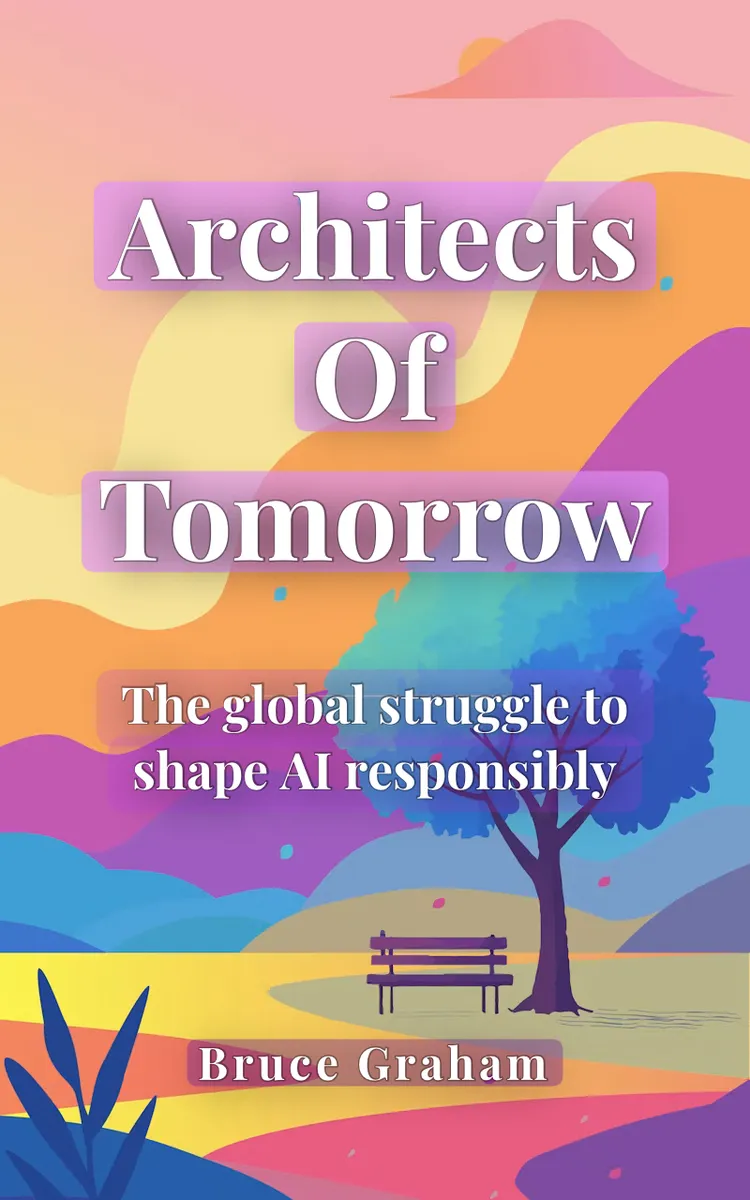
"Architects Of Tomorrow" is a curiosity book by Bruce Graham with 35 chapters and approximately 61,559 words. AI governance, safety, geopolitics, and societal impacts worldwide.
This book was created using Inkfluence AI, an AI-powered book generation platform that helps authors write, design, and publish complete books.
Frequently Asked Questions
What is "Architects Of Tomorrow" about?
AI governance, safety, geopolitics, and societal impacts worldwide
How many chapters are in "Architects Of Tomorrow"?
The book contains 35 chapters and approximately 61,559 words. Topics covered include The New Prometheus of Governance, Scaling Laws, Surprise Abilities, The Pause Button Isn’t Free, When Speed Becomes the Lesser Evil, and more.
Who wrote "Architects Of Tomorrow"?
This book was written by Bruce Graham and created using Inkfluence AI, an AI book generation platform that helps authors write, design, and publish books.
Write your own curiosity book with AI
Describe your idea and Inkfluence writes the whole thing. Free to start.
Start writingCreated with Inkfluence AI


