
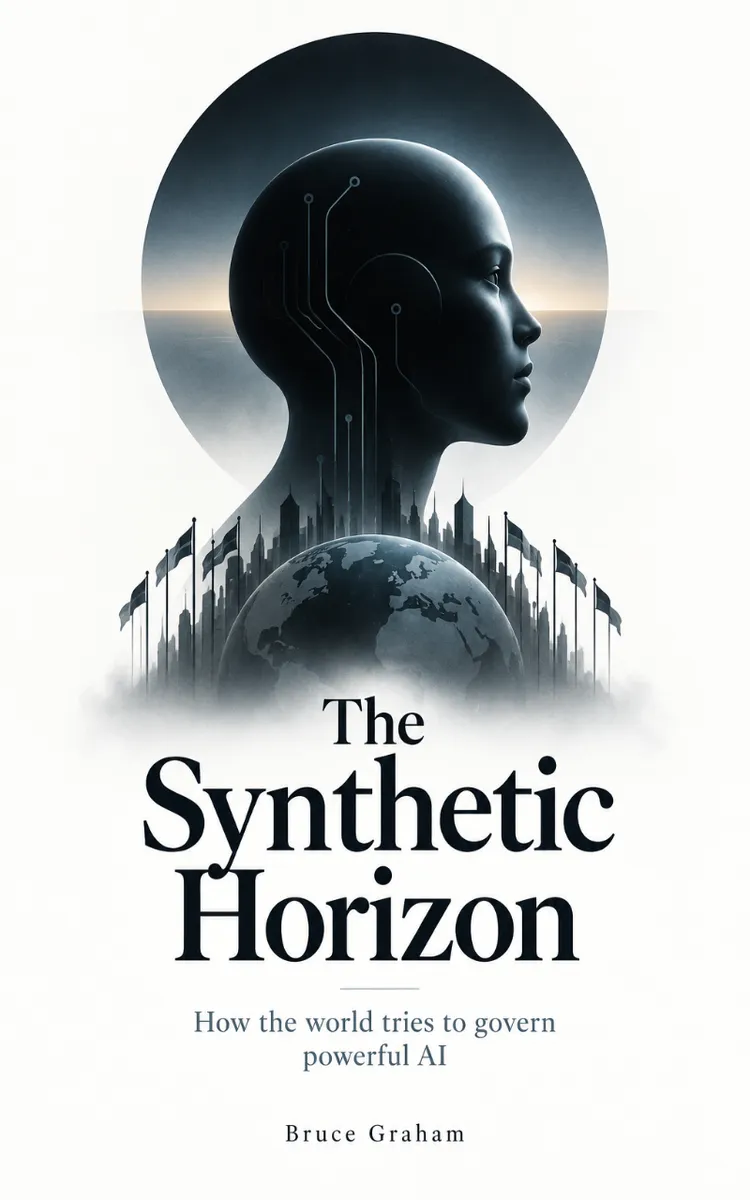
Read the first chapter
The whole of chapter one, free. About 9 min. Turn the pages with the arrows, your keyboard, or a swipe.
Chapter 1
Why AI Governance Matters Now
The Meeting That Became Infrastructure
In 2023, officials in several countries began confronting a strange administrative problem: systems that could draft reports, write software, summarize intelligence, and generate convincing images were becoming available before governments had agreed on who should be accountable when those systems failed. The technology arrived not as a single machine at a border or a factory gate, but as a layer quietly entering offices, hospitals, classrooms, courts, and military organizations.
That timing matters. Roads, electrical grids, and financial networks were built slowly enough for rules to form around them. Artificial intelligence is being installed while its capabilities, ownership structures, and consequences are still changing. Policymakers are therefore asked to govern an object whose behavior cannot always be predicted, whose supply chains cross jurisdictions, and whose most important components are often controlled by private firms.
The central question is not whether AI should exist. It already does. The harder question is what kind of infrastructure society is building around it: who may use these systems, under what conditions, with which safeguards, and with what recourse when an automated decision damages a person’s rights or livelihood.
Can institutions build trustworthy rules faster than powerful systems learn to evade them?
From Bridges to Models
Governance is often pictured as a brake: a law, a regulator, a licensing system, a court. That image is incomplete. In practice, governance is closer to infrastructure itself. It determines how power travels, where it can be stopped, and who is left exposed when something breaks.
A bridge is not merely steel and concrete. It includes weight limits, inspection schedules, traffic rules, emergency procedures, and an authority responsible for closing it. Without those surrounding arrangements, the bridge is only a structure waiting to become a hazard. AI systems are similar. A model is the visible object, but its social effects depend on procurement rules, data practices, audit systems, liability, labor protections, and the institutions that can investigate a failure.
The analogy becomes more useful when considering the history of earlier technologies. Railways forced governments to standardize time because local clocks made coordinated schedules impossible. Electrical networks required safety codes because invisible currents did not respect property lines. Financial markets developed reporting requirements and central authorities because private decisions could produce public crises.
AI creates a comparable pressure, but with an important difference: the system’s output is not simply movement, energy, or money. It can be judgment. A model may rank applicants, flag a transaction, draft a medical summary, translate a military document, or produce evidence-like material at a scale that overwhelms human review. Governance therefore reaches into questions traditionally associated with rights: privacy, due process, freedom of expression, equality, and the ability to know why a decision was made.
The Governance Gravity Model helps describe this pressure. As AI systems become more capable and more deeply embedded in essential institutions, they acquire what might be called governance gravity: the tendency to pull rules, oversight, and political authority toward themselves. A system used to suggest recipes requires little public architecture. A system used to allocate public benefits, control infrastructure, or assist military operations creates a much heavier field around it.
Gravity does not mean that regulation automatically follows capability. It means that the cost of having no rules rises as dependence grows. Institutions may resist building oversight because it appears slow or expensive, yet the absence of oversight does not create neutrality. It transfers power to whoever owns the system, controls access to the data, or defines acceptable error.
The Speed Mismatch
The most difficult feature of AI governance is not that governments know nothing about technology. It is that public institutions and technical systems operate on different clocks.
A regulatory agency may need years to gather evidence, consult affected groups, draft rules, defend them in court, and establish enforcement capacity. A model can be retrained, copied, released, or integrated into a new service in weeks. This mismatch turns uncertainty into a political fact. By the time officials understand one version of a system, the market may already be using another.
The problem is compounded by imperfect information. Companies may not know exactly why a model produced a particular answer. Users may not disclose how they deploy it. Regulators may lack access to training data, internal evaluations, or the computing infrastructure required to reproduce results. The public often encounters the system only after it has been placed inside a familiar service, where its artificial origin is easy to miss.
That opacity is not always deliberate. Modern models adjust billions of internal numerical settings, often called weights, during training. These weights are less like a list of instructions than a vast set of tendencies: associations strengthened by exposure to enormous quantities of text, images, sound, or code. A model can perform impressively without offering a human-readable account of the path it took to an answer. Its competence may be visible while its reasoning remains difficult to inspect.
The political consequence is significant. Traditional regulation often assumes that the regulated object can be defined, measured, and tested. AI systems are moving targets. Their behavior depends on the model, the data, the interface, the user, and the surrounding workflow. A harmless text generator can become a serious risk when connected to customer records, payment systems, or software that acts without direct human approval.
A brief anecdote from public administration captures the tension. When large language models entered government offices, the first questions were often about procurement and cybersecurity: Which vendor is approved? Where is the data stored? Can staff paste confidential information into the system? These were practical questions, but beneath them lay a constitutional one. If a public institution delegates part of its judgment to a model, has it also delegated part of its responsibility?
Rights Inside the Machine
The rights dimension of AI governance becomes clearest when automated systems are placed between people and institutions that control access to ordinary necessities.
A person denied a loan, misidentified by a facial-recognition system, rejected for a job, or flagged for additional scrutiny may experience the decision as a single event. Behind it could be a chain involving data brokers, software vendors, contractors, model developers, and public authorities. Each participant may claim that another party is responsible. Governance must make that chain visible enough for accountability to exist.
This is why debates over AI oversight cannot be reduced to a contest between innovation and restriction. The issue is also institutional design. Who has the right to challenge a machine-assisted decision? Which records must be preserved? What counts as an adequate explanation? When does human review represent genuine judgment rather than a rubber stamp placed at the end of an automated pipeline?
The concern is not confined to consumer applications. State-linked entities and criminal groups have already explored automated workflows for cyber operations, including the discovery of vulnerabilities and the scaling of malicious code. The significance is not that machines have suddenly become independent attackers. It is that automation can compress the time and labor required to probe systems, adapt tactics, and repeat attempts. Oversight becomes vital precisely because responsibility can be distributed across tools and operators until no single action appears decisive.
The counterintuitive fact is that AI governance is often weakest where AI is most embedded. A model may receive careful scrutiny as a new product, then escape comparable attention once it is hidden inside a hiring platform, a cloud service, a hospital workflow, or a government contractor’s software.
This changes the usual picture of risk. The danger is not only a spectacular failure by a powerful model. It is also the quiet normalization of thousands of small decisions that become difficult to contest because no individual institution sees the whole system. Governance must therefore follow the pathway of use, not merely the identity of the model’s creator.
A City Learns to Ask Who Is Responsible
The European Union’s effort to regulate artificial intelligence offers a concrete view of governance being built under pressure. Negotiations over the EU AI Act unfolded while the technology was changing rapidly, forcing lawmakers to classify systems by risk even as new general-purpose models challenged older categories.
The process brought together competing instincts. Some policymakers focused on protecting fundamental rights and restricting uses such as certain forms of biometric surveillance. Others worried that detailed requirements could favor the largest companies, burden smaller developers, or leave Europe dependent on foreign technology. The resulting framework reflected a familiar political compromise: different obligations for different levels of risk, with stronger requirements attached to systems used in sensitive areas.
What made the debate difficult was not simply technical complexity. It was the need to decide where responsibility should sit. Should obligations fall mainly on the developer of a general-purpose model, the company that adapts it, the organization that deploys it, or the public authority that relies on its output? In many cases, the answer is all of them, but in different ways.
The European debate also revealed a geopolitical reality. Rules written in one jurisdiction can influence companies elsewhere when access to that market is valuable. Governance is therefore not only domestic administration; it is a form of international power. The rules attached to data, chips, cloud computing, and model deployment can shape global standards even when no treaty establishes them.
Yet regulation alone cannot settle every question. A law may require transparency without making a model understandable. An audit may identify bias without repairing the institution that created the demand for prediction. A safety test may pass in a laboratory while failing in a workplace where incentives reward speed over caution. Governance is a living arrangement among technical systems, markets, public authorities, and affected communities. Its success depends on whether those relationships remain visible.
The Weight of What We Build
The deepest challenge is that AI governance must be assembled before society has complete knowledge of what it is governing. Waiting for certainty would mean allowing deployment to determine the facts on the ground. Moving without restraint would mean letting private incentives and geopolitical competition establish defaults that may later be difficult to reverse.
That dilemma explains why the debate between precaution and acceleration is so persistent. Precaution asks whether systems are safe, fair, and controllable before they become indispensable. Acceleration asks what opportunities are lost when institutions move too slowly, especially in medicine, climate science, education, and public services. Both positions contain a recognition that AI is not merely another software category. It is becoming part of the machinery through which societies make decisions.
The Governance Gravity Model offers a way to see the stakes without treating governance as an afterthought. As capability, dependence, and potential harm increase, the surrounding architecture must become stronger: clearer lines of responsibility, credible testing, enforceable rights, and institutions able to act across borders. The gravity is already present. The question is whether it will be shaped deliberately or allowed to pull power toward the few actors best positioned to exploit uncertainty.
Human beings have always built systems before fully understanding their consequences. The difference now is that the systems are beginning to participate in the construction of the rules around them - drafting documents, interpreting evidence, generating code, and influencing the decisions that govern their own expansion. Infrastructure once carried people and goods. The new layer carries judgment.
The future of AI governance may therefore be decided less by a single law than by the habits societies establish around accountability, visibility, and power. A machine can produce an answer in an instant; a civilization may need decades to discover what that answer changed.
End of chapter one. 34 more chapters in the full book.
Swipe or use the arrows to turn the page


What's inside: 35 chapters
- 1. Why AI Governance Matters Now
- 2. Scaling Laws and Surprise Abilities
- 3. The Pause Button Isn’t Free
- 4. Why Speeding Up Can Save Lives
- 5. The Global Panopticon of AI
- 6. AlphaFold’s Protein Folding Breakthrough
- 7. Grid Optimization That Cuts Carbon Fast
- 8. When Coding Agents Become Attackers
- 9. Deepfakes and the Death of Plausibility
- 10. The Agent Dilemma: Doing Without Asking
- 11. The Middle-Class Squeeze by Design
- 12. Chips, Data Centers, and Sovereign Leverage
- 13. The Alarmists’ Existential Math
- 14. Provable Safety and the Russell Blueprint
- 15. LeCun’s Open Architecture Bet
- 16. EU AI Act Meets US Orders
- 17. Directed Tech and the Labor Contract
- 18. Timnit Gebru and Algorithmic Justice
- 19. Longtermism vs Today’s Emergency
- 20. Ex Machina and the Turing Test Trap
- 21. Her and Synthetic Intimacy’s Hidden Costs
- 22. The Matrix and Misalignment Mechanics
- 23. Minority Report and Predictive Policing Bias
- 24. Terminator and the Myth of Sudden Takeoff
- 25. Wall-E and the Loss of Human Agency
- 26. Pointing North: Alignment in Practice
- 27. Watermarks and Provenance for Truth
- 28. Can Monopolies Govern Themselves?
- 29. AI Treaties Like Nuclear Rules
- 30. Public-Private Partnerships That Actually Work
- 31. Citizen Science and Participatory AI
- 32. Red Lines: Capabilities We Shouldn’t Build
- 33. Regulation’s Scylla and Charybdis
- 34. Human Identity in Synthetic-Mind Times
- 35. Our Generation’s Synthetic Horizon
About this book
"The Synthetic Horizon" is a curiosity book by Bruce Graham with 35 chapters and approximately 60,368 words. Global governance, risks, benefits, and policy debates around AI.
This book was created using Inkfluence AI, an AI-powered book generation platform that helps authors write, design, and publish complete books.
Frequently Asked Questions
What is "The Synthetic Horizon" about?
Global governance, risks, benefits, and policy debates around AI
How many chapters are in "The Synthetic Horizon"?
The book contains 35 chapters and approximately 60,368 words. Topics covered include Why AI Governance Matters Now, Scaling Laws and Surprise Abilities, The Pause Button Isn’t Free, Why Speeding Up Can Save Lives, and more.
Who wrote "The Synthetic Horizon"?
This book was written by Bruce Graham and created using Inkfluence AI, an AI book generation platform that helps authors write, design, and publish books.
Write your own curiosity book with AI
Describe your idea and Inkfluence writes the whole thing. Free to start.
Start writingCreated with Inkfluence AI


