
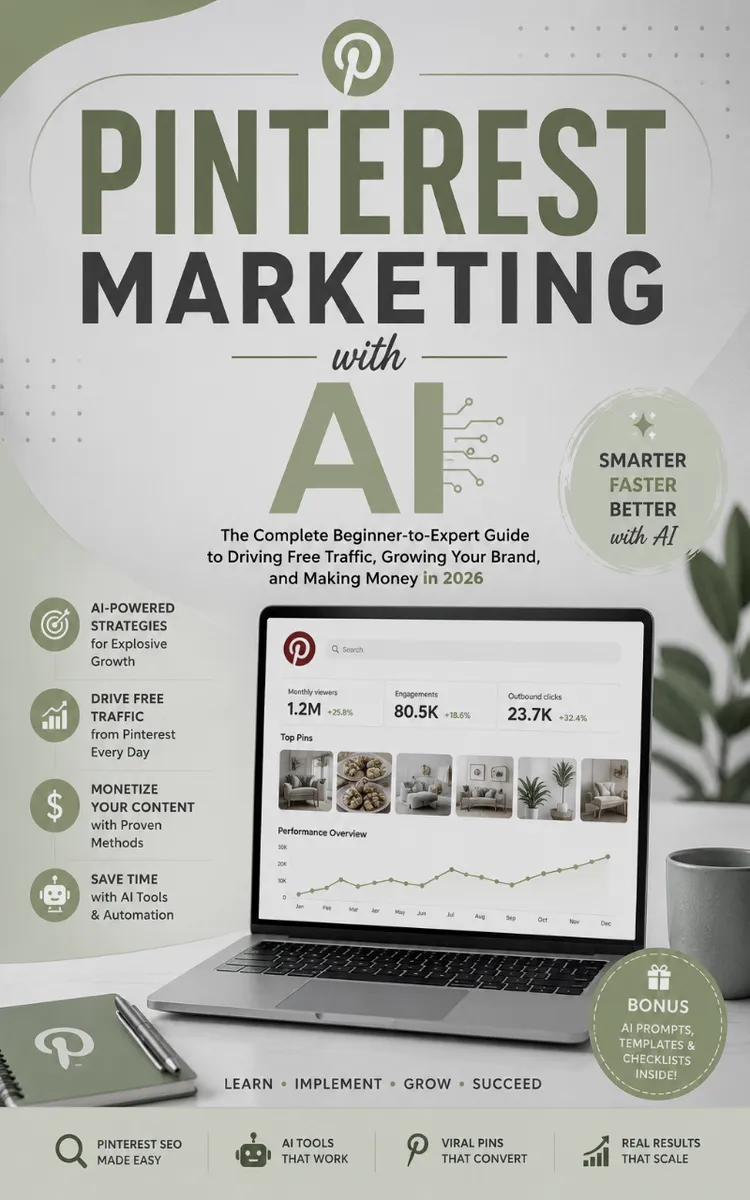
Read the first chapter
The whole of chapter one, free. About 11 min. Turn the pages with the arrows, your keyboard, or a swipe.
Chapter 1
Why Pinterest Is Still a Goldmine in 2026
Chapter 1 Cover Illustration Prompt (Full Page)
AI image prompt: Create a full-page, premium ebook chapter cover illustration in a modern 6×9 inch portrait layout. Scene: a stylish desk workspace with a laptop open showing Pinterest analytics (use generic charts and bars, not brand-locked UI text), a notebook with sticky notes, a phone displaying a grid of pin thumbnails, and a subtle “AI” glow effect coming from a small connected device. Add a gold “growth” ribbon motif that visually suggests “goldmine” without using exact text overlays. Colors: warm gold, deep navy, soft cream, and a small accent of teal. Lighting: cinematic soft light from the left, gentle reflections on the laptop screen, warm highlights on the gold ribbon. Style: clean modern editorial illustration, photorealistic-meets-digital-painting, crisp edges, high detail. Camera angle: slightly above desk level (top-left perspective), shallow depth of field to keep the laptop and key objects sharp. No clutter, no people, no readable brand UI text.
Why Pinterest Is Still a Goldmine in 2026
Pinterest is one of the few platforms where “old work” can keep paying you. You publish once, and your pins can keep showing up weeks, months, or even a year later - especially when your content matches what people are actively searching for. That difference matters in 2026, because many social platforms are built around fast attention and fast forgetting. Pinterest is built around intent: people save ideas, compare options, and come back.
The other reason Pinterest still wins is the way AI is changing what gets seen. Instead of only guessing what will perform, you can use AI to help you write clearer pin text, generate better visuals, and stay consistent with your publishing. AI does not replace good judgment - but it removes a lot of the friction that used to slow beginners down. If you can publish consistently and learn what your audience saves, Pinterest can turn into a steady stream of traffic you do not have to “buy” every day.
This chapter focuses on the practical truth: why Pinterest keeps working in 2026, what you must get right to make it work for you, and how to measure whether it’s working before you waste time. You will leave with a simple mindset and a clear set of checkpoints so you can build momentum fast.
What “Goldmine” Means on Pinterest in 2026 (Traffic That Doesn’t Expire Overnight)
When people say Pinterest is a goldmine, they usually mean one thing: long-lasting discovery. A pin is not just a moment. It can rank, be saved, and keep getting impressions because Pinterest keeps learning what to show the right people. In plain terms, your pins can keep getting seen even after the upload date.
In 2026, that long life is still the core advantage. If you publish helpful content that matches search intent, you are not only competing with other posts today - you are joining a library of ideas that Pinterest users browse over time. That is why a beginner who does not “go viral” can still win. Your goal is not random attention. Your goal is repeatable relevance.
Here is the practical way to think about it: if you post only during a campaign month, your results will look random. If you build a small library of pins over time, your results start to look like a system. You do not need thousands of followers. You need pins that keep getting impressions and clicks because they fit what someone is looking for.
AI image prompt for this subheading: Create an illustration showing an evergreen timeline on a Pinterest-like theme. Composition: a vertical timeline with dates fading into the distance, each date connected to a pin icon that glows softly as it travels downward. Add a small “library” motif in the background (shelf silhouettes) to represent long-term discovery. Colors: warm gold and muted slate blue with soft cream highlights. Lighting: gentle ambient lighting with a subtle glow around pins. Style: clean vector-meets-editorial illustration, high clarity. Camera angle: straight-on, centered framing, slight parallax effect.
Pinterest Rewards Intent, Not Just Follows
On many platforms, followers are the main scoreboard. On Pinterest, followers matter, but intent matters more. Pinterest users come to search, browse, and save. That changes what “good content” looks like. The best pins are not only pretty; they are useful and specific.
Specificity is the difference between a pin that gets ignored and a pin that gets saved. “Healthy dinner ideas” is broad. “High-protein sheet pan dinners for busy weeknights” is clear. The more your pin matches a real phrase someone would search, the easier it is for Pinterest to connect your pin to the right audience.
You can see this in the way Pinterest pin performance behaves. Pins that align with clear intent tend to collect impressions over time. Pins that are vague tend to spike early and fade quickly. That is why beginners often feel confused at first: they post something nice, it gets a little attention, then it stops. On Pinterest, “nice” is not enough. You have to be searchable.
AI image prompt for this subheading: Illustrate “intent” using a search-and-save visual metaphor. Composition: a large search bar floating above a grid of pin cards; each card has a short label like “recipe,” “checklist,” “how-to” (use generic text, not brand UI). Arrows connect from the search bar to selected pins that glow as if “matched.” Colors: deep navy background, teal accents, cream cards, and gold glow on matched pins. Lighting: crisp studio lighting with soft shadows. Style: modern flat illustration with subtle depth. Camera angle: slight top-down perspective (about 30 degrees).
The Real 2026 Advantage: AI Helps You Publish Better, Faster, and More Consistently
Beginners often get stuck on the same problem: publishing feels heavy. Writing takes time. Designing pins takes time. Even choosing topics takes time. AI does not magically fix weak ideas, but it can speed up the parts where most people stall.
Use AI to improve the basics that Pinterest rewards: clear pin titles, helpful descriptions, and visuals that match the topic. You can also use AI to stay consistent by turning one idea into multiple pin variations, each with a different angle. That matters because Pinterest testing is slow. You need enough shots on goal to learn what your audience responds to.
But you still need ownership. AI outputs can be polished and still be wrong for your niche. Your job is to check accuracy, align the pin with your actual offer or content page, and ensure the pin text matches what the viewer will see after the click. If you publish pins that promise one thing and deliver another, you will waste impressions and train people not to trust you.
So the advantage in 2026 is not “AI makes you rich.” The advantage is “AI reduces the time between idea and publication,” which gives you more data to learn from and more chances to rank.
AI image prompt for this subheading: Show AI assisting publishing without using complex jargon. Composition: a laptop screen with a split view: left side has a rough draft text box labeled “Pin title idea” (generic label), right side shows a clean formatted pin caption and a color palette swatch. Add a small AI chip icon hovering above, but keep it subtle. Include a pin grid in the foreground with two pins highlighted. Colors: cream workspace, navy screen, teal, and gold accents. Lighting: bright, clean office lighting with soft reflections. Style: modern semi-3D illustration, crisp and minimal. Camera angle: eye-level, slight three-quarter view.
The Checkpoints That Tell You Whether Pinterest Is Working
If you want free traffic and income, you need a way to tell whether your Pinterest effort is actually moving the needle. Guessing leads to random changes, and random changes prevent learning. Instead, use a simple measurement rhythm.
Pick a small set of outcomes and check them consistently. Start with impressions (how often Pinterest shows your pins), clicks (how often people go to your site or offer), and saves (how often people keep your pin for later). Impressions tell you the distribution. Clicks tell you a match and interest. Saves tell you lasting value.
Then tie those outcomes to real actions you control. If impressions rise but clicks do not, your pin wording or your destination page may not match the promise. If clicks rise but saves do not, your content might be “interesting” but not “useful enough to keep.” If neither improves, you likely need to sharpen your topic match and pin design clarity.
Set your first checkpoint window so you do not panic too early. Pinterest learning is not instant like a short-form video feed. A useful beginner checkpoint is to review after you have published enough to create patterns, not just one pin. Track the last 30 days of pins and compare which pins got the most impressions and clicks. Then double down on the themes that already show signs of intent match.
And assign accountability clearly: you own publishing, you own pin text accuracy, and you own what the viewer sees after the click. AI can draft, but you must approve.
AI image prompt for this subheading: Create an illustration of a simple performance dashboard. Composition: a clean board with three labeled cards: “Impressions,” “Clicks,” “Saves” (use these exact words). Each card has a small bar chart and a checkmark icon. Add a calendar page showing a 30-day window highlighted. Include a pen and a notebook beside the board. Colors: white background, navy text blocks, teal bars, gold checkmarks. Lighting: bright and clear, minimal shadows. Style: modern infographic illustration, premium ebook look. Camera angle: top-down flat lay.
Watch Outs That Stop Beginners From Getting Results
Pinterest is forgiving, but it is not magic. There are a few anti-patterns that quietly kill momentum, and beginners often do them without realizing it.
First, do not post pins that are only “aesthetic.” If the pin does not clearly tell people what it is about in plain words, it will struggle to earn impressions from search and related browsing. Pinterest is visual, but it is also language-driven. Your pin text needs to help Pinterest understand the topic.
Second, do not send clicks to a page that does not match the pin promise. If your pin says “meal prep checklist” and your destination is a generic homepage, people bounce, and your click-through suffers. Every pin should connect to a specific page that delivers the thing the pin suggests.
Third, do not change everything every day. Beginners often react to early low numbers by rewriting everything, redesigning every pin, and changing posting frequency. That creates noise and makes it hard to learn. Give your pins time to collect impressions, then adjust based on which themes actually perform.
Fourth, do not rely on one pin format only. If you only post one style, you reduce your chances of hitting the right audience mood. Use multiple angles for the same topic: step-by-step, list style, and before-and-after style, where it fits your niche. You will learn faster which angles earn saves and clicks.
AI image prompt for this subheading: Illustrate “watch outs” as warning icons over a Pinterest grid. Composition: a pinboard grid with some pins faded (representing low performance), and a few pins surrounded by red caution triangles (no scary style, just clear). Include four small panels with icons: blurry text, mismatched destination link, constant changes (spinning arrows), single pin format (one repeated icon). Colors: cream background, navy panels, teal pins, red caution accents restrained, gold highlights for the “good pins.” Lighting: clean, high contrast editorial style. Camera angle: slight angle top-down, like a flat lay.
The Simple Mindset That Keeps You Consistent
If you want Pinterest results in 2026, your job is not to chase perfection. Your job is to build a small, searchable library of helpful pins and keep improving based on evidence.
Think like a publisher: one good idea becomes multiple pins, each with clear text and a matching destination. Then you watch which pins earn impressions, clicks, and saves. You keep the winners, adjust the weak ones, and keep publishing.
This approach also protects you from burnout. Instead of constantly starting over, you are running a focused experiment every week. You are not “hoping” for traffic. You are building it.
If you do this with ownership and checkpoints, Pinterest can become your quiet advantage. The platform rewards consistency more than it rewards luck, and AI helps you stay consistent long enough to find your winning topics.
AI image prompt for this subheading: Create a “publisher mindset” visual. Composition: a notebook labeled with a simple “Publish → Track → Improve” flow using plain icons (arrow, chart, refresh). In the background, a series of pin thumbnails is arranged like a growing stack. Add a calm gold light beam symbolizing progress. Colors: warm gold, cream, navy, teal. Lighting: soft sunrise glow from upper right. Style: premium minimal illustration with gentle depth. Camera angle: three-quarter view from above, focusing on the notebook and pin stack.
Chapter 1 Summary (Quick Takeaway)
Pinterest is still a goldmine in 2026 because it rewards intent, supports long-lasting discovery, and gives beginners a real path to free traffic without needing massive follower counts. AI helps you publish better and more consistently, but your ownership stays the same: pin clarity, destination match, and consistent tracking. When you measure impressions, clicks, and saves with clear checkpoints, you stop guessing and start building a system that can grow.
AI image prompt for this summary: Illustrate a clean “summary card” layout with three checkmarked icons labeled “Intent,” “Evergreen discovery,” “Better publishing with AI” (generic text). Include a small Pinterest pin silhouette and a gold underline. Colors: cream card background, navy text, teal icons, gold checkmarks. Lighting: bright and crisp. Style: modern ebook callout illustration. Camera angle: straight-on, centered composition.
Chapter 1 Cover Illustration Prompt (Required Again)
AI image prompt: Full-page chapter cover illustration, 6×9 portrait. Scene: laptop with generic Pinterest analytics charts, phone showing a grid of pin cards, desk items neatly arranged, subtle AI light accents, warm gold growth ribbon motif. Colors: deep navy, warm gold, cream, teal. Lighting: soft left-side studio lighting, gentle screen reflections. Style: premium modern editorial illustration, high detail, no readable brand UI text. Camera angle: top-left desk perspective, shallow depth of field, pins and laptop sharp, background softly blurred.
End of chapter one. 4 more chapters and about 10,516 words in the full book.
Swipe or use the arrows to turn the page

What's inside: 5 chapters
- 1. Why Pinterest Is Still a Goldmine in 2026
- 2. Understanding Pinterest SEO
- 3. Best AI Tools for Pinterest Marketing
- 4. Creating Viral Pinterest Pins with AI
- 5. Pinterest Keyword Research Masterclass
About this book
"Pinterest Marketing With AI" is a marketing book by Vinay with 5 chapters and approximately 10,516 words. Using AI to optimize Pinterest marketing, traffic, and monetization.
This book was created using Inkfluence AI, an AI-powered book generation platform that helps authors write, design, and publish complete books. It was made with the AI Ebook Creator.
Frequently Asked Questions
What is "Pinterest Marketing With AI" about?
Using AI to optimize Pinterest marketing, traffic, and monetization
How many chapters are in "Pinterest Marketing With AI"?
The book contains 5 chapters and approximately 10,516 words. Topics covered include Why Pinterest Is Still a Goldmine in 2026, Understanding Pinterest SEO, Best AI Tools for Pinterest Marketing, Creating Viral Pinterest Pins with AI, and more.
Who wrote "Pinterest Marketing With AI"?
This book was written by Vinay and created using Inkfluence AI, an AI book generation platform that helps authors write, design, and publish books.
How can I create a similar marketing book?
You can create your own marketing book using Inkfluence AI. Describe your idea, choose your style, and the AI writes the full book for you. It's free to start.
Write your own marketing book with AI
Describe your idea and Inkfluence writes the whole thing. Free to start.
Start writingCreated with Inkfluence AI


