
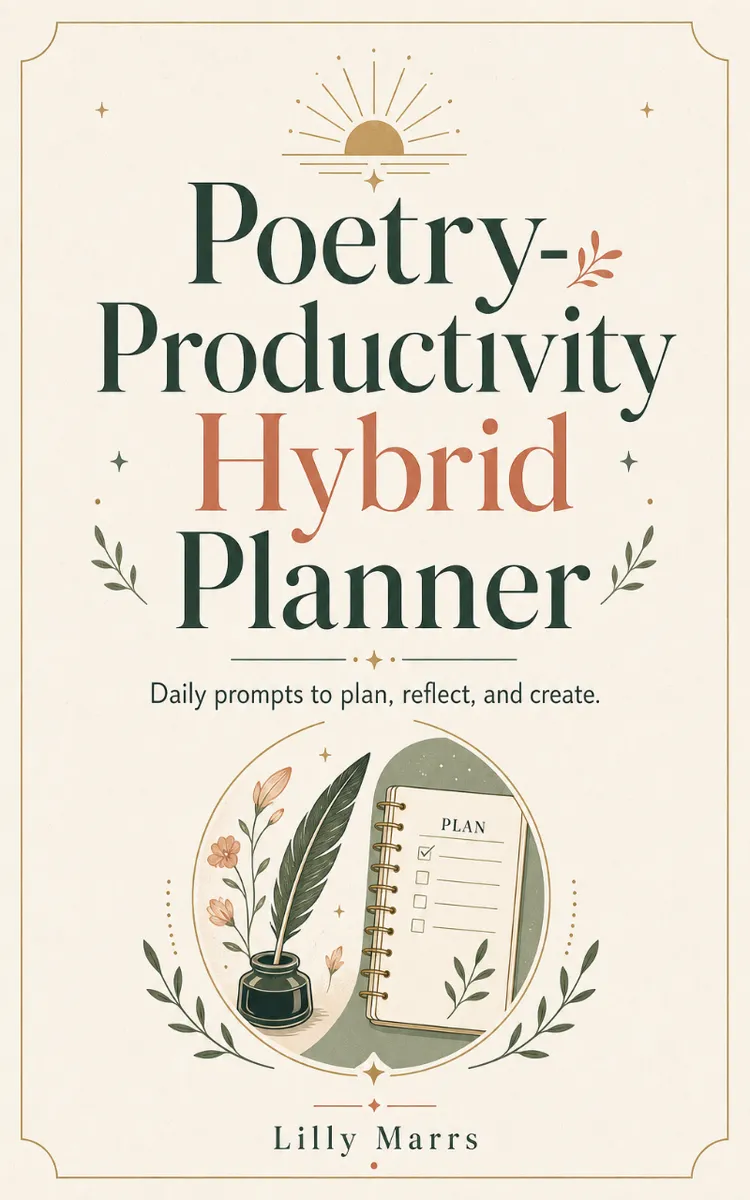

Read the first chapter
The whole of chapter one, free. About 6 min. Turn the pages with the arrows, your keyboard, or a swipe.
Chapter 1
Designing Your Weekly Theme
Give the Week a Clear Direction
A weekly theme is a short phrase that helps you decide what deserves your attention. It isn’t a slogan, a giant goal, or another task on your list. It’s a filter. When two plans compete, your theme helps you choose the one that best fits the week you actually have.
Pair that theme with a short poetic prompt, and your planning gains a little texture. The prompt gives you an image, question, or rhythm to carry through ordinary decisions. “Make room for the quiet” might guide you to protect two hours for focused work. “Tend the small flame” might remind you to follow up with three important customers instead of chasing ten new leads.
A useful weekly theme has three parts:
1. A focus: the area that matters most this week. 2. A boundary: what you will give less attention to. 3. A poetic prompt: a brief line that helps you remember the focus.
Key takeaway: Your theme should make choices easier, not give you one more thing to manage.
Keep the theme short enough to see at a glance. Aim for three to six words. Your poetic prompt can be one line, usually five to twelve words. It doesn’t need to rhyme or sound grand. It only needs to create a clear feeling or picture.
For example:
• Theme: Finish What’s Open - Boundary: Delay new side projects. - Poetic prompt: Close the doors gently.
The theme names the work. The prompt shapes the way you approach it.
Build Your Theme and Poetic Prompt
Materials needed: This planner, a pen, and your calendar or task list. Time required: 15 minutes.
Use the exercise below at the start of each week. If your week is already crowded, don’t try to create a perfect theme. Choose the clearest useful one.
Your Turn
1. Look at the next seven days on your calendar. Write down the three commitments that matter most. Include work, home, health, or personal responsibilities.
1. _______________________________________________ 2. _____________________________________________ 3. _______________________________________________
2. Review your task list. Circle up to five tasks that would make the biggest difference by the end of the week. Don’t circle tasks just because they’re easy. Choose tasks connected to real results.
3. Complete this sentence:
By the end of this week, I most want to have ______________________________.
4. Name the main focus in three to six words. Start with a verb when possible.
My weekly theme: _________________________________________________
5. Choose a boundary. What will you postpone, limit, or refuse so the theme has room?
This week I will give less attention to: _________________________________________________________________
6. Create a poetic prompt. Use one of these patterns, or make your own:
• Verb + image: “Carry the useful light.” - Question: “What needs tending first?” - Short instruction: “Leave space for the important.” - Nature image: “Let the roots grow deeper.”
My poetic prompt: _________________________________________________
7. Test the pairing against three likely decisions. Write a decision you expect to make, then complete the sentence.
Decision: _____________________________________________________ The theme suggests I should: ____________________________________
Decision: _____________________________________________________ The theme suggests I should: ____________________________________
Decision: _____________________________________________________ The theme suggests I should: ____________________________________
8. Check your work. Your theme and prompt are ready when all four statements are true:
• The theme has three to six words. - The prompt is one short line. - The boundary names something you can actually limit. - The pairing helps with at least two real decisions this week.
> Completed example > Main commitments: Repair the leaking sink, send Friday’s customer invoices, prepare Saturday’s market order. > Most important result: Have the market order packed by Thursday afternoon. > Weekly theme: Prepare Before Rush > Boundary: No redesigning the online shop this week. > Poetic prompt: Set the table before guests arrive. > Decision: A new product idea appears on Tuesday. > The theme suggests I should: Write it down, then return to the market order. > Decision: I need to choose between packing supplies and updating old photos. > The theme suggests I should: Buy the packing supplies first. > Decision: Thursday becomes crowded. > The theme suggests I should: Finish packing Wednesday evening instead.
Now copy your final pairing somewhere you’ll see it each morning:
Theme: _________________________________________________________ Poetic prompt: __________________________________________________
Read it once before choosing your first task. That small pause is the point. You’re not trying to turn every task into poetry. You’re giving the week a steady direction.
Use the Theme When the Week Gets Noisy
Your theme works best at decision points, not just during Monday planning. Use it when a customer changes an order, a family responsibility appears, or your task list grows faster than your available hours. Ask, “Which option serves this week’s theme?” Then choose the option that fits the theme and the time you truly have.
Suppose your theme is Protect the Deep Work, with the prompt Guard the quiet doorway. A two-hour block for estimates may deserve protection, even when email keeps arriving. You might silence notifications, move routine calls to the afternoon, and tell one colleague when you’ll reply. The expected outcome is specific: one uninterrupted block and a completed estimate by day’s end.
Or imagine your theme is Repair the Basics, with the prompt Start where the floor is loose. At a small gym, that could mean checking equipment, confirming member billing, and cleaning the storage area before adding a new class. The theme doesn’t ban improvement. It tells you which improvement comes first. By Sunday, you should be able to name two repaired basics and one postponed idea.
Use the poetic prompt as a quick reset when you feel pulled in several directions. Write it at the top of your daily page. Before adding a new task, finish this sentence:
Because my theme is __________________, I will __________________.
Keep the answer concrete. “I will protect Tuesday from extra meetings” is useful. “I will be more focused” is too loose to guide a decision.
Apply It
Choose one real situation from the coming week and complete the following:
Situation I expect: ______________________________________________ Choice I may need to make: _____________________________________ My theme points me toward: _____________________________________ The action I will take: _________________________________________ The result I expect by week’s end: _________________________________
At the end of the week, measure the theme by evidence, not mood. Count completed actions, protected time, postponed distractions, or finished conversations. If your theme was Follow Through, a reasonable measure might be three completed follow-ups. If it was Make Space, the measure might be two cleared work areas and one open evening.
A theme isn’t a test of your personality. It’s a tool you adjust. If it helped with decisions, keep the style. If it sounded nice but changed nothing, make it more concrete next time.
Review the Theme and Choose Your Next Step
Use these questions at the end of the week. Answer each in two or three sentences, or with short phrases and numbers. Specific evidence will help you build better themes.
Reflect: Which decision became easier because of your weekly theme? What did you choose, and what was the result?
__________________________________________________________ ________________________________________________________ __________________________________________________________
Reflect: Did your poetic prompt create a useful image or action, or did it feel too vague? Rewrite it so it points toward one visible behavior.
__________________________________________________________ ________________________________________________________ __________________________________________________________
Plan: What focus deserves attention next week, and what boundary will protect it?
__________________________________________________________ ________________________________________________________ __________________________________________________________
Circle one rating for this week:
Theme clarity: 1 2 3 4 5 Prompt usefulness: 1 2 3 4 5 Follow-through: 1 2 3 4 5
If your theme earned a four or five for usefulness, carry its structure forward. If it earned a one or two, shorten it, name a clearer result, or choose a more practical boundary. The best weekly line is the one that helps you act when the day gets crowded.
End of chapter one. 9 more chapters in the full book.
Swipe or use the arrows to turn the page

Substitute Teacher Packet Grades 1 2

Sub Binder and Sub Plans Bundle

Ready Made Sub Plans Grades 3 4
What's inside: 10 chapters
- 1. Designing Your Weekly Theme
- 2. Setting SMART Goals with Stanzas
- 3. Prioritizing with the 1-3-5 Method
- 4. Building a Morning Routine Poem
- 5. Time-Blocking with Breath Breaks
- 6. Turning Tasks into Micro-Sprints
- 7. Managing Energy with Mood Metrics
- 8. Handling Distractions with the Reset Verse
- 9. Reviewing Progress in a Closing Couplets
- 10. Sustaining Motivation with Future Letters
About this book
"Poetry-Productivity Hybrid Planner" is a workbook by Lilly Marrs with 10 chapters and approximately 13,863 words. A planner combining poetry and productivity prompts.
This book was created using Inkfluence AI, an AI-powered book generation platform that helps authors write, design, and publish complete books. It was made with the Workbook Generator.
Frequently Asked Questions
What is "Poetry-Productivity Hybrid Planner" about?
A planner combining poetry and productivity prompts
How many chapters are in "Poetry-Productivity Hybrid Planner"?
The book contains 10 chapters and approximately 13,863 words. Topics covered include Designing Your Weekly Theme, Setting SMART Goals with Stanzas, Prioritizing with the 1-3-5 Method, Building a Morning Routine Poem, and more.
Who wrote "Poetry-Productivity Hybrid Planner"?
This book was written by Lilly Marrs and created using Inkfluence AI, an AI book generation platform that helps authors write, design, and publish books.
How can I create a similar workbook?
You can create your own workbook using Inkfluence AI. Describe your idea, choose your style, and the AI writes the full book for you. It's free to start.
Write your own workbook with AI
Describe your idea and Inkfluence writes the whole thing. Free to start.
Start writingCreated with Inkfluence AI


