
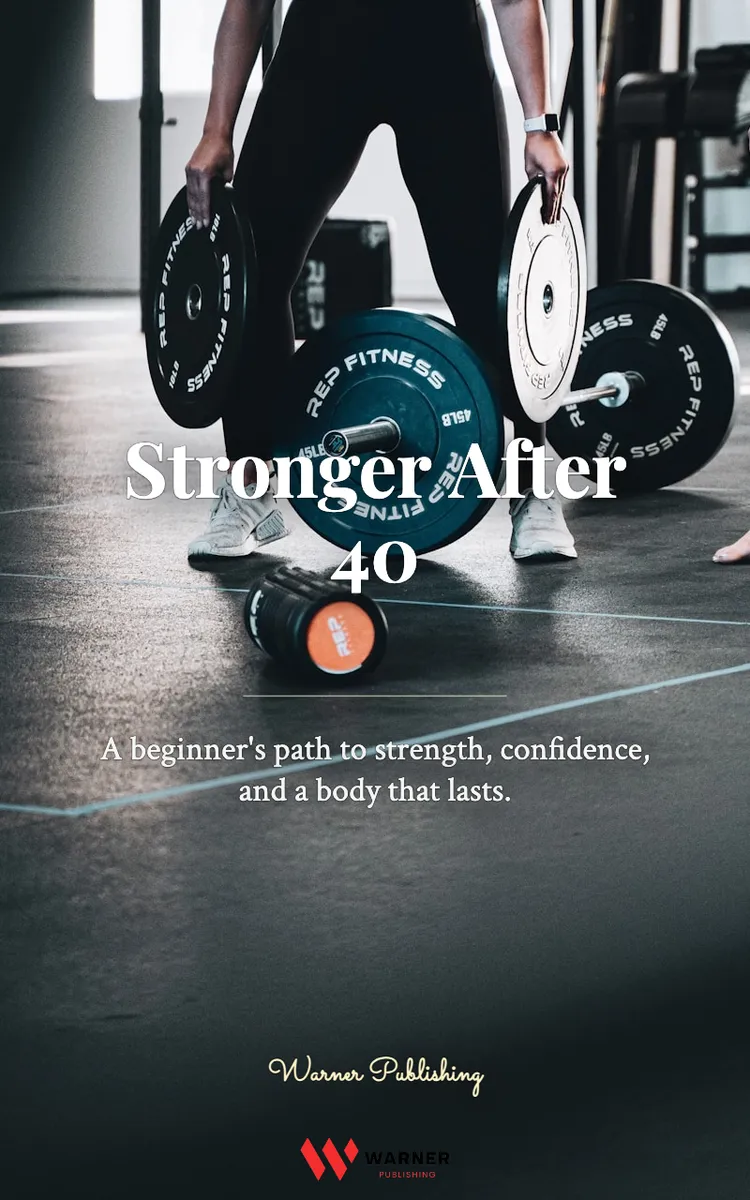

Read the first chapter
The whole of chapter one, free. About 7 min. Turn the pages with the arrows, your keyboard, or a swipe.
Chapter 1
Start Phase (Weeks 1-2): Safety Basics
Phase Overview
Could you lift the weight with steady control, stop with two good repetitions still available, and place every piece of equipment safely before you begin? Weeks 1-2 focus on answering those questions through light loads, a clear training space, and simple technique checks. The goal is not to test strength; it is to learn your starting loads and build repeatable movement habits.
Train on three nonconsecutive days each week, such as Monday, Wednesday, and Friday. Week 1 uses one set of each exercise. Week 2 adds a second set only when your form remains steady. Before every exercise, use the 3-Point Safety Checklist:
1. Space: Is the floor clear, dry, and firm? Can you move without hitting furniture, walls, pets, or loose cords? 2. Load: Can you complete the planned repetitions while keeping about two repetitions in reserve (RIR), meaning you could do two more with good form? 3. Control: Can you lower the weight smoothly, pause briefly where needed, and finish without pain, breath-holding, or shifting?
If one point fails, reduce the weight, adjust the setup, or stop that exercise. Your practical takeaway for this phase is simple: a safe starting load is one that leaves room for control.
Workouts
Set up a training area with a stable chair, a pair of light dumbbells or other hand weights, a resistance band with a secure anchor, and enough floor space to lie down with your arms extended. Keep at least one full arm’s length between you and nearby objects. Check that dumbbell handles are dry and that a resistance band has no cuts, cracks, or thin spots.
Begin each session with five minutes of easy movement. Walk around the room, swing your arms gently, and perform several slow body-weight squats to a comfortable depth. This is preparation, not a conditioning test. Use the first exercise as an additional load check.
Workout A - Week 1
| Exercise | Sets × Reps | Load | Rest | | --- | --- | --- | --- | | Chair squat | 1 × 8 | Body weight; hold 5-10 lb only if all 8 reps are controlled | 60-90 seconds | | Dumbbell floor press | 1 × 8 | A weight you could lift for 10 reps; begin with 5-15 lb per hand | 60-90 seconds | | Resistance-band row | 1 × 10 | Light band; the last 2 reps should remain smooth | 60-90 seconds | | Hip hinge to wall | 1 × 8 | Body weight; hold a light dowel only for position feedback | 60-90 seconds | | Farmer carry | 2 × 20-30 seconds | 5-15 lb per hand | 60 seconds |
Workout B - Week 1
| Exercise | Sets × Reps | Load | Rest | | --- | --- | --- | --- | | Elevated push-up | 1 × 6-8 | Body weight; hands on a sturdy counter or bench | 60-90 seconds | | Supported split squat | 1 × 6 per side | Body weight; hold a support with one hand | 60-90 seconds | | One-arm dumbbell row | 1 × 8 per side | 5-15 lb; use a light load that keeps your back still | 60-90 seconds | | Glute bridge | 1 × 10 | Body weight | 60-90 seconds | | Standing dumbbell curl | 1 × 8 | 5-10 lb per hand | 60 seconds |
Perform Workout A and Workout B on alternating sessions. A sample first week is A, B, A. If you train on a fourth day, repeat B only if you feel recovered and every technique check has passed. Do not add weight during the same session simply because the first set felt easy. Week 1 is for finding a dependable starting point.
Workout A - Week 2
| Exercise | Sets × Reps | Load | Rest | | --- | --- | --- | --- | | Chair squat | 2 × 8 | Use Week 1 load; add 5 lb total only if both sets are controlled | 60-90 seconds | | Dumbbell floor press | 2 × 8 | Use Week 1 load; increase by the smallest available amount if all reps were steady | 60-90 seconds | | Resistance-band row | 2 × 10 | Use the same band; step slightly farther away only if control is easy | 60-90 seconds | | Hip hinge to wall | 2 × 8 | Body weight; add a light dumbbell only when the hip movement is clear | 60-90 seconds | | Farmer carry | 2 × 30 seconds | Use Week 1 load; increase only if posture stays tall | 60 seconds |
Workout B - Week 2
| Exercise | Sets × Reps | Load | Rest | | --- | --- | --- | --- | | Elevated push-up | 2 × 6-8 | Keep the same surface; lower the surface only if every rep is controlled | 60-90 seconds | | Supported split squat | 2 × 6 per side | Use body weight; add 5 lb total only if balance and knee position remain steady | 60-90 seconds | | One-arm dumbbell row | 2 × 8 per side | Use Week 1 load; increase by 2-5 lb only if your torso does not twist | 60-90 seconds | | Glute bridge | 2 × 10 | Body weight; pause one second at the top | 60-90 seconds | | Standing dumbbell curl | 2 × 8 | Use Week 1 load; increase only if elbows stay still | 60 seconds |
For every exercise, complete a technique check during the first repetition and again during the final repetition. Ask yourself: Is the path controlled? Is the range comfortable? Am I using the target muscles rather than swinging, twisting, or rushing? If the answer changes by the final repetition, the load is too heavy for that exercise, even if you completed the assigned number.
Use a simple training record after each session. Write down the exercise, load, repetitions completed, and one short note such as “steady,” “too heavy,” or “counter too low.” This record is more useful than guessing at the next workout. Progress only when the same load feels controlled in two sessions. Then make one small change: add 2-5 pounds to a dumbbell exercise, use a slightly stronger band, lower a push-up surface by a few inches, or add one repetition within the stated range. Never increase load, repetitions, and difficulty at the same time.
The practical takeaway from these tables is that progression begins with proof of control. A completed set is not automatically a successful set; it is successful when the final repetition looks much like the first.
Training Notes
For the chair squat, place the chair behind you so it provides a depth target, not a seat for dropping. Keep your feet about hip-width apart, send your hips back, and touch the chair lightly before standing. Knees should track in the same direction as your toes. If you fall onto the chair or your heels lift, shorten the range or remove the weight.
For the floor press, lie on a clear floor with knees bent and feet planted. Start with the dumbbells over your chest, lower until your upper arms gently touch the floor, and press upward without bouncing. Keep your wrists straight. If your shoulders feel pinched, reduce the load and bring your elbows slightly closer to your sides.
For rows, keep your spine long and pull your elbow toward your hip. Do not jerk the weight or turn your chest to gain height. A resistance band should remain under light tension at the starting position. Inspect its anchor before every set; a door anchor must be fully closed on the opposite side of the door from you.
The hip hinge is a technique check for lifting safely. Move your hips backward while keeping a small bend in your knees and your back neutral. The wall should receive a gentle touch from your hips. If your knees travel far forward or your back rounds, move closer to the wall and reduce the range.
During carries, stand tall, keep your ribs over your hips, and walk slowly. A load that causes you to lean is too heavy. Keep a clear path and place the weights down under control rather than dropping them. This is especially important on hard floors, where a dropped dumbbell can damage the floor or bounce unpredictably.
Mild muscle effort and next-day stiffness can be normal when beginning. Sharp pain, joint pain, numbness, dizziness, chest pressure, or unusual shortness of breath is a reason to stop and seek appropriate medical advice. Do not train through symptoms to complete a table.
Before leaving the session, check your space again: weights returned, band released, chair stable, and floor clear. Then review your record and identify the first exercise where control became less certain. That exercise gives you the most useful information for the next workout. By the end of Week 2, you should know not only what you can lift, but what you can lift safely and repeatably - the foundation for getting stronger after 40.
End of chapter one. 9 more chapters and about 16,338 words in the full book.
Swipe or use the arrows to turn the page


What's inside: 10 chapters
- 1. Start Phase (Weeks 1-2): Safety Basics
- 2. Foundation Phase (Weeks 3-4): Technique Lock-In
- 3. Volume Phase (Weeks 5-6): Build Work Capacity
- 4. Strength Phase (Weeks 7-8): Heavier, Fewer Reps
- 5. Stability Phase (Weeks 9-10): Core and Balance
- 6. Intensity Phase (Weeks 11-12): Effort Targets
- 7. Deload Phase (Weeks 13-14): Recover and Reset
- 8. Rebuild Phase (Weeks 15-16): Return Stronger
- 9. Power Endurance Phase (Weeks 17-18): Smooth Tempo
- 10. Final Phase (Weeks 19-20): Personal Progress Plan
About this book
"Stronger After 40" is a fitness book by Warner Publishing with 10 chapters and approximately 16,338 words. What if the reason you feel “too old” for strength training is not your age, but your plan. Stronger After 40 is a beginner-focused strength program that teaches you how to lift safely, build repeatable technique, and progress without guessing.
This book was created using Inkfluence AI, an AI-powered book generation platform that helps authors write, design, and publish complete books. It was made with the AI Workout Plan Generator.
Frequently Asked Questions
What is "Stronger After 40" about?
What if the reason you feel “too old” for strength training is not your age, but your plan. Stronger After 40 is a beginner-focused strength program that teaches you how to lift safely, build repeatable technique, and progress without guessing. You start with light loads and simple setup rules, using a clear safety checklist and controlled reps that leave room for control. Then you lock in technique with tempo training, so your form stays steady when fatigue sets in. As you move into higher work capacity, you learn how to add volume intelligently, so you can train more consistently and recover better. If you want safe, effective routines you can actually follow, start here and get stronger week by week.
How many chapters are in "Stronger After 40"?
The book contains 10 chapters and approximately 16,338 words. Topics covered include Start Phase (Weeks 1-2): Safety Basics, Foundation Phase (Weeks 3-4): Technique Lock-In, Volume Phase (Weeks 5-6): Build Work Capacity, Strength Phase (Weeks 7-8): Heavier, Fewer Reps, and more.
Who wrote "Stronger After 40"?
This book was written by Warner Publishing and created using Inkfluence AI, an AI book generation platform that helps authors write, design, and publish books.
How can I create a similar fitness book?
You can create your own fitness book using Inkfluence AI. Describe your idea, choose your style, and the AI writes the full book for you. It's free to start.
Write your own fitness book with AI
Describe your idea and Inkfluence writes the whole thing. Free to start.
Start writingCreated with Inkfluence AI


