

Read the first chapter
The whole of chapter one, free. About 9 min. Turn the pages with the arrows, your keyboard, or a swipe.
Chapter 1
Leaving LA for Nome’s Cold
The plane bucked over the Bering Strait, and the woman across the aisle tightened her grip on a paper cup until coffee climbed over the lid.
Jake watched the dark water through the scratched oval window. Below, ice had broken into long white plates, each one angled differently, as if the sea had been dropped and poorly reassembled. Nome appeared without ceremony: a low scatter of buildings, a strip of road, the airport, and beyond them the flat, merciless horizon.
The pilot announced the landing. Nobody applauded.
Jake adjusted his tie, though he had removed his suit jacket three hours earlier and folded it beneath his head. The tie was a habit from Los Angeles, where every emergency had required one. He had left behind a corner office, a junior partner who lied with confidence, and a marriage that had ended so politely it seemed almost theoretical. He had told himself Nome was not an escape.
It was merely a place where no one knew him.
The tires struck hard. The plane shuddered, reversed its engines, and rolled past a row of snow machines half buried beside the runway. Jake looked at his watch. Los Angeles was still several hours behind him. His body had not agreed to the move yet.
Inside the terminal, a gust pushed through the opening doors and lifted the papers in his hand. A man in a red parka caught one against his boot, glanced at it, and handed it back.
“Apartment?” the man asked.
“Grocery store above it.”
The man looked at him once, then at the polished shoes beneath Jake’s travel-wrinkled trousers.
“Then you’re probably Jake.”
“That obvious?”
“Not really.” The man walked away.
Outside, the wind took hold of Jake’s face with immediate ownership. It found the gap beneath his collar and worked downward. His luggage wheels rattled over frozen ridges as he followed a woman toward a battered van. She had a knit cap pulled low and a cigarette tucked behind one ear.
“Grocery store?” she said.
“Apparently.”
“Get in.”
Jake put his bags in the back. “You must be the welcoming committee.”
She started the engine. “No.”
The van smelled of wet wool, diesel, and something fried. Jake climbed in and shut the door. The woman pulled away from the terminal without introducing herself. Snow skittered over the road in thin, fast sheets. The town seemed to move in fragments: a church, a fuel tank, a line of wooden houses crouched against the weather. There were no trees. Los Angeles had always offered escape routes - freeways, canyons, airports, the ocean if one felt theatrical. Nome offered a white horizon and a road that ended where the land did.
“Your stuff insured?” the woman asked.
“Yes.”
“Good.”
“Is there a particular reason you ask?”
“No.”
She drove on.
The grocery store stood on Front Street, narrow and square, with a faded blue sign and windows crowded by cans, gloves, and bright packages of something called Arctic Crunch. A bell sounded when they entered. Warmth struck Jake’s face, followed by the smell of cardboard, onions, and coffee that had been left too long on a burner.
A woman behind the counter looked up from a ledger. She had dark hair pulled into a knot and the steady expression of someone who had watched many people arrive convinced they were different.
“Jake?” she said.
He nodded.
“I’m Maren.”
She came around the counter and shook his hand. Her palm was dry and warm. She held on a fraction longer than necessary, or perhaps Jake had begun assigning meaning to ordinary contact.
“Two rooms upstairs,” she said. “Kitchenette. Bathroom. Heat works when it feels like working.”
“That’s reassuring.”
“You paid through the month.”
“I did.”
“Then you’re reassured.”
The woman from the van set Jake’s bags near the stairs. “He’ll need a key.”
Maren took one from a hook beneath the counter and handed it to him. “Front door locks at ten. If you come in late, knock on the side.”
“Who answers?”
“No one, usually.”
The woman laughed once. Maren did not.
Jake carried his bags upstairs. The steps were steep, their edges worn smooth by years of boots. On the landing, a narrow window looked toward the sea. Ice moved offshore in slow, grinding bands, making a sound too deep to be called a sound. It traveled through the glass and into his ribs.
The apartment had two rooms, as promised. A bed occupied one wall of the larger room. The smaller held a table, two chairs, a hot plate, and a sink with a faucet that trembled when he turned it. The wallpaper had yellowed around the edges. Someone had left a plastic fern on the sill.
Jake set down his suitcase.
“Well,” he said.
The apartment offered no opinion.
Maren stood in the doorway. “There’s a grocery discount for tenants.”
“How generous.”
“It’s not generosity. It’s inventory.”
He smiled. She did not, but the corner of her mouth considered it.
“Where can I get a drink?” he asked.
“Here.”
“I meant something stronger.”
“Not here.”
“Is there a bar?”
“There are bars.”
“Do they welcome strangers?”
Maren leaned against the doorframe. “They tolerate customers.”
“That may be all I need.”
She looked past him at the suitcase, the leather shoes, the folded jacket. “What did you do in Los Angeles?”
“Law.”
“What kind?”
“The expensive kind.”
“That narrows it down.”
“Corporate litigation.”
Maren’s eyes moved to his face. “And now?”
“Now I’m between things.”
“People say that when they’re unemployed or hiding.”
“I’m not unemployed.”
“Then you’re hiding.”
The words landed lightly, almost playfully. Jake felt them settle anyway.
He unpacked after she left. Shirts went into the narrow dresser. Razors and toothbrush beside the sink. A framed photograph of his former life - his office, the glass towers behind it, his own reflected face - went into a drawer. He could not bring himself to throw it away, which struck him as a poor beginning.
Downstairs, the store carried on without him. The bell rang. A child complained about a mitten. A man asked Maren whether the fuel truck had arrived. Their voices rose through the floorboards in pieces, intimate because there was nowhere for them to go.
Jake made coffee with water that tasted faintly metallic. He stood at the window while the sky dimmed without becoming dark. In Los Angeles, evening had always arrived with traffic, sirens, and the blue glare of office buildings. Here, the light thinned over the roofs and left the town exposed.
He called his former office.
A receptionist answered. “Weston, Pike, and - ”
“Never mind,” Jake said, and hung up.
His phone showed three messages. One from his sister. One from the airline about his luggage. One from a number he did not recognize.
You made it? it read.
Jake typed, Who is this?
The reply came almost immediately.
Nome.
He stared at the screen until it went black.
At nine-thirty, the cold began pressing through the window frame. Jake found a towel and wedged it along the sill. The apartment’s heater clicked twice, blew a breath of lukewarm air, and stopped.
He went downstairs.
Maren was alone behind the counter, counting bills. She wore a gray sweater now, and her hair had come loose around her face.
“Heater’s out,” Jake said.
“It does that.”
“Can it be persuaded?”
“Everything can be persuaded. Not everything can be fixed.”
She opened a drawer, took out a screwdriver, and came around the counter. Jake followed her up. She knelt beside the heater and removed the panel. Her movements were quick and practiced.
“You’ve been here long?” he asked.
“Long enough.”
“That’s not a number.”
“It’s the only one I use.”
She struck the side of the heater with the screwdriver. It rattled, coughed, and began blowing air that smelled of dust.
Jake stepped back. “I was going to suggest calling someone.”
“Who?”
“A repairman.”
Maren looked up at him. “There are three. One is drunk, one is out of town, and one will come tomorrow if he remembers.”
“Excellent.”
“You’re welcome.”
The heater continued its reluctant breathing. Maren rose, close enough that Jake could see a pale scar beside her chin.
“Nome isn’t Los Angeles,” she said.
“I noticed.”
“People will know what you buy before they know your name.”
“I only bought coffee.”
“They know.”
He laughed, and this time she did too, briefly.
“Why here?” she asked.
Jake looked toward the window. The ice had vanished into darkness, though he could still hear it moving.
“I wanted somewhere quiet.”
Maren folded her arms. “Quiet isn’t the same as private.”
“I’m beginning to understand that.”
“No. You’re beginning to be warm.”
She left him with the heater.
Later, he went out for air and found the wind had sharpened. The town’s few streetlights threw pale circles onto the snow. A truck passed, tires crunching, its driver lifting two fingers from the wheel without slowing. Jake stood beneath the grocery sign and watched it disappear.
Across the street, a man leaned against a snow machine, smoking. He was broad in the shoulders and wore a fur-lined hood pulled low.
“Lawyer,” the man called.
Jake looked behind him.
The man nodded toward the store. “You’re the lawyer.”
“Apparently.”
“Don’t make trouble.”
Jake smiled. “I’ve made a career of the opposite.”
The man dropped his cigarette into the snow and ground it out. “Outsiders come here thinking the place owes them a new life.”
“I don’t think it owes me anything.”
“Good.”
“Does that mean we’re friends?”
“No.”
The man climbed onto the snow machine. Its engine came alive with a hard mechanical growl.
Jake watched him go, then turned toward the store. Through the window, Maren was watching him. She lifted one hand, not quite a wave, and went back to her ledger.
Upstairs, Jake locked the door and set the key on the table. His two rooms were warm enough now. His bags were unpacked. His coffee cup sat beside the sink. A tentative routine had assembled itself around him, thin as ice and just as temporary.
He took off his tie and hung it from the back of a chair.
Then someone knocked below.
Maren’s voice rose through the floorboards. “Jake?”
He opened the door.
She stood on the landing, holding a paper sack. “You forgot dinner.”
“I didn’t forget. I made a choice.”
“Your choice was coffee.”
“It was a strong choice.”
She handed him the sack. Inside were bread, cheese, and a can of soup.
“People here notice things,” she said.
“I’m learning.”
“No, you’re not.” Her gaze moved past him into the apartment. “Not yet.”
From the street came the low growl of another engine, then silence.
Maren stepped back. “Lock the door tonight.”
“Is that advice?”
“It’s Nome.”
She descended before he could ask what the difference was. Jake closed the door and listened to her footsteps fade into the store below.
For the first time since leaving Los Angeles, he felt the shape of what he had done. Not freedom. Not yet. A room above a grocery store, a town with no interest in his reasons, and a warning delivered as casually as bread.
He put the soup on the hot plate.
Outside, the ice moved in the dark, grinding toward shore.
End of chapter one. 7 more chapters in the full book.
Swipe or use the arrows to turn the page


What's inside: 8 chapters
- 1. Leaving LA for Nome’s Cold
- 2. A Flirtation Above the Grocer
- 3. Gold Hunters Invite Jake Aboard
- 4. Jake Saves Them From the Capsize
- 5. The Iditarod Finish-Line Accusation
- 6. Maren’s Goodbye and Jake’s Break
- 7. Iditarod Aftermath, One Last Act
- 8. One-Year Departure Into Another Alaska
About this book
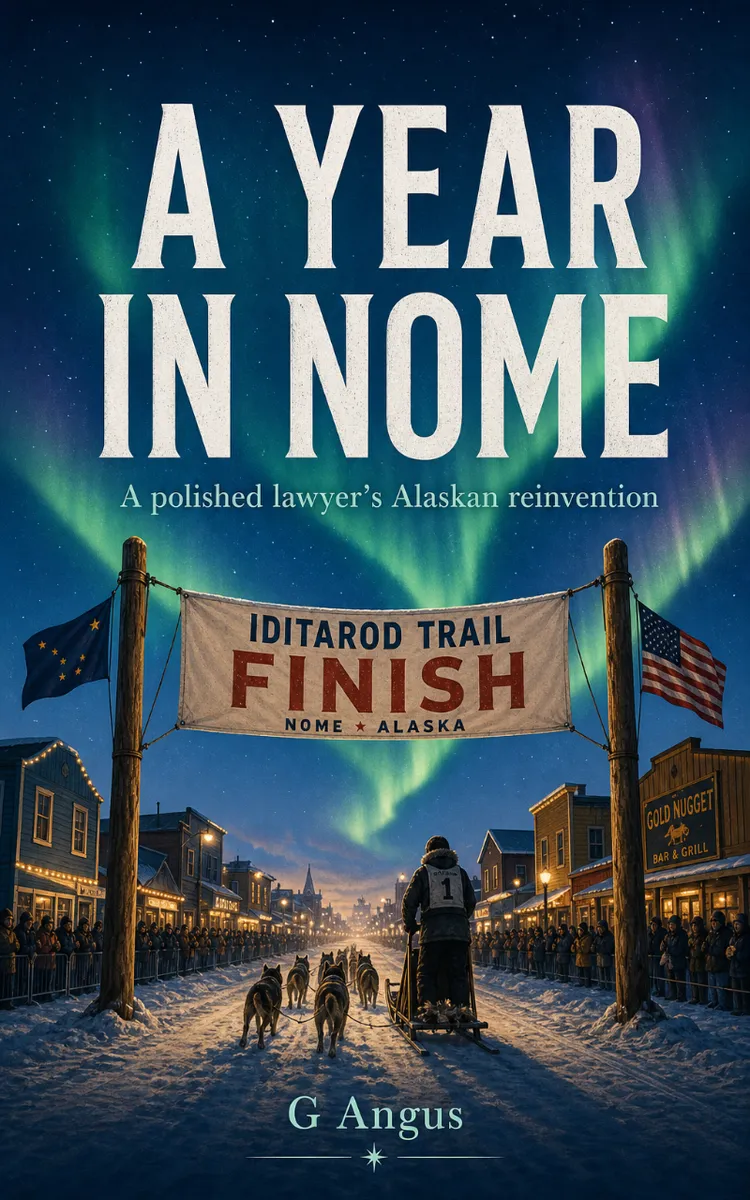
"A Year In Nome" is a fiction book by G Angus with 8 chapters and approximately 18,013 words. A year-long Alaskan coming-of-age reinvention in Nome.
This book was created using Inkfluence AI, an AI-powered book generation platform that helps authors write, design, and publish complete books. It was made with the AI Novel Writer.
Frequently Asked Questions
What is "A Year In Nome" about?
A year-long Alaskan coming-of-age reinvention in Nome
How many chapters are in "A Year In Nome"?
The book contains 8 chapters and approximately 18,013 words. Topics covered include Leaving LA for Nome’s Cold, A Flirtation Above the Grocer, Gold Hunters Invite Jake Aboard, Jake Saves Them From the Capsize, and more.
Who wrote "A Year In Nome"?
This book was written by G Angus and created using Inkfluence AI, an AI book generation platform that helps authors write, design, and publish books.
How can I create a similar fiction book?
You can create your own fiction book using Inkfluence AI. Describe your idea, choose your style, and the AI writes the full book for you. It's free to start.
Write your own fiction book with AI
Describe your idea and Inkfluence writes the whole thing. Free to start.
Start writingCreated with Inkfluence AI


