
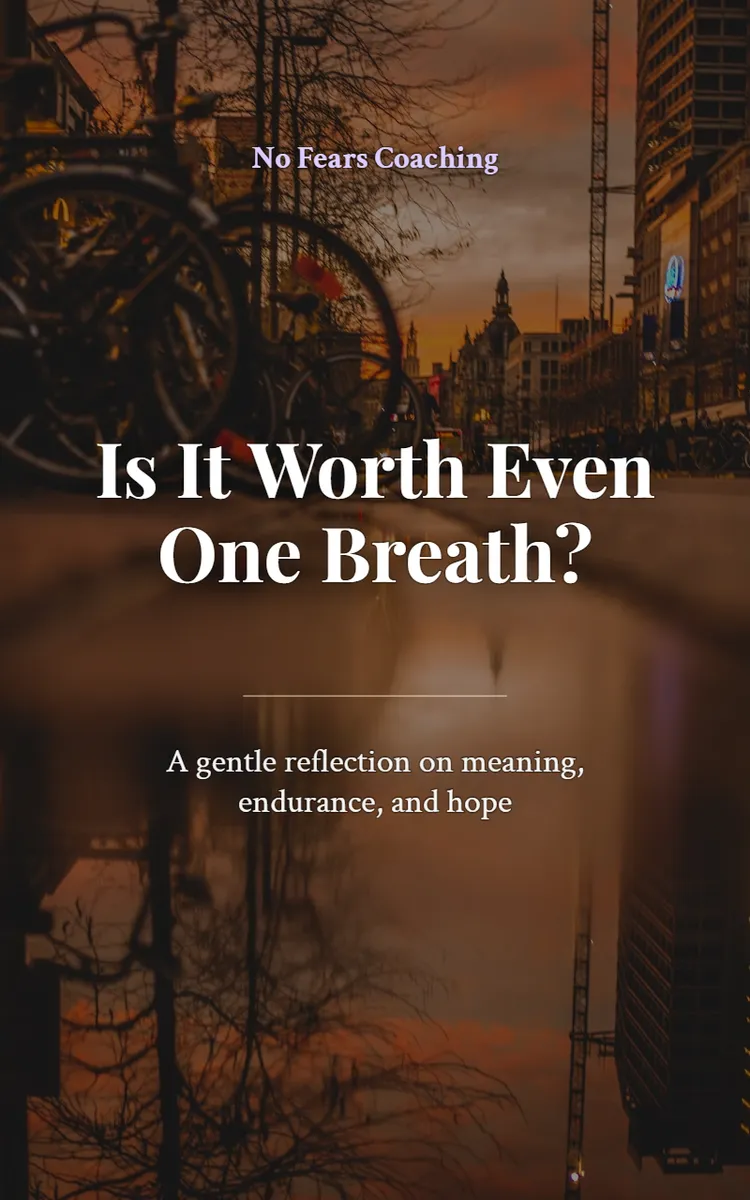
Read the first chapter
The whole of chapter one, free. About 9 min. Turn the pages with the arrows, your keyboard, or a swipe.
Chapter 1
Choosing One Breath Over Nothing
The monitor is still blinking. Your hands are still doing what they always do - check, chart, reset - while your mind tries to catch up. Then the weight lands: not dramatic, not cinematic. Just a steady, quiet collapse inside you. It’s the kind where you don’t even feel like you deserve to be helped because you’re “not that bad.” And still: your chest won’t open all the way. Your thoughts start talking like they’re the only voice left in the room.
Leona knows this moment. Leona is 34, an ER nurse, the kind of tired that has nothing to do with sleep and everything to do with carrying other people’s fear in your own body. It’s 2:17 a.m., and she’s been moving for hours. When the next call comes, she doesn’t feel brave. She feels emptied. And in that emptiness, she notices a strange fork: she can collapse into “nothing matters,” or she can choose one breath - just one - that proves she’s still here.
That’s what this chapter is about: not fixing your whole life in one sitting, not solving the meaning-problem like it’s a puzzle you can crack. It’s about shifting from collapse into a single, doable moment of aliveness when everything feels too heavy. Not later. Not after you “feel better.” In the exact moment your system wants to shut down.
This Chapter Is For You If You… - Feel your mind running toward shutdown when life gets heavy (especially in the middle of responsibility). - Want a way to move from “I can’t” to “I can” without pretending you’re fine. - Are tired of advice that only works when you already have energy. - Need something measurable - something you can do in seconds, not weeks.
If that’s you, you’re not broken. You’re just at the point where meaning needs a door that opens smaller than your pain.
The One-Breath Threshold
Your One-Breath Threshold is the smallest “yes” you can still make when collapse is trying to steal your breath.
Here’s the core idea: when you’re overwhelmed, your brain reaches for absolutes. Either everything is fine, or everything is ruined. Either you can keep going, or you’re finished. The Threshold cuts through that all-or-nothing logic. It gives you a tiny bridge - one breath, one small act of attention, one honest alignment with the fact that you’re alive right now.
Think of it like this: you don’t need to feel hopeful to choose a breath. You don’t need to believe your life is meaningful in order to prove you’re present. The breath is the proof. It’s not a philosophy. It’s a physical yes.
Leona’s night provides the example. A patient needs immediate attention, and her body responds the way bodies do under pressure - fast, efficient, numb around the edges. After a while, the numbness starts to feel like a warning. She catches herself thinking, What’s the point of all this? It’s a question that sounds deep. It’s also a trap, because it asks her to answer the whole universe while she can barely lift her ribs.
So she uses a threshold move that doesn’t require belief. She finds the breath. Not a perfect breath. Not a “mindfulness breath” from a calm video. Just the next breath that actually happens. She feels the inhale arrive like a stranger she doesn’t fully trust yet. Then she chooses an exhale that’s a little slower than the panic wants. One breath. That’s the whole intervention.
And something important happens: the collapse stops being the only storyline. It doesn’t disappear. It just loses control of the steering wheel.
In Practice, This Means… - You stop negotiating with collapse (“maybe I should quit” / “maybe nothing matters”) and instead do one small, body-based action. - You treat the breath like a switch: inhale = return to presence; exhale = release a little pressure. - You measure progress in seconds (“I did the breath”) rather than in mood (“I feel better now”). - You make room for meaning to arrive later, instead of demanding it right this minute.
Putting It Into Practice: From Collapse to a Single Breath
When everything feels too heavy, the temptation is to wait for readiness. You tell yourself, If I could just get my thoughts under control, then I’d try. But “readiness” is often the thing collapse steals first. So the One-Breath Threshold flips the order: you act first, then your mind catches up.
The practical part is simple, but not simplistic. You’re not forcing positivity. You’re creating a moment where your nervous system gets one clear instruction: I am here. I can still coordinate one basic action. That’s how you interrupt the slide into nothingness.
Try this with your next wave of heaviness. Pause - just enough to notice what’s happening inside you. Then do the threshold sequence:
First, locate the breath where it already is. For some people it’s the chest. For others it’s the belly. If you can’t feel it clearly, don’t wrestle. Put one hand on your sternum or abdomen and feel the movement. Contact is a shortcut back to reality.
Second, choose a shorter task than “calm down.” Your task is: inhale once, exhale once, with a little more length on the exhale than on the inhale. That’s it. You’re not trying to become a different person. You’re creating a tiny window where you remain in your life.
Third, name the moment honestly, without drama. Something like: This is the collapse moment. Or: I’m carrying too much right now. Naming doesn’t fix it, but it stops the mind from treating collapse like destiny.
Leona didn’t do this as a “serene” act. She did it while still on her feet. She did it between tasks, during a charting pause, in the exact cracks where time usually disappears. One breath. Then back to the next responsibility - because the next responsibility is real, and it’s waiting.
The Daily Moves That Make One Breath Possible
The One-Breath Threshold works best when you practice it before you need it. Not because you’ll be calm ahead of time, but because you’ll recognize the moment sooner when it shows up.
Morning (before you’re fully awake) 1. Take one breath and make the exhale slightly longer. Notice whether you feel any resistance to being in your body. That resistance is useful information, not a flaw. 2. Say one sentence to yourself: Today, if collapse comes, I will start with one breath. Keep it plain. Don’t add poetry you can’t live up to at 2 a.m.
Midday (when you’re doing something routine) 3. Choose one micro-break - 30 seconds is plenty. Feel your breath for three cycles. Then return to the task you’re already in. The goal isn’t relief. The goal is training.
Evening (when your mind tries to replay everything) 4. Do the Threshold once, even if you don’t feel like it. Put a hand on your chest and take one inhale, one longer exhale. Then write one line: What I’m carrying is… Keep it honest and specific.
When collapse hits (the rule for the moment) 5. If you catch yourself thinking “nothing matters” or “I can’t do this,” switch immediately to the Threshold: inhale once, exhale once, name the moment, then choose the smallest next action you can do in under two minutes.
That last rule is the difference between reflection and survival. Reflection without a next action can become another way to freeze.
Leona’s Shift: Before / Action / Result
Before: Leona is running on adrenaline and duty. She’s between patients, wiping down a surface, and her mind starts dropping heavy questions like stones. Why am I doing this? What’s the point? Her shoulders climb. Her breath turns shallow. The collapse voice says, It’s pointless. Just stop caring.
Action: She doesn’t argue with the philosophy. She goes to the body. One hand on her chest. One inhale. One exhale that’s just a little slower - longer by maybe a second. Then she names it: This is the collapse moment. She chooses the smallest next action: she turns to her charting and fills in one section, not everything. One entry. One breath, then one task.
Result: The question doesn’t vanish, but it loses its grip. The heaviness doesn’t become happiness. It becomes manageable. Leona still feels tired, still carries the night, but she’s no longer trapped in “nothing matters.” She returns to the work with a little more space inside herself - enough space to keep going without disappearing.
Notice what changed. The meaning didn’t arrive as a grand answer. The meaning arrived as movement. She proved to herself that she could choose aliveness in the middle of weight.
Prompts to Find Your Next Breath
1. What does collapse try to convince me is true right now? If your mind says “nothing matters,” ask what it’s protecting you from - grief, responsibility, hope, disappointment. Honest answers usually show up as a simple sentence you can’t unsee.
2. Where in my body does the heaviness live when I’m about to shut down? You might notice jaw tension, a tight throat, shallow breathing, or a hollow feeling in the belly. Pinpointing it makes the breath feel less like a concept and more like a door.
3. What would “one doable moment of aliveness” look like in under two minutes? It could be one chart entry, one glass of water, one stretch, one short message to a coworker. Your next move should be small enough that collapse can’t sabotage it.
4. Am I waiting for a feeling, or am I choosing an action? Feelings are weather. Actions are tools. If you catch yourself waiting for courage, try switching to breath first. Courage can follow; it doesn’t have to lead.
5. What is my honest relationship to hope tonight - do I want it, fear it, or resent it? You don’t have to pick “positive.” You just have to be truthful. Truthful hope is often quieter than motivational hope - and it lasts longer.
These prompts aren’t meant to produce insight like a product. They’re meant to bring you back to the threshold where you can still do something real.
Complete This Today: One Breath With a Name
Pick one moment today - right after you finish reading, or right now - and do the One-Breath Threshold exactly once.
Put one hand where you can feel your breath (chest or belly). Inhale once. Exhale once, a little longer. Then say one sentence out loud or in writing: “This is the collapse moment, and I’m choosing one breath.” After that, do a single next action that takes under two minutes - drink water, send one message, tidy one surface, step outside for a quick look at the sky. Keep it small.
Time needed: 2-4 minutes. You will know it worked when… you can feel a tiny shift from “I’m trapped” to “I can still move,” even if your mood doesn’t change. If you chose the breath and followed with one small action, the threshold held.
Carry that forward. Meaning doesn’t always arrive as an answer. Sometimes it arrives as a breath you chose on purpose - proof that survival is not just endurance, but participation. And that participation is what keeps the larger questions from swallowing you whole.
End of chapter one. 7 more chapters in the full book.
Swipe or use the arrows to turn the page


What's inside: 8 chapters
- 1. Choosing One Breath Over Nothing
- 2. Reframing Meaning as Daily Practice
- 3. Breaking the Spiral with Micro-Resets
- 4. Practicing Radical Acceptance of Reality
- 5. Letting Hope Be Small and Specific
- 6. Turning Values Into Breath-Level Choices
- 7. Building a Compassionate Inner Witness
- 8. Choosing Connection as Meaningful Survival
About this book
"Is It Worth Even One Breath?" is a inspirational book by No Fears Coaching with 8 chapters and approximately 13,942 words. Existential reflection on meaning, survival, and hope.
This book was created using Inkfluence AI, an AI-powered book generation platform that helps authors write, design, and publish complete books. It was made with the AI Inspirational Book Writer.
Frequently Asked Questions
What is "Is It Worth Even One Breath?" about?
Existential reflection on meaning, survival, and hope
How many chapters are in "Is It Worth Even One Breath?"?
The book contains 8 chapters and approximately 13,942 words. Topics covered include Choosing One Breath Over Nothing, Reframing Meaning as Daily Practice, Breaking the Spiral with Micro-Resets, Practicing Radical Acceptance of Reality, and more.
Who wrote "Is It Worth Even One Breath?"?
This book was written by No Fears Coaching and created using Inkfluence AI, an AI book generation platform that helps authors write, design, and publish books.
How can I create a similar inspirational book?
You can create your own inspirational book using Inkfluence AI. Describe your idea, choose your style, and the AI writes the full book for you. It's free to start.
Write your own inspirational book with AI
Describe your idea and Inkfluence writes the whole thing. Free to start.
Start writingCreated with Inkfluence AI


