
Read the first chapter
The whole of chapter one, free. About 13 min. Turn the pages with the arrows, your keyboard, or a swipe.
Chapter 1
Opening Your Eyes in the Crypt
Your bank statement sits open on the screen, glowing like evidence from a crime scene. One charge says “coffee.” Another says “coffee” again. A third says “online purchase,” which is financial language for “you forgot what happened, but your checking account remembers.” Your finger hovers over the page, ready to close the tab and return to the comforting lie that everything will somehow work out.
Don’t close it.
The statement isn’t the monster. It’s the flashlight. It shows where your money went, which bills keep stalking you, and how much room remains before your next paycheck arrives. Avoiding it lets the damage spread in the dark. Reading it gives you a map.
You don’t need to solve your entire financial life today. You need to identify what happened, separate facts from panic, and create a clear list of what requires attention. By the time you finish, you’ll have a working picture of your money: what came in, what went out, what repeats, what surprised you, and what threatens your next few weeks. That picture won’t feel pleasant. It will feel useful.
The Crypt Reality Check
The Crypt Reality Check gives you a controlled way to examine your statement without turning every charge into a personal trial. You’ll review one complete account period, record every transaction, label each item, and total the damage. The goal isn’t to shame yourself for buying lunch or to pretend every expense carries equal weight. The goal is to stop guessing.
Guessing creates two problems. First, you may panic over a purchase that barely matters while ignoring a recurring bill that quietly drains your account every month. Second, you may cut something important because it feels visible, while leaving several small charges untouched because they hide behind vague descriptions. Your statement removes the fog, but only if you read the whole thing.
Use one recent statement that covers a full period, such as the first through the last day of a month. Download the transaction list as a spreadsheet if your bank offers that option. If not, use paper or a blank document. You need the date, description, amount, and account balance after each transaction. Don’t rely on memory. Memory turns a $14 lunch into “probably around ten bucks” and transforms three separate delivery orders into “one weird week.”
Sort every transaction into one of four labels:
1. Money in - Record pay, transfers from another account, refunds, and other deposits. You need this total because spending only makes sense beside the money available to cover it.
2. Required out - Mark rent, utilities, insurance, minimum debt payments, medication, groceries, transportation, and other costs that protect your housing, health, work, or basic functioning. You may later reduce some of these, but you can’t treat them like random treats.
3. Chosen out - Mark restaurant meals, entertainment, clothing, hobbies, convenience purchases, and other spending you selected. This label doesn’t mean “bad.” It means you had a choice, which makes it easier to review without pretending the purchase never happened.
4. Unknown - Use this label when the description doesn’t tell you what happened or you can’t identify the charge. Unknown expenses deserve attention because forgotten spending can hide errors, duplicate charges, or subscriptions you no longer use.
Keep transfers separate from actual spending. Moving $300 from savings to checking doesn’t mean you earned $300, and moving $200 from checking to a credit card doesn’t mean you spent $200 that day if the card purchase already appeared earlier. Counting transfers as income or expenses can make your totals look cleaner or uglier than reality. Neither helps.
After labeling, mark every repeating charge with a small “R.” A repeating charge appears on a schedule, such as monthly rent, weekly childcare, a streaming service, or a quarterly insurance payment. Then mark every charge that feels irregular but predictable, such as annual registration, school costs, holiday spending, or a professional license. These expenses may not appear every month, but they still belong on your map. A bill doesn’t become imaginary just because it arrives wearing a quarterly disguise.
Now calculate four totals:
• Total money in - Total required out - Total chosen out - Total unknown out
Add the required and chosen spending together. Compare that amount with your money in. If the result looks impossible, check whether you included transfers, credit card payments, or a paycheck deposited into another account. The first pass often contains mistakes. That’s normal. The point of the first pass is to expose the shape of the problem, not produce a museum-quality financial artifact.
A simple example makes the method less mysterious. Suppose your account shows $3,200 in deposits during the period. You record $1,850 in required out, $920 in chosen out, and $110 in unknown out. Your spending totals $2,880, leaving $320 before accounting for transfers or charges that landed outside the statement period. That doesn’t mean you have $320 available to spend. It means your statement shows a gap worth investigating. If a $500 credit card payment appears in the account, you need to determine whether it paid for purchases already listed on the card statement. Double-counting can make you think you’re worse off than you are; missing it can make you think you’re safe when you aren’t.
The Crypt Reality Check works because it turns a haunted feeling into visible pieces. You don’t need to feel calm before you begin. You need a statement, a pen or spreadsheet, and enough time to finish one complete pass without escaping into online shopping as emotional support.
Mapping the Damage Without Panic
Set aside about 45 minutes for the first review. Choose a time when you won’t need to rush away halfway through. Open your bank statement, your credit card statement if you use one, and your calendar. The calendar matters because it helps you connect transactions with real events: payday, rent, insurance renewal, a trip, a repair, or a bill you forgot to expect.
Work from the oldest transaction to the newest. Don’t scan for the worst charge first. That approach invites panic and makes you skip ordinary transactions that reveal the pattern. Move line by line. Record what happened, label it, and continue. You’re doing evidence collection, not sentencing.
When a description looks unfamiliar, investigate it before you label it as fraud or dismiss it as harmless. Search the merchant name in your email, check receipts, and look at the date. Some businesses use a parent company name that doesn’t match the name on the storefront. A charge labeled “SQ *RIVER” may come from a small shop using a payment service. A charge labeled “APPLE.COM/BILL” may cover an app, storage plan, or subscription. Don’t assume the charge is fine just because the name looks official. Confirm it.
If you still can’t identify the charge, leave it under Unknown and circle it. Contact the bank or merchant after you finish the full statement. Stopping every few minutes to investigate one item can turn a 45-minute review into a three-hour descent through password resets and customer-service music. Finish the map first. Then handle the mysteries in a batch.
Look for clusters rather than isolated purchases. One $7 convenience-store charge may not change your month. Ten charges may reveal that you’ve been buying breakfast, drinks, and snacks on the way to work. One $28 delivery order may reflect a busy evening. Four orders in ten days may show that convenience has become a standing bill. The pattern matters more than the individual transaction because the pattern tells you what keeps returning.
Pay special attention to five warning signs:
1. The balance drops faster than expected. Compare the account balance after each transaction. A sharp drop may reveal a large bill, a duplicate payment, or several charges landing close together.
2. The same merchant appears repeatedly. Group matching or similar names. Repetition often points to a subscription, a habit, or a bill that needs a better place in your plan.
3. A charge appears after you thought you canceled. Check the cancellation date and confirmation email. Keep the evidence before you contact the company.
4. The account goes negative or gets close to zero. Mark the date and identify the transactions that caused the squeeze. Timing matters. A manageable monthly total can still create a crisis when bills arrive before income.
5. Your statement contains charges you can’t explain. Don’t bury them under “probably fine.” Unknown spending deserves a clear answer.
Separate timing problems from spending problems. If your income arrives on the 15th but your largest bills leave the account on the 1st, you may face a cash-timing problem even if your monthly income covers your monthly bills. If your account stays short after all income and spending totals appear, you face a spending or income gap. The fixes differ. Timing may require changing bill dates, creating a small buffer, or dividing a bill across paychecks. A spending gap requires reducing outflow, increasing income, or both. You can’t fix the wrong monster by swinging at it harder.
Your first review should answer five direct questions:
• How much money entered this account? - How much left for required costs? - How much left for chosen costs? - Which charges repeat? - Which charges remain unknown?
Write the answers at the top of the page. Include the statement dates. Without dates, your totals can mislead you when a paycheck or bill falls just outside the period. A statement ending on the 28th may not include rent charged on the 1st, even though rent still controls your next few days.
The purpose of this map isn’t to create a perfect budget yet. It’s to establish reality. You can’t decide what to cut, protect, delay, or renegotiate until you know what actually happened. The bank statement gives you the raw material. Your labels turn it into information.
A Full Crypt Reality Check
Use this process with a recent checking account statement covering one month. Assume the statement shows $3,400 in deposits, $2,050 in required out, $1,080 in chosen out, $75 in unknown out, and a $400 transfer to a credit card.
1. Gather the records. Open the checking statement, the credit card statement, recent receipts, and your calendar. Keep the records together so you can match dates and descriptions instead of relying on memory.
2. Record the deposits. Enter each deposit and confirm that the total reaches $3,400. If a deposit represents a transfer from another account, label it as a transfer rather than money in. Your expected outcome is a clean income total that doesn’t include recycled money.
3. Label every checking transaction. Mark rent, electricity, insurance, groceries, minimum payments, and transportation as required out. Mark restaurant meals, entertainment, clothing, and convenience purchases as chosen out. Leave five unclear charges totaling $75 under unknown until you investigate them.
4. Mark repeating charges. Place an “R” beside rent, insurance, phone service, and any subscriptions. Suppose three subscriptions total $42 per month. Record that total separately. Your expected outcome is a list of charges that will return unless you stop them.
5. Separate the credit card payment. The $400 payment from checking isn’t automatically another $400 of spending. Review the credit card statement. If the card shows $400 in purchases during the same period, the checking payment moves money between accounts while the card purchases represent the spending. If the card payment covers an older balance, record the payment as debt repayment and note that the purchases happened earlier.
6. Investigate the $75 unknown amount. Search email receipts, check merchant websites, and contact the bank for charges you still can’t identify. Suppose $30 turns out to be a forgotten app subscription, $25 belongs to a legitimate pharmacy purchase, and $20 remains unexplained. Cancel the app, keep the pharmacy charge under required out, and flag the $20 for bank review.
7. Calculate the first totals. Required out equals $2,075 after adding the pharmacy charge. Chosen out remains $1,080. Unknown out equals $20. Total identified spending equals $3,155, leaving $245 from the $3,400 deposit total before considering the credit card balance, upcoming bills, or account transfers.
8. Check the next seven days. Look at your calendar and upcoming bills. If rent of $1,200 leaves the account two days after the statement ends, the $245 isn’t available spending money. It’s already facing a large incoming obligation. Write that bill beside the balance so the number doesn’t trick you.
9. Write the danger points. Record the three most urgent findings: the $1,200 rent due soon, the $42 in subscriptions, and the $20 unexplained charge. Don’t write “fix finances.” Write actions you can complete, such as “review the three subscriptions,” “contact the bank about the $20,” and “protect rent money before discretionary spending.”
10. Save the map. Name the file with the statement period and keep the notes beside the statement. Your expected outcome is a dated snapshot you can compare with the next statement without starting from a blank page.
Quick checklist
• Download or print one complete statement. - Record every deposit and transaction. - Label each item as money in, required out, chosen out, or unknown. - Mark repeating charges with an “R.” - Keep transfers separate from spending. - Investigate unknown charges after the first full pass. - Compare the ending balance with bills due during the next seven days. - Write the three most urgent findings as specific actions. - Save the completed map with its statement dates.
If your totals don’t balance perfectly, don’t throw the papers across the room. Check the statement period, duplicate entries, pending charges, cash withdrawals, transfers, and credit card payments. A mismatch tells you to investigate. It doesn’t prove that you’ve failed.
Traps That Make the Crypt Look Worse
Counting credit card payments as new spending
A payment from checking to a credit card can look like an expense even when the purchases already appear on the card statement. Counting both can inflate your spending total and send you into unnecessary panic. The opposite mistake can hide debt repayment when the card purchases happened in an earlier period.
Do this: Match the payment against the credit card statement. Identify whether it covers current purchases, an older balance, interest, fees, or a mixture.
Not this: Add every credit card payment to checking-account purchases without checking for overlap.
If you can’t separate the pieces immediately, mark the payment as “review” and keep it out of the final total until you confirm what it covered. A temporary question beats a confident wrong answer.
Treating unknown charges as harmless
A vague merchant name may represent a valid purchase, a forgotten subscription, a duplicate charge, or fraud. Ignoring it leaves a hole in your map. Small unknowns can also repeat, turning one unanswered question into a recurring leak.
Do this: Search receipts and email, check the merchant’s billing name, and contact the bank for anything you still can’t identify. Save confirmation numbers and cancellation emails.
Not this: Label every unfamiliar charge as fraud before checking your records, or dismiss it because the amount looks small.
If you recognize the charge after investigating, relabel it. If you don’t, follow your bank’s dispute process promptly. Keep the date, amount, merchant description, and any communication connected to the charge.
Mistaking a low balance for the full damage
Your current balance shows what remains in the account at one moment. It doesn’t show bills that haven’t arrived, pending transactions, annual costs, or money already promised to rent and debt payments. A balance of $900 can feel comfortable until $1,100 in bills arrives next week.
Do this: Compare the balance with the next seven days of scheduled bills and known charges. Write those obligations beside the balance before deciding what you can spend.
Not this: Treat the number on the screen as free money.
If the account can’t cover the next scheduled obligations, mark the shortfall clearly. You may need to contact a biller, move a payment date, protect a required expense, or stop optional spending immediately. The earlier you see the gap, the more choices you have.
Trying to repair everything during the first review
The first statement review can uncover subscriptions, expensive habits, confusing transfers, old debt, and charges that make your stomach drop. Trying to fix every item before you finish the map creates overload. Overload sends you back into avoidance, where the crypt happily waits with its lights off.
Do this: Finish the full inventory, then choose the three most urgent actions based on timing, housing, health, work, and account safety.
Not this: Cancel a necessary service, miss a required payment, or make a rushed debt move because one charge embarrassed you.
A clear map comes before dramatic action. You’re not trying to defeat every creature in the building with one swing. You’re turning on the lights, marking the exits, and identifying which door needs attention first.
When the statement stops looking like a wall of accusations and starts looking like a list of dates, amounts, and decisions, you’ve already changed the situation. The crypt may still contain debt, habits, and unpleasant surprises. But you can see where you’re standing now, and that makes the next move possible.
End of chapter one. 29 more chapters in the full book.
Swipe or use the arrows to turn the page


What's inside: 30 chapters
- 1. Opening Your Eyes in the Crypt
- 2. Summoning the Monster Ledger
- 3. Bank Statement Autopsy for Fees
- 4. Your Cashflow Pulse Check
- 5. Choosing Your Survival Budget Mode
- 6. Impulse Buy Exorcism: The 24-Hour Rule
- 7. Subscription Vampires: Monthly Kill-Switch
- 8. Lifestyle Creep Zombies: Stop Upgrading
- 9. Bank App Alerts: Your Early-Warning System
- 10. Cash-Only Boundaries for Weak Spots
- 11. The Grocery Raid Plan: Spend Less, Eat Better
- 12. Transportation Hacks Without the Regret
- 13. High-Interest Debt: Pick Your Payoff Order
- 14. Minimum Payments Are a Trap
- 15. Negotiating APR Like You Mean It
- 16. Balance Transfers Without the Gotchas
- 17. Debt Snowball With a Realistic Budget
- 18. Emergency Fund: Chainsaws Against Zombies
- 19. Choosing Emergency Fund Size
- 20. Automated Budgeting Without Losing Control
- 21. The First Investing Step: Don’t Touch Debt Yet
- 22. Employer Match: Free Money Exorcism
- 23. Index Funds 101: The Boring Spell
- 24. Compound Interest: The Slow Monster
- 25. Risk Tolerance Without the Panic
- 26. Retirement Accounts: Which One to Use
- 27. Avoiding Investing Scams and Shiny Objects
- 28. Debt-Free Victory Lap: Keep the Gains
- 29. Long-Term Independence: Your Financial Operating System
- 30. Final Boss: Staying Broke-Proof Forever
About this book
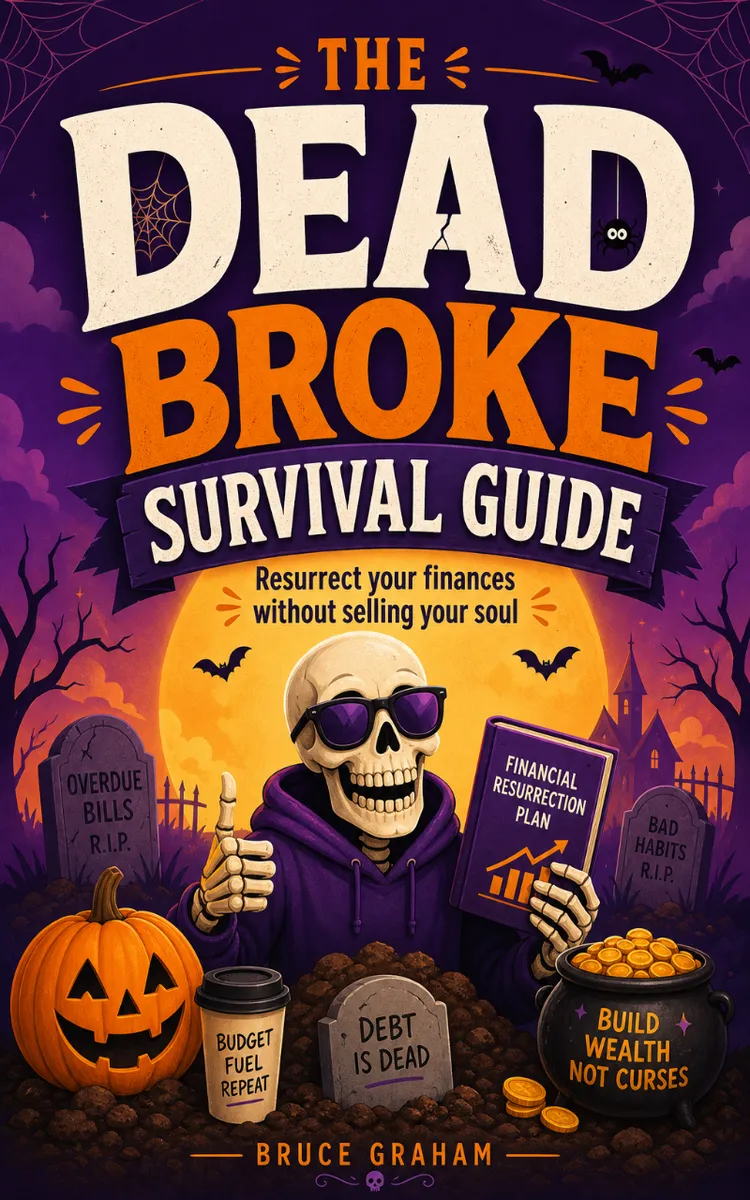
"The Dead Broke Survival Guide" is a finance book by Bruce Graham with 30 chapters and approximately 66,737 words. Personal finance tactics for debt, budgeting, saving, and investing.
This book was created using Inkfluence AI, an AI-powered book generation platform that helps authors write, design, and publish complete books. It was made with the AI Ebook Generator.
Frequently Asked Questions
What is "The Dead Broke Survival Guide" about?
Personal finance tactics for debt, budgeting, saving, and investing
How many chapters are in "The Dead Broke Survival Guide"?
The book contains 30 chapters and approximately 66,737 words. Topics covered include Opening Your Eyes in the Crypt, Summoning the Monster Ledger, Bank Statement Autopsy for Fees, Your Cashflow Pulse Check, and more.
Who wrote "The Dead Broke Survival Guide"?
This book was written by Bruce Graham and created using Inkfluence AI, an AI book generation platform that helps authors write, design, and publish books.
How can I create a similar finance book?
You can create your own finance book using Inkfluence AI. Describe your idea, choose your style, and the AI writes the full book for you. It's free to start.
Write your own finance book with AI
Describe your idea and Inkfluence writes the whole thing. Free to start.
Start writingCreated with Inkfluence AI


