
Read the first chapter
The whole of chapter one, free. About 8 min. Turn the pages with the arrows, your keyboard, or a swipe.
Chapter 1
Retirement Math and Target Number
The Number That Buys Your Freedom
What would happen if your paycheck stopped next month? The answer starts with one number: the annual cost of the life you want to keep. Without that number, “retire before 40” stays a wish. With it, you can calculate how much to invest, how long the work will take, and whether your current plan can support the finish line.
Early retirement math does not require a perfect forecast. It requires clear assumptions that you can check and update. You need to know what you spend now, which costs disappear when work ends, which costs remain, and how much room your portfolio needs for bad markets and changing plans.
By the end of this process, you will have a personal target rather than a borrowed rule. You will estimate your retirement spending, choose a withdrawal assumption, calculate a portfolio target, and connect that target to a savings timeline. The goal is not to predict every future bill. The goal is to make your plan specific enough to act on.
Build Your Target with the FIRE Target Builder
The FIRE Target Builder turns a vague goal into four working numbers: annual retirement spending, annual portfolio withdrawals, required portfolio size, and years until you reach it. FIRE means financial independence, retire early. Here, financial independence means your investments can cover your planned spending without a job.
Start with spending, not income. Income tells you how much money enters your account. Spending tells you how much your portfolio must replace. Review the last twelve months of bank and credit-card records. Add rent or mortgage payments, utilities, groceries, insurance, transportation, medical costs, subscriptions, travel, hobbies, gifts, taxes, and irregular bills. Divide the total by twelve to find your current monthly average.
Then separate work-related costs from retirement costs. A daily commute, work lunches, professional clothing, and business travel may shrink or disappear. Health insurance, home repairs, food, property taxes, and basic transportation may remain. Add a practical allowance for expenses you do not pay every month. If you spend $600 on car repairs twice a year, count $100 per month rather than pretending the cost does not exist.
Use these steps:
1. Measure your current spending. Add every category from the past twelve months. Use actual transactions instead of memory because small weekly purchases can distort a rough estimate. 2. Remove costs that work creates. Subtract commuting, office meals, work clothing, and other expenses that disappear after retirement. Keep the savings only if you have a specific reason to expect them. 3. Add retirement-only costs. Include more travel, hobbies, home projects, health coverage, or support for family if those plans matter to you. Your target must fund the life you intend to live, not a stripped-down version you will resent. 4. Add a safety margin. Multiply your annual estimate by 1.10 or add a separate cash reserve for irregular costs. This gives your plan room for repairs, price increases, and imperfect estimates without pretending that the future will match a spreadsheet. 5. Choose a withdrawal assumption. Divide your target portfolio by the annual amount you expect to withdraw. A 4% withdrawal assumption means a $1,000,000 portfolio supports $40,000 of first-year withdrawals under the model. For an early retirement lasting many decades, test a more cautious assumption, such as 3.5%, and compare the result. 6. Calculate the target portfolio. Divide annual retirement spending by your chosen withdrawal rate. If you plan to spend $48,000 per year and use 3.5%, the calculation is $48,000 ÷ 0.035 = about $1,371,000. 7. Connect the target to your timeline. Compare your current investments, annual contributions, and expected investment growth with the target. A compound-interest calculator or spreadsheet can show whether your target arrives in eight years, fifteen years, or later.
Your withdrawal assumption matters because retiring at 39 creates a longer period for your portfolio to support you than retiring at 65. A lower withdrawal rate creates a larger target and gives you more protection. It also forces an honest conversation about spending. If the target looks too large, you can reduce spending, increase savings, earn more, retire later, or combine part-time income with portfolio withdrawals.
Use a simple table to keep the assumptions visible:
| Item | Example | |---|---:| | Current monthly spending | $4,200 | | Work costs removed | -$450 | | Retirement costs added | +$500 | | Monthly retirement estimate | $4,250 | | Annual spending | $51,000 | | Planning margin | $5,100 | | Target annual spending | $56,100 | | Withdrawal assumption | 3.5% | | Portfolio target | $1,602,857 |
The table does not promise that the result will be exact. It shows which input drives the result. If you lower annual spending by $5,000, the portfolio target falls by roughly $143,000 at a 3.5% withdrawal assumption. That is why controlling recurring expenses can change your timeline more than chasing a slightly higher investment return.
A Complete FIRE Target Builder Example
Use the following process with your own statements, spreadsheet, or budgeting app. The numbers below show the expected result at each stage.
1. Record the spending baseline. Add twelve months of expenses and find an average of $4,600 per month, or $55,200 per year. This includes a $500 monthly mortgage payment, $700 for groceries, $600 for transportation, $350 for insurance and medical costs, and the remaining amount across utilities, entertainment, repairs, and other bills.
2. Remove work-related expenses. The plan removes $300 per month for commuting, work meals, and professional clothing. Annual spending falls by $3,600, from $55,200 to $51,600. Do not remove the mortgage simply because work ends; keep it unless the mortgage will definitely be paid off before retirement.
3. Add the cost of the planned lifestyle. The plan adds $400 per month for travel, hobbies, and home projects. Annual spending rises by $4,800, reaching $56,400. This step prevents a common mistake: building a target around survival spending and then discovering that retirement feels too restricted.
4. Add a planning margin. Add 10% to cover irregular expenses and estimation errors. The target becomes $62,040 per year. Round that figure to $62,000 so the calculation stays easy to update.
5. Calculate two portfolio targets. At a 4% withdrawal assumption, divide $62,000 by 0.04. The result is $1,550,000. At a 3.5% assumption, divide $62,000 by 0.035. The result is about $1,771,000. The gap of roughly $221,000 shows the price of choosing a more cautious plan.
6. Measure the timeline. Suppose the current portfolio equals $300,000, annual investing equals $60,000, and the planning model assumes 5% yearly growth after inflation. A compound-growth spreadsheet can project the portfolio to about $1.05 million after eight years and about $1.40 million after eleven years. It may reach the $1.55 million target around thirteen years and the $1.77 million target around fifteen years, depending on the timing of deposits and market results. Treat these dates as planning estimates, not promises.
7. Test a practical adjustment. If spending falls by $6,000 per year after the mortgage ends, the 3.5% target falls by about $171,000. That change may shorten the timeline more reliably than assuming unusually strong investment returns. Update the model with the actual mortgage payoff date and confirm that property taxes, insurance, repairs, and maintenance remain in the budget.
Review the result quarterly, not daily. Check the spending estimate against actual transactions, update the portfolio balance, and record the amount invested. If the target moves, write down why. A higher target caused by planned travel makes sense. A higher target caused by forgotten insurance bills reveals a budgeting problem you can fix.
Quick checklist
• Export twelve months of bank and credit-card transactions. - Group spending into clear categories. - Remove only costs that will genuinely end with work. - Add healthcare, housing, repairs, travel, and hobbies. - Add a stated planning margin. - Test both a 4% and a 3.5% withdrawal assumption. - Divide annual spending by the chosen withdrawal rate. - Record your current portfolio and yearly contributions. - Run the timeline through a spreadsheet or compound-interest calculator. - Recheck the plan every quarter.
Mistakes That Distort the Target
Using income as the retirement budget
A person earning $90,000 may spend $45,000, while another person earning $60,000 may spend nearly all of it. Replacing income creates a target that may be far too large or too small. Use spending because the portfolio pays for spending, not for your old salary.
Do this: Build the target from twelve months of actual transactions and add planned retirement costs.
Not this: Assume retirement requires the same amount as your current salary.
Ignoring irregular bills
Monthly averages often hide property repairs, insurance renewals, vehicle work, medical treatment, and annual fees. A budget that looks accurate for ten months can fail when several large bills arrive together. Add those costs to the year they occur, then divide the total by twelve.
Do this: Keep a separate irregular-expense line and fund it every month.
Not this: Treat a quiet month as proof that your annual spending is low.
Treating the target date as guaranteed
A spreadsheet can show a projected date, but markets do not deliver smooth returns. A long decline near your retirement date can leave you with less money than the model predicts. Protect the plan by testing a later retirement date, a lower withdrawal rate, reduced spending during weak markets, or part-time income for the first few years.
Do this: Maintain a base target and a cautious target, then decide what conditions must exist before you leave work.
Not this: Quit on the first date a calculator displays.
Your target becomes useful when you can explain every major input: what you spend, what will change, how much your portfolio must provide, and what assumptions set the date. Once those numbers sit in front of you, early retirement stops being a distant idea and becomes a sequence of decisions - each one visible, measurable, and adjustable.
End of chapter one. 7 more chapters in the full book.
Swipe or use the arrows to turn the page
What's inside: 8 chapters
- 1. Retirement Math and Target Number
- 2. Budgeting for Maximum Investable Cash
- 3. Emergency Fund and Risk Buffer
- 4. Index Investing with Auto-Contributions
- 5. Tax-Advantaged Accounts Strategy
- 6. Building a Bond and Cash Glidepath
- 7. Stock Picking Only When It Fits
- 8. Retire Before 40 Withdrawal Plan
About this book
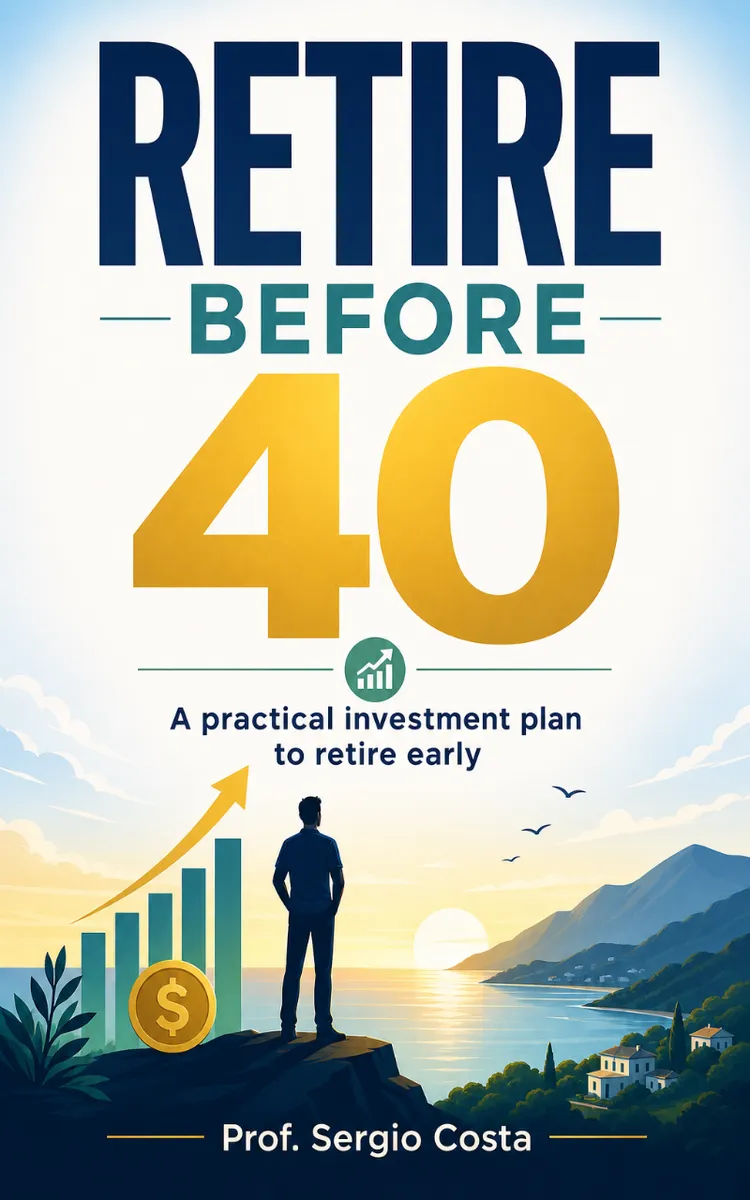
"Retire Before 40" is a finance book by Prof. Sergio Costa with 8 chapters and approximately 13,569 words. What if your paycheck stopped next month, and you still had to live the life you want? Early retirement is not a vibe, it is a math problem, and most plans fail because they never get specific enough to act on. In Retire Before 40, you will learn the exact numbers behind your freedom, from estimating your annual retirement spending to building a portfolio target and connecting it to a realistic savings timeline.
This book was created using Inkfluence AI, an AI-powered book generation platform that helps authors write, design, and publish complete books. It was made with the AI Ebook Generator.
Frequently Asked Questions
What is "Retire Before 40" about?
What if your paycheck stopped next month, and you still had to live the life you want? Early retirement is not a vibe, it is a math problem, and most plans fail because they never get specific enough to act on. In Retire Before 40, you will learn the exact numbers behind your freedom, from estimating your annual retirement spending to building a portfolio target and connecting it to a realistic savings timeline. You will also build the cash system that protects your investments, so a bad month does not turn into a permanent loss. With actionable investment examples and clear frameworks, you will stop borrowing rules and start running your plan like a professional.
How many chapters are in "Retire Before 40"?
The book contains 8 chapters and approximately 13,569 words. Topics covered include Retirement Math and Target Number, Budgeting for Maximum Investable Cash, Emergency Fund and Risk Buffer, Index Investing with Auto-Contributions, and more.
Who wrote "Retire Before 40"?
This book was written by Prof. Sergio Costa and created using Inkfluence AI, an AI book generation platform that helps authors write, design, and publish books.
How can I create a similar finance book?
You can create your own finance book using Inkfluence AI. Describe your idea, choose your style, and the AI writes the full book for you. It's free to start.
Write your own finance book with AI
Describe your idea and Inkfluence writes the whole thing. Free to start.
Start writingCreated with Inkfluence AI


