
Read the first chapter
The whole of chapter one, free. About 7 min. Turn the pages with the arrows, your keyboard, or a swipe.
Chapter 1
The Ego Behind Your Trades
Learn How Identity Shapes an Investment Decision
In 2008, many investors did not sell because their research suddenly proved worthless. They sold because the falling market challenged something more personal: their judgment. A portfolio statement can show a number, but the number often carries a second message in the owner’s mind: I was wrong. I am not as capable as I thought. Other people can see it.
That private message changes behavior. An investor who normally reviews a business carefully may start checking prices every few minutes. Someone who prides themselves on patience may sell simply to end the embarrassment. Another person may hold on longer than reason allows because selling would feel like admitting defeat.
The core thesis of this book is simple: investing success is 80% behavior, psychology, and self-awareness, and 20% math. Math still matters. You need to understand price, cash flow, debt, and the possible range of outcomes. But a sound calculation cannot rescue a decision that your identity refuses to accept. The important question is not only, “What should I buy?” It is also, “What does this decision say about me, and how might that answer control me?”
Identity means the picture you carry of yourself. You may see yourself as a careful investor, an early adopter, a contrarian, a business owner who understands companies, or the person in your family who finally became good with money. These descriptions feel harmless until an investment threatens them. Then you may defend the description instead of examining the decision.
Consider an investor who built a reputation among friends for finding overlooked companies. After one successful purchase, every later idea starts to look like a test of that reputation. A plain index fund feels too ordinary. A sensible sale feels like surrender. A complicated position feels attractive partly because it proves the investor still has an edge. The investment may look rational on paper, but pride has already chosen the direction.
The same pattern appears in a small-business owner’s portfolio. An owner who spends each day solving operational problems may believe that their practical judgment transfers directly to markets. That confidence can help them study a company’s products or customers. It can also make them dismiss risks outside their experience. The owner does not merely hold a position; they hold a claim about who they are: I understand businesses better than most people.
That claim creates pressure. If the investment falls, the owner may search for explanations that protect the self-image. If the investment rises, the gain may strengthen the belief beyond what the evidence supports. Neither reaction starts with a clean review of the position. Both start with the ego.
Identity also affects what you refuse to buy. An investor who sees themselves as disciplined may avoid a sensible opportunity because it feels too popular. An investor who sees themselves as bold may reject a boring, diversified approach because it seems beneath their ability. An investor who considers themselves independent may resist changing a view even when new facts deserve attention. The label becomes more important than the result.
You do not need to eliminate identity. You need to stop letting identity make the final decision. Your self-image can help you set standards, but it should not determine whether a position deserves capital. A useful investment process asks what the asset can do for your financial plan, not what owning it allows you to say about yourself.
Self-Image Quietly Drives Decisions That Look Rational but Feel Personal
The Ego-Trade Loop explains how this happens. First, you form a self-image: I am a smart stock picker, I am patient, or I do not follow the crowd. Next, you make a trade that supports that image. The trade then becomes evidence for the identity, whether the result came from skill, luck, or a favorable market. Finally, you protect the identity by defending similar trades, even when the original reason has weakened.
The loop feels logical because each step connects to the previous one. You studied the company, bought the shares, watched them rise, and concluded that you have good judgment. The problem begins when the conclusion becomes more important than the evidence. You stop asking whether the next decision deserves capital and start asking whether it preserves your record.
This loop can run in both directions. A winning trade may tell you that you are unusually capable. A losing trade may tell you that you must recover your reputation. Both messages can lead to poor choices. The winner encourages larger risks because the ego wants another confirmation. The loser encourages stubbornness because the ego wants to erase the admission of error.
A practical way to interrupt the loop starts before you place a trade. Write down the decision in plain language, including the reason you are buying, what would change your view, and how much uncertainty you accept. Then add one uncomfortable sentence: “If this fails, I may be tempted to defend my identity instead of reviewing the facts.” That sentence matters because it separates the investment from your character before the market tests you.
Use a second question before committing money: “Would I make this same decision if nobody knew about it?” If the answer changes, examine the social and personal pressure. You may be buying a well-known company because it makes you look informed. You may be avoiding a simple fund because it makes you feel ordinary. You may be holding a position because selling would force you to explain yourself.
The question does not prove that the trade is wrong. It reveals that the trade carries emotional weight. Once you see that weight, you can inspect the actual decision more clearly.
You can also create an identity-free review. Cover the company name, ticker, purchase price, and your original commentary. Review only the current facts: the asset, its present valuation, its role in your plan, and the reasons you would buy it today. Then ask, “If I did not already own this, would I choose it now?” This question does not belong to the sunk cost problem; it focuses on the personal attachment created by your self-image. You are checking whether pride has become part of the holding.
Keep the answer short. Long explanations often give the ego more material to defend. Write three sentences: what the investment does, why it belongs in your plan, and what personal feeling makes the decision difficult. The third sentence may read, “Selling would make me feel less intelligent,” or “Buying this would make me feel behind.” Naming the feeling reduces its ability to disguise itself as analysis.
Self-image also shapes position size. An investor who wants to be known as decisive may commit too much capital to one idea. An investor who wants to appear cautious may spread money across so many holdings that no decision matters. The numbers may look deliberate, but the underlying question remains personal: “What kind of investor do I want others, or myself, to see?”
Before adjusting a position, describe the action without identity language. Replace “I need to prove this thesis” with “I am increasing exposure to this asset.” Replace “I cannot admit defeat” with “I am deciding whether the current opportunity justifies continued ownership.” Replace “A serious investor would hold” with “What evidence supports holding?” Plain language strips away the courtroom drama inside your head.
The same practice helps when you receive praise. Compliments can strengthen the Ego-Trade Loop just as criticism can. If someone calls you a gifted investor after a successful trade, accept the compliment without turning it into a rule. Ask what part of the result came from your process and what part came from conditions you could not control. You do not need to deny skill. You need to keep one outcome from becoming a permanent identity.
Build a short pre-trade identity check into your routine:
• What identity does this trade support? - Would I still make it if nobody could see the result? - Which fact, if it changed, would make me reconsider? - Am I choosing the investment, or defending my image? - Can I explain the decision without describing myself?
These questions work because they target the hidden motive directly. They do not ask you to become emotionless. They ask you to notice when emotion has borrowed the language of reason.
The goal is not to remove pride from investing. Pride can encourage preparation, patience, and care. The danger begins when you protect the person you believe yourself to be more fiercely than you protect your capital. A good investor can say, “This was a poor decision,” without turning that sentence into “I am a poor investor.” That separation creates room to change.
Your portfolio is not a public examination of your intelligence. It is a tool for turning saved capital into future choices, security, and freedom over time. When you treat every trade as a verdict on your character, the market gains power over more than your money. It gains power over your mood, your confidence, and your willingness to think clearly.
Notice the identity attached to your next decision. Write it down before you act. Then ask whether the trade serves your financial life or merely protects a story about yourself. The market cannot see your pride, but it can expose the decisions pride makes.
End of chapter one. 24 more chapters in the full book.
Swipe or use the arrows to turn the page


What's inside: 25 chapters
- 1. The Ego Behind Your Trades
- 2. Confirmation Bias in Plain Sight
- 3. Loss Aversion and the Pain Budget
- 4. Why You Chase Winners
- 5. The Sunk Cost Fallacy in Investing
- 6. Narratives Beat Numbers-Until They Don’t
- 7. Overconfidence and the Illusion of Control
- 8. Herding: When Everyone Feels Right
- 9. Regret Aversion and the Fear of Being Wrong
- 10. Position Sizing: Emotion’s Hidden Lever
- 11. Risk Isn’t What You Think
- 12. Luck, Skill, and the Attribution Trap
- 13. The Uncertainty Tax
- 14. Base Rates: The Quiet Reality Check
- 15. Survivorship Bias and the Missing Graveyard
- 16. The Market Doesn’t Care About Your Story
- 17. Wealth vs. Status: The Comparison Trap
- 18. The Lifestyle Creep You Don’t Notice
- 19. The Need to Look Smart
- 20. How to Define Enough Money
- 21. Staying in the Game Beats Timing
- 22. Drawdown Planning for Humans
- 23. Rebalancing Without Emotional Sabotage
- 24. The Behavior Checklist for Every Trade
- 25. Risk, Luck, and the Art of Enough
About this book
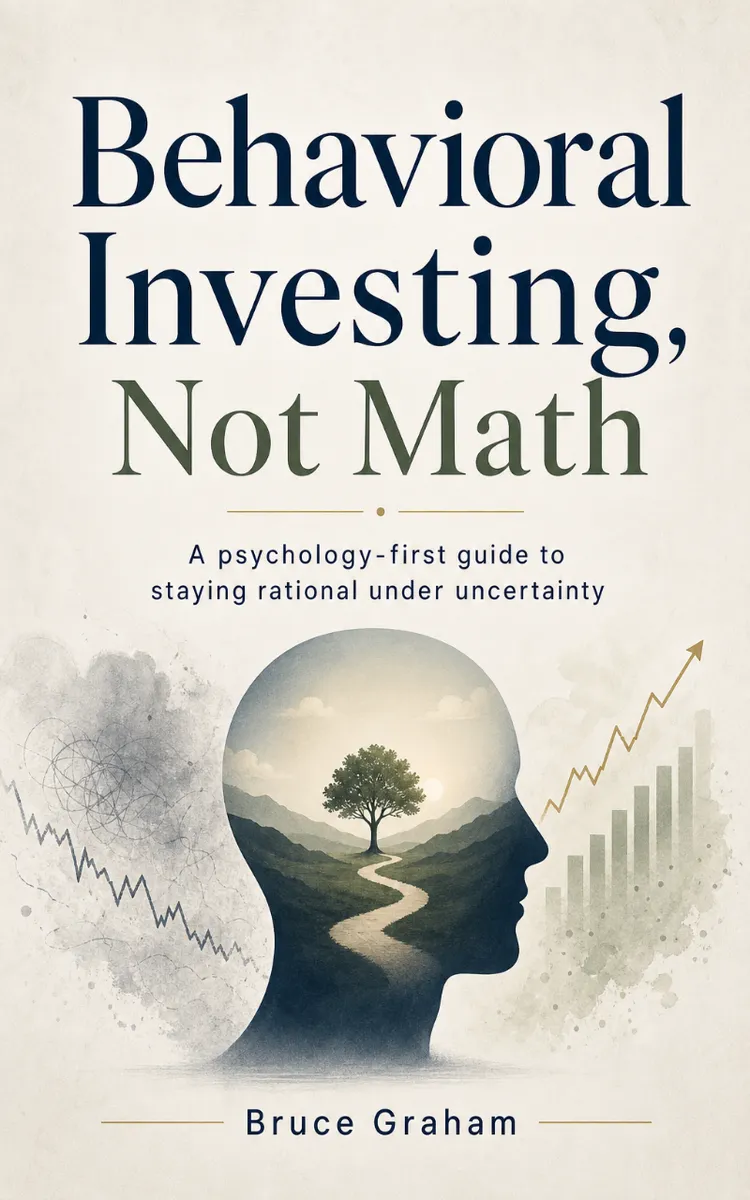
"Behavioral Investing, Not Math" is a finance book by Bruce Graham with 25 chapters and approximately 41,105 words. Psychology and behavior mechanics behind investing decisions.
This book was created using Inkfluence AI, an AI-powered book generation platform that helps authors write, design, and publish complete books. It was made with the AI Ebook Generator.
Frequently Asked Questions
What is "Behavioral Investing, Not Math" about?
Psychology and behavior mechanics behind investing decisions
How many chapters are in "Behavioral Investing, Not Math"?
The book contains 25 chapters and approximately 41,105 words. Topics covered include The Ego Behind Your Trades, Confirmation Bias in Plain Sight, Loss Aversion and the Pain Budget, Why You Chase Winners, and more.
Who wrote "Behavioral Investing, Not Math"?
This book was written by Bruce Graham and created using Inkfluence AI, an AI book generation platform that helps authors write, design, and publish books.
How can I create a similar finance book?
You can create your own finance book using Inkfluence AI. Describe your idea, choose your style, and the AI writes the full book for you. It's free to start.
Write your own finance book with AI
Describe your idea and Inkfluence writes the whole thing. Free to start.
Start writingCreated with Inkfluence AI


