

Read the first chapter
The whole of chapter one, free. About 8 min. Turn the pages with the arrows, your keyboard, or a swipe.
Chapter 1
Set Your Grocery Planning Baseline
What if your next grocery list already has the wrong goal built into it - because your household needs changed but your planning didn’t? You’ll feel it fast: you buy the same “usual” items, then you run out early, or you end up with ingredients you can’t use before they spoil.
This chapter helps you stop guessing. You will define your household needs, constraints, and priorities so every list and meal plan starts from reality, not habit. After you finish, you’ll have a simple baseline that tells you what to buy, what to skip, and what matters most in your week - before you open a grocery app.
You’ll also get a practical tool you can reuse: the Baseline Reset Scorecard. It turns messy household details (kids’ snacks, work schedules, budget limits, leftovers, diet preferences) into clear targets you can shop against. Keep reading and you’ll build one scorecard you can update whenever life changes.
Set your household needs, constraints, and priorities using the Baseline Reset Scorecard
Your grocery plan fails for one of three reasons: you don’t know what your household needs right now, you ignore a constraint that affects what you can cook or store, or you pick priorities that don’t match your real life. The Baseline Reset Scorecard fixes all three by forcing you to write down your inputs in plain terms and then translate them into shopping targets.
Start by gathering household facts for the next 7 days. Use simple numbers and specific limits. Nora, age 32 and new parent, learned this the hard way: she planned meals around “what sounds good,” but her baby’s feed times made her cooking window unpredictable. Her list kept drifting, and she bought ingredients she couldn’t cook in time. Once she used a scorecard with concrete constraints, her shopping became calmer and more predictable.
Use these scorecard components to define your baseline. You’ll fill them in once, then you’ll adjust them when your week changes.
1. Household “people count” and roles (who eats what, when). Write the number of people who will eat meals you plan for (example: 2 adults + 1 baby who eats purées you prepare). Then note any patterns (example: one adult works late twice this week, so they need an easy option).
2. Meal coverage target (how many planned meals you want to handle). Decide how many meals your plan will cover. If you plan 5 dinners out of 7 days, you still allow 2 nights for takeout, leftovers, or simple meals. This prevents over-planning and keeps your list aligned with your energy.
3. Cooking reality (time and tools you can actually use). List your real cooking windows and tools. Example: “Weeknights: 20-30 minutes after bedtime. Weekend: 1-2 hours.” If you rely on a slow cooker or sheet pan, name it. If you don’t have time to chop, plan for pre-cut or frozen.
4. Storage and freshness limits (what you can keep). Check what you can store and how long it stays good for your household. Example: “We finish produce within 3-4 days,” or “We freeze extra portions when we cook.” Your list should respect your refrigerator capacity and your cleanup tolerance.
5. Diet and preference priorities (what you must include, what you avoid). Write must-haves (example: “high-protein breakfast,” “no dairy for one person”) and avoid items (example: “skip complicated seafood recipes this week”). Priorities keep you from wasting time on meals you won’t actually eat.
6. Budget guardrails (a spending cap with a purpose). Pick a weekly budget number you can stick to, then decide where flexibility lives. Example: “$180 total. $60 for fresh produce and proteins, $40 for pantry staples, rest for convenience items like pre-cooked rice.” A guardrail stops impulse substitutions.
7. Waste rule (how you prevent leftovers from turning into trash). Decide what you will do with extra food before it goes bad. Example: “Cook once, eat twice” for one dinner; “Turn leftover chicken into wraps the next day.” A waste rule protects your budget and reduces stress.
Ask yourself a quick question after you fill each item: Does this detail change what I buy or how I cook? If it doesn’t, you can keep it simple or leave it out.
Putting it into practice: build Nora’s baseline and turn it into a real list plan
Let’s walk through a realistic setup using the Baseline Reset Scorecard approach. Nora is new to planning with a baby, so her “constraints” matter more than her “ideas.” She wants a baseline that works for the next 7 days and doesn’t collapse when her schedule shifts by a few hours.
She starts with a quick reset on a Sunday night and writes down her scorecard details. Then she turns those details into shopping targets. Here’s how she does it, step by step, with numbers you can copy.
Nora’s Baseline Reset Scorecard (example for the next 7 days)
1. People count and roles - 2 adults eat planned dinners and breakfasts - 1 baby eats purées and finger foods she prepares - One adult works late 2 nights, so they need a fast dinner option
Expected outcome: Her plan includes 2 “fast” nights and 5 nights that match her cooking window.
2. Meal coverage target - Plan 5 dinners - Plan 5 breakfasts - Allow 2 dinners for leftovers or convenience
Expected outcome: Her list stays realistic instead of trying to cover every meal.
3. Cooking reality - Weeknights: 25-35 minutes maximum - Weekend: 1.5 hours for prep - Tools: sheet pan + rice cooker (she uses them because they reduce hands-on time)
Expected outcome: She chooses recipes that fit those tools and time limits.
4. Storage and freshness limits - Refrigerator holds about 5-7 days of leftovers for her household - Baby purée prep must happen in small batches - She freezes extra portions of cooked proteins
Expected outcome: She shops for produce that can be used within her freshness window, and she adds a freeze plan.
5. Diet and preference priorities - Everyone eats the same dinners - She prioritizes protein at breakfast - She avoids dishes with lots of separate sauces (too many steps when the baby cries)
Expected outcome: She picks meals that use one main sauce or seasoning.
6. Budget guardrails - Weekly budget: $200 - Fresh produce + proteins: $110 - Pantry staples and convenience: $90
Expected outcome: She stops at $200 (or adjusts by swapping a protein type, not skipping dinners).
7. Waste rule - Make one “cook once, eat twice” protein - Use leftover dinner as lunch or wraps within 48 hours
Expected outcome: She plans leftovers instead of hoping they happen.
Now Nora uses this baseline to shape her list categories. She doesn’t start with recipes. She starts with needs.
Nora’s shopping plan (turn baseline into a list)
1. Count planned dinners and add a fast option - She plans 5 dinners total. - She sets aside 2 “easy nights” for leftovers or convenience.
Expected outcome: She buys enough ingredients for 5 dinners, plus a simple backup approach (like a rotisserie chicken + salad kit) that fits her schedule.
2. Choose one cook-once protein for “eat twice” - She picks a protein that reheats well (example: chicken thighs or ground turkey). - She plans one dinner to create leftovers.
Expected outcome: She reduces waste and reduces decision fatigue midweek.
3. Match produce to her freshness window - She selects produce that she can use quickly (example: baby-friendly fruits for purées, leafy greens for salads, quick-cook vegetables). - She avoids buying delicate items she can’t finish.
Expected outcome: Her refrigerator doesn’t turn into a “mystery produce drawer.”
4. Build pantry staples around planned breakfasts - She chooses 5 breakfasts that share ingredients (example: oats + yogurt alternative or eggs + toast + fruit). - She checks what she already has first.
Expected outcome: Less duplication and fewer last-minute store runs.
5. Add “convenience items” on purpose - She includes one or two helpers that save time (example: pre-cut vegetables or microwave rice). - She only adds these because her baseline says weeknights are 25-35 minutes.
Expected outcome: Convenience stays inside the budget and doesn’t become a random habit.
Quick checklist (use this before you shop) - Write your people count and any schedule changes (example: 2 late nights). - Pick your meal coverage target (example: 5 dinners, 5 breakfasts). - Set your cooking reality (example: 25-35 minutes, sheet pan, rice cooker). - Decide your storage and freshness limits (example: freeze extra protein). - Choose diet priorities (example: protein at breakfast, avoid multi-sauce meals). - Set a budget guardrail (example: $200 with a produce/protein split). - Add a waste rule (example: cook once, eat twice; leftovers within 48 hours).
When Nora finishes this, her next grocery list becomes easier to build: she knows what must be covered, what time allows, and how she will use leftovers. That clarity turns “shopping” into a repeatable routine.
What to watch for: common mistakes that break your baseline (and how to fix them)
Even with a scorecard, small slips can throw your planning off. The goal isn’t perfection - it’s catching the pattern before it costs you money or time.
Mistake 1: You write priorities that don’t change your list. If you “prefer” meals that take 1 hour but your week only allows 25-35 minutes, your list won’t match reality. Do this: Translate each priority into a shopping or cooking rule. Example: “No multi-step sauces” becomes “buy one seasoning blend or one sauce base” and “pick sheet-pan meals.” Not this: “We want healthy home-cooked meals,” with no time or ingredient changes.
Mistake 2: You plan 7 dinners like you always do. When you cover every dinner, you accidentally remove flexibility. New parents, busy work weeks, and sick days all happen. Do this: Choose a meal coverage target you can actually hit (example: plan 5 dinners and allow 2 easy nights). Not this: “We’ll cook every night,” then you scramble for replacements when your schedule breaks.
Mistake 3: You ignore storage limits and freshness, then blame yourself for waste. If you buy delicate produce you can’t finish, you’ll waste money and feel behind. Do this: Match produce to your freshness window and add a freeze or leftover plan for at least one ingredient group (example: freeze extra cooked protein; use leftovers within 48 hours). Not this: Buying extra “just in case” items without a plan to use them.
If you catch any of these while building your baseline, don’t start over from scratch. Update one scorecard component and re-check the shopping targets it affects.
A final reflection prompt for this section Ask yourself: If my schedule changes by a few hours this week, which part of my baseline keeps me safe - time, meal coverage, storage, budget, or waste rule? Strengthen the one that would break first.
When your baseline actually matches your household, your grocery list stops being a guess. It becomes a tool you can trust - even on the days you don’t feel like thinking. And that sets you up for building meal plans and shopping routines that hold steady from week to week.
End of chapter one. 7 more chapters in the full book.
Swipe or use the arrows to turn the page


What's inside: 8 chapters
- 1. Set Your Grocery Planning Baseline
- 2. Build a Repeatable Meal Planning Rhythm
- 3. Create a Pantry-First Grocery List
- 4. Use the 3-Category Shopping System
- 5. Plan Portions With the Leftover Rule
- 6. Schedule Your Shopping Day and Time
- 7. Run a Smart In-Store Decision Checklist
- 8. Track Results and Improve Next Week
About this book
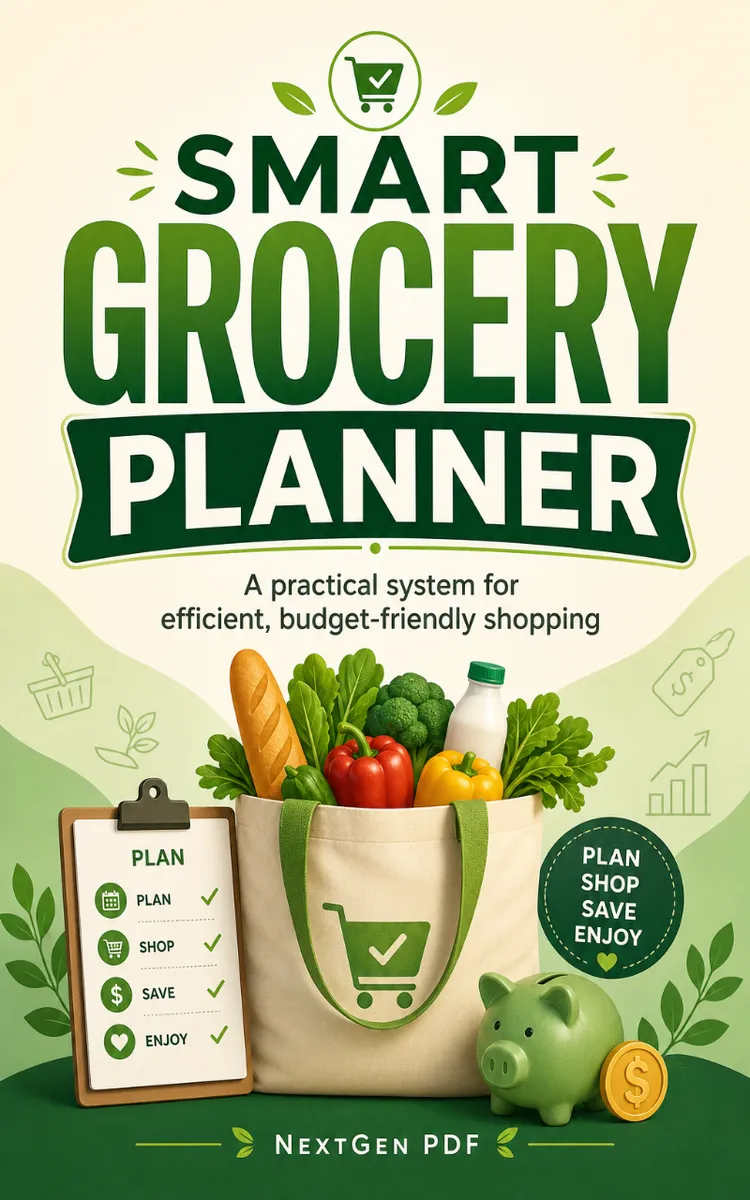
"Smart Grocery Planner" is a how-to guide book by NextGen PDF with 8 chapters and approximately 15,844 words. Planning grocery lists, meal planning, and shopping routines.
This book was created using Inkfluence AI, an AI-powered book generation platform that helps authors write, design, and publish complete books. It was made with the AI Ebook Generator.
Frequently Asked Questions
What is "Smart Grocery Planner" about?
Planning grocery lists, meal planning, and shopping routines
How many chapters are in "Smart Grocery Planner"?
The book contains 8 chapters and approximately 15,844 words. Topics covered include Set Your Grocery Planning Baseline, Build a Repeatable Meal Planning Rhythm, Create a Pantry-First Grocery List, Use the 3-Category Shopping System, and more.
Who wrote "Smart Grocery Planner"?
This book was written by NextGen PDF and created using Inkfluence AI, an AI book generation platform that helps authors write, design, and publish books.
How can I create a similar how-to guide book?
You can create your own how-to guide book using Inkfluence AI. Describe your idea, choose your style, and the AI writes the full book for you. It's free to start.
Write your own how-to guide book with AI
Describe your idea and Inkfluence writes the whole thing. Free to start.
Start writingCreated with Inkfluence AI


