
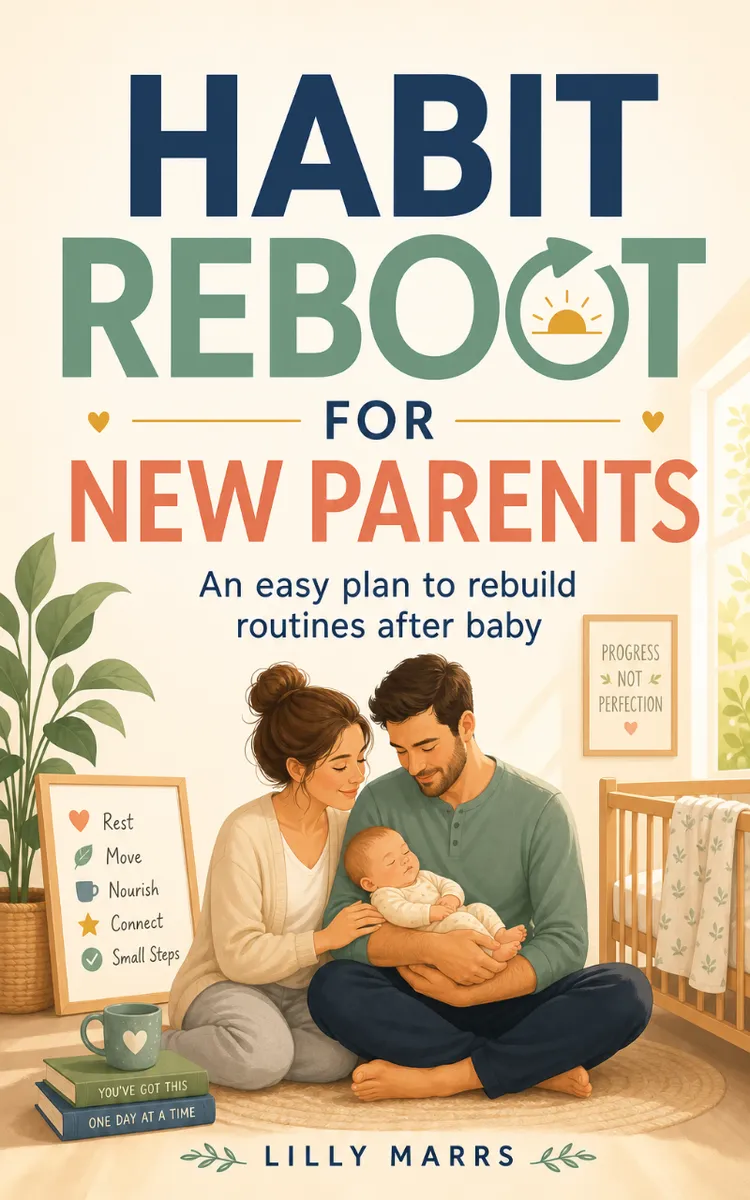
Habit Reboot For New Parents
Created with Inkfluence AI
Rebuilding habits and routines for new parents
Table of Contents
- 1. Reclaiming Your Identity as Parent
- 2. Breaking the Perfectionism Trap
- 3. Building Boundaries Without Guilt
- 4. Designing a Sleep-Support Routine
- 5. Creating a Feed-Change-Reset Rhythm
- 6. Using the Two-Minute Habit Starter
- 7. Communicating Needs With the 4-Word Ask
- 8. Rebuilding Confidence Through Wins
- 9. Coping With Setbacks Using the Reset Ladder
- 10. Designing a Purpose-Driven Weekly Review
Preview: Reclaiming Your Identity as Parent
A short excerpt from “Reclaiming Your Identity as Parent”. The full book contains 10 chapters and 14,710 words.
The Person in the Mirror at 3:17 A.M.
What part of you feels missing since becoming a parent?
Maybe it’s the part who used to finish a workout, make plans without checking nap schedules, or wear something that wasn’t chosen for spit-up resistance. You love your child fiercely, yet some days you catch your reflection and think, I don’t recognize this version of me.
The tension isn’t that your old self was better. It’s that you’re measuring today against a life that no longer exists. You’re asking a new parent to perform like a pre-parent, then feeling disappointed when the math doesn’t work.
You don’t need to get your old identity back; you need a daily way to practice the person you’re becoming.
From Former Self to Becoming Self
Old Belief: I’ll feel like myself again when I can return to my old routines.
New Reality: I rebuild my sense of self by taking small actions that match who I’m becoming now.
The old belief sounds reasonable because familiar routines once gave you proof of who you were. You ran before work, cooked elaborate meals, built your business, or read at night. Those actions weren’t just tasks. They were identity evidence. Each one whispered, This is the kind of person I am.
Parenthood changes the available time, energy, and attention behind those actions. If you wait for the old conditions to return, your identity stays on hold. The new reality gives you another route: choose one tiny action that reflects your current values, even when the day is messy.
Suppose you used to train for long-distance races. Your baby’s sleep is unpredictable, and a full run feels impossible. The old approach says, “A ten-minute walk doesn’t count.” The becoming approach says, “Today, I’m a person who keeps a promise to my body.” You put on your shoes and walk for ten minutes while the stroller rolls beside you. The walk doesn’t recreate your old life. It confirms your new one.
That distinction matters. You aren’t pretending parenthood hasn’t changed you. You’re giving yourself visible proof that being a parent is part of your identity, not the whole of it.
The Identity Anchor Loop
Identity change becomes easier when it has a small, repeatable shape. The Identity Anchor Loop is simple:
Notice → Name → Act → Record
First, notice the moment you start comparing yourself with who you used to be. Maybe you feel irritated while folding tiny laundry because you remember having evenings to yourself. Maybe you hesitate before opening your laptop because your old work rhythm feels gone.
Then name the person you’re becoming in plain language. Not a grand title. Something you can actually live today: “I’m becoming a parent who protects a little creative time,” or “I’m becoming someone who cares for my body without demanding perfection.”
Next, act in a way that takes five minutes or less. Open the notebook and write three lines. Stretch beside the crib. Send one message that keeps a friendship alive. The action should be small enough to survive a rough day.
Finally, record the evidence. Write one sentence in your phone: “Today I kept my creative identity alive by writing one paragraph.” This matters because tired brains tend to remember what went wrong. A record helps you see the pattern you’re building.
Signs the old-self pattern is running your life
1. You dismiss small actions because they don’t look like your former routine.
A ten-minute walk feels pointless because it isn’t your old hour-long workout.
2. You describe yourself only through your responsibilities.
Your answer to “How are you?” becomes “Busy with the baby,” even when other parts of you are still asking for attention.
3. You keep postponing identity-building until life becomes predictable.
The next nap, next month, or next season becomes the place where you’ll finally begin.
4. You feel guilty whenever you do something that isn’t directly for your child.
Rest, friendship, learning, and creative work start to feel like selfish extras instead of parts of a healthy self.
The Identity Anchor Loop turns identity from a feeling you’re waiting for into evidence you can create today.
Questions for the Person You’re Becoming
1. Which part of your old identity are you grieving most clearly?
Be specific. “My freedom” may become “I miss deciding what to do after dinner without planning around anyone else.” Naming the real loss keeps you from treating every difficult feeling as failure.
2. What value from that former life still belongs in your future?
Perhaps you miss running, but the deeper value is strength. Maybe you miss hosting friends, but the value is connection. The old routine can change while the value remains.
3. What would a two-minute version of that value look like today?
If learning matters, read one page. If creativity matters, sketch one messy idea on the back of an envelope. The point isn’t to complete the old activity....
About this book
"Habit Reboot For New Parents" is a self-help book by Lilly Marrs with 10 chapters and approximately 14,710 words. Rebuilding habits and routines for new parents.
This book was created using Inkfluence AI, an AI-powered book generation platform that helps authors write, design, and publish complete books. It was made with the AI Self-Help Book Writer.
Frequently Asked Questions
What is "Habit Reboot For New Parents" about?
Rebuilding habits and routines for new parents
How many chapters are in "Habit Reboot For New Parents"?
The book contains 10 chapters and approximately 14,710 words. Topics covered include Reclaiming Your Identity as Parent, Breaking the Perfectionism Trap, Building Boundaries Without Guilt, Designing a Sleep-Support Routine, and more.
Who wrote "Habit Reboot For New Parents"?
This book was written by Lilly Marrs and created using Inkfluence AI, an AI book generation platform that helps authors write, design, and publish books.
How can I create a similar self-help book?
You can create your own self-help book using Inkfluence AI. Describe your idea, choose your style, and the AI writes the full book for you. It's free to start.
Write your own self-help book with AI
Describe your idea and Inkfluence writes the whole thing. Free to start.
Start writingCreated with Inkfluence AI


