

Read the first chapter
The whole of chapter one, free. About 5 min. Turn the pages with the arrows, your keyboard, or a swipe.
Chapter 1
Color-Matching Shapes for Beginners
Core Idea: Matching Shape + Color (Cut, Sort, Pair)
When kids match shapes and colors together, they’re building two skills at once: noticing the shape (circle, square, triangle, rectangle) and noticing the color (red, blue, yellow, green). The fun part is that you don’t need fancy tools - just cut-and-sort pages and a simple “pair it up” routine.
Here’s the key idea: a shape isn’t finished until it’s matched with the same shape and the same color. That’s why these pages use a repeatable loop: cut → find the match → place it in the correct spot. It’s like a puzzle, but with clear answers.
Key takeaway: A correct match means both the shape AND the color match - not just one.
You’ll see this chapter’s routine use the same steps every time: 1. Cut out the pieces along the dotted lines. 2. Sort pieces by color first (so shapes don’t get mixed up). 3. Within each color, pair the pieces to the matching shape. 4. Check your work using the “same-shape + same-color” rule.
---
Guided Practice: Color-Matching Cut-and-Sort (With a Clear Finish Line)
Materials needed: printed shape-color cut-and-sort page(s), child-safe scissors, a glue stick (optional), and a small tray or plate for sorting. Time required: about 15-20 minutes.
Set up a “sorting zone” and a “matching zone.” Sorting zone = one small pile for each color. Matching zone = the matching outlines on the page.
Your Turn 1. Find the page area with the cut-out pieces (they’ll be shapes with colors). 2. Cut out only 6 pieces to start (for example: 2 reds, 2 blues, 1 green, 1 yellow). - Expected outcome: you should have 6 loose pieces ready to sort. 3. Make 4 mini-piles in your sorting zone by color: Red pile, Blue pile, Green pile, Yellow pile. - Expected outcome: each pile contains pieces of only one color. 4. Now grab the Red pile and match each red piece to the same shape on the page. - Expected outcome: every red piece is placed on a red outline that has the same shape. 5. Repeat for the Blue pile, then Green, then Yellow. - Expected outcome: all pieces you cut are placed, with no “extra” pieces left on your tray. 6. Do a quick check: for each placed piece, say out loud the two matches: “red circle,” “blue square,” etc. - Expected outcome: all placed pieces are both the right color and the right shape.
Here’s a completed example (what “done” looks like for a tiny set of 6):
> Completed example (6 pieces matched): > - Red circle → placed on red circle outline > - Red triangle → placed on red triangle outline > - Blue square → placed on blue square outline > - Blue rectangle → placed on blue rectangle outline > - Green oval (if your page has it) → placed on green oval outline > - Yellow triangle → placed on yellow triangle outline > Finish line: no cut pieces left on the side, and every outline has a piece that matches both color and shape.
Optional (only if your child wants more): Cut the next 6 pieces and repeat the same steps. - Expected outcome: the second set is also fully placed with no extras.
---
Real-World Application: Spotting Shape + Color Matches in Daily Life
Once your child gets the cut-and-sort pattern, you can “borrow” the same rule in real life: find the thing that matches the shape and the color. It’s quick, and it feels like a game instead of a lesson.
Try this with snacks (easy win). Put two cups on the table: one with red items (like red fruit snacks) and one with blue items (like blueberries). Then say, “Find a circle that matches the red cup.” If your snack pieces are all the same shape, you can switch the prompt to “Find the red one” and then add shapes with a toy cookie cutter later. Expected outcome: your child correctly puts items into the right color cup based on the “color first, then shape” idea.
Another scenario: toy cleanup. Use small bins labeled by color (Red bin, Blue bin). Put two shapes of toys on the floor - like block shapes or plastic pieces - and ask for a “blue square” or “red triangle.” Expected outcome: your child brings the correct toy to you, not just the correct color. If they bring the right color but wrong shape, don’t scold - just pause and ask, “Is it the same shape too?” That question lines up perfectly with the rule from the page.
You can also do a “window search” when you’re out. Point at a playground sign or a sticker and ask for a matching piece: “Find something that looks like a triangle and is the same color as this triangle.” Expected outcome: your child points to an object that matches both the look and the color (or at least makes a guess you can confirm together). That’s the same skill, just in a new place.
Apply It 1. Choose one real-life place: snack table, toy bins, or a window/outdoor look. 2. Pick two colors only (example: red and blue) so it stays manageable. 3. Ask for three matches: “red circle,” “blue square,” “red triangle” (or the shapes your child is practicing). 4. Stop after the 3rd match even if they want to keep going. - Expected outcome: you can name the score out loud: “You got __ out of 3 correct.”
---
Reflect: Quick Questions + Next-Step Choices (No Messy Guessing)
You’ve just trained the “same-shape + same-color” rule with real cut pieces. Now let’s lock it in with a few clear checks. Answer using short phrases or single words - whatever’s easiest.
Reflect 1. When you checked your work, what did you say to yourself each time? ________________________________________________ ______________________________________________ ________________________________________________
2. Which was harder today: matching the color first or matching the shape after that? ________________________________________________ ______________________________________________ ________________________________________________
3. Pick your next step: cut another set of pieces, or try the Apply It game with snacks/toys for 3 matches. Which one will you do? ________________________________________________ ______________________________________________ ________________________________________________
After you answer, you’ll have a simple plan. If matching shape was tricky, start the next round by sorting into color piles first (that step helps a lot). If color was tricky, slow down and do fewer pieces - like 4 instead of 6 - so each match gets extra attention. Either way, you’re building the same skill with the same rule, and that’s what makes it stick.
End of chapter one. 6 more chapters in the full book.
Swipe or use the arrows to turn the page

Substitute Teacher Packet Grades 1 2

Sub Binder and Sub Plans Bundle

Ready Made Sub Plans Grades 3 4
What's inside: 7 chapters
- 1. Color-Matching Shapes for Beginners
- 2. Counting Stars Up to Ten
- 3. Tracing Letters with Sound Clues
- 4. Simple Patterns with Stickers
- 5. Measuring with Paper Rulers
- 6. Feelings Faces and Calm Breaths
- 7. Story Sequencing from Start to Finish
About this book
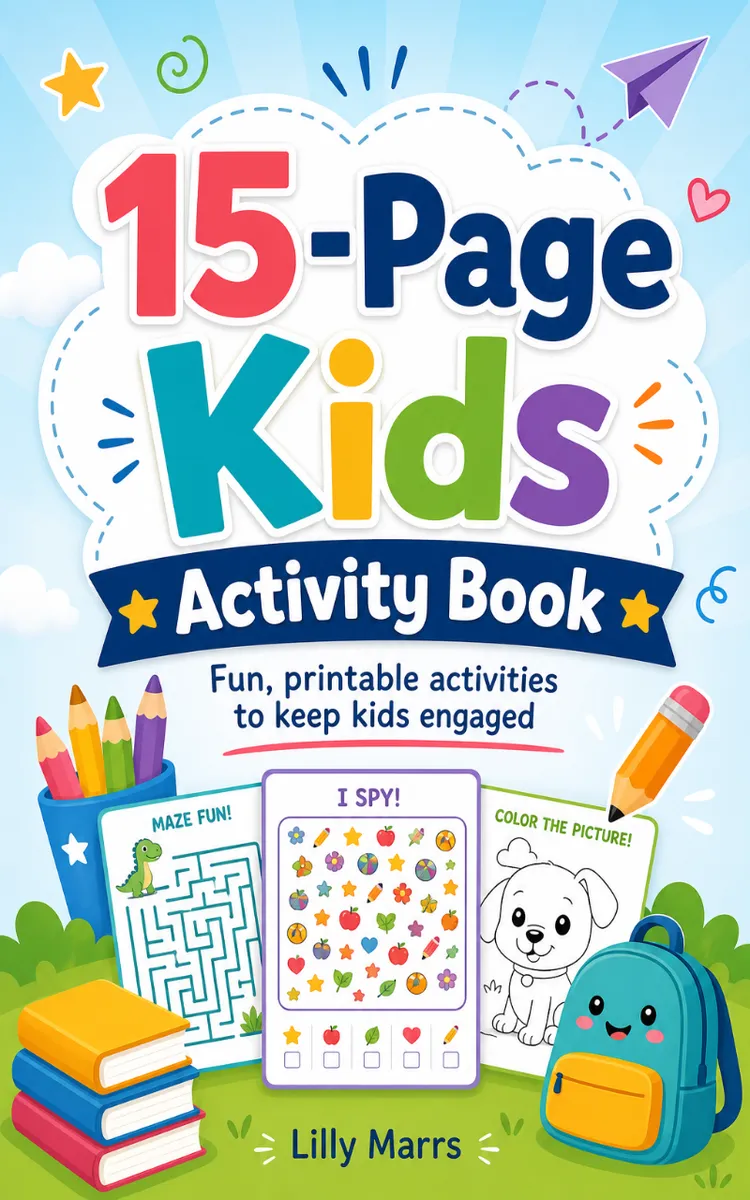
"15-Page Kids Activity Book" is a workbook by Lilly Marrs with 7 chapters and approximately 7,939 words. Printable activity pages for children.
This book was created using Inkfluence AI, an AI-powered book generation platform that helps authors write, design, and publish complete books. It was made with the Workbook Generator.
Frequently Asked Questions
What is "15-Page Kids Activity Book" about?
Printable activity pages for children
How many chapters are in "15-Page Kids Activity Book"?
The book contains 7 chapters and approximately 7,939 words. Topics covered include Color-Matching Shapes for Beginners, Counting Stars Up to Ten, Tracing Letters with Sound Clues, Simple Patterns with Stickers, and more.
Who wrote "15-Page Kids Activity Book"?
This book was written by Lilly Marrs and created using Inkfluence AI, an AI book generation platform that helps authors write, design, and publish books.
How can I create a similar workbook?
You can create your own workbook using Inkfluence AI. Describe your idea, choose your style, and the AI writes the full book for you. It's free to start.
Write your own workbook with AI
Describe your idea and Inkfluence writes the whole thing. Free to start.
Start writingCreated with Inkfluence AI


