

Read the first chapter
The whole of chapter one, free. About 8 min. Turn the pages with the arrows, your keyboard, or a swipe.
Chapter 1
Beatlemania Crosses the Atlantic
The Night America Met the Beatles
On February 9, 1964, roughly 73 million Americans watched four young men from Liverpool appear on The Ed Sullivan Show. The remarkable part was not simply that a British band had become famous in the United States. It was that, for a few minutes, American television turned a foreign musical act into a shared national experience.
The Beatles had already caused a sensation in Britain. In America, audiences and industry gatekeepers were initially slower to embrace them, Earlier British performers had crossed the Atlantic without changing the country’s musical weather. The Beatles arrived after years of American rhythm and blues, rock ’n’ roll, and early pop had shaped their sound, then returned that influence in a form Americans had not expected: faster, sharper, funnier, and packaged with an energy television could transmit instantly.
Their arrival followed what can be called the Invasion-to-Impact Arc. First came the invasion: records, headlines, airport crowds, and television appearances. Then came the impact: changes in teenage behavior, record buying, fashion, broadcasting, and the assumptions American musicians made about where the next important sound might come from.
How did a four-man band turn a television appearance into a change in the cultural direction of an entire country?
Liverpool Sends a Signal
The Beatles’ American breakthrough was years in the making. John Lennon, Paul McCartney, George Harrison, and Ringo Starr had developed in Liverpool, a port city whose connection to the United States ran through records brought home by sailors and through the city’s busy club scene. American artists such as Chuck Berry, Little Richard, Buddy Holly, and Carl Perkins were not distant influences. Their records were working materials.
By the early 1960s, the group had become a disciplined live act. Their long residency at the Cavern Club helped them develop a tight, fast-moving performance style, while manager Brian Epstein shaped their public appearance with matching suits and controlled presentation. Producer George Martin helped turn their songs into recordings that were polished without losing their momentum.
The British breakthrough came in 1963. “Please Please Me,” “From Me to You,” and “She Loves You” moved the group from local success to national phenomenon. British newspapers began using the word Beatlemania to describe the screaming crowds and disorder surrounding their appearances. The term sounded faintly medical, suggesting an almost epidemic level of public excitement, In practice, it described a mixture of music, celebrity, humor, and mass media that had become difficult to separate.
America was a harder market. The Beatles’ early releases appeared through smaller labels and did not immediately gain traction. Their first single, “Please Please Me,” received limited attention in the United States. Capitol Records, the American arm of EMI, initially hesitated to invest heavily in the group. That delay mattered because American radio was crowded with domestic performers, and a British act needed more than a good song to break through.
A decisive turning point came with 'I Want to Hold Your Hand,' released in the United States in late December 1963 and rising to the top of the Billboard Hot 100 by early 1964, The song was direct, bright, and easy to remember, but its success also reflected timing. American teenagers were ready for something that felt new without being entirely unfamiliar. The Beatles’ music carried echoes of American rock ’n’ roll while presenting them through British voices, close harmonies, and a carefully shaped group identity.
The Ed Sullivan Effect
Ed Sullivan had already introduced American audiences to many performers, but his television program was more than a stage. It was one of the country’s most powerful cultural filters. Families watched together, and the show placed comedians, dancers, actors, circus performers, and musicians in the same Sunday-night frame. A booking on The Ed Sullivan Show could make a performer known to millions who had never heard a record.
Sullivan first encountered the Beatles in London in October 1963, when he saw the commotion surrounding the group at Heathrow Airport. He later arranged for them to appear on his program. The booking was made before the band had become a major American success, but by the time of the broadcast, “I Want to Hold Your Hand” had changed the situation.
The Beatles appeared on three consecutive Sullivan programs: February 9 in New York, followed by appearances recorded in Miami on February 16 and February 23. The first broadcast began with the group performing “All My Loving,” “Till There Was You,” and “She Loves You.” Their second appearance included “I Saw Her Standing There” and “I Want to Hold Your Hand.”
The performance was carefully managed, yet viewers experienced it as spontaneous. The matching suits, the hair, the smiles, and the quick exchanges with Sullivan created a distinct visual identity. Their music was important, but so was the fact that all four members seemed to function as a unit. They were not simply four singers placed beside one another. They looked like a small society with its own language and rules.
The response was immediate. Newspapers reported crowds at Kennedy Airport when the Beatles arrived on February 7. Police officers struggled to manage the fans gathered outside the Plaza Hotel and along the routes connected with their appearances. The scenes were not merely promotional stunts. They showed how quickly television, radio, newspapers, and teenage conversation could reinforce one another.
One telling moment from the broadcast makes that position clear. When Sullivan introduced them, the screen identified each member by name, and a caption added the phrase “Sorry Girls, He’s Married” beneath John Lennon’s name. The joke acknowledged the audience’s fascination while also making the Beatles’ private lives part of the television event. Their appeal was musical, but it was also visual and personal.
The Sullivan appearance did not create the Beatles from nothing. It concentrated an existing force. Records had prepared the audience, radio had spread the songs, newspapers had reported the frenzy, and television made the phenomenon visible in living rooms across the country at the same moment.
From British Band to American Cultural Force
The counterintuitive fact is that the Beatles’ American conquest was built partly from American music. They were treated as an invasion, yet the musical materials they carried across the Atlantic had been formed by the very culture they appeared to disrupt.
That matters because the Beatles did not replace American popular music by rejecting it. They rearranged it. Their recordings reflected rhythm and blues, country music, early rock, vocal harmony, and the songwriting traditions of Tin Pan Alley. American listeners could recognize pieces of their own musical past inside something that sounded newly foreign.
After February 1964, the effect spread beyond the Beatles’ own records. British groups received greater attention from American record companies and radio programmers. The Rolling Stones, the Animals, the Kinks, the Who, and other acts gained opportunities in the United States. The so-called British Invasion became a wave rather than a single success story.
American musicians also changed their sense of possibility. The Beatles wrote many of their own songs, played their own instruments, and presented themselves as a creative partnership rather than as interchangeable performers working under the direction of a record company. Their example encouraged other groups to take songwriting and studio decisions more seriously.
The shift was not only musical. Teenagers copied the Beatles’ haircuts and narrow suits. Record stores became places where young people searched for the next British sound. Television producers paid closer attention to groups whose appeal could be communicated through appearance as quickly as through music. The boundary between performer and personality grew thinner.
The Beatles also altered the economic geography of pop. American artists had long dominated the international market, but the Liverpool group demonstrated that a band from outside the United States could become central to American culture. The Atlantic Ocean still separated the countries, but radio and television made that distance less meaningful.
A Crowd at Kennedy Airport
The arrival at Kennedy Airport on February 7 provides the clearest human-scale image of the transformation. Thousands of fans gathered to see the Beatles step onto American soil. Reporters and photographers documented the scene, while television cameras turned the airport into a national stage. The group had not yet performed for its largest American audience, but the public response had already become part of the story.
For the teenagers in the crowd, the event represented more than access to four musicians. It was participation in a new kind of public culture. Fans carried signs, shouted, reached toward the arriving band, and became visible actors in the spectacle. Their excitement was reported with a mixture of amusement and alarm, as though adult observers were trying to decide whether Beatlemania was entertainment, rebellion, or simply a passing craze.
The airport scene also revealed the role of collective attention. A fan alone could admire a record. Thousands gathered at an airport transformed admiration into an event that news organizations could broadcast and families could discuss. The audience helped create the phenomenon it had come to witness.
That pattern continued in the days that followed. The Beatles’ television appearances gave distant viewers a sense of belonging to the same moment as the crowds in New York and Miami. A teenager watching from a living room did not need to attend a concert to feel connected to the movement. The screen supplied the crowd, the music, and the shared date.
Their success therefore depended on more than talent or promotion. It depended on a society increasingly organized around simultaneous media experiences. Television made the Beatles national; teenagers made them culturally powerful; the recording industry made the transformation profitable and repeatable.
The Sound of a New Possibility
The Beatles’ arrival in 1964 exposed a change already underway in American life. Popular culture was becoming faster, more visual, and more international. A song could cross an ocean, become a headline, appear on television, and turn its performers into symbols within weeks.
Yet the lasting significance of Beatlemania was not that Americans briefly screamed for a British band. It was that the country discovered how quickly a shared media moment could reorganize taste. The Beatles showed that music could be heard, watched, imitated, debated, and consumed as one connected experience.
Their story also complicates the idea of cultural invasion. The Beatles came from Liverpool, but they carried American influences back in transformed form. What looked like an outside force was partly a return: American rock ’n’ roll, filtered through British musicians and delivered through a new media system.
In 1964, the distance between a song and a social movement became remarkably short. Somewhere between a record spinning on a turntable and four figures appearing on a Sunday-night television screen, popular music became a way for millions of people to recognize that they were living through the same moment. The question left behind is not only why America welcomed the Beatles, but what other changes were waiting for the right signal to become visible.
End of chapter one. 9 more chapters and about 17,480 words in the full book.
Swipe or use the arrows to turn the page


What's inside: 10 chapters
- 1. Beatlemania Crosses the Atlantic
- 2. Civil Rights on the National Stage
- 3. Johnson’s War on Poverty
- 4. The Gulf of Tonkin Turning Point
- 5. Bond, Beatles, and the Big Screen
- 6. Television Brings the World Home
- 7. Motown’s Sound Takes Shape
- 8. The Fair of Tomorrow
- 9. Goldwater’s Conservative Revolution
- 10. A Year Between Two Americas
About this book
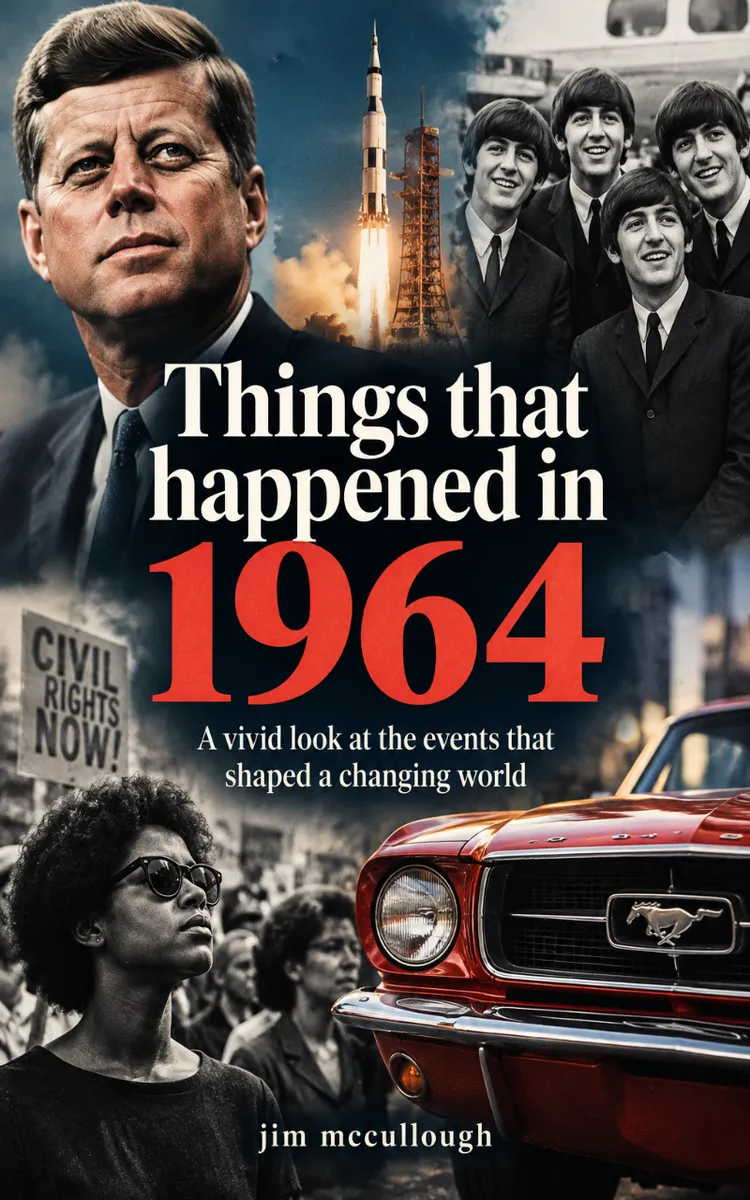
"Things that happened in 1964" is a curiosity book by jim mccullough with 10 chapters and approximately 17,480 words. Music, politics, movies, television, and major news events of 1964.
This book was created using Inkfluence AI, an AI-powered book generation platform that helps authors write, design, and publish complete books.
Frequently Asked Questions
What is "Things that happened in 1964" about?
Music, politics, movies, television, and major news events of 1964
How many chapters are in "Things that happened in 1964"?
The book contains 10 chapters and approximately 17,480 words. Topics covered include Beatlemania Crosses the Atlantic, Civil Rights on the National Stage, Johnson’s War on Poverty, The Gulf of Tonkin Turning Point, and more.
Who wrote "Things that happened in 1964"?
This book was written by jim mccullough and created using Inkfluence AI, an AI book generation platform that helps authors write, design, and publish books.
Write your own curiosity book with AI
Describe your idea and Inkfluence writes the whole thing. Free to start.
Start writingCreated with Inkfluence AI


