

Read the first chapter
The whole of chapter one, free. About 7 min. Turn the pages with the arrows, your keyboard, or a swipe.
Chapter 1
Remember Death to Live Fully
When One Day Becomes Today
“You could leave life right now. Have that determination in your heart.” - Marcus Aurelius
That sentence can first sound severe, even like a threat, before it softens into a reminder. It becomes useful when we hear it as a reminder: life isn’t an endless supply we can spend carelessly and replace later. One day, there will be no later. Remembering that gently can change the way you look at an ordinary morning, a delayed phone call, or the decision you keep postponing.
The point isn’t to make death the center of every moment, but to keep it present enough to refine your choices. That would make a poor schedule and an even worse breakfast companion. The point is to keep death honest and close enough to sharpen your attention. The One-Day Lens asks a simple question: if today were one of your limited days, what deserves your presence? Gratitude? Courage?
This Chapter Is For You If...
• You keep saying “someday” about a conversation, visit, creative project, or change you already know matters.
• Your days feel full but strangely absent, as if you’re completing tasks without really inhabiting your life.
• You want to think about death without panic, drama, or borrowed beliefs.
• You’re ready to make one small choice today that reflects what you value before time makes the choice for you.
This awareness is especially useful when life feels automatic and you move without meaning. You may still be working, caring for people, paying bills, and keeping appointments. Yet something important feels muted. The One-Day Lens doesn’t ask you to abandon responsibility. It helps you notice whether your responsibilities are supporting the life you mean to live - or quietly replacing it.
The One-Day Lens Turns Mortality Into Attention
Because life is limited, today deserves deliberate attention.
Death gives the day an edge. Without that edge, it’s easy to treat time as an abstract possession. “I have plenty of time” can quietly become “I’ll call next week,” “I’ll rest after this busy season,” or “I’ll say what I mean when the moment is easier.” Sometimes next week arrives. Sometimes it doesn’t. We don’t need to predict which moments will be final to treat them as meaningful.
Consider a person who has been meaning to visit an aging parent. The visit may require a two-hour drive, a rearranged workday, and patience with a conversation that repeats itself. The One-Day Lens doesn’t guarantee a perfect visit. It simply makes the cost of postponing visible. A decision that looked inconvenient in the morning may look precious when placed beside the fact of limited time.
This lens also changes small moments. Drinking coffee while scrolling through messages becomes a chance to notice the taste and warmth before the day takes over. A disagreement with a partner becomes a choice between proving a point and protecting the relationship. Work remains work, but you may stop giving every minor problem the emotional weight of a life-or-death event. Death helps us sort what is truly urgent from what only demands attention.
In Practice, This Means...
• Give your best attention to one person or task instead of scattering it across five screens.
• Make one postponed call, request, apology, or invitation while the opportunity is still available.
• Let a minor irritation stay minor; not every inconvenience deserves an hour of your life.
• Choose a meaningful experience over a needless delay when the real barrier is fear or habit.
Daily Practices for Remembering Without Becoming Grim
The One-Day Lens works best as a brief practice, not a constant mental alarm. A few minutes at specific points in the day can bring mortality into view and then return you to living.
• Morning practice: quietly acknowledge the day you actually have, pausing before your phone.
Before checking your phone, say quietly, “This is one of my days.” Don’t add a speech. Notice your body, the room, and one person or responsibility that matters today. Then choose one action that would make the day feel honestly used. It might be calling your brother, taking a proper lunch, or finishing the first page of a proposal you’ve delayed.
• Morning: identify one “later” that needs a date.
Write down one thing you keep postponing. If it matters, put a specific time beside it. “Visit my aunt” becomes “Call Aunt Rosa at 6:30 tonight.” “Work on my health” becomes “Walk for twenty minutes after dinner.” A date turns a wish into a decision.
• Midday: use the sixty-second One-Day Lens pause.
Stop wherever you are - at your desk, in the truck, in the shop, or standing in a grocery line. Take three slow breaths and ask, “What deserves my attention for the next hour?” This question can interrupt the habit of reacting to whatever notification arrived last.
• Midday: separate discomfort from danger.
Death awareness can make courage practical. Ask, “Am I avoiding this because it’s truly unsafe, or because it’s uncomfortable?” If the answer is discomfort, take the smallest honest step: send the message, ask the question, make the appointment, or speak the first sentence.
• Evening: record three things that were real.
Keep a small note on your phone or beside your bed. Write three specific details, not general praise. “My daughter laughed at dinner.” “The air smelled like rain.” “I finished the repair I thought would take all day.” This isn’t forced praise or platitude; it’s specific attention to what was real. It’s training your attention to recognize a life while you’re living it.
• Weekly: review your calendar as a record of values.
Once a week, look at the previous seven days. Ask where your time went and what it says about what you considered important. If the calendar contains only labor, errands, and obligations, add one appointment with life itself: a walk with someone you love, an hour for music, a meal without phones, or a place you’ve wanted to see.
You don’t need to perform these practices perfectly. Missing a morning reminder doesn’t mean you’ve failed at being alive. The practice is simply to return before another day disappears unnoticed.
A Decision Changed by the One-Day Lens
Before:
You’ve received a message from someone you care about after a tense exchange. You’re still irritated, and the message doesn’t contain the apology you wanted. Your first impulse is to wait until they “learn their lesson.” You tell yourself there will be time to sort it out.
Action:
You take the sixty-second pause. Three breaths. Then you ask, “If I knew we had only a few more conversations, what would I want my next one to sound like?” You don’t erase the problem or pretend you weren’t hurt. You send a clear message: “I’m still upset about what happened, but I don’t want silence to become the whole story. Can we talk tomorrow at 7?”
Result:
The conflict may not disappear. That isn’t the promise. What changes is your part in it. You stop allowing pride and delay to make the decision. You protect the possibility of repair while the relationship is still available to you.
This same pattern applies outside relationships. Before: you keep waiting for the perfect time to schedule a medical checkup, begin counseling, apply for training, or take a long-planned trip. Action: you let mortality clarify the next practical step. Result: the future stops being a storage room for your intentions.
Questions That Make Time Visible
• What am I postponing because I assume I’ll always have another chance?
Be specific. If the answer is a person, choose contact. If it’s an experience, identify the cost and the first date you could make it happen. Honest reflection often reveals that the obstacle is not time but discomfort, money, pride, or uncertainty.
• Where did I give too much of today to something that won’t matter in a year?
Look at one recent argument, worry, or work problem. This isn’t an invitation to dismiss real responsibilities. It’s a chance to notice when a small event borrowed the emotional space meant for people and purposes you value more.
• What truth about death do I avoid, and what would accepting it free me to do?
Perhaps you avoid the fact that your parents are aging, your body is changing, or your own health needs attention. Acceptance isn’t approval of loss. It is seeing reality clearly enough to make a loving choice inside it.
• If today were a complete sample of my life, what would I want to keep, and what would I change?
Don’t demand a total life overhaul. Choose one repeatable adjustment. Put the phone away during dinner. Leave work on time twice a week. Tell someone you appreciate them while they can hear it.
• What courageous action can I complete within the next twenty-four hours?
Keep it small enough to do and meaningful enough to matter. A five-minute call can be courageous. So can asking for help, declining an empty obligation, or booking the appointment you’ve avoided.
Make today more deliberate.
Set a timer for ten minutes today. Put your phone out of reach, write down one thing you’ve been postponing, and take the smallest real step toward it before the timer ends - a message, a booking, a date on the calendar, or a direct request.
Estimated time: ten minutes.
You will know it worked when... you feel the difference between thinking about what matters and having actually moved it forward. The step may be modest, but it will belong to your life rather than to some vague future.
Death doesn’t ask us to live anxiously. It asks us to stop treating life as an unlimited draft. Let that truth steady your attention today. One day is all you ever hold at once - and this one is already here.
End of chapter one. 7 more chapters and about 12,112 words in the full book.
Swipe or use the arrows to turn the page

What's inside: 8 chapters
- 1. Remember Death to Live Fully
- 2. Choose Meaning Over Mere Comfort
- 3. Stop Waiting for Perfect Timing
- 4. Practice Daily Gratitude That Reaches Deeper
- 5. Let Relationships Be Your Main Meaning
- 6. Use Fear as a Compass, Not a Stop Sign
- 7. Choose Presence Over Performance
- 8. Write Your Alive Plan for the Rest of Today
About this book
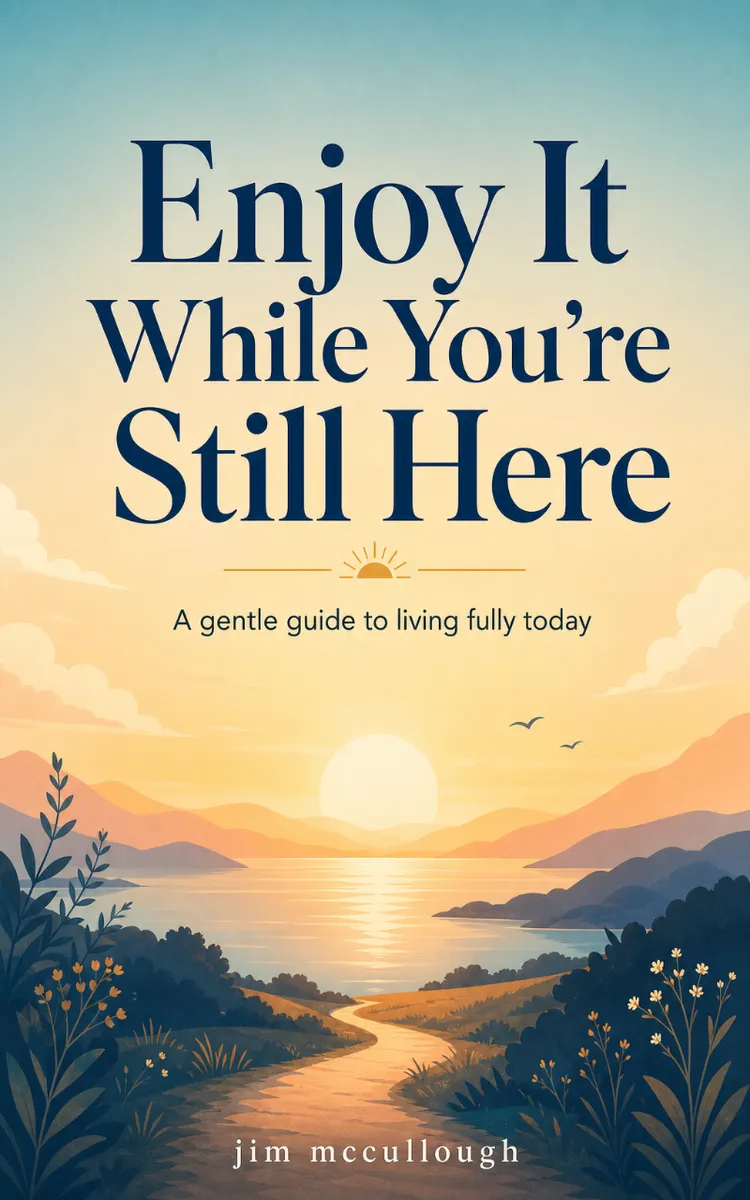
"Enjoy It While You're Still Here" is a inspirational book by jim mccullough with 8 chapters and approximately 12,112 words. Finding meaning and joy in life before death.
This book was created using Inkfluence AI, an AI-powered book generation platform that helps authors write, design, and publish complete books. It was made with the AI Inspirational Book Writer.
Frequently Asked Questions
What is "Enjoy It While You're Still Here" about?
Finding meaning and joy in life before death
How many chapters are in "Enjoy It While You're Still Here"?
The book contains 8 chapters and approximately 12,112 words. Topics covered include Remember Death to Live Fully, Choose Meaning Over Mere Comfort, Stop Waiting for Perfect Timing, Practice Daily Gratitude That Reaches Deeper, and more.
Who wrote "Enjoy It While You're Still Here"?
This book was written by jim mccullough and created using Inkfluence AI, an AI book generation platform that helps authors write, design, and publish books.
How can I create a similar inspirational book?
You can create your own inspirational book using Inkfluence AI. Describe your idea, choose your style, and the AI writes the full book for you. It's free to start.
Write your own inspirational book with AI
Describe your idea and Inkfluence writes the whole thing. Free to start.
Start writingCreated with Inkfluence AI


