

Read the first chapter
The whole of chapter one, free. About 5 min. Turn the pages with the arrows, your keyboard, or a swipe.
Chapter 1
Finding Patterns in Pictures
Shapes and Colors That Repeat
A pattern is a design that follows a rule. The rule might repeat shapes, colors, or both. For example, a red circle followed by a blue square can repeat again and again:
red circle, blue square, red circle, blue square
To find what comes next, look for the smallest group that repeats. That group is called the pattern unit. Check the shapes first, then check the colors. Sometimes the shape stays the same while the color changes. Sometimes both change together.
Use these steps when you study a picture pattern:
1. Look from left to right. 2. Name each shape and color. 3. Circle the smallest group that repeats. 4. Copy that group once more. 5. Choose or draw the next picture.
Key takeaway: A repeating pattern has a rule, and the next picture must follow that rule.
Try not to guess from only the last picture. Compare several pictures. In this pattern, ▲ ● ▲ ●, the repeating unit is ▲ ●. The next shape is ▲ because the unit starts again.
Patterns can have three or more parts, too. A pattern such as yellow star, yellow star, green heart repeats in groups of three. Finding the group makes a tricky row much easier.
Guided Practice: Build the Next Picture
Materials needed: pencil, crayons or colored pencils, and a ruler Time required: 10-15 minutes
You’ll make a pattern, find its repeating unit, and continue it. Draw each symbol about 2 centimeters wide so your row has room.
1. Draw this pattern in a row: red circle, blue square, red circle, blue square. 2. Put a small box around the first repeating unit. 3. Write the repeating unit here: ____________________________ 4. Draw the next two pictures. Color them correctly. 5. Now copy this second pattern: green triangle, yellow star, yellow star, green triangle, yellow star, yellow star. 6. Box the smallest group that repeats. 7. Write the repeating unit here: ____________________________ 8. Draw the next three pictures. 9. Create your own pattern using two shapes and two colors. Make at least eight pictures. 10. Underline the repeating unit. Ask a partner or grown-up to cover the last two pictures. Draw what belongs there. 11. Check your work. You are finished when each new picture matches the same repeating unit.
Completed example
> Pattern: red circle, blue square, red circle, blue square > Repeating unit: red circle, blue square > Next two pictures: red circle, blue square
Your Turn
Complete each row. Write the missing shape or color before you draw it.
A. red heart, yellow heart, red heart, yellow heart, ________, ________
Missing pictures: _____________________________________________
B. blue triangle, blue triangle, green circle, blue triangle, blue triangle, green circle, __________
Missing picture: ______________________________________________
C. purple star, orange square, purple star, orange square, ________, ________
Missing pictures: _____________________________________________
Now make one “almost pattern.” Change one picture so the pattern is no longer correct.
Pattern: _____________________________________________________
Changed picture: ______________________________________________
What should the changed picture be? ____________________________
Check your answers by reading the row aloud. If the same group repeats from beginning to end, your pattern works. If one picture breaks the rhythm, fix that picture and try again.
Apply Patterns to Everyday Things
Repeating patterns show up in places you already know. A tiled floor might use black square, white square, black square, white square. A bracelet might repeat red bead, blue bead, green bead. A shirt could have a stripe, dot, stripe, dot design. The pictures may look different, but the job is the same: find the repeating unit.
Try this quick pattern hunt at home or outside. Find three patterns in five minutes. Look at floor tiles, fence posts, wrapping paper, socks, plates, or building decorations. For each one, record the repeating shapes or colors. You’re done when you have three examples and can point out the smallest repeating group in each.
Apply It
| Where you found it | Shapes or colors | Repeating unit | |---|---|---| | ________________ | ______________ | ______________ | | ______________ | ______________ | ______________ | | ______________ | ______________ | ________________ |
Here’s another useful challenge. Pack five objects in a row, such as a pencil, eraser, pencil, eraser, pencil. Ask someone to remove the last object. Predict what belongs there. Then check your answer. The expected outcome is one correct prediction based on the repeating unit, not a guess based only on the object before the gap.
Patterns also help with sorting and designing. If you’re making a paper chain, repeat blue link, yellow link, yellow link. If you’re lining up toy cars, repeat small car, large car. Before you finish, check at least four groups. Each group should match the first group exactly. If one group is different, find the odd picture and replace it.
A pattern detective keeps a careful eye on two details: what changes and what stays the same. A row of red circles and blue circles changes color but keeps the shape. A row of red circle, blue square changes both. Naming those details helps you explain the rule clearly.
Reflect and Check Your Pattern Skills
Answer each question in a sentence, a list, or a small drawing. Use the lines to show your thinking.
Reflect
1. Look at this pattern: yellow star, green circle, yellow star, green circle. What is the repeating unit, and what are the next two pictures?
__________________________________________________
__________________________________________________
__________________________________________________
2. Which is easier for you to notice first: repeating shapes or repeating colors? Give one example from today’s puzzles.
__________________________________________________
__________________________________________________
__________________________________________________
3. Draw an eight-picture pattern that uses a group of three. Circle the repeating unit and mark the next picture with a star.
__________________________________________________
__________________________________________________
__________________________________________________
Self-check
Put a check beside each statement you can honestly finish.
• [ ] I can name the shapes and colors in a picture pattern. - [ ] I can find the smallest group that repeats. - [ ] I can draw at least two pictures that come next. - [ ] I can explain whether the shape, color, or both are changing. - [ ] I can find a repeating pattern in an everyday object.
Count your checks: ______ out of 5
If you checked 4 or 5, you’re ready for a longer pattern. If you checked 3 or fewer, make a four-picture pattern, box its repeating unit, and continue it twice. Your goal is simple: spot the rule, follow the rule, and check the result.
End of chapter one. 6 more chapters in the full book.
Swipe or use the arrows to turn the page

Substitute Teacher Packet Grades 1 2

Sub Binder and Sub Plans Bundle

Ready Made Sub Plans Grades 3 4
What's inside: 7 chapters
- 1. Finding Patterns in Pictures
- 2. Solving Mazes with Step Plans
- 3. Using Clues for Matching Pairs
- 4. Sorting by Size, Shape, and Color
- 5. Completing Sequences with Missing Pieces
- 6. Reading Simple Maps and Directions
- 7. Creating Your Own Puzzle Challenge
About this book
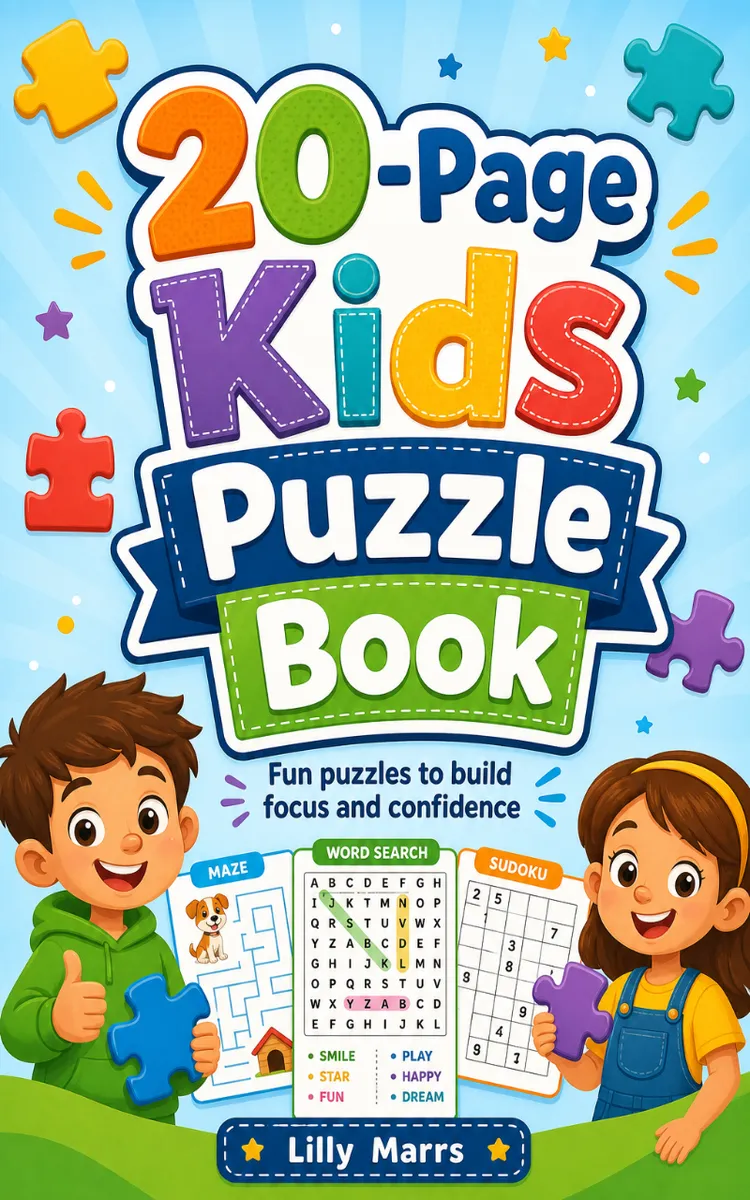
"20-Page Kids Puzzle Book" is a workbook by Lilly Marrs with 7 chapters and approximately 8,712 words. A short puzzle workbook for children.
This book was created using Inkfluence AI, an AI-powered book generation platform that helps authors write, design, and publish complete books. It was made with the Workbook Generator.
Frequently Asked Questions
What is "20-Page Kids Puzzle Book" about?
A short puzzle workbook for children
How many chapters are in "20-Page Kids Puzzle Book"?
The book contains 7 chapters and approximately 8,712 words. Topics covered include Finding Patterns in Pictures, Solving Mazes with Step Plans, Using Clues for Matching Pairs, Sorting by Size, Shape, and Color, and more.
Who wrote "20-Page Kids Puzzle Book"?
This book was written by Lilly Marrs and created using Inkfluence AI, an AI book generation platform that helps authors write, design, and publish books.
How can I create a similar workbook?
You can create your own workbook using Inkfluence AI. Describe your idea, choose your style, and the AI writes the full book for you. It's free to start.
Write your own workbook with AI
Describe your idea and Inkfluence writes the whole thing. Free to start.
Start writingCreated with Inkfluence AI


