

Read the first chapter
The whole of chapter one, free. About 9 min. Turn the pages with the arrows, your keyboard, or a swipe.
Chapter 1
Paris: Navigating the Capital by Car
Paris is a poor place to “just drive around” and a brilliant place to arrive by car, park once, and switch to walking and the Metro. The ring road, one-way streets, bus lanes, cyclists, delivery vans, and camera-controlled clean-air rules can turn a short journey into a slow one. Plan the car for getting in and out - not for sightseeing.
Quick Facts
• Best months: April - June and September - October, when the weather is comfortable and traffic is usually less punishing than in July. - Getting there: From Calais, allow about 3-3½ hours via the A16 and A1; motorway tolls are roughly €25 - €30. A Eurostar from London to Paris starts around €39 one way when booked early. The car-train shuttle from Folkestone to Calais commonly costs €100 - €250 return, depending on dates. - Budget per day: Budget $110 / Mid-range $240 / Luxury $500 - Languages: French; English is common in central hotels and attractions. - Currency: Euro (€) - Time needed: 3-4 days minimum
Paris suits drivers who are happy to trade the steering wheel for a contactless Metro ticket. Its difference from destinations such as Bordeaux or the Loire Valley is density: major sights, small restaurants, museums, and neighbourhood markets sit close together, but the roads are busy enough that a parked car quickly becomes an expensive piece of luggage.
Arriving, Parking, and Staying Legal
Your cleanest arrival from Calais is the A16 to the A1, entering Paris from the north. From the south or east, the A6 and A4 feed into the city. Before setting off, check live traffic in Waze or Google Maps and avoid arriving between 7:30-9:30 a.m. and 4:30-7:30 p.m. The Périphérique is useful as a bypass, but it isn’t a sightseeing route; it’s a fast-moving urban motorway with frequent lane changes.
Paris and the surrounding metropolitan area use the Crit’Air low-emission sticker system. Foreign-registered vehicles need a French Crit’Air vignette, ordered at certificat-air.gouv.fr. Prices start at €4.61, including postage. Allow several weeks for delivery. A rental car should already have one, but ask the rental desk to confirm its category.
Restrictions can change with pollution levels, but older petrol and diesel vehicles may be barred from the Paris low-emission zone. The zone covers Paris inside the Périphérique, and restrictions generally operate Monday to Friday, 8 a.m. - 8 p.m., excluding public holidays. Don’t assume the motorway ring road makes you exempt: the Périphérique itself has separate rules, and signs matter.
For parking, use a garage rather than hunting for a kerbside space. Saemes Parking Pyramides at 15 Rue des Pyramides, 75001, is handy for the Louvre and central hotels; it operates 24 hours and costs roughly €4 - €6 per hour, with daily rates commonly around €40 - €50. Indigo Paris Montparnasse at 8 Rue du Commandant Mouchotte, 75014, is useful on the Left Bank and also operates 24 hours. Prices change, so check the operator’s app before entering.
If your hotel has no garage, consider leaving the car at a suburban park-and-ride station and taking the Metro or RER. Parking Relais Château de Vincennes, near Metro Line 1 and RER A, is a practical eastern option; daily parking is generally far cheaper than central garages. Another sensible approach is booking a hotel with parking near La Défense, then using Metro Line 1 into the centre.
Driving across Paris is rarely worth it. A taxi from a central garage may cost €10 - €20, while a Metro journey costs about €2.15 for a single ticket in 2026 pricing ranges; fares can change, so check Île-de-France Mobilités before travel. The Metro runs roughly from 5:30 a.m. until 1:15 a.m., later on Friday and Saturday nights. Use the official Bonjour RATP app for routes and service alerts.
See Paris Without Moving the Car
Paris rewards a walking-and-Metro plan. Park near your accommodation, then group sights by area instead of criss-crossing the city.
1. Eiffel Tower The tower is open daily, usually from 9:30 a.m. until 11:45 p.m., with seasonal variations. Lift tickets to the summit are commonly about €36, while stairs-to-second-floor tickets cost less, often around €14. Allow 2-3 hours, including security. Book through the official Eiffel Tower website, and use the Trocadéro viewpoint for photographs before crossing to the tower rather than arriving by car.
2. Louvre Museum Open Monday, Thursday, Saturday, and Sunday from 9 a.m. - 6 p.m., and Wednesday and Friday until about 9 p.m.; closed Tuesday. Admission is generally around €22. Allow at least three hours, though a focused visit works better than trying to conquer the whole building. Enter through the Carrousel du Louvre when available - it’s usually calmer than the pyramid queue.
3. Notre-Dame and Île de la Cité Notre-Dame is free to enter, though opening arrangements and timed systems can change; check the cathedral’s official site before visiting. Allow 60-90 minutes for the cathedral and another hour for Île de la Cité. Arrive early, then walk to the nearby Shakespeare and Company bookshop at 37 Rue de la Bûcherie rather than trying to park on the island.
4. Musée de l’Orangerie Open Wednesday - Monday, generally 9 a.m. - 6 p.m.; closed Tuesday. Admission is about €12.50, and 90 minutes is enough for Monet’s enormous Water Lilies and the smaller collection downstairs. Go late in the afternoon, then walk through the Tuileries Garden to the Place de la Concorde.
5. Canal Saint-Martin The canal is free and open at all hours, with 1-2 hours ideal for a relaxed walk. Start at Quai de Valmy and follow the water south toward Place de la République. The insider move is to visit on a weekday morning, when the locked footbridges and tree-lined quays feel local rather than crowded.
6. Musée de la Chasse et de la Nature Open Tuesday - Sunday, usually 11 a.m. - 6 p.m., with a later closing on some days; admission is around €13. Allow 90 minutes. At 62 Rue des Archives, it’s an unusual, atmospheric museum in the Marais, and its compact size makes it an excellent rainy-day stop after parking outside the centre.
7. Parc des Buttes-Chaumont Open daily from early morning until evening, with hours varying by season; entry is free. Allow 1-2 hours for the paths, lake, and hilltop Temple de la Sibylle. Take Metro Line 7bis to Buttes-Chaumont instead of driving - the park’s steep streets and limited parking are not worth the hassle.
Skip These Tourist Traps
• Skip the restaurants directly beside the Eiffel Tower on Avenue de Suffren; walk 10 minutes to Les Cocottes, 135 Rue Saint-Dominique, for individual casserole dishes, usually €18 - €30. - Skip paying for a river cruise at the busiest sunset slot; take Metro Line 6 across Bir-Hakeim and walk along the Seine instead. - Skip the Champs-Élysées for dinner. Visit Bouillon Pigalle, 22 Boulevard de Clichy, where classic dishes are usually €10 - €18 and the atmosphere is livelier.
Neighbourhoods, Beds, and Meals
Neighbourhood choice matters more than having a view. The Marais is central and walkable but can be noisy. Saint-Germain-des-Prés is polished and convenient for the Left Bank. Montparnasse offers better road access and several garages. La Défense is practical for drivers, with modern hotels and direct Metro Line 1, though it feels less traditionally Parisian.
| Budget Tier | Recommendation | Area | Price/Night | Best For | |---|---|---|---:|---| | Budget | Generator Paris | Place de Colonel Fabien | $45 - $90 | Private rooms and easy Metro access | | Mid-range | Hôtel Le Six | Montparnasse | $180 - $280 | Drivers wanting nearby garages and a quiet base | | Luxury | Hôtel Lutetia | Saint-Germain-des-Prés | $650 - $1,000 | A landmark stay with central Left Bank access |
Bouillon Pigalle (South Pigalle) - Traditional French. Order the steak-frites with pepper sauce (€14 - €18). It’s quick, affordable, and open late enough to rescue you after a long motorway arrival.
Les Cocottes (7th arrondissement) - French comfort food. Order the chicken cocotte with mash (€24 - €30). The one-pot portions are generous, and the restaurant is a manageable walk from the Eiffel Tower.
L’As du Fallafel (Le Marais) - Jewish-Middle Eastern. Order the falafel pita (€9 - €12). The queue moves quickly, and it’s ideal when you want lunch without committing to a long meal.
Le Comptoir du Relais (Saint-Germain-des-Prés) - Bistro cooking. Order the daily menu, often around €45 - €60. Tables are tight and reservations are difficult, but the food is a strong reason to leave the car parked.
Breizh Café (Montorgueil) - Breton crêpes and cider. Order a galette complète (€14 - €18) with a bowl of cider (€5 - €7). It’s a dependable, informal stop near central Metro connections.
Street Food to Try
• Crêpe au beurre-sucre: €4 - €7 from a street stand. - Jambon-beurre baguette: €5 - €8 at a traditional bakery. - Falafel pita: €9 - €12 in the Marais. - Gaufre with chocolate: €5 - €8 near major sights.
Practical Tools for a Car-Free Paris
Once the car is parked, pack for walking, sudden rain, and the small annoyances of public transport. Paris pavements are uneven, and a suitcase with tiny wheels will complain loudly on cobblestones.
Packing Checklist
• Comfortable shoes with grippy soles for long pavements and Metro stairs. - A light waterproof jacket for sudden showers. - A small cross-body bag with a secure zip. - A reusable water bottle. - A phone power bank for maps and ticket apps. - A paper copy of your hotel address. - A Crit’Air sticker confirmation or rental-car paperwork. - A compact umbrella. - Earplugs for lively hotel streets. - A small coin purse for bakery purchases and public toilets.
Useful Phrases
1. Bonjour, vous pouvez m’aider? (bohn-ZHOOR, voo poo-VAY may-DAY?) - Hello, can you help me? 2. Où est le parking le plus proche? (oo ay luh par-KEENG luh ploo PROHSH?) - Where is the nearest car park? 3. Je cherche cette adresse. (zhuh SHERSH set ah-DRESS) - I’m looking for this address. 4. Une table pour deux, s’il vous plaît. (oon TAH-bluh poor duh, seel voo PLAY) - A table for two, please. 5. L’addition, s’il vous plaît. (lah-dee-SYON, seel voo PLAY) - The bill, please. 6. Est-ce que je peux payer par carte? (ess kuh zhuh puh pay-YAY par KART?) - Can I pay by card?
Money-Saving Tips
1. Book a hotel with parking outside the centre, then use a €2.15 Metro ticket instead of paying €40 - €50 for central parking. 2. Buy museum tickets from official websites, not resellers adding booking fees. 3. Choose the Louvre’s late opening on Wednesday or Friday to make one ticket cover a longer, quieter visit. 4. Eat the weekday lunch menu at a bistro; many offer two courses for €18 - €25. 5. Walk between nearby sights. The Louvre, Tuileries, Place de la Concorde, and Musée de l’Orangerie form one excellent car-free route.
Common Mistakes
• Entering Paris without a Crit’Air sticker; order it before departure and keep proof in the car. - Following a sat-nav into a bus or cycle lane; obey the blue lane signs even when the route looks faster. - Leaving luggage visible in a parked car; use a guarded garage and take everything with you. - Booking a hotel by “central Paris” alone; confirm its exact address, nearest Metro station, and parking arrangement first.
Paris becomes much easier when you stop asking the car to do a pedestrian’s job. Use it to reach the city, secure it in a garage, and let the Metro, your feet, and a good pair of shoes handle the rest.
End of chapter one. 7 more chapters and about 16,270 words in the full book.
Swipe or use the arrows to turn the page


What's inside: 8 chapters
- 1. Paris: Navigating the Capital by Car
- 2. Normandy: Channel Crossings and Landing Beaches
- 3. Loire Valley: Châteaux by Road
- 4. Bordeaux: Wine Roads and City Parking
- 5. Provence: Market Towns and Summer Roads
- 6. French Alps: Passes, Tolls, and Safety
- 7. Lyon: Road Rules and Local Etiquette
- 8. Dordogne: Slow Routes to Hidden Villages
About this book
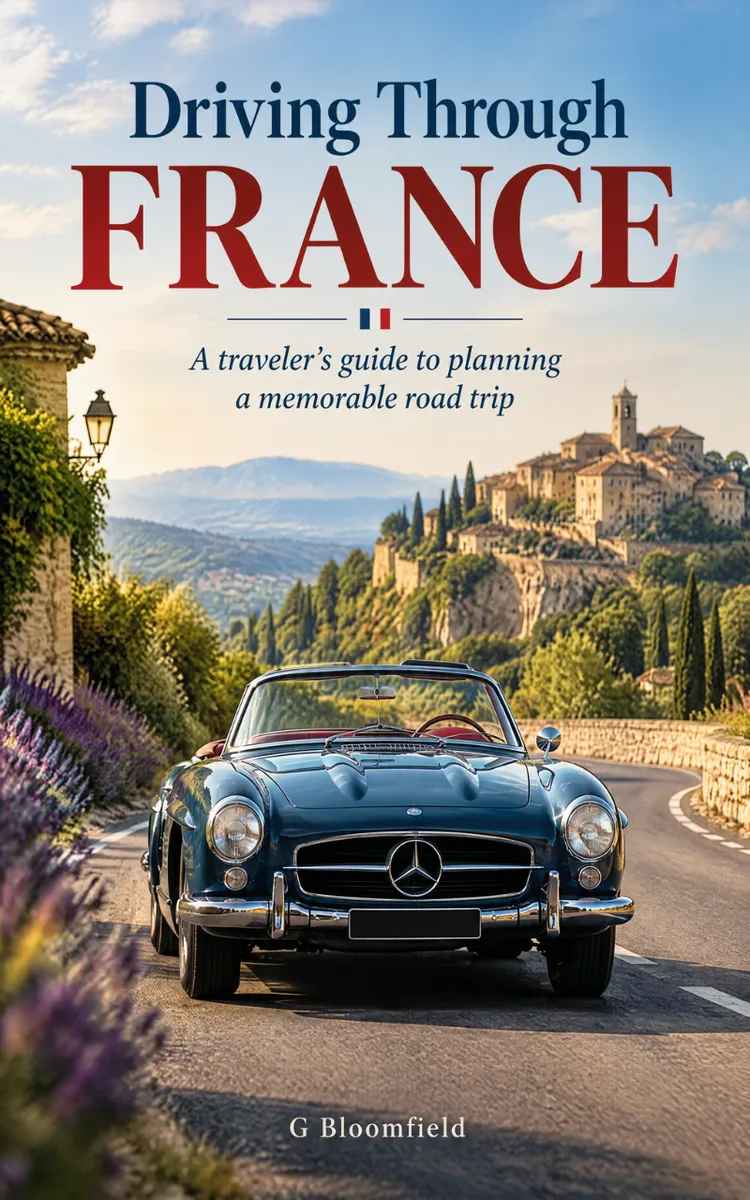
"Driving Through France" is a travel book by G Bloomfield with 8 chapters and approximately 16,270 words. Planning a driving holiday in France, from road rules to destinations.
This book was created using Inkfluence AI, an AI-powered book generation platform that helps authors write, design, and publish complete books. It was made with the AI Travel Guide Creator.
Frequently Asked Questions
What is "Driving Through France" about?
Planning a driving holiday in France, from road rules to destinations
How many chapters are in "Driving Through France"?
The book contains 8 chapters and approximately 16,270 words. Topics covered include Paris: Navigating the Capital by Car, Normandy: Channel Crossings and Landing Beaches, Loire Valley: Châteaux by Road, Bordeaux: Wine Roads and City Parking, and more.
Who wrote "Driving Through France"?
This book was written by G Bloomfield and created using Inkfluence AI, an AI book generation platform that helps authors write, design, and publish books.
How can I create a similar travel book?
You can create your own travel book using Inkfluence AI. Describe your idea, choose your style, and the AI writes the full book for you. It's free to start.
Write your own travel book with AI
Describe your idea and Inkfluence writes the whole thing. Free to start.
Start writingCreated with Inkfluence AI


