
Read the first chapter
The whole of chapter one, free. About 7 min. Turn the pages with the arrows, your keyboard, or a swipe.
Chapter 1
Name the Feeling, Win the Day
When the Feeling Takes the Wheel
Tara is 34, an ER nurse, and halfway through a rotating shift when a small mistake lands badly. She misses a detail during handoff. Her coworker asks a sharp follow-up question. Nobody says she’s incompetent, but Tara feels heat climb into her face.
By the time she gets to her car, the moment has grown teeth. I’m slipping. They’ve noticed. I can’t keep doing this. She starts typing a defensive message to her coworker, then deletes it. At home, she snaps at her partner over a question about dinner. One tense moment has quietly taken over the whole evening.
The problem isn’t that Tara feels strongly. The problem is that the feeling is driving before she’s identified it.
What if naming the feeling could interrupt the spiral before it chooses your next move?
From “This Is Me” to “This Is What I Feel”
Old Belief: If I feel overwhelmed, angry, ashamed, or anxious, the feeling is telling me the truth about who I am and what’s happening.
New Reality: A feeling is real information, but it isn’t a complete verdict. Naming it creates enough space to choose what happens next.
When an emotion stays vague, it tends to spread. “I feel awful” can mean embarrassed, threatened, disappointed, exhausted, resentful, or afraid. Your body may react to all of those with a tight chest, a hot face, a clenched jaw, or the urge to disappear. Without a clear label, the brain often fills in the blank with a story.
That story can sound convincing. They don’t respect me. I always mess things up. This day is ruined. The feeling and the story begin to blend until they seem like one solid fact.
The Emotion Label Ladder separates them. You start with a broad word, then move toward a more precise one:
• Bad becomes upset. - Upset becomes embarrassed. - Embarrassed becomes afraid I looked careless.
That final label doesn’t magically fix the shift. It does something more practical: it tells you what kind of problem you’re actually holding.
Tara’s first label might be “angry.” After a breath, she notices something underneath it: “I’m embarrassed, and I’m worried people think I’m unsafe.” That’s different from “My coworker is disrespectful.” The first label points toward reassurance, repair, or rest. The second pushes her toward a fight.
Naming the feeling doesn’t make you weak or dramatic. It keeps one rough moment from becoming a full identity.
Why Precision Creates Space
Emotions arrive quickly because they’re built to get your attention. Your body reacts before your thoughtful mind has finished explaining what happened. That’s useful when you need to move fast. It’s less useful when a short email feels like a personal attack or a delayed reply becomes proof that someone is leaving.
A label acts like a hand on the steering wheel. Not a hard yank. Just enough pressure to remind you that you’re still in the car.
Use the Emotion Label Ladder in three passes:
1. Name the weather. Say, “I feel bad,” “I feel activated,” or “Something is off.” 2. Choose the neighborhood. Ask whether it’s anger, fear, sadness, shame, disappointment, or overwhelm. 3. Find the address. Add the more exact meaning: “I feel dismissed,” “I’m afraid I’ll fail,” or “I’m disappointed that my effort wasn’t noticed.”
The goal isn’t perfect emotional vocabulary. You don’t need to identify the difference between irritation and resentment while standing in a supply closet with three alarms sounding. You need a label that’s accurate enough to slow the automatic reaction.
Signs this pattern is running your life:
1. You say “I’m fine” while your body is tense, then explode over something minor hours later. 2. You make decisions at the peak of a feeling, such as quitting, sending the message, canceling plans, or spending money to soothe yourself. 3. You replay one interaction repeatedly but can’t say exactly what hurt. 4. You treat an emotional reaction as evidence: “I feel rejected, so they must have rejected me.”
The Label Is the Pause
A precise feeling name doesn’t erase the emotion; it stops the emotion from becoming the only voice in the room.
Tara can still be embarrassed after naming it. She may still need to apologize for a sharp reply or ask her coworker to clarify the handoff. But she’s less likely to send a message written by panic. The label gives her a choice between reacting and responding.
Try saying the label out loud, even quietly: “This is embarrassment.” “This is fear.” “This is disappointment.” The simple sentence creates distance without denying what’s happening. You aren’t saying, “I shouldn’t feel this.” You’re saying, “I can notice this.”
Questions That Put You Back in the Driver’s Seat
1. What’s the broadest honest label for what I feel right now? Start without judging yourself. “Bad,” “stressed,” or “off” is allowed. The point is to stop pretending you feel nothing and begin moving up the ladder.
2. If this feeling had a more precise name, what might it be? Ask whether you’re mainly angry, afraid, sad, ashamed, disappointed, or overwhelmed. Tara might discover that what looks like anger is actually fear of being seen as careless.
3. What story did my feeling attach itself to? Write the story exactly as it appears: They think I’m useless or I always ruin things. Then place the label before it: “I feel ashamed, and I’m telling myself they think I’m useless.” That wording separates emotion from assumption.
4. What choice would I make if I waited ten minutes before acting? Don’t promise yourself a perfect response. Just identify the action that becomes less tempting after the first surge passes. Maybe you’d save the text as a draft, drink water, or ask one clarifying question.
5. What does this feeling need - not what does it demand? Anger may demand a confrontation but need a boundary. Shame may demand hiding but need a repair conversation. Overwhelm may demand quitting but need food, sleep, or one smaller task.
An honest answer may be messy: “I’m disappointed, and I want someone to notice how hard I’ve been working.” That’s useful. You’ve found the need beneath the reaction, which gives you more options than snapping or silently keeping score.
The Seven-Day Emotion Label Ladder
Challenge: Name It Before You Act
For the next seven days, practice labeling one emotionally charged moment each day. Choose a moment that registers at least a 5 out of 10 in intensity, but not one so overwhelming that you can’t safely pause.
• Stop for ten seconds and feel your feet against the floor. - Take one slow exhale, making it slightly longer than your inhale. - Complete the three rungs: “I feel.” “More specifically, I feel.” “The story I’m telling myself is ___.” - Write the label in your phone under a note titled Emotion Label Ladder. - Wait ten minutes before sending a difficult message or making a major decision, whenever waiting is safe and practical. - At the end of the day, record what you did next and whether the label changed your choice.
Expected difficulty: Medium
You don’t have to label every feeling. One honest entry per day is enough to build the skill. On a rotating shift, Tara might do this in the supply room, in her car before driving, or beside the kitchen counter after getting home. The location doesn’t matter. The interruption does.
You’ll know it’s working when:
• You catch the feeling earlier, before it becomes a full spiral. - Your label becomes more specific than “stressed” or “mad.” - You notice the difference between what happened and what you assumed it meant. - You delay at least one reaction you would have regretted. - Your next action feels intentional, even if the emotion is still present.
Some days, the only win will be writing, “I’m overwhelmed, and I’m telling myself I can’t handle one more thing.” That still counts. You’ve turned a blur into something you can work with.
A Name Can Change the Next Move
Naming the feeling doesn’t change what happened; it changes who gets to choose what happens next.
• You learned to move from a broad feeling to a precise one with the Emotion Label Ladder. - You saw how vague emotions can merge with harsh stories and steer impulsive choices. - You practiced separating the feeling, the story, and the need underneath. - You created a seven-day habit for pausing before acting at the emotional peak.
Tara’s shift may still be hard. Your day may still contain unfair comments, missed details, bad news, and moments that sting. But once you can say, “This is shame,” or “This is fear,” the feeling is no longer an unnamed force running the whole day.
That small act of naming is where recovery begins - and where one bad day starts losing its vote.
End of chapter one. 7 more chapters in the full book.
Swipe or use the arrows to turn the page


What's inside: 8 chapters
- 1. Name the Feeling, Win the Day
- 2. Break the Perfectionism Trap
- 3. Rewire Beliefs With Evidence Sprints
- 4. Build Boundaries Without Guilt
- 5. Create a 10-Minute Reset Routine
- 6. Turn Triggers Into Data
- 7. Practice Repair After Emotional Ruptures
- 8. Integrate Resilience Into Your Purpose
About this book
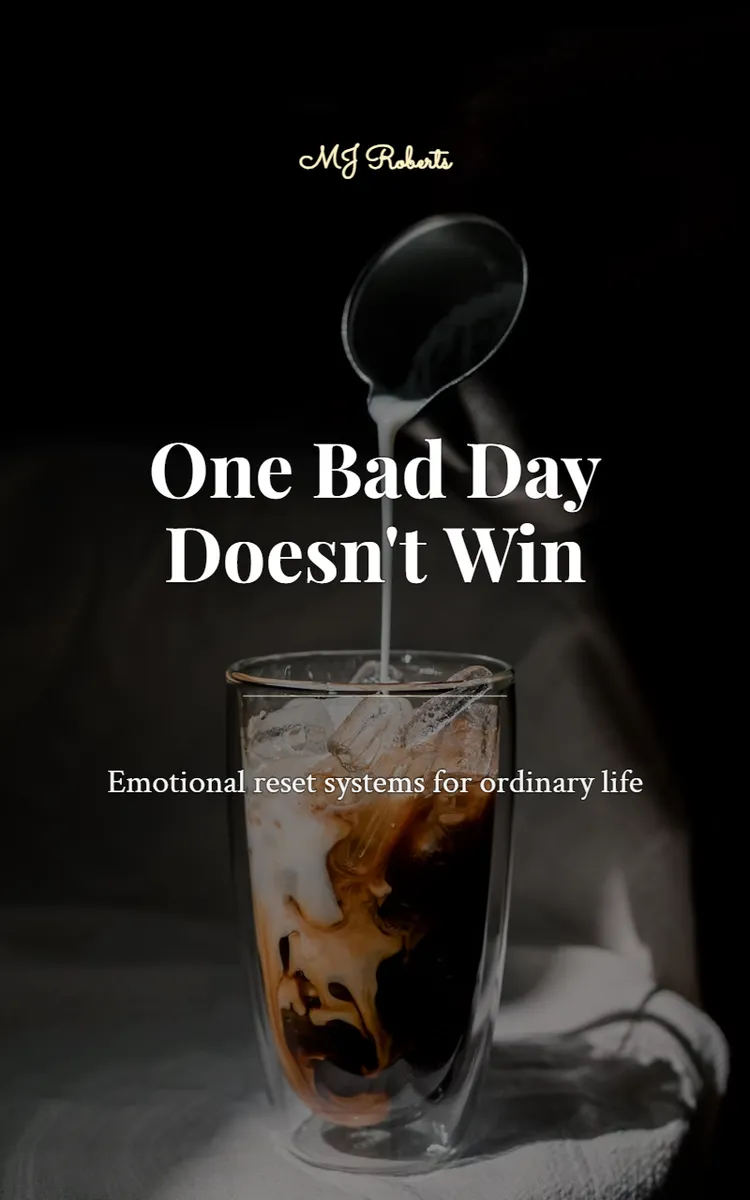
"One Bad Day Doesn't Win" is a self-help book by MJ Roberts with 8 chapters and approximately 12,695 words. Emotional regulation and recovery strategies after bad days.
This book was created using Inkfluence AI, an AI-powered book generation platform that helps authors write, design, and publish complete books. It was made with the AI Self-Help Book Writer.
Frequently Asked Questions
What is "One Bad Day Doesn't Win" about?
Emotional regulation and recovery strategies after bad days
How many chapters are in "One Bad Day Doesn't Win"?
The book contains 8 chapters and approximately 12,695 words. Topics covered include Name the Feeling, Win the Day, Break the Perfectionism Trap, Rewire Beliefs With Evidence Sprints, Build Boundaries Without Guilt, and more.
Who wrote "One Bad Day Doesn't Win"?
This book was written by MJ Roberts and created using Inkfluence AI, an AI book generation platform that helps authors write, design, and publish books.
How can I create a similar self-help book?
You can create your own self-help book using Inkfluence AI. Describe your idea, choose your style, and the AI writes the full book for you. It's free to start.
Write your own self-help book with AI
Describe your idea and Inkfluence writes the whole thing. Free to start.
Start writingCreated with Inkfluence AI


