

Read the first chapter
The whole of chapter one, free. About 7 min. Turn the pages with the arrows, your keyboard, or a swipe.
Chapter 1
You Are the Sky, Not the Weather
When the Sky Seems to Be Falling
At 7:42 on a Tuesday morning, Mara sits in her parked car outside the office, hand resting on the door handle. One email waits on her phone: Can we talk about yesterday’s mistake? Before she opens it, a flock of black ravens erupts in her mind.
You’ve ruined everything. They know you’re not capable. You should turn around and never go in.
Her chest tightens. The parking lot blurs at the edges. For a moment, the thoughts feel less like messages and more like weather - thunder overhead, rain in her eyes, wind pushing her toward the easiest escape. Then Mara notices something strange. The sky hasn’t actually collapsed. The car is still beneath her. Her feet are still on the floor mat. The ravens are loud, but they aren’t in charge.
She opens the email. It asks for a conversation, not her resignation. The mistake is real; the catastrophe is not. Mara walks inside carrying both facts: she feels afraid, and she is more than fear. The question isn’t whether dark weather will arrive - it’s whether you’ll mistake it for the whole sky.
The Ravens That Borrow Your Voice
The Deadline Raven: Luis sees a message from his manager marked “urgent.” His first thought is, I’m about to get fired. His stomach drops, and he starts drafting an apology for a disaster nobody has described.
The Mirror Raven: Priya catches her reflection after a sleepless night. I look awful. People can tell I’m falling apart. She cancels lunch, not because anyone criticized her, but because the thought has dressed itself as a fact.
The Doorway Raven: Devon stands outside a community class he wants to attend. You’ll say something embarrassing. They’ll notice you don’t belong. He turns around, then spends the evening feeling disappointed in himself.
What all these have in common:
• A passing thought presents itself as a permanent truth. - A feeling supplies convincing evidence, even when facts are missing. - The person begins to shrink around the thought. - The thought changes behavior before it gets examined.
Each person has a real experience underneath the raven’s message. Luis may have made a mistake before. Priya may genuinely feel exhausted. Devon may be nervous in unfamiliar rooms. The problem isn’t that their minds noticed risk. Minds are built to notice risk. The problem is that a single prediction takes the microphone and starts speaking for the entire self.
This is the Sky-and-Weather Distinction. Your thoughts and feelings are weather: changeable, sometimes fierce, often worth noticing. Your enduring sense of self is the sky: spacious enough to hold fear, shame, anger, and hope without becoming any one of them. Saying “I’m having the thought that I’ll be fired” creates a little room around the thought. Saying “I’m a failure” closes the room.
That small change in language isn’t pretending everything is fine. It’s refusing to let a raven write your identity in permanent ink.
Learning to Stay Larger Than the Storm
Thoughts often feel true because they arrive quickly and carry emotion. A worried thought can trigger a racing heart; the racing heart then seems to confirm the thought. I feel unsafe, so I must be unsafe. The loop is persuasive, but it isn’t proof.
Feelings are signals, not verdicts. Anxiety may point to uncertainty. Shame may point to something you wish you’d handled differently. Sadness may show that something matters. None of these feelings can, by themselves, define who you are. A storm can tell you the air has changed. It can’t tell you the sky has disappeared.
The Sky-and-Weather Distinction also protects you from the opposite mistake: using “I am the sky” as a reason to ignore real problems. If you made a hurtful comment, the grounded response isn’t, That was only weather, so it doesn’t matter. It’s, Regret is here. I can listen, repair what I can, and still remain more than this moment. Perspective makes responsibility possible without turning responsibility into self-erasure.
You may need this distinction when:
1. A single mistake becomes a verdict about your whole character. 2. A strong feeling makes you certain something terrible is happening. 3. You avoid an ordinary action because a prediction feels like a warning. 4. You keep asking, “What’s wrong with me?” instead of, “What is happening in my mind right now?”
You can experience a thought or feeling fully without handing it the authority to define you.
Try the distinction today with one sentence. When a raven appears, say, “This is weather moving through me.” Then name the weather precisely: fear of disappointing my boss, shame about canceling plans, anger because I felt ignored. Specific language lowers the raven’s dramatic costume. It turns a prophecy into an experience you can observe.
Questions for the Open Sky
1. What thought has been trying to define you lately? Write the exact sentence, not a softened version. Maybe it’s, I’m impossible to love or I always ruin opportunities. Then add: “I am having the thought that…” Notice whether the sentence feels even slightly less solid.
2. What feeling usually arrives with that thought, and where do you feel it in your body? Describe the physical weather: tight jaw, hot face, heavy arms, buzzing stomach. This isn’t an exercise in talking yourself out of emotion. It’s a way to meet the feeling as something happening within you, rather than as proof of who you are.
3. What did the raven urge you to do - or avoid doing? Perhaps you didn’t send the proposal, answer the text, or ask for clarification. Write what the raven predicted would happen. Then write what you actually know, separating facts from forecasts.
4. When have you remained yourself while a difficult feeling passed through? Think of a specific day: you felt rejected but still cared for your child; you felt anxious but made the appointment; you felt ashamed but apologized. The point isn’t to produce a heroic story. Ordinary evidence counts.
5. What would the sky-sized version of you do next? Keep it small and observable. You might reread the email once, drink water, return a call, or say, “I need ten minutes before I answer.” A larger sense of self usually chooses the next honest step, not the grandest one.
The Seven-Day Sky-and-Weather Practice
Challenge name: The Raven Report
For seven days, keep a note on your phone titled “Raven Report.” Each entry should take less than three minutes. You’re not trying to create perfect calm. You’re practicing the pause between an inner message and an automatic reaction.
Difficulty level: Gentle but revealing.
• Day 1 - Spot the bird: Record one troubling thought exactly as it appeared. Add, “This is a thought, not a command.” - Day 2 - Name the weather: Identify the feeling and its body location. Use plain words such as fear, sadness, irritation, or shame. - Day 3 - Separate fact from forecast: Make two lines: “What I know” and “What my mind predicts.” Keep each line concrete. - Day 4 - Notice the behavior: Write what the thought made you want to do. Did you hide, check, cancel, argue, apologize too much, or go silent? - Day 5 - Ask the sky-sized question: “If this feeling could stay for ten minutes without deciding my identity, what useful action could I take?” - Day 6 - Test the prediction: Take one small action the raven discouraged. Send the message, enter the room, ask the question, or complete the task for five minutes. - Day 7 - Review the evidence: Look back at your notes. Circle one thought that changed, one feeling you tolerated, and one action you took while still uncomfortable.
Celebrate when...
• You catch a thought before it becomes a decision. - You can name a feeling without calling it your personality. - You separate at least one fact from one prediction. - You take a small, values-based action while the weather is still unsettled.
The challenge works because repetition teaches your attention a new habit. Each time you observe a raven without obeying it, you gather evidence that thoughts can be loud without being leaders. You’re not waiting to become fearless. You’re learning that fear can ride along while you steer.
The Sky Remains
Your thoughts and feelings may change the weather, but they do not define the sky of who you are.
• The Sky-and-Weather Distinction separates your enduring self from passing mental and emotional conditions. - Thoughts become less commanding when you label them as thoughts instead of facts or identity statements. - Feelings deserve attention and care, but they aren’t final evidence about your worth, safety, or future. - Small actions taken during difficult weather strengthen perspective more reliably than arguments with every raven.
Mara still had to discuss her mistake. Luis still had to open the urgent message. Priya still had a tired face, and Devon still felt nervous at the doorway. Perspective didn’t erase their circumstances. It gave them enough room to meet those circumstances as whole people.
The aviary will grow noisier as we examine the tricks thoughts use to look like truth. For now, remember where you stand: beneath changing weather, within a sky that has never needed to shout to remain vast.
End of chapter one. 7 more chapters and about 11,321 words in the full book.
Swipe or use the arrows to turn the page


What's inside: 8 chapters
- 1. You Are the Sky, Not the Weather
- 2. Spotting the Raven’s Distortions
- 3. Lighting the Truth Lantern
- 4. Watching Thoughts Without Obeying
- 5. Choosing Actions Through Fear
- 6. Changing the Inner Aviary
- 7. Meeting Setbacks with Self-Compassion
- 8. Living Beyond the Raven’s Forecast
About this book
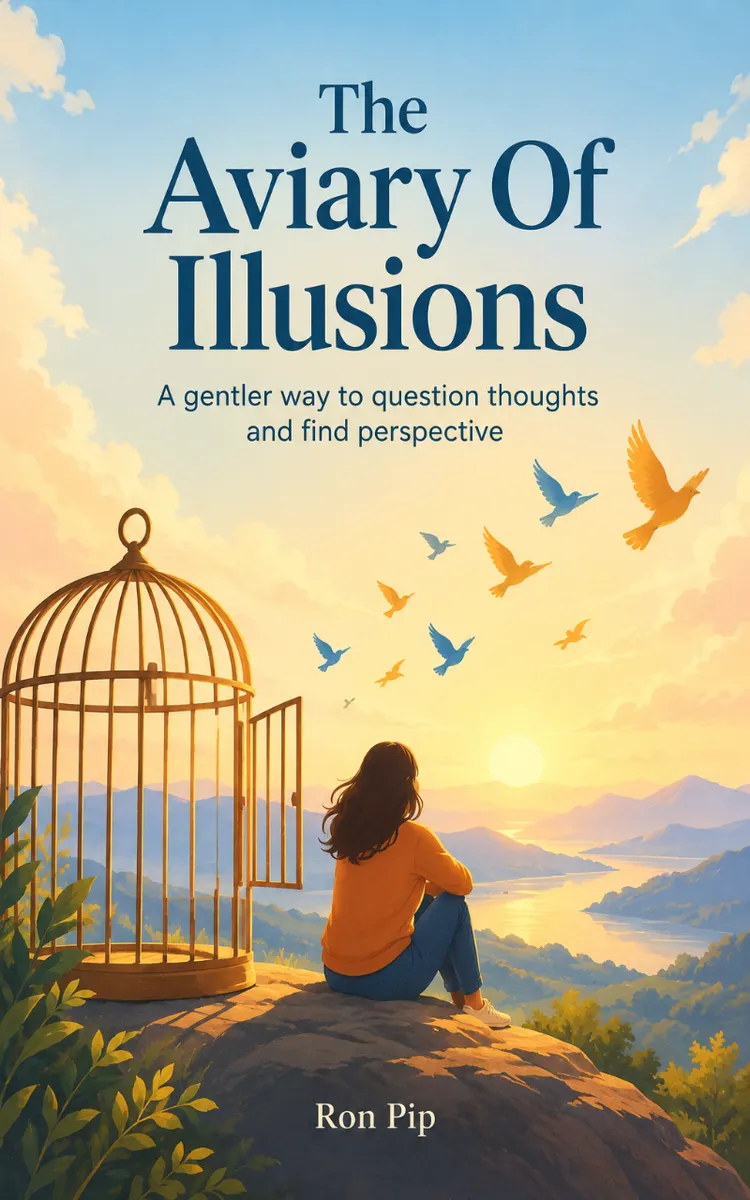
"The Aviary Of Illusions" is a self-help book by Ron Pip with 8 chapters and approximately 11,321 words. Cognitive behavioral therapy, cognitive distortions, and observing thoughts without attachment.
This book was created using Inkfluence AI, an AI-powered book generation platform that helps authors write, design, and publish complete books. It was made with the AI Self-Help Book Writer.
Frequently Asked Questions
What is "The Aviary Of Illusions" about?
Cognitive behavioral therapy, cognitive distortions, and observing thoughts without attachment
How many chapters are in "The Aviary Of Illusions"?
The book contains 8 chapters and approximately 11,321 words. Topics covered include You Are the Sky, Not the Weather, Spotting the Raven’s Distortions, Lighting the Truth Lantern, Watching Thoughts Without Obeying, and more.
Who wrote "The Aviary Of Illusions"?
This book was written by Ron Pip and created using Inkfluence AI, an AI book generation platform that helps authors write, design, and publish books.
How can I create a similar self-help book?
You can create your own self-help book using Inkfluence AI. Describe your idea, choose your style, and the AI writes the full book for you. It's free to start.
Write your own self-help book with AI
Describe your idea and Inkfluence writes the whole thing. Free to start.
Start writingCreated with Inkfluence AI


