
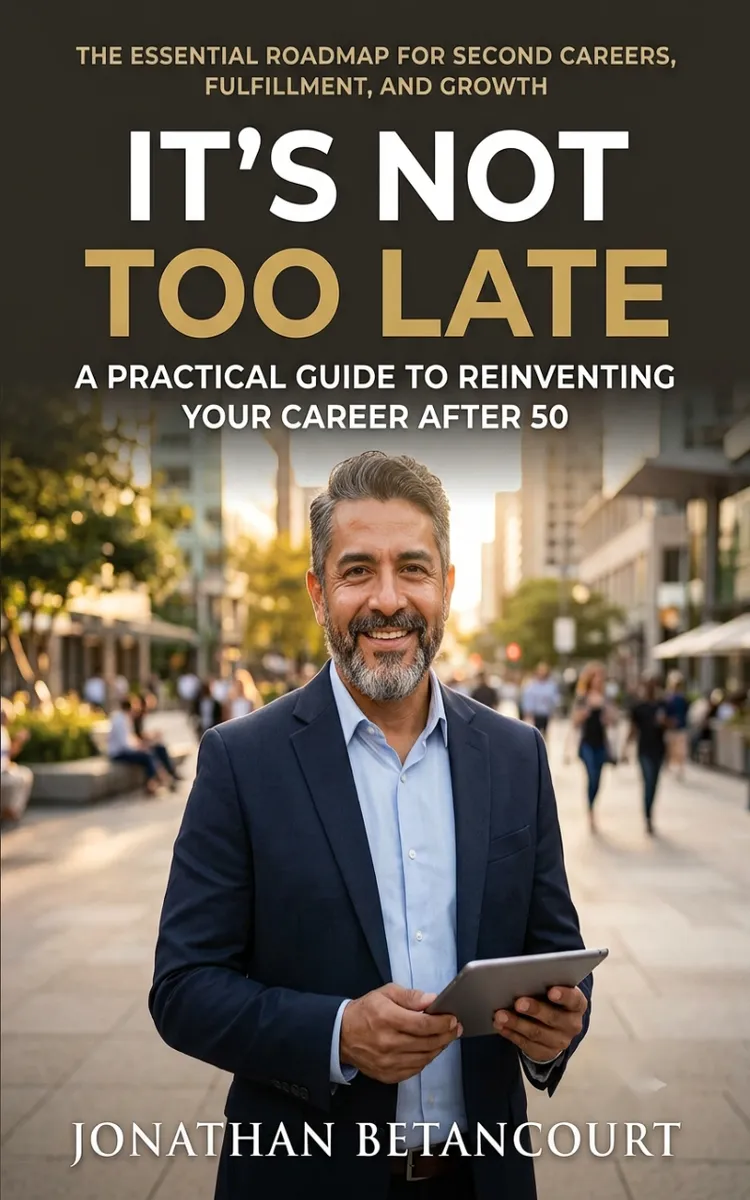

Read the first chapter
The whole of chapter one, free. About 8 min. Turn the pages with the arrows, your keyboard, or a swipe.
Chapter 1
The “Too Old” Myth Breaker
In the job market, “age” rarely acts like a hard stop - it acts like a story people tell themselves, and that story often gets disproven fast once you start looking at the actual opportunities on the ground.
If you’ve ever caught yourself thinking, “I’m too old to change careers,” you’re not alone. Darlene, 54, an operations manager with a decade of process work behind her, said it almost word-for-word when we first started talking. She didn’t mean it as a dramatic line. She meant it the way you mean “the floor is slippery” - like a real, physical fact. Then she did something plain and practical: she started tracking what employers were asking for (not what she feared they’d judge), and she kept showing up to conversations anyway.
Here’s the punchline: the more she looked at actual job descriptions and the way hiring really gets done in her area, the less her “too old” belief matched reality. The belief didn’t vanish because someone told her to be positive. It loosened because the evidence kept stacking up - alongside a few real stories that made it obvious she wasn’t the exception, just the person whose fear was loudest.
• Late reinvention is viable because hiring needs don’t disappear at 50 - they change shape. - Your age is often a bias issue, not a capability issue, and biases can be managed with evidence and positioning. - The advantage of starting later isn’t just “confidence.” It’s experience, clearer judgement, and usually a more stable runway. - When you match your story to what employers are actually buying, “too old” turns into “finally a fit.”
The Pattern: How “Too Old” Shows Up in Your Daily Choices
The “too old” myth has a very specific rhythm. It starts as a thought - usually quiet at first - then it turns into a routine. You skim postings and stop at the first line that triggers you (“required: 3-5 years,” “recent experience,” “entry-level”). You save the “maybe” options for later, and later never comes because your brain keeps treating the future like a courtroom. Then you respond to every gap with extra caution: you don’t apply, you don’t ask, you don’t reach out, because doing so would force you to face rejection that you believe you already “deserve.” It’s exhausting. And it makes you feel busy while you’re actually protecting yourself.
Darlene recognized her pattern instantly. She said she’d open a job board, see something she could do, and then - without even applying - she’d start editing herself. She’d rewrite her resume for “younger” language, trim anything that sounded “too senior,” and avoid roles that looked like she might have to be a beginner again. She wasn’t lazy. She was strategic in the wrong direction. She was treating the job market like it was built to keep people out, instead of built to solve problems. And once you start doing that, you never get the part where reality corrects the narrative.
So tell me - when you think about changing careers, do you recognize that you stop yourself in the first five minutes, before the evidence ever gets a chance to land?
A New Perspective: What If “Too Old” Is Just a Hiring-Story Mismatch?
Here’s the question that usually gets people stuck for years because it sounds too simple: What if the real issue isn’t your age - it’s whether your experience is being presented in a way employers can actually use right now?
When your fear is “I’m too old,” you’re assuming the market is judging you as a whole person. But most hiring decisions are narrower than that. Employers aren’t buying your life story. They’re buying a capability that reduces risk: someone who can run systems, communicate clearly, manage stakeholders, troubleshoot problems, and deliver results without drama. If your resume and conversations are telling a different story than the one they’re trying to hire, you’ll feel shut out - even if you’re qualified.
Darlene’s before-and-after is a good example. Before, she applied to roles that looked close to her old title, but she wrote her resume like she was defending herself: long timelines, generic “responsible for” bullets, and a lot of “I’ve done this before” energy. Her interviews were polite, and then they’d drift away. After, she changed two things. First, she rebuilt her resume around outcomes and transferable capabilities that matched employer language - things like workflow improvement, cross-team coordination, and operational reporting. Second, she stopped trying to sound “current” by borrowing buzzwords. Instead, she used one specific example per application: a process she improved, what broke before, and what changed after (for her, it was a clean reduction in bottlenecks and fewer handoff failures). Suddenly, the conversations didn’t feel like a trial. They felt like problem-solving.
That shift matters because it changes what evidence you collect. When you present yourself in a way that helps hiring managers quickly see “this person can do the job,” age fades into the background where it belongs. Bias still exists - let’s be honest - but it can’t overpower clear fit forever. The market isn’t blind. It’s just busy. Your job is to be easy to understand.
Break the mismatch, and “too old” stops being a verdict and starts becoming a negotiable assumption.
Breaking It Down: The Cause-and-Effect Chain of Late-Career Viability
1. When you assume you’re too old, you skim roles and avoid applying to anything that risks showing your “gap” (or you tailor your resume to hide your seniority). 2. You feel relief in the short term, because you’re protecting yourself from rejection. 3. So you stay in the same lane, using your energy on reassurance activities instead of real-world signals (more reading, more tweaking, fewer conversations). 4. Which leads to less evidence - and the belief “they won’t hire me” hardens because you never collect counterexamples.
Now the alternative chain - the one that creates proof:
1. When you treat “too old” as a hypothesis, you gather evidence by applying to a small batch of roles that match your capabilities (not your comfort). 2. You feel exposed at first, because you’re letting the market see you. 3. So you tighten your positioning around transferable outcomes, using one concrete story per role instead of trying to sound younger. 4. Which leads to real feedback loops - replies, interviews, and even “not this role, but try this” moments that quietly dismantle the myth.
Here’s the practical part: Darlene didn’t need a miracle to change. She needed a different input. She started with five targeted applications over two weeks, each one aligned to the same core strengths she already had - coordination, process thinking, and making messy operations run smoother. She adjusted based on what interviewers asked. Within a month, her experience didn’t feel like a liability. It felt like leverage. Not because she magically changed age - because she changed the signal she sent.
Evidence beats fear. Always.
Check In With Yourself: The Late-Career Viability Index
Use this quick self-check to see where the “too old” myth is actually doing its work. Rate yourself from 1 to 10 (or answer yes/no). Don’t overthink it - this is about pattern, not perfection.
1. How often do you avoid applying because you’re worried about how age will be perceived? (1-10) A low score usually means you collect evidence quickly. A high score means you’re protecting yourself, and protection can look like “being realistic.”
2. When you look at a job posting, do you focus first on what you match - or what you might be “missing”? (1-10) If you score high, you’re probably scanning for gaps fast. That creates a mindset that only notices rejection signals, even before anyone has responded.
3. Do you have at least 2 concrete examples of outcomes you can explain clearly (without sounding defensive)? (Yes/No) “Yes” tells you you can position yourself for what employers buy. “No” often means your experience is stuck in your head instead of ready for conversations.
4. How comfortable are you reaching out for information (not a job ask) in your target field? (1-10) Low comfort usually means you wait for permission or certainty. Higher comfort builds momentum and turns bias into dialogue.
Interpretation guide: - Mostly 8-10s and Yes: Your “too old” belief might be loud, but it’s not steering your decisions much. You’re ready to move from belief to execution. - Mostly 1-4s: Your fear is likely running the show. Start with small evidence moves (applications, outreach, one story refresh) before you expect big confidence. - Mixed results: That’s normal at 50+. You might be strong in positioning but avoid applying - or you might apply, but your examples aren’t sharp enough to land.
Take Action: The Evidence-First Week Challenge
You don’t need a new personality. You need a new feedback loop. Start this today.
Evidence-First Week Challenge
1. Pick 3 target job postings in your area (today, 20 minutes). Choose roles that fit your transferable capabilities - even if they aren’t identical to your old title. Difficulty: Easy.
2. Write one “outcome story” for each posting (tomorrow, 45 minutes). Use a simple structure: What was broken? What did you do? What changed? Keep it to 6-10 sentences. Difficulty: Medium.
3. Apply to all 3 - or request a short informational chat if applications feel risky (within 7 days). If you apply, use your outcome stories and keep the rest tight. If you reach out, ask one specific question about what success looks like in the first 90 days. Difficulty: Hard.
You’ll know it’s working when… - You get at least one response (even a “no” that leads to “try this other role”). - You notice your mind shifting from “they won’t hire me” to “here’s what they’re actually looking for.” - Your conversations start sounding less like a defense and more like a fit discussion.
At midlife, the temptation is to wait until you feel ready. But readiness is usually a result of motion, not a prerequisite. You’ll feel exposed because you’re doing something real - collecting evidence.
The deeper takeaway is this: the “too old” myth survives in the dark. Bring it into daylight with targeted applications, sharper stories, and honest feedback, and it starts to look less like truth and more like a habit you can outgrow.
And once you’ve got evidence on your side, the next step becomes clearer - how you name what you want, and what you’re actually willing to trade to get it.
End of chapter one. 9 more chapters in the full book.
Swipe or use the arrows to turn the page


What's inside: 10 chapters
- 1. The “Too Old” Myth Breaker
- 2. Naming the Fear Without Letting It Drive
- 3. Your Transferable Skills Asset Map
- 4. The Runway and Wants Clarity Check
- 5. Pivot, Portfolio, or Full Reinvention
- 6. Credibility Gaps Without Time Waste
- 7. Rewrite Your Story for “Why Now”
- 8. The Money Bridge Budget That Works
- 9. Networking Without the Outsider Feeling
- 10. Win Offers by Negotiating Experience
About this book
"It’s Not Too Late" is a self-help book by Jonathan Betancourt with 10 chapters and approximately 17,256 words. Career reinvention strategy and mindset for people over 50.
This book was created using Inkfluence AI, an AI-powered book generation platform that helps authors write, design, and publish complete books. It was made with the AI Self-Help Book Writer.
Frequently Asked Questions
What is "It’s Not Too Late" about?
Career reinvention strategy and mindset for people over 50
How many chapters are in "It’s Not Too Late"?
The book contains 10 chapters and approximately 17,256 words. Topics covered include The “Too Old” Myth Breaker, Naming the Fear Without Letting It Drive, Your Transferable Skills Asset Map, The Runway and Wants Clarity Check, and more.
Who wrote "It’s Not Too Late"?
This book was written by Jonathan Betancourt and created using Inkfluence AI, an AI book generation platform that helps authors write, design, and publish books.
How can I create a similar self-help book?
You can create your own self-help book using Inkfluence AI. Describe your idea, choose your style, and the AI writes the full book for you. It's free to start.
Write your own self-help book with AI
Describe your idea and Inkfluence writes the whole thing. Free to start.
Start writingCreated with Inkfluence AI


