

Read the first chapter
The whole of chapter one, free. About 8 min. Turn the pages with the arrows, your keyboard, or a swipe.
Chapter 1
Understanding Biblical Counseling
Why Biblical Counseling Requires More Than Good Advice
“Scripture does not merely tell us what to believe; it teaches us how to live before God and with one another.”
A counseling appointment can become unfocused when people bring pain, conflict, fear, or confusion without a clear way to examine what is happening. Biblical counseling provides that direction. Dr. Lee Martin uses Scripture, prayer, careful listening, and professional judgment to help clients identify the real problem, understand their responsibilities, and take faithful next steps. The goal does not involve attaching a Bible verse to every problem or offering quick religious answers. The goal involves bringing the whole situation honestly before God and responding with truth, wisdom, and obedience.
Professional biblical counseling also has clear limits. Counseling does not replace emergency medical care, psychiatric treatment, legal advice, pastoral authority, or responsible action when someone faces immediate danger. A counselor should not pretend to know every detail after one conversation. Careful listening matters because accurate guidance depends on accurate understanding. Scripture provides the standard, prayer asks for God’s wisdom, and professional judgment helps apply biblical truth to the specific circumstances in front of us.
After reading this section, you should know how the Scripture-and-Care Compass guides counseling, how to arrange an appointment with Dr. Martin, what information to send before the first session, and how to prepare spiritually and practically. Your first responsibility is simple: tell the truth about your situation so the counseling process can begin from reality rather than appearance.
The Scripture-and-Care Compass
The Scripture-and-Care Compass keeps counseling anchored. It joins biblical truth with careful attention to the person, the facts, and the decisions that require wisdom. Use these four movements to understand what happens during counseling:
• Scripture establishes the direction.
Dr. Martin examines concerns through the teaching of Scripture rather than personal preference alone. For example, a conflict may involve anger, dishonesty, fear, unforgiveness, poor communication, or several issues at once. Scripture helps identify what honors God and what requires repentance, correction, patience, or protection. “Your word is a lamp for my feet and a light on my path” (Psalm 119:105).
• Prayer places the work before God.
Prayer does not replace preparation or action. It asks God for wisdom, humility, courage, and self-control while the client and counselor examine the situation. James 1:5 directs those who lack wisdom to ask God, who gives generously. Before a session, pray specifically for honest speech and a willing response to truth.
• Careful listening separates facts from assumptions.
Dr. Martin listens for what happened, what you believed, what you felt, what you chose, and what consequences followed. Bring specific examples instead of broad statements such as “nothing ever changes.” A clearer statement sounds like: “For three weeks, we argued after work, and I left the room without explaining where I was going.” Specific details make responsible counsel possible.
• Professional judgment applies truth with care and limits.
Professional judgment considers safety, timing, maturity, family responsibilities, health concerns, and the difference between what you can control and what you cannot. It also recognizes when another service should join the counseling plan. If a client reports immediate danger, serious medical symptoms, or thoughts of self-harm, the counselor must address safety first and direct the person toward emergency or medical support.
Ask yourself before the appointment: What do I know for certain? What am I assuming? What part of this situation belongs to my choices? What response would reflect obedience to God? These questions do not excuse another person’s wrongdoing, but they help you address your own responsibilities without losing sight of justice or safety.
To arrange an appointment, contact Dr. Lee Martin at 214 202 0449, visit drleemartin.org, or send an appointment request by email. State your preferred format - Zoom, phone, or in-person - along with your general concern and several available times. Complete the intake forms in this book and email them to Martinintegrity@yahoo.com before the appointment. The forms give Dr. Martin time to review the facts and prepare focused questions, rather than spending the entire first session collecting basic information.
Prepare in four practical ways:
• Set aside a quiet place and reliable connection for a Zoom or phone session.
• Bring a Bible, a notebook, your calendar, and any relevant documents.
• Write one or two goals for counseling, such as “respond without escalating conflict” or “understand how to address repeated dishonesty.”
• Pray for honesty, humility, and courage to act on clear biblical direction.
Counseling works best when you bring facts, remain open to correction, and complete agreed-upon steps between sessions. The Compass points toward faithful action, not endless discussion.
A Prepared Appointment in Practice
Consider a client who seeks help for repeated conflict at home. The client wants counseling by Zoom and reports that arguments happen several evenings each week. The client believes the spouse causes every conflict, but the intake form also reveals raised voices, leaving the room without explanation, and refusing to discuss the issue the next day. A careful counseling process does not dismiss the spouse’s behavior, but it also does not allow the client to avoid personal responsibility.
The preparation and first-session process should look like this:
• Request the appointment.
Call 214 202 0449 or use drleemartin.org. Ask for a Zoom appointment and provide two or three possible times. The expected outcome is a confirmed date, time, and meeting method.
• Select the service.
Individual counseling costs $150 for a 50-minute session. A package of 3 sessions paid upfront costs $350, and a package of 5 sessions paid upfront costs $500. The client should choose a package only after considering the likely need for continued work and the payment terms.
• Complete and send the intake forms.
Provide contact information, the main concern, relevant history, current risks, goals, and permission for appropriate communication. Email the completed forms to Martinintegrity@yahoo.com before the appointment. The expected outcome is a usable picture of the concern before counseling begins.
• Prepare the facts.
List three recent examples with dates or approximate dates. For each example, record what happened, what you said or did, what the other person said or did, and what happened afterward. This prevents the session from relying only on memory or emotion.
• Pray and examine your response.
Ask God to expose sinful reactions, strengthen wise boundaries, and help you receive truth. Read a short passage such as James 1:19: “Everyone should be quick to listen, slow to speak and slow to become angry.” The expected outcome is a prepared heart, not a promise that the session will feel comfortable.
• Attend ready to listen and act.
During the session, answer questions directly. If Dr. Martin identifies a responsibility you would rather avoid, ask for clarification instead of changing the subject. Write down the agreed action, when you will complete it, and what result you expect.
Services also include group counseling at $300 per 50-minute session for up to 7 participants, with packages of 3 sessions for $800 or 5 sessions for $1300. Church consultation or conflict resolution costs $300 per hour or $1,500 per day. Sessions are available via Zoom, phone, or in person. When Dr. Martin comes to the client for an in-person session, the client pays travel and other expenses in addition to the regular rate. These details should be confirmed before the appointment so payment expectations do not distract from the counseling work.
Service
Rate
Individual counseling, 50 minutes
$150
Individual package, 3 sessions paid upfront
$350
Individual package, 5 sessions paid upfront
$600
Group counseling, 50 minutes, up to 7 participants
$300
Group package, 3 sessions
$750
Group package, 5 sessions
$1200
Church consultation or conflict resolution
$300 per hour
Church consultation or conflict resolution full day (8 hrs)
$1500 per day
Quick checklist
• Contact Dr. Martin at 214 202 0449 or drleemartin.org.
• Choose Zoom, phone, or in-person counseling.
• Complete every applicable intake form.
• Email the forms to Martinintegrity@yahoo.com.
• Prepare three specific examples.
• Bring your Bible, notebook, calendar, and questions.
• Pray for wisdom, honesty, and obedience.
• Confirm the fee, package, and any in-person expenses.
• Write down the next action before ending the session.
A prepared client does not need perfect words. A prepared client brings accurate information and a willingness to respond to biblical direction.
Limits, Mistakes, and Wise Next Steps
Mistaking Bible verses for instant solutions
A client may quote a verse while avoiding the facts, the harm caused, or the action required. Scripture gives direction, but responsible application requires listening and judgment.
Do this: Explain the situation in concrete terms, then ask how the relevant biblical truth applies.
Not this: Use a verse to end the conversation before anyone examines the problem.
Treating counseling as a substitute for emergency care
Counseling cannot provide immediate protection from violence, manage a medical emergency, or replace crisis services. If you face immediate danger, contact emergency services or move to a safe location. If you experience a serious medical or mental-health crisis, seek qualified emergency or medical care and tell Dr. Martin what support you have contacted.
Do this: Put safety first and provide accurate information about urgent risks during intake.
Not this: Wait for a regular appointment while an immediate threat continues.
Arriving with accusations but no personal examination
A client may describe another person’s failures in detail and offer no clear account of personal words, actions, or choices. This approach blocks careful counseling because it turns the appointment into a prosecution rather than a search for truth.
Do this: Separate the other person’s responsibility from your own. Record what you did, what you said, what you feared, and what you can change.
Not this: Assume counseling exists to prove that you are right.
The intake forms support this honest process. Complete the client information and contact form, presenting concern form, counseling goals form, relevant history form, safety and emergency information form, and communication and consent form. Include current medications or professional care when relevant, identify urgent safety concerns, and answer every question as accurately as possible. If a question does not apply, write “not applicable” rather than leaving the counselor to guess.
Professional Christian counseling is not a replacement for personal responsibility, church fellowship, medical care, or lawful protection. It offers trained attention and biblical direction when the situation requires more than private effort or casual advice. A layperson may care deeply, and self-help may provide useful reflection, but difficult patterns often require someone who can listen without being controlled by the conflict, recognize limits, ask precise questions, and apply Scripture with disciplined judgment. Dr. Martin’s role is not to take responsibility away from you. It is to help you see your responsibility clearly, respond to God’s truth, and pursue wise action with a plan.
Begin with truthful information, a willing heart, and practical preparation. When Scripture sets the direction, prayer shapes the posture, careful listening clarifies the facts, and professional judgment protects the process, counseling can move beyond confusion toward faithful, measurable steps.
End of chapter one. 7 more chapters in the full book.
Swipe or use the arrows to turn the page


What's inside: 8 chapters
- 1. Understanding Biblical Counseling
- 2. Choosing Services and Understanding Fees
- 3. Booking Your First Appointment
- 4. Completing the Intake Forms
- 5. Preparing Spiritually for Counseling
- 6. Getting Ready for the Session
- 7. Working Safely With a Counselor
- 8. Making Progress After Counseling
About this book
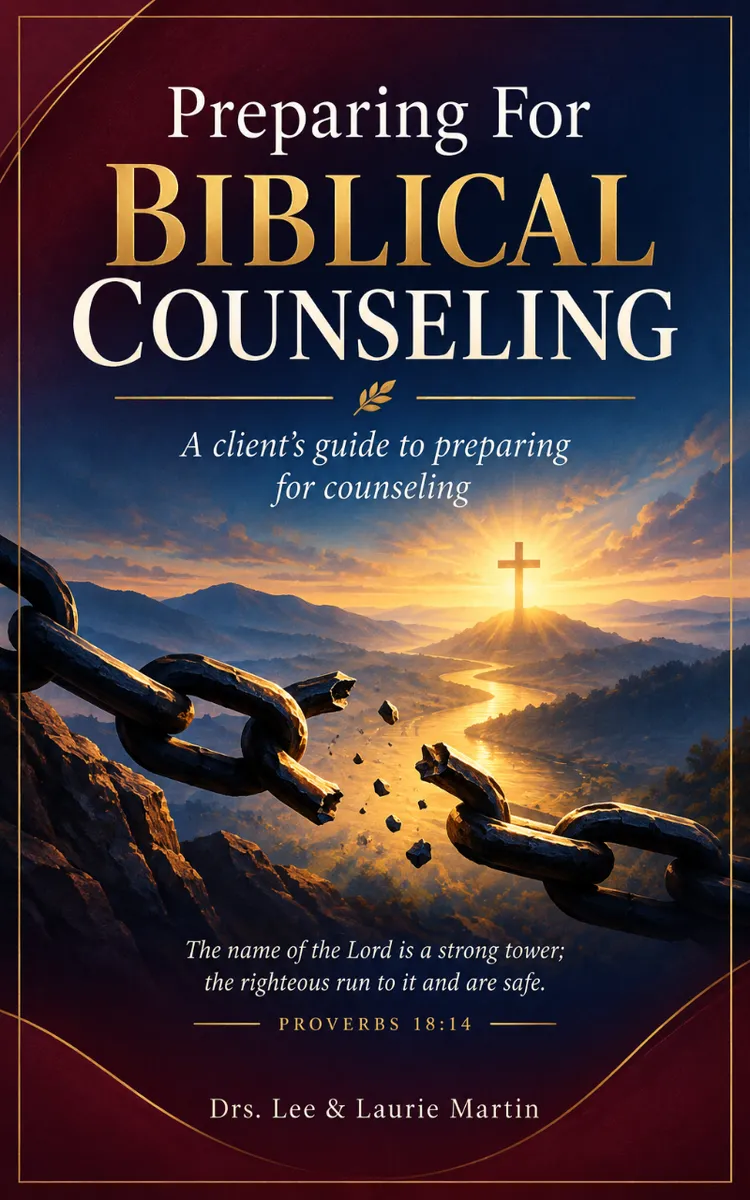
"Preparing For Biblical Counseling" is a how-to guide book by Drs. Lee & Laurie Martin with 8 chapters and approximately 15,132 words. Appointment preparation, intake forms, counseling services, and biblical counseling logistics.
This book was created using Inkfluence AI, an AI-powered book generation platform that helps authors write, design, and publish complete books. It was made with the AI Ebook Generator.
Frequently Asked Questions
What is "Preparing For Biblical Counseling" about?
Appointment preparation, intake forms, counseling services, and biblical counseling logistics
How many chapters are in "Preparing For Biblical Counseling"?
The book contains 8 chapters and approximately 15,132 words. Topics covered include Understanding Biblical Counseling, Choosing Services and Understanding Fees, Booking Your First Appointment, Completing the Intake Forms, and more.
Who wrote "Preparing For Biblical Counseling"?
This book was written by Drs. Lee & Laurie Martin and created using Inkfluence AI, an AI book generation platform that helps authors write, design, and publish books.
How can I create a similar how-to guide book?
You can create your own how-to guide book using Inkfluence AI. Describe your idea, choose your style, and the AI writes the full book for you. It's free to start.
Write your own how-to guide book with AI
Describe your idea and Inkfluence writes the whole thing. Free to start.
Start writingCreated with Inkfluence AI


