
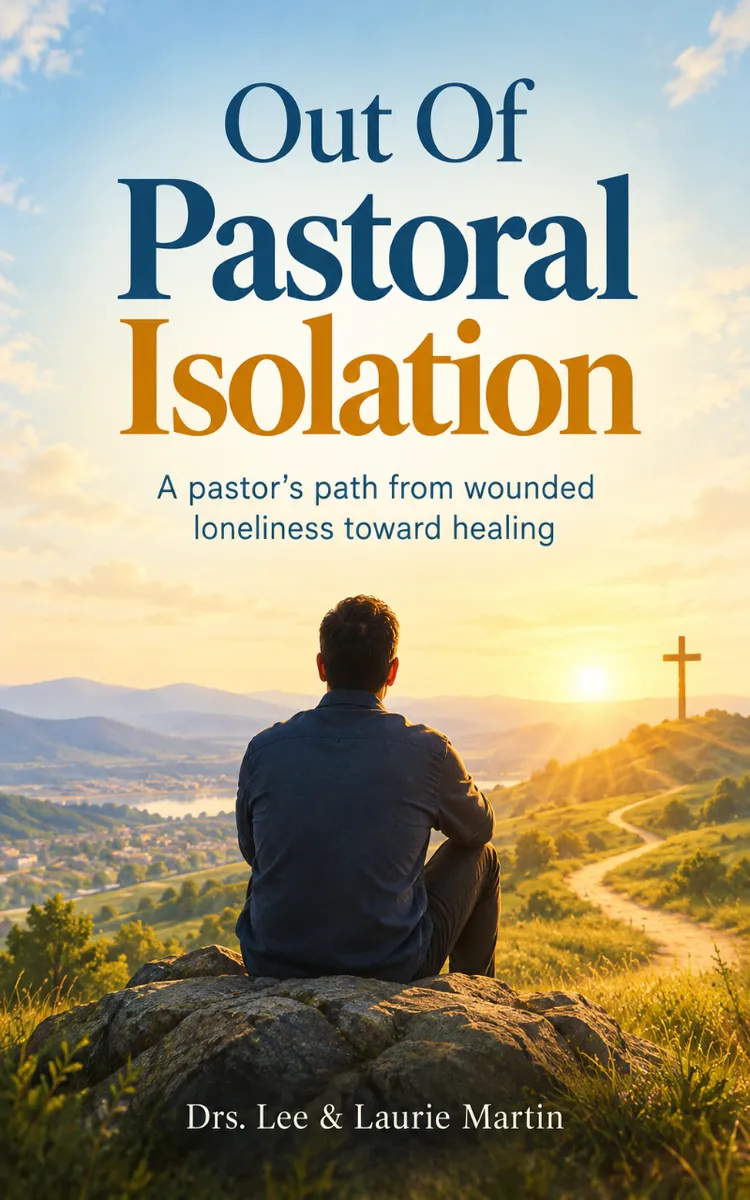

Read the first chapter
The whole of chapter one, free. About 7 min. Turn the pages with the arrows, your keyboard, or a swipe.
Chapter 1
Naming Pastoral Isolation
When “I Need a Little Space” Becomes a Way of Life
When did closing your office door stop being a short pause and become the safest part of your day? You finish preaching, shake hands, answer the urgent questions, and then slip away before anyone can ask how you’re doing. The phone lights up. You turn it face down. A text from a trusted friend waits unanswered because replying might open a conversation you don’t have strength to manage.
At home, you may call it rest. You eat alone, scroll through messages without responding, and rehearse Sunday’s sermon long after the house is quiet. You still pray, but your prayers have become mostly functional: “Help me get through this week.” You still care about people, but their needs feel like one more hand reaching into an already empty cupboard. You tell yourself you’re protecting the church from your weariness. Perhaps you’re also protecting your weariness from being seen.
The pattern can look spiritual from the outside. It can even feel responsible. But is this familiar rhythm quietly becoming your normal?
Could the “quiet place” you need actually be the place where you hide?
Solitude and isolation may look alike on a calendar, but they move in opposite directions in the soul. Solitude creates space to return to God, yourself, and others with greater honesty. Withdrawal creates distance so you won’t have to be known, challenged, disappointed, or hurt again. One is chosen for renewal. The other is often chosen by fear, shame, resentment, or exhaustion.
Jesus practiced solitude without abandoning relationship. “Very early in the morning, while it was still dark, Jesus got up, left the house and went off to a solitary place, where he prayed” (Mark 1:35). His quiet place wasn’t an escape from love. It prepared Him to return to people. After praying, He went with His disciples to continue His ministry. Solitude had a door, and that door opened back toward obedience and community.
Elijah’s story shows how easily restorative solitude can become withdrawal. After Mount Carmel, he ran into the wilderness, sat beneath a broom tree, and said, “I have had enough, Lord” (1 Kings 19:4). God did not shame him. He gave him sleep, food, and gentle attention. Yet God also asked, “What are you doing here, Elijah?” (1 Kings 19:9). The question wasn’t a rebuke for needing rest. It was an invitation to notice whether his hiding place had become his identity.
Picture the difference in ordinary pastoral life. Before, you leave a painful meeting and disappear for three days. You call it “processing,” but you avoid the elder who needs a clear answer. After learning to distinguish solitude from withdrawal, you still take an hour alone. You pray, name the wound, eat something, and schedule a conversation within forty-eight hours. The quiet remains, but it no longer controls the story.
The Solitude-W withdrawal Compass helps you notice the direction of your quiet. Ask: Does this time move me toward God, truth, and healthy relationship - or away from them? A compass doesn’t scold you for being lost. It tells you where you are.
The Chain That Turns Wounds into Distance
Pastoral withdrawal usually doesn’t begin with a dramatic decision. It grows through a sequence.
1. When a criticism, betrayal, conflict, or ministry failure wounds you, the moment feels larger than the moment itself. 2. You feel exposed, angry, ashamed, or depleted. 3. So you reduce contact. You stop returning calls, shorten conversations, and keep trusted people at arm’s length. 4. Which leads to fewer honest relationships, more private assumptions, and deeper loneliness. The silence then seems to prove that nobody understands.
David knew what it was to feel surrounded and alone. “Even my close friend, someone I trusted, one who shared my bread, has turned against me” (Psalm 41:9). His pain was relational, not imaginary. Yet Scripture gives us his psalms, his cries, and his continued turning toward God. He did not pretend betrayal had no effect. He refused to let betrayal become his only address.
Here’s the alternative chain:
1. When a wound occurs, you name it before God and one safe person. 2. You feel the pain without making it your permanent conclusion. 3. So you take measured solitude for prayer, rest, and honest reflection. 4. Which leads to a wise next conversation, clearer boundaries, and renewed connection.
This isn’t instant healing. It’s a different direction. “Carry each other’s burdens, and in this way you will fulfill the law of Christ” (Galatians 6:2). Burdens carried alone become heavier partly because isolation removes the witnesses who can help us see what is true.
Solitude restores your ability to return; withdrawal trains you to remain away.
Finding Your Starting Point on the Compass
Use these questions slowly. Don’t answer as the pastor you think you should be. Answer as the tired person God already sees.
1. On a scale of 1-10, how often does your alone time leave you more open to people? A higher score may show restorative solitude. A low score may reveal that quiet has become emotional retreat.
2. Yes or no: When someone checks on you, do you feel irritated before you feel grateful? A “yes” may point to accumulated hurt or fear of being examined. It doesn’t make you ungrateful; it shows where your defenses are working hardest.
3. On a scale of 1-10, how quickly do you return a message from one trusted person? A high score suggests that solitude still has a relational doorway. A low score may mean avoidance is gaining strength.
4. Yes or no: Can you name one person who knows the truth about your current condition? If the answer is no, your isolation is not merely a lack of social activity. It may be a lack of safe witness. “Confess your sins to each other and pray for each other so that you may be healed” (James 5:16). The verse assumes honest presence, not polished ministry performance.
Here’s a simple interpretation guide. If your answers show openness, contact, and a return to relationship, you may need more healthy solitude, not less. If they show irritation, delay, secrecy, and avoidance, begin by naming withdrawal without condemning yourself. A compass reading is useful precisely because it can change.
The Forty-Eight-Hour Return
Action title: Take solitude, then choose a return.
1. Set a twenty-minute quiet appointment today. Put your phone in another room. Read Mark 1:35 and Psalm 139:23-24: “Search me, God, and know my heart.” Write one sentence answering, “What am I avoiding?” Difficulty: Easy.
2. Within twenty-four hours, contact one safe person. Send a plain message: “I’m more withdrawn than I want to be. Could we talk for twenty minutes this week?” Don’t explain everything by text. The goal is connection, not a perfect report. Difficulty: Medium.
3. Within forty-eight hours, take one relational step. Make the call, meet for coffee, or ask a trusted leader to sit with you. Share one current wound, one fear, and one practical need. Difficulty: Hard.
You’ll know it’s working when:
• you can describe your quiet time as renewal rather than disappearance; - one trusted person knows more truth about your present condition; - you take a next step instead of waiting to feel completely ready.
Expect resistance. Your mind may offer reasonable-sounding excuses: “They’re busy,” “It isn’t serious,” or “I’ll reach out after Sunday.” That resistance matters because withdrawal protects itself with delay. A small, scheduled return interrupts the pattern before it becomes a settled way of life.
The Truth About Where You Are
You can be surrounded by a congregation and still be living as though no one is allowed to reach you.
• Solitude turns us toward God and prepares us to return to people. - Withdrawal uses distance to protect a wounded heart from being known. - Elijah shows that exhaustion can make hiding feel like the only option. - Your first step is not self-condemnation; it’s an honest compass reading followed by one safe return.
Jesus did not despise quiet places. He used them faithfully. He also did not remain there when love and obedience called Him back. Your need for rest is not a failure. Your wounds are not proof that you are unfit to shepherd. But your wounds do need truthful company, because isolation can quietly turn pain into a worldview.
So, as you look honestly at your patterns, what wound, fear, or disappointment has been teaching you to call withdrawal “solitude” - and what might change if you let God meet you there before you take the next step toward someone safe?
End of chapter one. 7 more chapters in the full book.
Swipe or use the arrows to turn the page


What's inside: 8 chapters
- 1. Naming Pastoral Isolation
- 2. Reclaiming Identity Beyond the Role
- 3. Recognizing the Wounds Beneath Withdrawal
- 4. Interrupting Isolation’s Harmful Cycle
- 5. Setting Boundaries Without Guilt
- 6. Rebuilding Trust Through Honest Connection
- 7. Healing with Skilled Support
- 8. Sustaining Connection and Renewed Calling
About this book
"Out Of Pastoral Isolation" is a self-help book by Drs. Lee & Laurie Martin with 8 chapters and approximately 12,159 words. Pastoral isolation, its causes and consequences, and steps toward healing.
This book was created using Inkfluence AI, an AI-powered book generation platform that helps authors write, design, and publish complete books. It was made with the AI Self-Help Book Writer.
Frequently Asked Questions
What is "Out Of Pastoral Isolation" about?
Pastoral isolation, its causes and consequences, and steps toward healing
How many chapters are in "Out Of Pastoral Isolation"?
The book contains 8 chapters and approximately 12,159 words. Topics covered include Naming Pastoral Isolation, Reclaiming Identity Beyond the Role, Recognizing the Wounds Beneath Withdrawal, Interrupting Isolation’s Harmful Cycle, and more.
Who wrote "Out Of Pastoral Isolation"?
This book was written by Drs. Lee & Laurie Martin and created using Inkfluence AI, an AI book generation platform that helps authors write, design, and publish books.
How can I create a similar self-help book?
You can create your own self-help book using Inkfluence AI. Describe your idea, choose your style, and the AI writes the full book for you. It's free to start.
Write your own self-help book with AI
Describe your idea and Inkfluence writes the whole thing. Free to start.
Start writingCreated with Inkfluence AI


