
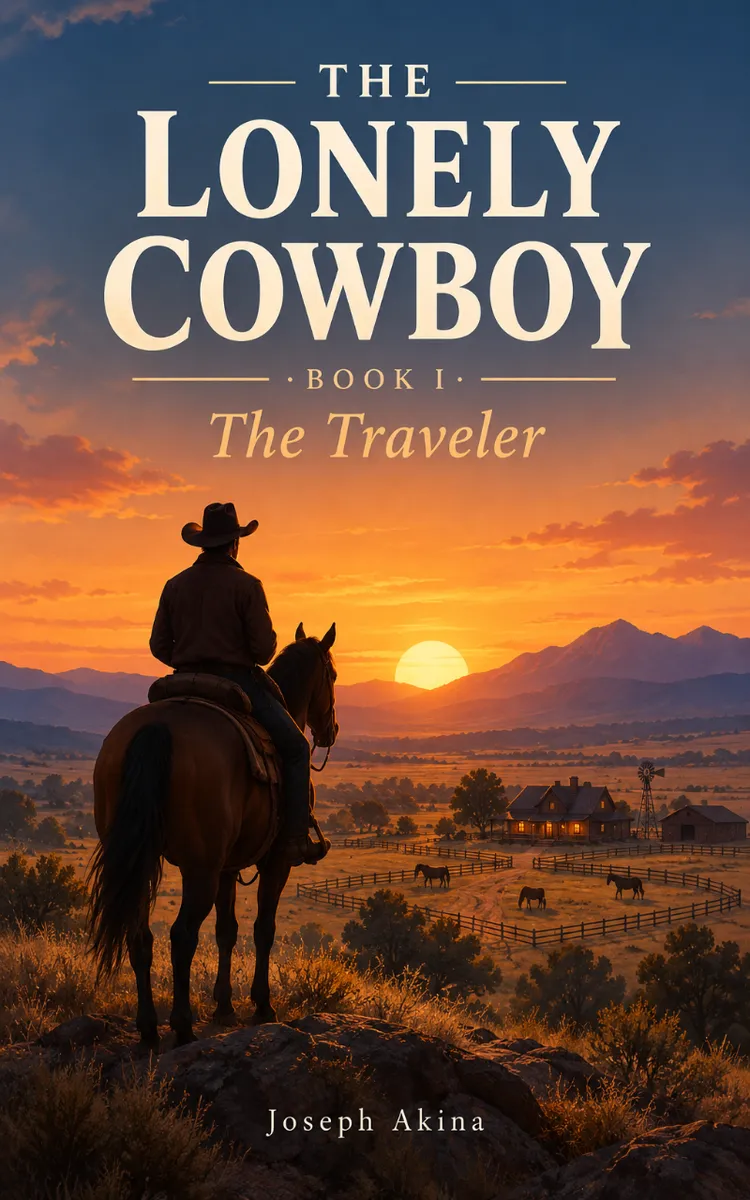

Read the first chapter
The whole of chapter one, free. About 7 min. Turn the pages with the arrows, your keyboard, or a swipe.
Chapter 1
A Wish Beneath the Stars
The tree answered only with the creak of an old limb. Frank stayed until the first stars showed. He did not yet know that beneath the roots, in soil he had crossed a thousand times, lay something that would change the meaning of every debt and every promise his father had left behind.
'Pa,' he said to the empty pasture, 'I could use a little of that patience now.'
He took off his hat and set it beside him. The wind moved through the branches with a sound like distant water. For the first time all day, Frank allowed himself to admit that he was afraid. Not of labor or hunger, both of which he understood, but of standing in front of Nancy and saying that he had lost their home.
The sun lowered behind the far ridge. Frank counted the tasks for tomorrow and found the list growing rather than shrinking. He thought of selling two horses, then dismissed it; they were needed for the work. He thought of selling the south pasture, but the ranch would be poorer without it. Every solution seemed to require surrendering a piece of the life John had left him.
Once, after Frank broke a neighbor's gate and tried to blame a stray horse, John had made him repair the gate before explaining why the lie was worse than the damage. The wood could be replaced, he said. Trust took longer to grow. Frank had carried that lesson into adulthood, though he was beginning to suspect that hiding the ranch debt from Nancy was another kind of lie.
Toward evening he went to the little rise above the creek, where the old tree spread its branches over ground packed hard by years of boots and weather. There were places on the ranch that felt more like his father's property than his own. This was one of them. John had brought him here when a job went badly or a quarrel left him too proud to apologize. They would sit without speaking until Frank was ready to say what he had done. His father never demanded the words. He waited for them.
He watched her walk back to the house with the buckle in her hand. He wondered how much she knew, and whether she was allowing him the dignity of telling her in his own time. John had once said that kindness sometimes looked like patience. Frank had not understood how difficult it could be to receive it.
'There's always work ahead,' she replied. 'The trick is remembering there is a day in front of you too.'
Frank said he was thinking about the work ahead.
'Unless you've spent all morning wishing the buckle would mend itself,' she added.
Nancy was not easily fooled. She had lived through lean years beside John and knew the sound a man made when he counted the same figures in his head again and again. At noon she found Frank in the barn staring at a broken harness buckle. She picked it up, examined the crack, and told him that a smith could mend it for less than a new harness would cost.
He had nearly told his mother at breakfast. She had set two plates on the table and asked whether the south trough was holding water. Frank had answered the question, then listened while she described a patch she intended to sew onto his winter coat. There had been a moment when he might have said that the ranch was in more trouble than he had admitted. Instead he had asked for another biscuit. The silence afterward had felt like a small betrayal.
The mail had arrived two days earlier. One envelope contained a notice about the ranch account, another a reminder of a charge for seed that had not produced enough to repay its cost. The handwriting on the bank notice was neat and impersonal. Whoever had written it had probably never stood in a pasture and counted cattle against a note. Frank had folded the letter and put it in the kitchen drawer where Nancy kept spare buttons, though hiding it there did nothing to change the amount.
At the far edge of the pasture, the fence sagged against a post that had split down its length. Frank took his hammer and a coil of wire from the shed. The post needed replacing, but replacement meant lumber, and lumber meant money. He pulled the wire tight enough to hold until winter and knew, even as he worked, that winter was when such repairs came due. He had learned the difference between fixing a thing and persuading it to last a little longer. Lately he seemed to do nothing else.
The east pasture had been thin for three seasons, and that morning Frank had found a calf nosing the ground where the grass should have been. He carried a bucket from the well and set it beside the animal, then watched it drink as if there were no other concern in the world. A calf had no understanding of promissory notes, interest, or the particular humiliation of asking a banker for another thirty days. It knew thirst and the relief of water. Frank envied the simplicity of it.
The ranch was quiet enough for Frank to hear the wind worrying at the dry grass. He sat on the porch with his elbows on his knees and watched the last color leave the western sky. The day's work had followed him into the night: a split rail that still needed replacing, a water trough that leaked faster than he could patch it, two sacks of feed that would not last until the end of the month. Every problem seemed small by itself. Together they had become five thousand dollars. Five thousand dollars might as well have been five million. Behind him, the house settled with familiar creaks.
His mother, Nancy, had gone to bed after insisting she was not tired. Frank knew better. Worry had a way of aging a person before sleep ever got the chance. He leaned back and looked toward the stars. "Just enough," he murmured. "That's all I'm asking." Enough to clear the debt. Enough to keep the land. Enough that Nancy would never have to look at another notice folded on the kitchen table. He almost laughed at himself. The sky had never answered him before. His father would have laughed too, though not cruelly. John had believed in work more than wishes.
When Frank was a boy, his father had put a shovel in his hands before he was strong enough to use it properly and told him that land never cared about excuses. The memory carried Frank away from the porch. He was twelve again, standing beside John near the old tree at the edge of the property. The tree had already been ancient then, its trunk thick enough that Frank could not wrap both arms around it. John had been planting 2 something nearby while Frank complained that the summer heat would kill it anyway. John had rested both hands on the shovel. "You see that tree?" he asked.
"Hard not to." "Life is like that tree. Give it water, give it room, give it patience, and it'll grow. You suffocate the roots, deny it what it needs, and sooner or later it'll die." Frank had rolled his eyes the way boys did when fathers tried to turn chores into lessons. John noticed. "I'm not talking about trees anymore, son." That got Frank's attention. "Be kind when you can. Be firm when you have to. And if you give somebody your word, don't make them chase you for it. Respect and integrity.
That's what a man owns when everything else gets taken away." Frank had remembered the words long after forgetting what they planted that day. Now John was gone. The ranch remained. So did the debt. Frank stood from the porch and walked into the dark yard. The old tree was a shadow against the stars. He stopped beneath it and rested a hand against the bark. "Could use one more lesson, Pa." The wind moved through the branches. Something near the roots caught the moonlight. Frank frowned. He crouched, brushed away loose dirt and found the edge of something that did not belong there. Metal.
He dug with his hands first, then hurried to the shed for a shovel. The object was deeper than he expected. When the earth finally released it, Frank sat back hard. A bar of dull yellow metal lay in the hole. He stared at it. Then he lifted it with both hands and nearly dropped it from the weight. Gold. Frank looked toward the dark house, then back at the bar. For the first time in months, the debt disappeared from his thoughts. In its place came a far more dangerous question. What had his father buried beneath that tree? 3
End of chapter one. 21 more chapters and about 94,856 words in the full book.
Swipe or use the arrows to turn the page


What's inside: 22 chapters
- 1. A Wish Beneath the Stars
- 2. The Tree
- 3. A Fortune Beneath the Floor
- 4. Worth More Than the Ranch
- 5. Marshal Skip
- 6. The Knife in the Door
- 7. A Debt Repaid
- 8. The Man Called Amir
- 9. The Traveler by the Fire
- 10. The Blackwater Gang
- 11. The Battle at the Ridge
- 12. The Cry Beyond the Ridge
- 13. The Hunter on the Trail
- 14. The Woman from Louisiana
- 15. White Knife
- 16. A Free Man's Road
- 17. The Soldier and the Hunter
- 18. Home Is Where We Return
- 19. Beneath the Floorboards
- 20. The Price of Gold
- 21. The Things John Left Behind
- 22. The Road to Louisiana
About this book
"THE LONELY COWBOY · BOOK I The Traveler" is a fiction book by Joseph Akina with 22 chapters and approximately 94,856 words. It covers key insights and practical takeaways on the topic.
This book was created using Inkfluence AI, an AI-powered book generation platform that helps authors write, design, and publish complete books. It was made with the AI Novel Writer.
Frequently Asked Questions
What is "THE LONELY COWBOY · BOOK I The Traveler" about?
"THE LONELY COWBOY · BOOK I The Traveler" is a fiction book by Joseph Akina covering key insights and practical takeaways on the topic.
How many chapters are in "THE LONELY COWBOY · BOOK I The Traveler"?
The book contains 22 chapters and approximately 94,856 words. Topics covered include A Wish Beneath the Stars, The Tree, A Fortune Beneath the Floor, Worth More Than the Ranch, and more.
Who wrote "THE LONELY COWBOY · BOOK I The Traveler"?
This book was written by Joseph Akina and created using Inkfluence AI, an AI book generation platform that helps authors write, design, and publish books.
How can I create a similar fiction book?
You can create your own fiction book using Inkfluence AI. Describe your idea, choose your style, and the AI writes the full book for you. It's free to start.
Write your own fiction book with AI
Describe your idea and Inkfluence writes the whole thing. Free to start.
Start writingCreated with Inkfluence AI


