
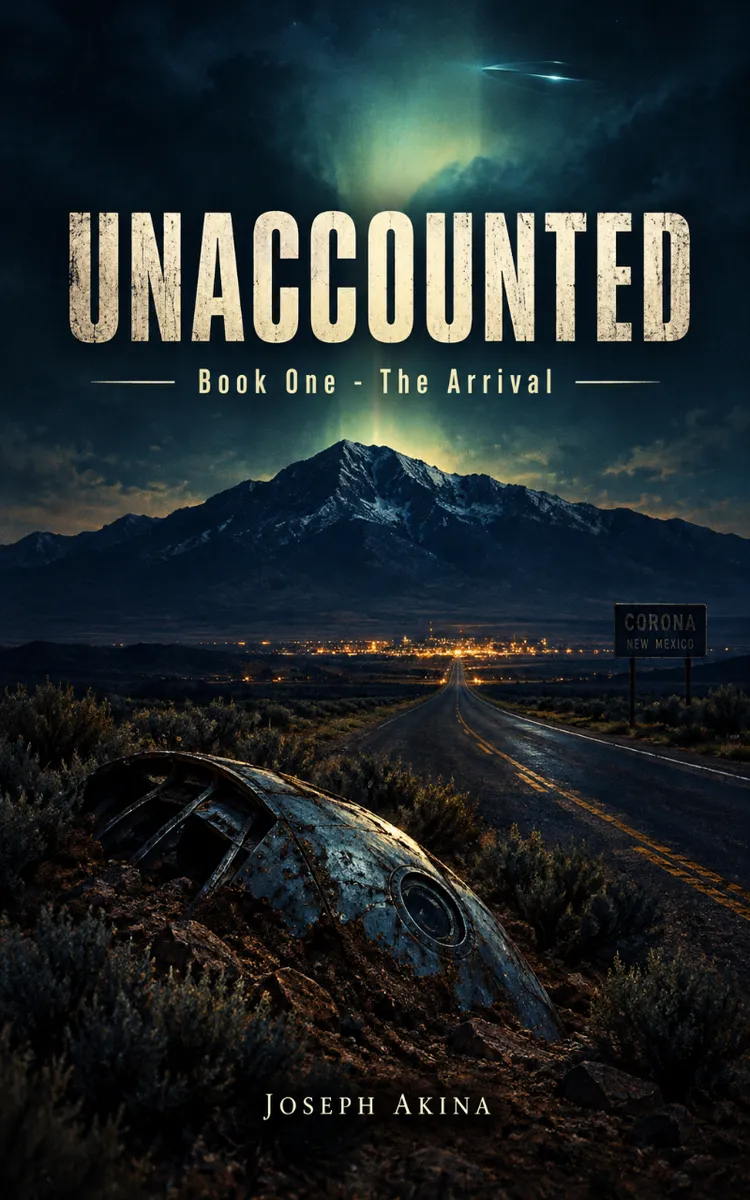

Read the first chapter
The whole of chapter one, free. About 24 min. Turn the pages with the arrows, your keyboard, or a swipe.
Chapter 1
The Western Ridge
It was the absence of birdsong.
Along the western shoulder of Gallinas Peak, the pines had been alive with small, sharp calls only moments before. Wind stirred the upper branches. A scrub jay flickered between patches of shadow. Somewhere down the slope, a woodpecker had been striking a dead trunk with the patient insistence of a carpenter. Then, almost together, the sounds stopped.
The wind remained.
No one stood on the ridge to notice the difference. There was no road leading to that particular shelf of stone, no cabin, no lookout tower, and no fence line to persuade a rancher that he ought to climb so high. Far below, the pale country west of the mountains stretched outward in immense, broken bands. In the east, the slopes descended toward Corona and the scattered ranches that depended on the weather, the railroad, and each season's uncertain bargains.
For several seconds the air above the ridge looked no different from the air anywhere else.
Then the outline of a rock bent.
It was a small disturbance, an error in the landscape that could have been mistaken for heat shimmer if the morning had been warm enough. A white seam slipped across the blue sky. It curved, darkened, and disappeared. The distant horizon folded into an unnatural angle before returning to its proper shape.
Something descended into the space between two battered stands of pine.
It came without thunder. It did not trail fire. The brush below it barely moved.
At the final instant, a shallow bowl of dust lifted from the stone and drifted toward the edge of the ridge. Needles trembled on the nearest branches. The thing touched down with a dull vibration that passed through rock rather than air, and the world became still again.
Had a person approached from below, he might have seen nothing more than a patch of exposed granite, a broken strip of earth, and a few trees shivering in the cold. Yet between those trees rested a vessel long enough to occupy the greater part of the shelf. Its shape could be guessed only by the places where light failed to behave correctly: a displaced shadow, a sliver of mountain appearing half a foot too far to the left, the faintest line along which stone seemed to overlap stone.
Inside the vessel, a single occupant waited.
The ridge had looked suitable from a distance for reasons that became more precise under close examination. Its western face dropped away in shelves. A person climbing from the nearest pass would have to choose between open stone, where a silhouette would show against the sky, and dense trees, where the ground gave every footstep an audible consequence. Neither approach was impossible. Both demanded time. Time was the advantage Zarek needed.
He moved slowly along the outer limit of the concealed vessel, measuring the mountain not as scenery but as a sequence of potential approaches. One narrow runnel held last winter's ice beneath a crust of needles. A rocky ledge ended in a fall steep enough to discourage a careless animal. The southern approach had better footing, which made it more dangerous; anything human attempting to reach the ridge would likely use it. A wind-twisted pine stood alone where the slope broke downward. He fixed its shape in memory, along with every passage between the rocks.
In the ship, the terrain had appeared in layers of elevation and estimated movement. Outside, it acquired weight and resistance. Needles caught against his feet. A stone shifted under the pressure of his step. The scent of resin thickened whenever the wind changed. None of it could be entirely reproduced by a survey taken from above. He had traveled to this world to distinguish what its inhabitants had made from what the world itself demanded of them. The mountain made those demands without negotiation.
At the rim he remained motionless while a bird landed several paces away. It tipped its head and watched him. A creature so small had no way of understanding the difference between the rock it inhabited and the traveler who had crossed an immense distance to stand upon it. Yet it assessed him, judged the distance, and took flight. Its decision was immediate and complete. Zarek made no effort to follow it.
He considered the significance of an observer being observed. A reconnaissance mission did not depend on invisibility alone. It depended on an accurate understanding of what another creature recognized as unusual. A bird noticed motion, perhaps unfamiliar posture, perhaps sound. A person would notice all of those things and afterward begin asking what they meant. In the settlements below, explanations moved from one individual to another. He had already seen evidence of that in the way trails connected dwellings and the way those dwellings gathered along the road. A solitary sighting could become a shared concern without its subject ever moving again.
He crossed to a sheltered gap and found an old length of wire twisted around a tree. It had not grown there. Rust had claimed the exposed portions, but one end was still tied with deliberate turns. Human activity had climbed farther into the mountain than a casual glance suggested. He followed the wire a few yards to where it vanished beneath stones and found a shallow depression packed with ash. A camp, abandoned long enough for rain to scatter its edges. Someone had come here carrying fire, food, and metal. Someone might return.
That discovery altered his initial estimate of the ridge. Remote was not unvisited. Empty was not unclaimed. He looked again at the false granite concealing his vessel, studying the thin boundary that only he could reliably locate. What he had brought must remain separate from what the mountain had always contained. A careless trail worn into the soil, a repeated disturbance in the brush, or an animal frightened from the same place too often could betray a location without anyone seeing the ship.
He took a different route back. He placed his feet on stone where possible, passed through the trees without breaking low branches, and paused at the edge of the landing shelf to let the wind erase the sound of his passage. Nothing pursued him. Nothing called out. Still, he committed himself to using more than one path. The ship could hide its shape; the surrounding earth could not hide every consequence of his presence.
Below him, a thread of road briefly brightened under the sun. Something traveled along it, too far away to identify beyond a moving glint. He watched until it disappeared behind a low rise. The first beings of this world he encountered might not be discovered on the mountain at all. They might arrive in numbers, moving together along those straight scars across the land, certain that every mile had a destination and every destination a name.
Zarek did not move when the landing sequence ended. He watched the ridge through a forward surface that admitted the world without declaring itself a window. Frost clung to shaded cracks in the rocks. The trees here were taller than those on the lower slopes. A dark-winged bird circled above the valley, regained its courage, and crossed the peak without approaching.
The descent had required little correction. The surrounding mountains offered folds of terrain and heights from which he could examine a substantial tract of country. There were signs of a settlement to the east, lines of movement to the south, and the fine, regular scratches on the land that usually indicated sustained habitation. None had been apparent from his final approach as more than markings. At this distance, the people who made them remained invisible.
That suited him.
For a long time he simply studied the light.
A low sun washed the ridgeline in copper. Shadows lengthened across the shelf as clouds passed overhead. Within the vessel, several muted shapes changed their arrangement, responding to measurements he had not yet considered important enough to review. He dismissed them without touching anything visible. The vehicle settled further into silence, its surface taking on the color and texture of the surrounding stone.
It was not painted to resemble rock. The rock itself appeared to continue across it.
Zarek examined the effect from three directions. Where the vessel's curved flank should have interrupted the view of a juniper, the tree remained whole. A ragged stripe of lichen extended seamlessly over a surface the lichen had never touched. The camouflage adjusted as the sun rose another fraction above the eastern slopes.
Acceptable.
He waited until a second bird passed nearby. Then he opened the craft.
There was no hiss, no metallic clatter. A narrow portion of the false landscape drew inward and made a dark threshold. Cold mountain air entered. It carried resin, mineral dust, and the dry sweetness of vegetation that had endured winter. Zarek remained just within the opening and allowed the air to move around him.
The atmosphere was breathable. That had never been the uncertain part of the mission. His task was not to determine whether one of his kind could survive a moment on this world; that could have been answered without landing. He had come to learn whether a population could live here, and what the existing inhabitants would do if it tried.
Such questions could not be resolved from a distance.
He stepped onto the ridge.
His boots met the granite, and for the first time the full weight of the place seemed to rise through him. The world had a density that instruments reduced to numbers without quite explaining. The rock was cold. The thin wind caught at the fabric across his shoulders. Somewhere below him a branch snapped under its own strain and fell, taking smaller twigs with it.
He listened until the last needles stopped falling.
In the shape he wore, he appeared to be a man. There was nothing conspicuous about the arrangement of his limbs or the way his clothes hung on him. His face, reflected briefly in the dark surface of the vessel, was ordinary enough that a stranger might remember his coat before remembering his features. A human observer would have looked twice only because a man had appeared on a lonely mountain without any obvious means of getting there.
When the afternoon cooled, Zarek returned to the ship and studied the country beyond the ridge through the broad viewing surface. The mountain's silhouette lay across a shallow sea of plains. Some distances remained clear; others dissolved in dust. He marked the road to the east, a pair of branching tracks, and the roofs of structures so small they seemed provisional against the surrounding land. Human settlements were rarely placed by chance. Water, transportation, shelter, trade: he searched for the forces that had brought so many separate lives into one location.
The vessel presented a revised survey, bringing the surrounding terrain closer without any visible instrument extending from its concealed shell. He traced the mountain's folds, noted an area where vegetation thinned abruptly, and compared the mapped pathways with what he had seen on foot. Where the survey reported a navigable surface, loose stones made travel slow. Where the survey marked a dense obstacle, animals had opened a narrow corridor. The difference mattered. His equipment described capacity; experience described likelihood.
Far below, a locomotive pulled across the open land. He could not hear it at first. Only the moving line of smoke identified the engine, a dark seam that lengthened and faded beneath the afternoon sky. Its cars followed with unwavering discipline, each one bound to the next. When the sound finally reached him, it arrived as a low vibration punctuated by faint metallic blows. Human beings had learned to make enormous weight follow narrow rails. They had also arranged their daily lives so that the arrival of such a machine meant something predictable.
He watched the train until the hills concealed it. A road offered choice at every turning. Rails offered fewer choices and therefore stronger expectations. If he wished to study people without appearing remarkable, he would need to learn what they expected at each place and hour. A newcomer stepping from a train had a reason to be unfamiliar. A man appearing from a ridge without equipment or explanation did not. The distinction would shape his earliest attempts at contact.
He turned his attention to the valley after sunset. Lights appeared in scattered homes, then a cluster near the settlement. Their appearance did not follow a single pattern; one brightened while another went out. The rhythm suggested work ending at different hours, meals prepared in separate kitchens, people settling into habits that belonged only to them. From above, those lights could be counted. From inside any one room, the night would have another meaning entirely.
A remote vibration passed through the vessel, so slight that it could have been mistaken for wind pressing the hull. Zarek examined its source. It was not a malfunction. The mountain itself had shifted at a scale that scarcely affected the rocks around him. He observed the measurement, recorded it, and allowed the vessel to quiet again. A planet that appeared still to its inhabitants was never entirely still. The people below built homes, roads, and institutions on moving ground and called it permanence.
He did not find the thought amusing. It was an indication of how resilient their constructions had become. The settlements persisted despite storms, cold, distance, and the fragility of the bodies occupying them. Such persistence was precisely why Earth deserved closer study. Survival had become organization. Organization had become custom. Custom made each person depend on strangers they would never meet.
He made no further movement toward the town that night. The purpose of reconnaissance was not to arrive quickly. It was to arrive without altering what one intended to observe. He would learn first how the people entered the mountains, what they carried, and how they returned. There would be opportunities to descend. For now the western ridge remained the only place on Earth where he knew every nearby sound and could recognize a new one before it reached him.
That was a problem easily solved by not being observed.
Zarek turned west.
Below the ridge, the country opened in mile after mile of pale, rumpled land. Hills softened into broad plains. Dry channels traced paths between outcrops; narrow stands of trees followed water hidden below the surface. Far away, a line on the earth ran straighter than any stream. It might be a road or a track. He marked its direction and returned his attention to the nearer slopes.
He had selected this landing place because it offered room for the vessel and an outward view. On the ground, he discovered reasons to remain that no distant survey could have supplied. Fallen trunks lay where they had come to rest years earlier. Loose stone had accumulated in natural breaks. Human passage, if there had been any, left no recent pattern he could recognize. The ridge was exposed, but the approaches were difficult and the camouflage did not depend on concealment by brush.
He could stand in the open and not be alone.
A gray animal moved between the pines to his left. He heard it before he saw it: a deliberate tread, a pause, another tread. When it emerged, narrow-faced and wary, it stopped at the edge of a patch of sunlight and stared in his direction. Its ears turned independently toward distant sounds.
Zarek remained motionless.
The animal looked toward the vessel. Its gaze traveled across the stone where the hull rested. For an instant its body tightened, as though one of its senses had detected a contradiction the others could not locate. Then it stepped away, found a track descending between the trees, and vanished.
He added the encounter to his observations.
Concealment did not mean the same thing to every living creature.
Near midnight a distant light appeared on the road and moved slowly along the base of the mountain. It stopped at a fork and remained stationary long enough that Zarek wondered whether the vehicle had failed. Another light came toward it. The two met, paused, and separated, one proceeding uphill, the other returning along the plain. To an observer who understood nothing of their arrangements, the pattern might have suggested an exchange or inspection. To the people in the vehicles, it could have been nothing more than directions asked and given.
Zarek registered both possibilities. He had come with a mission that required decisions about an entire inhabited world, yet those decisions would be built from scenes as small as two machines stopped beneath a dark sky. He did not trust a conclusion reached too soon. Some of the records available before his journey described humanity as inventive and violent, cooperative and territorial, capable of astonishing patience and sudden destruction. The categories were so broad as to be nearly useless. He needed to learn what people did when no one expected them to be important.
For an hour he studied the lights of distant dwellings. One remained burning long after the others faded. Another flashed twice, went dark, and returned. He thought of people crossing rooms and speaking to each other, of work unfinished, of sickness, of reading, of all the activities that might explain a lamp's endurance. Without knowing the reason he could only observe the fact. He discovered he did not resent that limitation. It gave shape to the work ahead.
The first cold entered the air before dawn. Zarek stood with his back to the concealed vessel and watched a thin line of light creep along the eastern edge of the mountains. Nothing about the valley declared itself extraordinary. Ordinary activity was precisely what interested him. A world suitable for settlement was not merely a place where bodies could survive. It was a place already full of intentions. Those intentions would have to be understood before anyone could decide what it meant to arrive among them.
Behind him the camouflaged hull remained invisible except at the brief moment when a gust set the nearby pine branches moving and the false landscape required a correction. Zarek saw the adjustment. A person ten steps away might not have. He wondered whether an observer determined to find an impossibility could learn to recognize the slight mistake. The question would stay with him long after he left this ridge.
He walked the full length of the ridge and tested the slopes below it. There was an easy descent to the north for a creature willing to move carefully among broken rocks, and a more gradual route south through trees and grass. Westward, the mountain dropped away too sharply for routine travel. The eastern approach was longer and exposed at several points, but it eventually connected with lower country where a traveler might pass without attracting notice.
That would matter later.
By midday he had mapped the nearby terrain as thoroughly as he needed. He returned to the landing shelf and stood beside the place where the vessel should have been. The air above it was cool and clear. His eyes found the seam because he knew where to look. He reached forward, and an unseen surface yielded beneath his palm.
For a few moments he remained there, one hand resting on a craft that seemed to consist of empty mountain air.
A sound came from below.
He withdrew his hand.
It was not the sharp movement of an animal. The noise repeated at a regular interval, traveled a short distance, paused, and began again. Metal striking metal, softened by trees and distance. A human-made rhythm.
The ridge offered no welcome in the human sense. It did not ask who he was, what he had brought, or why he had come. Zarek valued its indifference. It gave him time to decide which questions mattered before anyone below thought to ask them of him.
Zarek stepped to the ridge's southern edge.
The source lay too low to see. He listened. The strikes resumed, followed by a rough human voice carried in fragments on the wind. Another voice answered. Then came a thin, brief whinny.
Horses, he thought, reviewing one of the countless forms of life he had studied before his arrival. Or their close domestic equivalents here. Humans were nearby, and they had brought tools.
He did not go to them.
Even the weather required interpretation. A cloud could mean shade for the ridge and rain for the valleys beyond, or nothing at all. He watched its shadow cross the country in stages, darkening one slope and revealing another. The settlements below appeared and disappeared within that traveling pattern, though none had physically moved. Human witnesses, he thought, must often disagree about the same event simply because each had stood beneath a different portion of the sky. Perspective was not always deception. Sometimes it was only position.
A hawk turned above the ridge and settled on a branch from which it could command the valley. It remained still so long that Zarek wondered whether it watched a specific creature or merely waited for motion. Then it dropped suddenly beyond the trees, wings narrowing, and rose again with nothing visible in its talons. Observation did not guarantee success. The hawk returned to its perch and continued watching. Zarek recognized the discipline.
When the first distant vehicle began climbing a road toward the mountain, he watched it without leaving his position. The driver could be seeking pasture, a campsite, or passage to another settlement. There was no reason to place himself in the vehicle's path. He noted the time, the route, and the sound of its engine. If it returned by the same road, it would tell him something about how long its business required. If it did not, another route existed that he had not yet identified. Either outcome would add to the survey.
Instead, he shifted behind a boulder and watched the valley until the voices moved away. They did not climb. They did not turn toward his ridge. He learned nothing of the words they had spoken; distance had broken them beyond useful recognition. But their presence changed the mountain. It was no longer a place without witnesses. It was a place where witnesses could arrive.
The distinction was important.
He returned to the vessel and instructed it to remain concealed. He did not leave the ridge immediately. There were still too many unknowns, and haste would turn those unknowns into unnecessary risks.
He spent the afternoon gathering small observations.
The light changed more quickly when clouds crossed the peak than it had from above the atmosphere. A squirrel traveled the same branch three times, stopping each time to inspect a point he could not see. The exposed rock warmed in the sunlight and cooled rapidly when a shadow covered it. A faint haze accumulated over the distant lowlands. Once, from far beyond the southern hills, he heard a noise that might have been an engine.
He was especially interested in the ways the land bore marks of use. Trails formed where feet repeatedly found the easiest route. Trees had been cut in one distant patch, leaving straight edges unlike the shattered remains of storm damage. When he raised his attention toward the east, he could make out the suggestion of roofs among the country beyond the nearest folds.
Corona.
The name was one of several human labels attached to this region in the information he had collected. A settlement, small enough that its people might know when a stranger arrived. Such places were useful for observation but poor places to improvise an identity. A city allowed anonymity through numbers. A village made anonymity depend upon patience.
He could be patient.
Near evening, the breeze shifted to the east. Smoke reached him in a faint trace, not from a forest fire but from controlled combustion far below. He followed its path with his eyes until he found a thread rising above a dark patch of trees. Someone was cooking, heating a building, burning waste, or doing one of the other things humans did with fire. The possibilities were ordinary. He recorded them anyway.
He had traveled a great distance to stand on a mountain and watch smoke.
The thought did not trouble him. The scale of a journey did not decide the value of its smallest observations. Understanding a world required noticing what its inhabitants considered too familiar to explain.
When the sun began to disappear, the colors changed with surprising violence. The west turned gold, then orange, then a deep red that seemed to hang behind the distant hills. The shadows between the trees became almost black. The exposed crown of Gallinas Peak caught the last light while the lower slopes were already swallowed by evening.
Zarek remained on the ridge.
An aircraft appeared far to the southwest.
At first it was no more than an insect-sized interruption against the bright distance. It advanced slowly, its line of flight steady. A faint mechanical drone reached the mountain only after he had watched it for some time. He tracked it without moving his head. The machine's movement differed from that of the birds; its corrections were deliberate and angular, and its course ignored the contours of the land.
A human aircraft. Crude by the standards of the vessel beside him, but entirely capable of carrying people across the country and seeing what they should not see.
He studied its silhouette until it became indistinct.
The aircraft continued past. It neither circled nor descended. Long before its sound faded, the scout vessel had shifted its camouflage to match the darkening ridge.
He looked back toward the western sky.
The people of this world could fly. They could move heavy machines across immense stretches of land. They could shape the earth and communicate beyond the distance of a voice. They also seemed remarkably occupied with making one another afraid.
Reports gathered before his arrival had been filled with accounts of a war spanning continents and oceans. The conflict had not ended. Its machinery had grown larger and its losses had grown difficult to count. Zarek knew these facts, but they remained facts assembled from signals, images, and records. A living civilization was more than the worst things it reported about itself. He had come to distinguish what humans did from what humans might be capable of doing.
He could not accomplish that from the ridge alone.
Night arrived without ceremony.
The stars emerged one by one, then in multitudes. In the cold, thin air they looked near enough to touch. Zarek recognized portions of the sky by angles and distances rather than by the names human observers had assigned to them. He knew where he had come from. He did not look for it for very long.
A coyote called below the peak. Another answered farther off. Their voices carried cleanly through the dark, followed by a silence deeper than the one that had greeted his arrival.
He returned to the vessel.
At his approach the entrance opened in a narrow fold of darkness. Inside, subdued light revealed a space built for one occupant and little else. There was a place to rest, surfaces arranged around his reach, and sealed compartments whose contents would not be needed unless the mission changed. He had brought enough to remain independent for a time. That was not the same as being able to live here indefinitely.
He reviewed the records of the day.
Atmospheric readings. Temperature gradients. Biological movement. The evidence of human roads, settlement, tools, domestic animals, and aircraft. He noted the voices below the ridge and the animal's hesitation near the disguised hull. Each observation was modest. Together they formed a beginning.
He considered the next stage.
The surrounding country offered routes to the settlement. He would need clothing appropriate to local custom, a plausible account of his arrival, and a reason for remaining near the town that did not invite questions. He could study these matters before approaching anyone. The desire to begin immediately was not a good reason to do so.
He suspended the review and returned to the entrance.
The wind had strengthened. Pine branches rubbed together with a low, almost conversational sound. Far below, one isolated light shone for a little while and then disappeared. Another remained steady to the east. Someone was still awake in the country beneath him.
For the first time since landing, he imagined what it would mean to stand among those lights. A room with other voices in it. A question directed at him. The need to answer quickly, as though he had been born here and had a life that reached backward through the years.
He had prepared for the mechanics of such encounters. He had not yet measured their cost.
Zarek closed the vessel and returned to the stone shelf outside. The camouflage resumed, making the entrance disappear so completely that even he could see only a tiny, deliberate wrongness in the starlight.
Then, at the eastern edge of the ridge, a second sound rose from the valley.
An engine.
This one was much closer than the aircraft had been. It struggled, dropped into a lower register, and caught again. Two white lamps appeared on a distant track, advancing slowly between dark folds of country. The vehicle stopped. Its lights remained fixed on a patch of earth. A door slammed, faint but unmistakable. A human voice carried upward on the wind.
Zarek crouched in the shadow of a boulder and watched.
The lights went out.
For a long time, nothing moved.
He did not know who had come into the hills or why a traveler would stop there after dark. There were many innocent explanations. In a place this large, coincidence was inevitable. Yet the two voices he had heard during the afternoon had come from somewhere below that same slope, and the vehicle had halted near the route they might have taken.
A single fact did not become a pattern because it was interesting.
He waited.
One light came on again, briefly, then vanished. The engine started. The vehicle turned until its lamps swept across a section of hillside far below him, and began retracing its path.
No one approached the ridge.
Eventually the sound faded.
Zarek remained where he was long after it had gone. He kept his gaze on the dark valley and measured the distance between the place where the vehicle had stopped and the lowest practicable ascent toward the peak. It was close enough to merit attention. Not close enough to justify action.
He rose and moved back to the concealed ship.
The valley was quiet now, except for wind and the distant animals calling from the trees. To a human standing on that ridge, there would have been no sign that anything unusual had occurred. No scar in the ground. No wreckage. No strange light to follow. Only a mountain, an open sky, and the scattered lamps of ordinary lives below.
That was how Zarek intended to keep it.
At the threshold he paused, listening once more toward the east.
Tomorrow he would begin learning how to become one of them.
Tonight, he would remain unaccounted for.
End of chapter one. 11 more chapters and about 86,084 words in the full book.
Swipe or use the arrows to turn the page


What's inside: 12 chapters
- 1. The Western Ridge
- 2. A Stranger to This World
- 3. Beneath the Gallinas
- 4. The Quiet Observer
- 5. The Things People Say
- 6. Forty-Five Seconds
- 7. The Weight of Ordinary Things
- 8. The High Country
- 9. A Man Called Zach
- 10. Blood on the Ridge
- 11. A Room Among Strangers
- 12. The Light Before Dawn
About this book
"UNACCOUNTED" is a fiction book by Joseph Akina with 12 chapters and approximately 86,084 words. It covers key insights and practical takeaways on the topic.
This book was created using Inkfluence AI, an AI-powered book generation platform that helps authors write, design, and publish complete books. It was made with the AI Novel Writer.
Frequently Asked Questions
What is "UNACCOUNTED" about?
"UNACCOUNTED" is a fiction book by Joseph Akina covering key insights and practical takeaways on the topic.
How many chapters are in "UNACCOUNTED"?
The book contains 12 chapters and approximately 86,084 words. Topics covered include The Western Ridge, A Stranger to This World, Beneath the Gallinas, The Quiet Observer, and more.
Who wrote "UNACCOUNTED"?
This book was written by Joseph Akina and created using Inkfluence AI, an AI book generation platform that helps authors write, design, and publish books.
How can I create a similar fiction book?
You can create your own fiction book using Inkfluence AI. Describe your idea, choose your style, and the AI writes the full book for you. It's free to start.
Write your own fiction book with AI
Describe your idea and Inkfluence writes the whole thing. Free to start.
Start writingCreated with Inkfluence AI


