

Read chapter 2
The whole of chapter two, free. About 16 min. Turn the pages with the arrows, your keyboard, or a swipe.
Chapter 2
Sound Beneath the Water
Tomari, Sakhalin Island — November 6, 2018
There were sounds that a man learned to live inside.
Yuri Kaidanovsky had spent most of his life inside the noise of machinery: the chatter of pneumatic tools, the heavy breath of pumps, the voice of pressure passing through steel. At seventeen he had listened to the gearboxes of armored vehicles in a workshop outside Khabarovsk. At thirty he had slept beside a generator whose uneven rhythm told him when the fuel filters needed changing. At sixty he could stand beneath Cherno Alpha's left knee and identify a failing hydraulic coupling before the maintenance instruments admitted anything was wrong.
He had never liked the silence that followed a machine stopping.
On the morning Raythe came ashore, the silence arrived first.
The harbor lights went out one section at a time. The road above the docks disappeared behind a low wall of snow moving east from the water. Inside Forward Defense Station Four, Yuri watched an old cathode-ray monitor brighten and dim as the electrical supply faltered. Someone cursed in the radio room. Someone else asked whether the outage was part of the scheduled load shedding.
Yuri put down his cup of tea.
"Not scheduled," he said.
The young lieutenant beside the console looked at him. "How can you be certain, Chief?"
"Because I would have signed it."
Officially Yuri was a chief master sergeant assigned to the Pan Pacific Defense Corps' Russian maintenance establishment. The title sounded grander than the work. At the Vladivostok Shatterdome, where he supervised sections of Cherno Alpha's maintenance team, nobody addressed him by the full designation unless they wanted a favor or expected a reprimand. Men twice the rank of the young lieutenant came to Yuri when a part seized, a pressure line stuttered, or the vast Mark-1 Jaeger refused to acknowledge that its own diagnostics could be wrong.
For the past two days he had been on Sakhalin, inspecting auxiliary defense grids and validating an emergency evacuation plan. Cherno Alpha had been airlifted toward Kamchatka, where official forecasts predicted Raythe's landfall. The creature abruptly reversed course. Redeploying an eighty-five-meter Jaeger required helicopters, fuel, and time; none could be summoned on demand.
The timing was bad enough to feel deliberate.
A chime sounded from the threat receiver. It was a modest tone, absurdly gentle for the information it carried. A young signals operator leaned toward the screen.
"Unknown mass, northwest approach. Offshore. Sonar contact from the picket station." He swallowed. "The displacement is... that can't be right."
The lieutenant stepped forward. "Classification?"
"Pending. We only have a partial profile."
Yuri heard a second sound beneath the voices: a low metallic shiver traveling through the floor. He looked toward the harbor windows. In the distance, derricks hung over gray water like frozen skeletons. Nothing moved beyond the shoreline except fog.
"Get me Vladivostok," he said. "Direct maintenance command, not the public relay."
The lieutenant started to object. Yuri held up one grease-darkened hand.
"Now."
The first alert arrived on every speaker at once. The voice was clipped and automatic, repeating a phrase so familiar that it had lost some of its meaning on ordinary days.
KAIJU WARNING. COASTAL SECTORS, INITIATE EVACUATION.
There was no ordinary day after that.
Outside, the station's security staff opened the service gates. Trucks carrying dockworkers and families began turning south toward the inland road. An elderly woman with a white shopping bag walked faster than the people around her; the bag split and oranges rolled across the snow. A soldier jumped down from a vehicle, gathered them without waiting for thanks, and ushered her onto a bus.
Yuri watched for a moment too long.
"What is Cherno's status?" he asked.
The lieutenant relayed the question. Static scratched the line. Finally came an answer from Vladivostok: Cherno stood northeast, its carrier aircraft diverted to Okha for fuel, awaiting new intercept coordinates.
He knew the language. It meant no one could promise anything.
"Tell them I need the machine," he said. "Tell them I know what the delay means."
"And if they say no?"
"Then tell them to hurry."
The thing in the sea rose without drama. At first it was only a broad dark ridge moving between the harbor breakwaters, like a strip of land that had come loose from the coast. Then a neck unfolded upward, too long and strangely jointed, supporting a head ringed with bony growths. Water fell from armored plates. What Yuri first mistook for a chain of submerged rocks shifted beneath the surface, revealing a body larger than the largest industrial vessel in the bay.
Raythe.
Nobody at Station Four knew the name yet. It would be assigned later from a growing catalog of horrors, entered in the PPDC's records alongside its category, dimensions, and death toll. On that morning it was simply something the human mind refused to measure.
The coastal batteries began firing.
Their opening barrage struck the water short of the creature, sending white columns upward. The second found its shoulder. Raythe twisted, emitting a sound that pressed against the windows and passed directly through Yuri's teeth. A steel locker opened by itself. One of the radio operators screamed and covered his ears.
The lieutenant turned pale. "We're not holding it."
"Nobody asked us to hold it," Yuri replied. "We're buying road time."
He took the paper evacuation chart from the wall and put it on the console. There were six roads out of Tomari, but only two could carry heavy civilian traffic. The northern route passed beneath an elevated fuel pipe. The southern road crossed a shallow river where ice would make braking difficult. He marked the western approach with his thumb.
"Keep those batteries alive until the third convoy clears here. Then move every person you can."
"What about you?"
Yuri did not answer immediately. He was thinking of a boy of eleven sitting on a kitchen floor, stripping a seized bearing apart with his father's tools. The boy had been Nikolai, furious because the machine would not yield. Yuri had told him the steel was not an enemy. Force mattered, but knowing where to place it mattered more.
A younger boy, Viktor, had watched without speaking, then pointed to a narrow retaining clip nobody else had noticed.
"The grid needs someone who understands the bypass," Yuri said at last.
"I can learn."
"Not today."
A shell detonated outside, shattering the upper windows. The room filled with white dust and salt wind. Somewhere a secondary cable ignited, giving off the bitter smell of burning insulation.
Yuri rolled up his sleeves.
In his life he had become many things: a conscript, a mechanic, a father, a widower, a soldier serving a country that no longer existed under its old name. But beneath every uniform was the same conviction. Machinery had one obligation. It was supposed to work when somebody needed it.
The harbor shook again.
He opened the cabinet beneath the main console and reached toward the emergency transfer panel.
Beyond the windows the creature turned inland, and the defense station's warning siren climbed into a steady, unbearable scream.
The emergency transfer panel had been built for a smaller war.
Its switches were thick, ridged things with numbers worn smooth by decades of gloved hands. Newer PPDC control systems occupied the room above it, digital screens layered over Soviet wiring that nobody had been paid enough to remove. Yuri knew both generations. In Vladivostok he often joked that Cherno Alpha survived because old machinery refused to be embarrassed by new machinery, and new machinery was too expensive to admit when it needed the old.
He had no patience for jokes now.
"Main relay is cooking," said Lieutenant Sokolov. He was kneeling by the floor grille, flashlight clenched between his teeth. "There's smoke in the conduit."
"Then stop feeding the main relay." Yuri pulled an emergency diagram from a cracked plastic sleeve. "We need the southern battery on the auxiliary loop."
"That loop feeds the hospital."
"Hospital has generators. Battery doesn't. Ask them to confirm they have switched." Yuri looked toward the radio operator. "Ask, don't assume."
The young woman at the radio desk sent the call twice before a trembling voice replied that hospital power was stable. Yuri waited for the full confirmation, then moved a heavy switch. The station lights died and came back amber. Farther along the coast, a battery that had fallen silent resumed firing.
The creature struck a warehouse with its shoulder. An entire face of concrete folded inward. It moved with a horrifying lack of haste, as though the town existed only as debris placed carelessly in its path. Its elongated neck dipped; a loading crane vanished between armored plates and jaws. The sound that followed was not an explosion but the twisting complaint of steel under more force than it had ever been designed to bear.
Sokolov backed away from the windows. "My wife is on the south road."
"Then help keep the guns working." Yuri checked the resistance numbers. "Every minute you give her is a minute she can use."
His own sons were far away. Nikolai might already be airborne or beyond reach on another assignment that would never appear in a public record. Viktor would be inside a guarded technical facility, surrounded by people who trusted numbers more readily than intuition. Neither knew that their father was at Station Four. They believed he was inspecting a coastal auxiliary site, a routine task he had dismissed over a hurried call the previous evening.
He had wanted to ask how they were sleeping. Instead he had told them to eat properly.
A dispatcher cut through the radio traffic. The final buses from the hospital were joining the southern road. Two more civilian convoys remained trapped at the docks behind abandoned freight vehicles. Engineers were trying to clear the route.
"Give me fifteen minutes," Yuri said.
"We have eight," Sokolov answered, looking toward the shattered windows.
"Then you will work faster than you thought possible."
A boom rolled up from the breakwater. One of the guns had fired too close to a fuel line. Orange flame flashed across the water, briefly outlining the Kaiju's head and the deep folds beneath its armor. It recoiled, then lunged forward, dragging the flaming remains of a ship toward the nearest line of buildings.
The lieutenant staggered as the ground shifted. "Why isn't Cherno here?"
"Because you cannot fly a machine the size of an apartment block across an ocean without aircraft and fuel," Yuri said. "They sent Cherno where Raythe was supposed to go. Raythe changed its mind." He turned to the relay board. "And because we have what we have."
A new crack opened in the ceiling. Dust poured down like dry snow. Sokolov called for evacuation. The radio operator began packing documents into a canvas sack.
Yuri said, "Take them."
Sokolov looked at him. "You too."
"The coast battery is still operating."
"I can leave someone—"
"No." Yuri softened his voice. "Lieutenant, you can lead people out of here. I can't do that and hold this grid together. Take the operator. Take everyone."
A painful silence followed. Sokolov had spent enough time in uniform to recognize an order he hated.
"You're not required to stay."
Yuri smiled without pleasure. "And you are not required to argue."
The men left one after another. The radio operator hesitated at the door, looking at the red status lights fluttering along the console. Yuri gave her the same nod he had used with junior mechanics in the Cherno bay. Go. There is work waiting for you somewhere else.
When he was alone, the station felt larger and older. Rain blew through the broken panes, speckling the papers on the desk. The low notes of Raythe's call carried through the damaged building like pressure inside a ship's hull.
Yuri lifted the receiver. "Station Four to Southern Battery. Manual support engaged. Tell me when the last convoy crosses Marker Twelve."
A man's voice answered amid gunfire. "Copy, Four. We have movement near the fuel depot. Can you maintain feed?"
"I can maintain it until you tell me not to."
The batteries fired in staggered succession. Yuri watched their demand pull against the damaged feeder. Every successful salvo pushed the temperature gauges higher. He removed his jacket and rolled it beneath the door to keep spray out of the lower cable tray. He opened the emergency water line, letting cold harbor water hiss through a heat exchanger that had not seen maintenance in six years. The flow was inadequate. He adjusted it until the needle stopped climbing.
A sound came from the western wall. Three hard knocks, spaced several seconds apart.
For a moment he imagined Nikolai at thirteen, banging on the workshop door because he had broken another tool and wanted to confess before his father found out. The boy always knocked harder when frightened. Viktor never knocked at all; he entered quietly, already carrying an explanation.
The western wall knocked again.
Concrete split.
Yuri raised the receiver once more. "Station Four to Southern Battery. Status of the last convoy?"
Static, then a voice: "They've cleared Marker Twelve. All civilian vehicles accounted for. Sergeant Major, the coastal guns are still—"
"Good," Yuri said.
He switched the circuit into its final emergency hold, a configuration intended to preserve the batteries if the local control room failed. He knew it could sustain the output only briefly. Briefly was enough.
The glass wall blew inward. He heard the sound a moment after seeing the world beyond it disintegrate. A black mass passed above the building, blotting out the sky. Support beams snapped in sequence as pressure traveled down through the roof. The desk lifted from its bolts. Yuri placed one hand on the relay handle and braced himself against the panel.
He thought of his sons not as soldiers but as children. Nikolai racing a battered bicycle over spring mud. Viktor falling asleep with a mathematics book open across his chest. Their faces at their mother's funeral, each trying unsuccessfully to become the stronger one for the other.
Then he thought of Cherno Alpha waiting on a distant coast, its enormous hands unable to reach Tomari in time.
"Hold," he told the circuit.
The western wall collapsed.
Minutes later, the battery on the southern headland fired its last salvo before the emergency reserve emptied. The evacuation convoy was already over the ridge.
Much later, when Cherno Alpha finally engaged Raythe in the waters beyond Sakhalin, no one on the command net knew exactly how many people had escaped because Station Four had continued functioning. The counts would be revised again and again. None of the revisions would bring Yuri back.
His last confirmed transmission entered the PPDC archive as a fragment of ordinary maintenance speech: Feed stable. Continue firing.
Nikolai learned that his father had died from a message consisting of eleven words.
He received it in a military transit hangar beneath sodium lights that turned every face yellow. His team was waiting for transport orders, their gear stacked beside a row of heated trucks. Outside, a fine powder of snow swept across the runway. A communications sergeant approached with a sealed terminal, handed it to Nikolai, and stepped away before he could ask what the message concerned.
Yuri Kaidanovsky. PPDC. Confirmed deceased, Tomari incident. Further details pending.
Nikolai read it three times. His mind refused to connect the words. His father was not a man who died. He was a man who corrected people when they used that kind of language. A man who returned from winter exercises with frost in his beard and accused everyone at home of being too comfortable. A man whose hands had carried the scents of machine oil and cheap black tea for so long that Nikolai associated those smells with safety.
Someone behind him laughed at a joke unrelated to the message. Nikolai turned so sharply the man stopped laughing.
His superior, Major Grachev, took one look at him and ordered the others away. "What's happened?"
Nikolai handed over the terminal. Grachev read it without moving his mouth. He was a compact man with a face weathered by operations that had never received commendations. Nikolai trusted him as far as a man could trust anyone who signed orders for work nobody would acknowledge later.
"You're on compassionate leave," Grachev said. "Effective now."
"I want to go to Tomari."
"You'll go wherever the recovery authority allows."
"I said Tomari."
"I heard you."
Grachev lowered his voice. "Captain. You are not the only son who lost a father today. Don't make me remind you what discipline means."
Nikolai looked across the hangar. The rows of equipment cases, the men shifting from foot to foot, the trucks whose engines continued running against the cold: it all seemed obscene. The world had chosen to remain functional.
"Send someone else on the operation," he said.
"Already done."
He almost thanked the major. Instead he said, "I need to find my brother."
Viktor received the news in a room with no windows.
There were eight screens on the wall, each showing a separate slice of the Pacific defense network. The General Staff's Technical Intelligence Division had access to reconnaissance feeds, procurement records, threat assessments, and the classified engineering reports that official briefings simplified into colored graphs. Viktor had spent the morning cross-checking reactor stress models from two separate PPDC facilities. He had been awake for thirty-one hours, and he distrusted his own arithmetic enough to make another pass.
A warning appeared on one screen: TOMARI — CASUALTY UPDATE.
He expanded the report. There were hundreds of provisional names, most associated with evacuation zones, hospitals, and port facilities. In the section marked Forward Defense Station Four, he found his father's name. A second line identified the station as structurally destroyed. A third indicated that all personnel remaining inside were presumed dead.
Viktor did not move for nearly a minute. Then he opened the sensor archive.
He examined the timestamps of Raythe's changing approach, Cherno Alpha's deployment and helicopter-refueling logs, the coastal battery power traces, and the evacuation corridor. He did not look at photographs. He looked at data, because data had always been the one thing in his life that could be rearranged until it made sense.
It did not make sense.
A warning flashed when he requested deeper access to the Cherno Alpha readiness log. He supplied his credentials. The request failed. He tried the emergency coordination channel and received the same answer.
The second denial irritated him more than it should have. He was not attempting to steal secrets. He wanted to know why his father had been standing at a forward station while the machine he maintained was unavailable. He wanted to know who made the deployment decisions. He wanted the sequence of events, because a sequence was something he could hold in his head without coming apart.
His supervisor entered quietly. Colonel Morozova wore no visible expression as she approached his workstation.
"Viktor. You need to go home."
"This readiness entry is restricted."
"I know."
"My father was at the site."
"I know that as well."
He turned toward her. "Then you'll understand why I require the complete record."
Morozova closed the file with a command from her own terminal. "I understand why you think you do. That is different."
"We lost a coastal grid for want of a functioning relay. Cherno was unavailable. There will be a complete review."
"There will be several reviews. You are not assigned to them."
"I'm assigned to technical intelligence."
"And your judgment is compromised."
He rose so abruptly the chair rolled against the rear console. For the first time in years, his voice became loud enough to turn heads in another section of the room.
"Compromised by what? By wanting facts?"
Morozova did not raise her voice. "By having your father in that casualty list."
The accusation was undeniable. That made it unbearable.
She escorted him to the outer corridor herself. Before leaving, she said, "You are one of the brightest people this division has ever employed. Don't let one terrible day persuade you that the world can be repaired by solving every number in it."
Viktor listened without responding.
Two hours later Nikolai called him from a military airfield. For a long time neither knew what to say.
"Have you spoken to the recovery teams?" Nikolai asked.
"They are still clearing the station."
"Was he alone?"
"Near the end."
Nikolai's breath rasped through the connection. "Why?"
Viktor looked at the closed door to his apartment, at the gloves lying on a chair where he'd left them the previous morning. "Because he believed the people on the road mattered more than the people giving orders."
"I'm coming."
"I know."
They met at the airport in Yuzhno-Sakhalinsk the following evening. Nikolai arrived carrying a military bag and the kind of stillness that made strangers move aside. Viktor was waiting near a vending machine, dark circles beneath his eyes, wearing a coat too thin for the weather.
Neither embraced at first.
Nikolai looked at his brother, saw something fragile behind the habitual calculation, and crossed the gap between them. Their arms locked together. Viktor's shoulders shook once. Nikolai held him until the trembling stopped.
In the days that followed they would discover the difference between a confirmed death and a recovered body, between an official report and a complete account, between being told that someone had been brave and understanding what that bravery had cost.
For that moment, the two brothers stood in a public terminal while travelers moved around them with suitcases, children, and ordinary destinations.
Nikolai did not cry. He could not make his body perform the action.
Viktor did, once, silently, against his brother's shoulder.
End of chapter two. 33 more chapters and about 95,423 words in the full book.
Swipe or use the arrows to turn the page


What's inside: 35 chapters
- 1. ACT I: The Ash of Tomari
- 2. Sound Beneath the Water
- 3. Contours of Grief
- 4. Half-Truths
- 5. Price of Desertion
- 6. Cold Storage
- 7. Beneath the Tundra
- 8. Name without Witness
- 9. ACT II: Iron in the Permafrost
- 10. Where Steel Should Stand
- 11. North Gantry
- 12. The Machinery of Absence
- 13. Unpiloted Test
- 14. Three Minds, Two Pilots
- 15. Standing
- 16. Signal in the Chukchi
- 17. Icebreaker
- 18. The Price of Keeping Silent
- 19. The News from Alaska
- 20. Where Yuri Stood
- 21. Blade Trial
- 22. Fire Against the Current
- 23. No Flag in the Water
- 24. ACT III: Ghost Echoes
- 25. Visitor at the Gate
- 26. People Aboard the Oriole
- 27. Faulty Forecast
- 28. Light Where None Belongs
- 29. Narrow Passage
- 30. The Rabbit Hole
- 31. No Longer Invisible
- 32. Long Way Home
- 33. Handshake from Nowhere
- 34. Following the Freight
- 35. The Line Beneath the Island
About this book
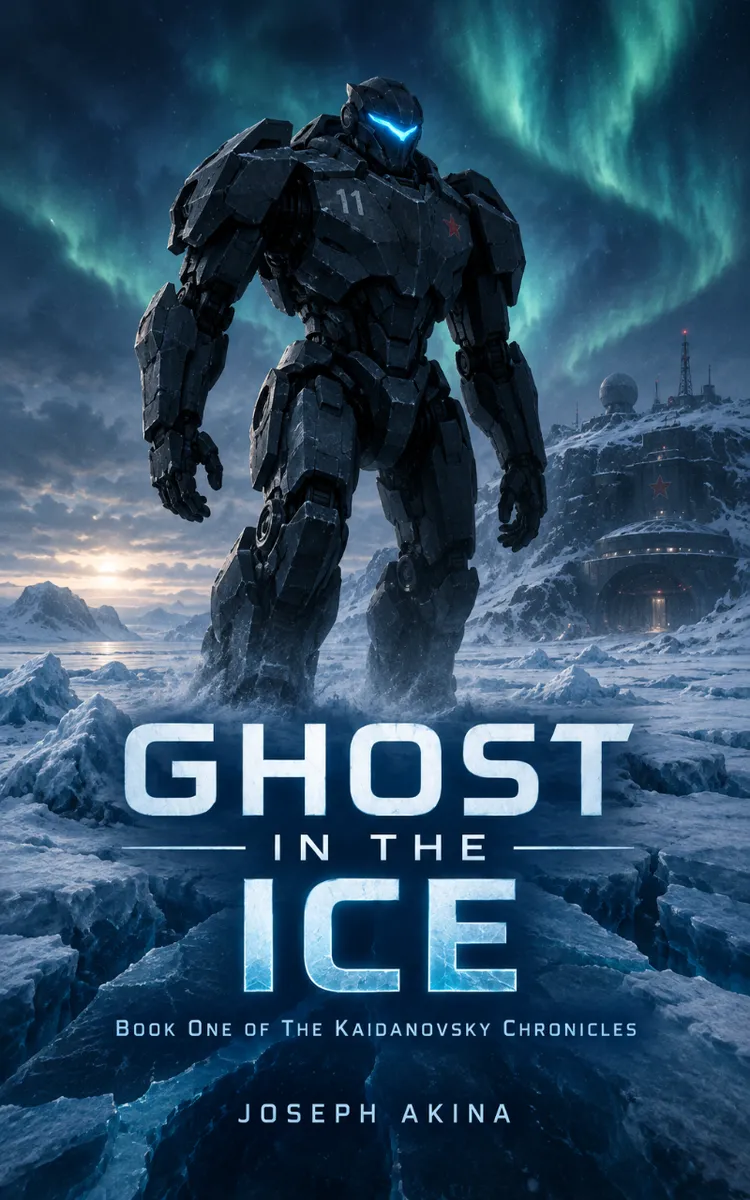
"Ghost in the Ice" is a fiction book by Joseph Akina with 35 chapters and approximately 95,423 words. It covers key insights and practical takeaways on the topic.
This book was created using Inkfluence AI, an AI-powered book generation platform that helps authors write, design, and publish complete books. It was made with the AI Novel Writer.
Frequently Asked Questions
What is "Ghost in the Ice" about?
"Ghost in the Ice" is a fiction book by Joseph Akina covering key insights and practical takeaways on the topic.
How many chapters are in "Ghost in the Ice"?
The book contains 35 chapters and approximately 95,423 words. Topics covered include ACT I: The Ash of Tomari, Sound Beneath the Water, Contours of Grief, Half-Truths, and more.
Who wrote "Ghost in the Ice"?
This book was written by Joseph Akina and created using Inkfluence AI, an AI book generation platform that helps authors write, design, and publish books.
How can I create a similar fiction book?
You can create your own fiction book using Inkfluence AI. Describe your idea, choose your style, and the AI writes the full book for you. It's free to start.
Write your own fiction book with AI
Describe your idea and Inkfluence writes the whole thing. Free to start.
Start writingCreated with Inkfluence AI


