
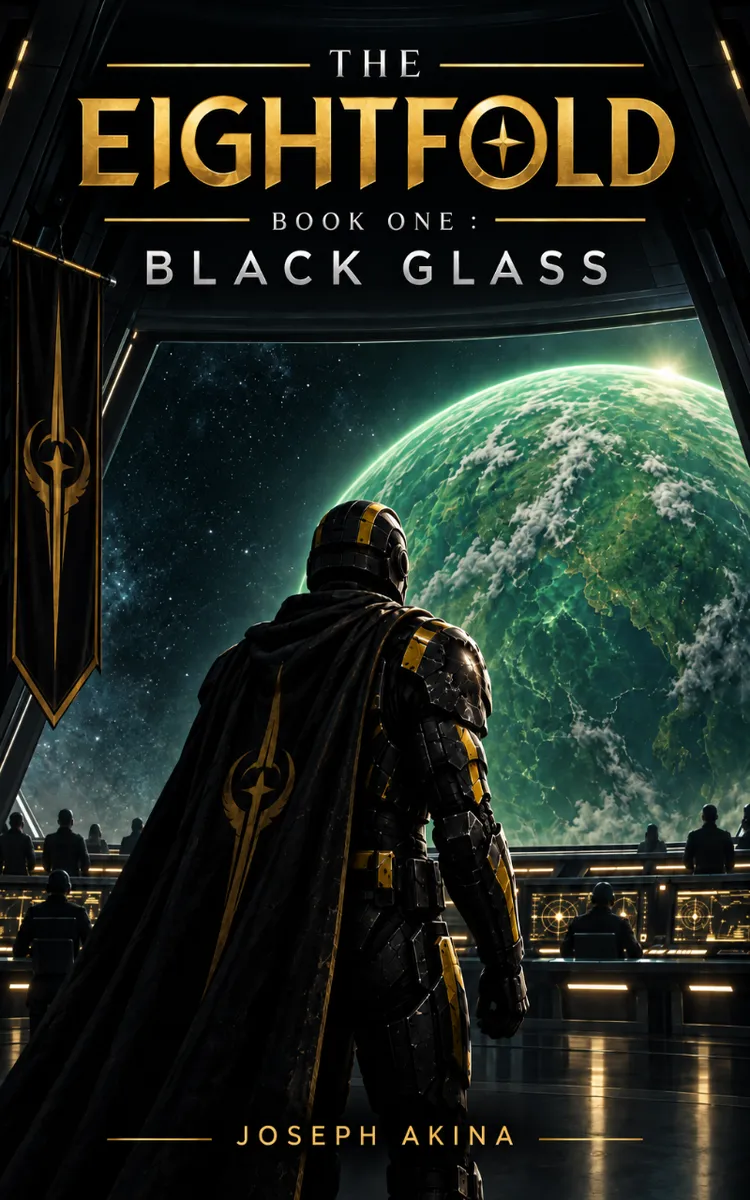

Read the first chapter
The whole of chapter one, free. About 17 min. Turn the pages with the arrows, your keyboard, or a swipe.
Chapter 1
ORDERS IN THE DARK
Bulwark receives an authorization that should not exist, and learns that the new unit will belong to the Ministry of Intelligence, hidden even from the Ministry of Humanity.
Hell Commander Titus Harlan had learned long ago that the most dangerous rooms in the galaxy were the quiet ones.
A battlefield announced itself, artillery screamed before it landed. Chargers shook the ground hard enough to warn the soles of a Helldiver's boots. Bile hissed through smoke. Tunnels trembled before they opened. Even an ambush usually left something behind for a soldier who knew how to look: displaced dust, broken stone, birds fleeing a horizon that appeared empty.
Command rooms were different, whole worlds ended there, catalogued and cold.
Forty-three minutes after the Unbroken Covenant entered the Mars refit corridor, the summons reached Harlan He was still sealed inside his armor. That was standard procedure.
The Helldiver contract spelled out helmet rules for every operational phase. Once a diver entered active duty status, the helmet stayed on through transport, staging, command briefings, deployment, recovery, and any other period in which the service considered the soldier under operational control. The language ran for eleven paragraphs. Most simply summarized it: helmets stayed on until duty ended.
Harlan had never bothered testing how seriously Super Earth intended the rule to be. He already carried enough scars on his armor. He didn't need disciplinary marks in his file as well.
His suit was black and gunmetal with old yellow markings repainted so many times that some edges no longer aligned. The left shoulder carried a deep gouge where a Terminid mandible had punched through the first layer of plate on New Thermopylae. Three maintenance chiefs recommended replacing it, and three had failed to do so. Chief Morrow was becoming the fourth.
"The actuator is compensating around damaged material," Morrow said, standing beneath the open service gantry in the Covenant's armory. "Compensation becomes load. Load becomes failure. Failure becomes a commander explaining why his left arm stopped working while something large was trying to remove it."
Harlan's helmet speakers flattened his reply into the calm mechanical voice every Helldiver eventually learned to recognize as his own. "Then repair the actuator."
"Replace the plate."
"No."
"You do understand that metal has no sentimental value."
"Neither do maintenance chiefs."
Morrow had just started answering when a bridge runner appeared in the armory hatch carrying a black authorization slate with both hands. She stopped two meters away.
"Hell Commander. Priority seal. Ministry of Intelligence. Eyes only."
Morrow became silent. That told Harlan more than the black slate. He took it.
The screen remained blank until the slate authenticated his armor transponder, gauntlet print, and the subdermal identity chip at his wrist. A destination code appeared. STRATEGIC CHAMBER SEVEN. IMMEDIATE. No mission title. No sender. No routing through Fleet Command.
Harlan looked at the runner through the narrow gold visor of his helmet. "They are aboard?"
"Arrived before we entered the cradle, sir."
The Unbroken Covenant was supposed to spend eighteen hours being patched, fueled, rearmed, and insulted by engineers who believed combat officers existed to damage expensive equipment. Beyond the armory doors, repair crews moved beneath open hull plating. Sparks fell from a gantry in short orange showers. Ammunition sleds rolled toward the magazines. Through the hangar shield, Mars filled half the sky.
Harlan had expected inspections. He had expected deployment orders. He had not expected the Ministry of Intelligence to reach his ship before the repair crews finished securing it.
He handed the diagnostic cable back to Morrow. "The shoulder waits."
"It already waited through two campaigns."
"Then it has experience."
Morrow stared at the black slate. "That serious?"
"If they wanted me relaxed, they would have sent a calendar invitation."
Harlan locked the final gauntlet seal and left.
The route to Strategic Chamber Seven ran beneath fleet coordination, into a hidden sector of the Covenant that most crewors never saw.
The corridor changed first. Normal ship passages were labeled aggressively. Deck numbers. fire stations. emergency routes. slogans reminding every citizen-soldier that vigilance was liberty with better posture.
The Intelligence corridor had none of it. Bare gray bulkheads. No navigation markings, no shipboard network access, and lighting isolated from the main system.
Two security officers waited at the blast door wearing black armor without unit insignia. Their helmets were as featureless as their records probably were.
One scanned Harlan's slate. The other checked his weapon and armor authorization. Neither asked him to remove the helmet. They knew the contract too.
The door opened. A sharp, refrigerated draft met him.
Three people waited around a circular projection table. Two wore charcoal Ministry armor rather than uniforms, helmets sealed and visors dark. The third stood at the head of the table in a black command coat worn over a light armored undersuit. Her helmet was clipped shut like everyone else's, silver bars built into the collar seal.
"Hell Commander Titus Harlan," she said. "Director Mara Venn. Ministry of Intelligence. Special Operations Directorate."
Harlan stopped across from her. "You came a long way to interrupt repairs."
"Your ship can be repaired without you."
"Most things can. Doesn't mean they improve."
One of the analysts made a sound over the comm net that might have been the beginning of a laugh. Venn ignored it.
"You were selected because of New Thermopylae."
Harlan went still.
"Then pick another commander; I won't go."
"I did not say because of the propaganda."
That stopped him.
Venn touched the table. Blue light rose between them. A planetary chain unfolded in miniature. Erata Prime. Fenrir III. Turing. Meridia.
Harlan knew the configuration before the labels finished resolving. "Barrier Planets."
"Correct."
"Terminid Control System deployment."
"Correct again."
Meridia expanded until it floated above the table. Green continents. Blue oceans. White cloud systems. Peaceful from orbit. Most worlds looked peaceful from orbit.
"The public brief," Venn said, "describes the Terminid Control System as permanent planetary containment. Termicide dispersal towers suppress reproduction, reduce regional populations, and convert the Barrier Planets into a strategic wall."
Harlan watched the world rotate.
"And the brief you don't send to the Ministry of Humanity?"
The room became quiet.
Venn tilted her helmet slightly. "Good."
"That wasn't praise."
"No. It was confirmation that we recruited the correct commander."
The hologram changed. The clean planetary image fractured into raw combat recordings, biological scans, sensor failures, casualty plots, orbital-strike overlays, and migration estimates stamped with Ministry of Intelligence compartment markings.
Harlan read the classifications. Several were higher than his current clearance. Venn had opened them anyway.
The first recording came from Fenrir III. A Helldiver patrol advanced through a field of dead Terminids after an artillery strike. Twenty seconds into the footage, the corpses shifted. Not because they were alive. Something underneath them was using the bodies as cover. Warriors erupted from the mound at close range. The footage froze.
Another file replaced it. Turing.
A hive network collapsed by orbital bombardment three times in eleven days. Each new entrance appeared farther from the previous strike geometry. By the fourth excavation cycle, the tunnel approach had shifted beneath geological formations that reduced orbital penetration from the same firing solution.
Then came the Chargers. Side-by-side scans showed measurable differences in carapace density and plate angle across regional populations.
Harlan leaned toward the projection. "Same classification?"
"Yes," one analyst answered.
"Comparable maturity?"
"As close as we can estimate."
"Different weapon exposure?"
A pause.
"Yes."
Harlan looked at Venn. "You think they're adapting to doctrine."
"We think they may be adapting faster than doctrine changes."
Careful answer. Harlan disliked careful answers unless they were attached to dangerous truths.
"Terminids adapt. Everyone who survives long enough knows that."
"Across generations," Venn said. "Across environments. Under regional pressure. What concerns us is the compression."
Dates appeared. Eleven days. Seven. Four. Three.
Human action. Terminid response. Human adjustment. Another response. Not strategy in the human sense. Not evidence of officers under the ground issuing orders. Something more dangerous in its simplicity. Pressure and answer.
Harlan felt New Thermopylae rise behind his visor. Thirty-two Helldivers had been assigned to hold an evacuation corridor for twelve minutes. Twelve became forty-seven. Four walked away.
The Ministry of Humanity turned the battle into a victory reel within nine days. Citizens saw civilians running toward transports beneath heroic gunfire. They saw Bulwark standing in smoke, weapon raised, armor scorched. They saw the final barricade still standing.
They did not see Sergeant Imani crawling toward a disabled sentry with half an arm missing. They did not see Pell and Danner dragging the same ammunition crate because neither had enough strength left alone. They did not see twenty-eight names.
Humanity was good at giving people a story they could survive hearing. Intelligence, apparently, had called him here because it wanted the version people could not.
"Why show me this?" Harlan asked.
Venn restored Meridia on the table, and now Termicide towers crawled across the surface.
"Because the Control System is about to apply planetary pressure to an organism whose response curve is accelerating. If it works, the Barrier Planets become a wall. If it does not, the first people to understand why may be standing inside the failure."
"Send scientists."
"We are."
"They'll die."
"Some will."
The answer came too quickly to be comfortable.
"Then send protection teams."
"Already assigned."
"Then you don't need me."
Venn looked toward the two analysts. Both stepped away from the table. Seven empty armored silhouettes appeared beside Harlan's service identifier. He stared at them.
Venn spoke slowly now. "What we need is not a protection team."
The silhouettes separated into functions. INCENDIARY CONTROL. ANTI-HEAVY. CHEMICAL AND ENVIRONMENTAL WARFARE. CLOSE ASSAULT. DEMOLITION AND COMBAT ENGINEERING. HIGH-MOBILITY RECONNAISSANCE. EXPERIMENTAL SYSTEMS. COMMAND.
"Eight personnel," Venn said. "One command element. Seven specialists. Permanent integration. Independent tactical authority inside mission constraints. Direct collection mandate."
Harlan read the categories twice. "A weapons test team."
"No."
"An intelligence team."
"Yes."
The answer made him look at her.
Venn continued. "Not attached to Intelligence. Not supported by Intelligence. Owned by the Ministry of Intelligence."
The distinction settled across the room.
Harlan's voice flattened. "Military command will love that."
"Military command will not know enough to hate it."
One of the analysts changed the display. A second roster appeared. Blank. No names. No service numbers. No ship assignment. Across the top ran a Ministry of Humanity header.
Harlan understood before Venn explained. "To the Ministry of Humanity," she said, "this detachment does not exist."
The words were simple, but their ramifications reached through every ministry chain.
"No public roster," Venn continued. "No recruitment profile. No operational citations routed through Humanity channels. No standard after-action archive. Missions will be compartmented before they reach the wider bureaucracy. Casualty notices, if required, will route through prior commands or cover assignments."
Harlan stared at the empty Humanity record. "You want ghosts."
"I want a team that can collect truths before those truths become public problems."
"That's a very clean way to say ghosts."
"Clean language is useful in government."
Harlan looked back at the eight specialist roles. "Why hide them from Humanity?"
Venn did not answer immediately. When she did, the tone had changed.
"Humanity makes narratives; Intelligence cultivates uncertainty. The two ministries cooperate until uncertainty becomes politically inconvenient. If your team discovers that a celebrated weapons program is failing, I need the failure before someone edits it into success. If you discover a new Terminid strain before panic control is prepared, I need the biology before a broadcaster needs a slogan."
Harlan's visor reflected Meridia's green light. "And if we die?"
"Then the public loses a group it never knew existed, quietly and without ceremony."
One analyst shifted uncomfortably. Harlan did not. He had buried enough people to recognize an ugly truth when someone had the courage to say it plainly.
"What do you actually want this team to do?"
Venn touched the projection again. The eight roles moved around Meridia.
"Enter unstable Terminid environments. Solve multiple classes of problem without waiting for reinforcement packages. Test battlefield assumptions under real pressure. Recover samples. Evaluate new enemy behavior. Destroy strategic targets. Determine why established doctrine failed. Return with intelligence before the next formation repeats the mistake."
Harlan watched the functions rotate. Fire. Heavy kill. Gas. Steel. Explosives. Mobility. Experimental systems. Command.
"A laboratory that shoots back," he said.
"That phrase has already been used."
"Then whoever used it should be reassigned."
Venn almost laughed. Almost.
"Who chooses them?" Harlan asked.
"You'll be given a candidate pool to work from."
"Not what I asked."
"You will have selection authority subject to Intelligence clearance."
"No."
The analysts looked up.
Venn remained still. "Explain."
"You choose the mission. I choose the people. If someone fails clearance because they sold secrets to the enemy, tell me. If they fail because the Ministry dislikes their disciplinary file, save the explanation."
"You are asking for exceptional latitude."
"You are asking me to make eight incompatible specialists behave like one unit while the enemy changes underneath them. Clean records are not the qualification."
Venn's visor turned toward the scar on his left shoulder. "Your own record would support that argument."
"Exactly."
Harlan stepped closer to the table. "Second condition. Raw intelligence."
"Mission packages will include relevant reporting."
"Raw."
"There are compartments above your clearance."
"Raise it."
"That is not trivial."
"Neither is becoming a ghost."
Silence.
Harlan pointed toward the adapted Charger scan. "If you want us to learn why that plate changed, I need raw sensor logs and regional material scans. Not the conclusion somebody decided was safe to distribute. If we are collecting Intelligence for you, then Intelligence does not blind us on the way down."
Venn considered him. "Granted within operational compartments."
"Third. Command succession is internal. If I am cut off, incapacitated, or dead, my executive officer takes command. No analyst on another planet overrides that because a headset gives them confidence."
"You have not selected an executive officer."
"I know who I want to ask first."
Venn paused. "Fourth?"
No Ministry of Humanity observers. No publicity officers. No embedded media. No recruitment cameras."
Venn tilted her helmet. "That will not be difficult."
"Why?"
"Because Humanity cannot publicize a unit it is not cleared to know exists."
That was when the scale of it finally became real. No victory reels. No medals displayed in public ceremony. No families pointing at broadcasts and saying there. No memorial footage if the team vanished. For most Helldivers, anonymity came after death. For this unit, it would begin at recruitment.
Harlan looked again at the empty silhouettes. "What designation?"
A document opened above the table. MINISTRY OF INTELLIGENCE SPECIAL OPERATIONS CELL VIII COMPARTMENT: BLACK GLASS The title was deliberately boring. That meant it had probably been chosen well.
"Cell Eight," Harlan said. "Until your team earns something else."
"And the Unbroken Covenant?"
"Officially, she remains a standard Super Destroyer under rotational strategic tasking. Humanity records will show no permanent special detachment aboard. Your personnel movements will be buried inside replacement traffic."
Harlan looked toward the bulkhead as though he could see through it to his ship. "My crew?"
"Need-to-know. Senior command staff will receive a compartment briefing. Everyone else will know only the cover mission required for their job."
"I don't lie to my crew."
"Then become comfortable with silence."
He disliked her answer. That did not make it wrong.
"How bad is the forecast you didn't show me?"
Venn waited several seconds. "We don't have one."
Harlan frowned behind the visor. "You have models for everything."
"Yes."
"Then you have a forecast."
"We have forecasts that disagree so dramatically that choosing one would be fiction."
The room changed for him then. Not physically.
The same projections glowed. The same officers stood around the same table. Mars still turned beyond several decks of metal. But Harlan understood why Intelligence had crossed bureaucratic lines to build a team Humanity was forbidden to see.
They were not preparing for something they knew was coming. They were preparing because knowledge itself had fallen behind.
"When?" he asked.
"Operational inside twenty-one days."
"Seven recruits."
"Yes."
"First mission?"
Venn did not answer. She did not need to.
Meridia floated between them.
Harlan turned toward the door. "Commander."
He stopped.
"One more condition," Venn said.
Harlan looked back.
"The helmet contract applies without exception once a recruit enters this compartment. No unsealed faces in operational spaces. No personal imagery stored outside Intelligence custody. No visual identifiers the Ministry of Humanity can match against this unit."
Harlan glanced at the seven armored silhouettes. "Helldivers already keep helmets on."
"Most of them become public people anyway. Your team will not. The helmet is no longer only uniform. It is part of the compartment."
That, he thought, was the most Intelligence sentence she had spoken all night.
"Understood."
"What will you call them?"
Harlan looked again at the empty places. Names became banners. Banners became stories. Stories belonged to Humanity. This team had not earned one yet. Maybe it never would publicly.
"Use the number," he said.
"And later?"
Harlan faced Meridia one last time. "Later, we'll see who comes back."
He left.
The Unbroken Covenant felt louder after the Intelligence deck. Repair crews shouted over machinery. Cargo lifters moved ammunition pallets through the central hangar. A diagnostic alarm repeated every eleven seconds from somewhere above, persistent enough to suggest nobody had found the fault. Harlan preferred it. Noise was honest, something he could measure when politics could not.
He took the long route toward the secure planning compartment Intelligence had activated beside his quarters. On the way, he passed the drop bay.
Eight Hellpods stood open beneath the launch gantries. They were not reserved for Cell Eight. Not yet. Technicians were replacing guidance assemblies in three. One had half its thermal shielding removed. Another sat beneath a diagnostic scaffold while two engineers argued about atmospheric tolerances.
Still, Harlan stopped. Eight.
Too few for the operations Venn described. Too many to remain invisible if the wrong ministry started asking questions. Which meant every person mattered more than the number.
Inside the secure compartment, a terminal waited. The candidate pool contained three hundred twelve names.
Harlan remained helmeted when he sat. The mission clock had started the moment Venn activated Cell Eight. Under the contract, operational control had begun. There would be no casual faces now.
The first file held a parade-perfect assault officer, top scores, four generals' recommendations, so polished it felt paper-thin. Harlan closed the file after thirty seconds.
The second had completed nine Terminid deployments without a disciplinary action. Closed.
The third was an anti-armor specialist with excellent accuracy and a record filled with commendations for compliance. Closed.
By candidate twenty, Harlan understood the problem. The pool had been assembled by institutions looking for excellence as institutions understood it. Clean records. High scores. Predictable performance. Predictable people.
The enemy was becoming less predictable. He changed the search parameters.
UNAUTHORIZED TACTICAL MODIFICATION. FIELD EXPEDIENT. MISSION SUCCESSFUL - PROCEDURAL REVIEW PENDING. COMMAND DEVIATION. EXCESSIVE MATERIAL DAMAGE.
The list improved immediately. Some candidates were reckless. Some were simply arrogant. Some had survived bad decisions and mistaken survival for proof that the decisions had been good. Harlan discarded them too.
Then a refinery incident appeared. MERIDIAN FUEL RIOTS - COMPLEX TWELVE. He opened it.
The first image showed a refinery district burning at night. Harlan expected chaos. Instead, he found geometry. Fire lines divided access corridors with unnerving precision. Fuel had been vented into evacuated trenches and ignited to force Terminid movement away from residential sectors. A pumping station had been deliberately destroyed to collapse a tunnel network. Inert gas denied one route without triggering a secondary explosion. The refinery died section by section while evacuation lanes remained open.
The operation violated six direct orders. The colony survived.
Harlan opened the command review. DEATH CAPTAIN KAEL VOSS. The personnel image was not a face. Active Helldiver files did not need one.
A red-and-black armored figure stood against a neutral identification wall, helmet sealed, narrow amber-red visor lit beneath a scorched hood and scarf. Fire damage marked the lower cape. One gauntlet carried the serial plate of an incendiary weapons certification.
CALLSIGN: CINDER. Former refinery security. Industrial emergency operations. Incendiary warfare qualification. Multiple commendations. Multiple reprimands.
One sentence in the investigation caught Harlan's attention. CAPTAIN VOSS DID NOT EMPLOY FIRE PRIMARILY TO DESTROY HOSTILES. SHE EMPLOYED FIRE TO CONTROL WHERE HOSTILES WERE PERMITTED TO EXIST.
Harlan read it twice. Then he opened the raw tactical map.
The board of inquiry had argued about destroyed infrastructure. Evacuation command had argued she should have withdrawn. Logistics had calculated replacement cost down to the credit. Harlan ignored all of them. He watched the routes. Every time the swarm changed direction, Voss changed the battlefield before it reached the next junction. She had not defended a line. She had built one out of heat, pressure, smoke, and collapse. More importantly, she had known what not to burn. He opened later deployments.
Borealis Reach: redirected incendiary fire to preserve a civilian desalination plant, forcing her team into shorter engagement distance. Kharon Vale: abandoned a prescribed extraction corridor after wind shifted toxic smoke toward the landing zone. Seven minutes lost. Entire squad recovered. Darius Minor: refused an order to ignite an infested fuel depot until trapped engineers were confirmed clear.
Each incident produced a disciplinary review. Each ended in mission success.
Harlan looked at the roster. INCENDIARY CONTROL was one slot. Executive officer was not listed at all. Intelligence had given him specialists. It had not told him who should stand beside him when the plan broke. He had already decided that question mattered more.
A direct recruitment terminal opened, flagged under BLACK GLASS authorization. A warning appeared.
RECIPIENT ACCEPTANCE WILL TRIGGER MINISTRY OF INTELLIGENCE COMPARTMENTALIZATION. MINISTRY OF HUMANITY ACCESS: NONE. PUBLIC SERVICE ROUTING: SUSPENDED FOR DURATION OF ASSIGNMENT. HELMET IDENTIFICATION PROTOCOL: MANDATORY.
Harlan read the warning once. Then began typing.
DEATH CAPTAIN KAEL VOSS. REPORT TO THE SES UNBROKEN COVENANT.
NO CEREMONY. NO PRESS. BRING EVERYTHING YOU TRUST WHEN THE WALLS FAIL.
He paused. Then added the line that mattered. I am offering you command, not a medal.
He sent it, and the message vanished into an Intelligence route the Ministry of Humanity could not see.
Outside, Mars burned red beneath the repair docks. Beyond it waited the Barrier Planets, Termicide towers, millions of Terminids, and a future Intelligence could no longer model with confidence.
On the terminal, one of the seven silhouettes changed. Not occupied. Not yet. Flagged. KAEL VOSS. CINDER. CONTACT INITIATED.
Twenty-one days remained. Harlan still needed six specialists after her. And Voss had not said yes. But for the first time since entering Strategic Chamber Seven, the problem felt smaller. Not safe. Not manageable. Smaller.
Deep inside the Unbroken Covenant, repair hammers struck the hull in slow metallic beats. A countdown heard only by people who did not officially exist.
End of chapter one. 10 more chapters and about 41,285 words in the full book.
Swipe or use the arrows to turn the page


What's inside: 11 chapters
- 1. ORDERS IN THE DARK
- 2. FIRE GEOMETRY
- 3. THE SKY HAS NO WALLS
- 4. OLD BROTHERS, NEW WAR
- 5. VOLTAGE
- 6. THREE SONS, ONE SHADOW
- 7. Jax Mercer
- 8. Lucan Vale
- 9. THREE BROTHERS, ONE WAR
- 10. THE EIGHTH PLACE
- 11. BEFORE THE DROP
About this book
"The Eightfold Book One : Black Glass" is a general book by Joseph Akina with 11 chapters and approximately 41,285 words. It covers key insights and practical takeaways on the topic.
This book was created using Inkfluence AI, an AI-powered book generation platform that helps authors write, design, and publish complete books.
Frequently Asked Questions
What is "The Eightfold Book One : Black Glass" about?
"The Eightfold Book One : Black Glass" is a general book by Joseph Akina covering key insights and practical takeaways on the topic.
How many chapters are in "The Eightfold Book One : Black Glass"?
The book contains 11 chapters and approximately 41,285 words. Topics covered include ORDERS IN THE DARK, FIRE GEOMETRY, THE SKY HAS NO WALLS, OLD BROTHERS, NEW WAR, and more.
Who wrote "The Eightfold Book One : Black Glass"?
This book was written by Joseph Akina and created using Inkfluence AI, an AI book generation platform that helps authors write, design, and publish books.
Write your own book with AI
Describe your idea and Inkfluence writes the whole thing. Free to start.
Start writingCreated with Inkfluence AI


